教育行业

Search documents
十四届长沙市委第十一轮巡察全部完成进驻
Chang Sha Wan Bao· 2025-09-21 01:37
Group 1 - The 11th round of inspections by the Changsha Municipal Party Committee has commenced, focusing on 19 educational institutions, including the Education Bureau [1] - The inspections aim to evaluate the implementation of important directives from General Secretary Xi Jinping regarding education and to ensure adherence to the Party's self-revolution principles [2] - The inspection teams will conduct a two-month review period, during which they will accept reports and complaints related to various disciplinary violations [3] Group 2 - The inspection will emphasize political supervision, problem orientation, and the principle of putting people first, while also ensuring effective political oversight in the education sector [2] - Key areas of focus include the political construction of schools, the implementation of the fundamental task of moral education, and adherence to the leadership responsibilities of Party committees [2] - A dedicated hotline and communication channels will be established for reporting issues related to political, organizational, and disciplinary violations during the inspection period [3]
国脉科技:8月21日召开董事会会议
Mei Ri Jing Ji Xin Wen· 2025-08-21 23:12
Group 1 - The company Guomai Technology (SZ 002093) held its ninth fifth board meeting on August 21, 2025, to review proposals including the use of self-owned funds for securities investment and wealth management [1] - For the first half of 2025, Guomai Technology's revenue composition was as follows: 76.5% from the education sector, 22.8% from telecommunications outsourcing services, and 0.7% from other businesses [1] - As of the report, Guomai Technology's market capitalization was 13 billion yuan [1]

多邻国25Q2超预期,建议关注教育AI应用的投资机会
Xinda Securities· 2025-08-08 07:50
Investment Rating - The industry investment rating is "Positive" [2] Core Insights - Duolingo's Q2 2025 results exceeded expectations with revenue of $252 million, surpassing the guidance of $243.5 to $246.5 million, and an adjusted EBITDA margin of 31.2%, exceeding the guidance of 24.5% to 25.5% [3] - Monthly Active Users (MAUs) grew by 24% year-over-year to 128 million, while Daily Active Users (DAUs) increased by 40% to 48 million, indicating strong user engagement [3] - The paid user base reached 10.9 million, a 36% increase year-over-year, with a paid penetration rate of 9%, up 0.4 percentage points year-over-year [3] - Revenue growth was robust at 41% year-over-year, with subscription revenue increasing by 46.4% [3] - The company raised its full-year revenue guidance to $1.011 to $1.019 billion, up from the previous guidance of $987 to $996 million [3] - The report emphasizes the potential for non-linear growth driven by AI applications in the education sector, recommending a focus on companies leading in educational AI agent development [3] Summary by Sections Revenue and Profitability - Duolingo achieved revenue of $252 million in Q2 2025, exceeding guidance [3] - Adjusted EBITDA margin reached 31.2%, surpassing previous expectations [3] User Engagement - MAUs reached 128 million, with a year-over-year growth of 24% [3] - DAUs increased to 48 million, reflecting a 40% year-over-year growth [3] - User stickiness improved, with DAUs/MAUs ratio at 37.2%, up 4.3 percentage points year-over-year [3] Paid User Metrics - Paid users grew to 10.9 million, a 36% increase year-over-year [3] - Paid penetration rate reached 9%, with a slight increase from the previous year [3] Future Outlook - Full-year revenue guidance was raised to $1.011 to $1.019 billion [3] - The report suggests focusing on companies at the forefront of educational AI development [3]

券商晨会精华 | 股市流动性仍维持充裕 有利于A股慢牛行情纵深演绎
智通财经网· 2025-08-06 00:46
Market Overview - The market experienced a rebound, with the Shanghai Composite Index surpassing 3600 points, reaching a new closing high for the year. The total trading volume in the Shanghai and Shenzhen markets was 1.6 trillion yuan, an increase of 97.5 billion yuan compared to the previous trading day. The Shanghai Composite Index rose by 0.96%, the Shenzhen Component Index increased by 0.59%, and the ChiNext Index gained 0.39% [1]. Industry Insights Home Appliance Industry - CITIC Securities indicated that the home appliance industry maintains a high level of prosperity, with a positive outlook on leading companies. The demand for air conditioning has surged due to high summer temperatures, and the upgrade of black electrical products is driving an increase in average prices. The sweeping robot industry is seeing marginal improvements in competition, and profit margins are expected to reach a turning point. The change in e-commerce tax rules is beneficial for leading brands, and two-wheeled vehicles are experiencing high sales growth due to national subsidies [2]. AI and Education - Galaxy Securities reported that the commercialization of AI in education and human resources is accelerating. The large model technology is expected to further drive the iteration of AI applications in these sectors in the second half of the year. Notable developments include the launch of the AI CLASS product by Dou Shen Education, which achieved a GMV of over 17.4 million yuan by July 30, and the AI exam preparation system by Fenbi, which generated over 14 million yuan in sales within two months. The introduction of AI 2.0 tools by Keri International is also expected to enhance recruitment processes [3]. Stock Market Liquidity - Huaxi Securities emphasized that the stock market liquidity remains abundant, which is conducive to the sustained development of a slow bull market in A-shares. The current financing balance in the A-share market has risen to around 2 trillion yuan, with the financing balance accounting for 2.3% of the circulating market value, reflecting a broad source of incremental funds. The report suggests focusing on new technologies and growth directions, such as AI computing power and solid-state batteries, as well as reallocation opportunities in undervalued sectors [4].
2025上半年中国教育行业融资风向报告,创投圈的钱都去哪了?
3 6 Ke· 2025-07-30 09:05
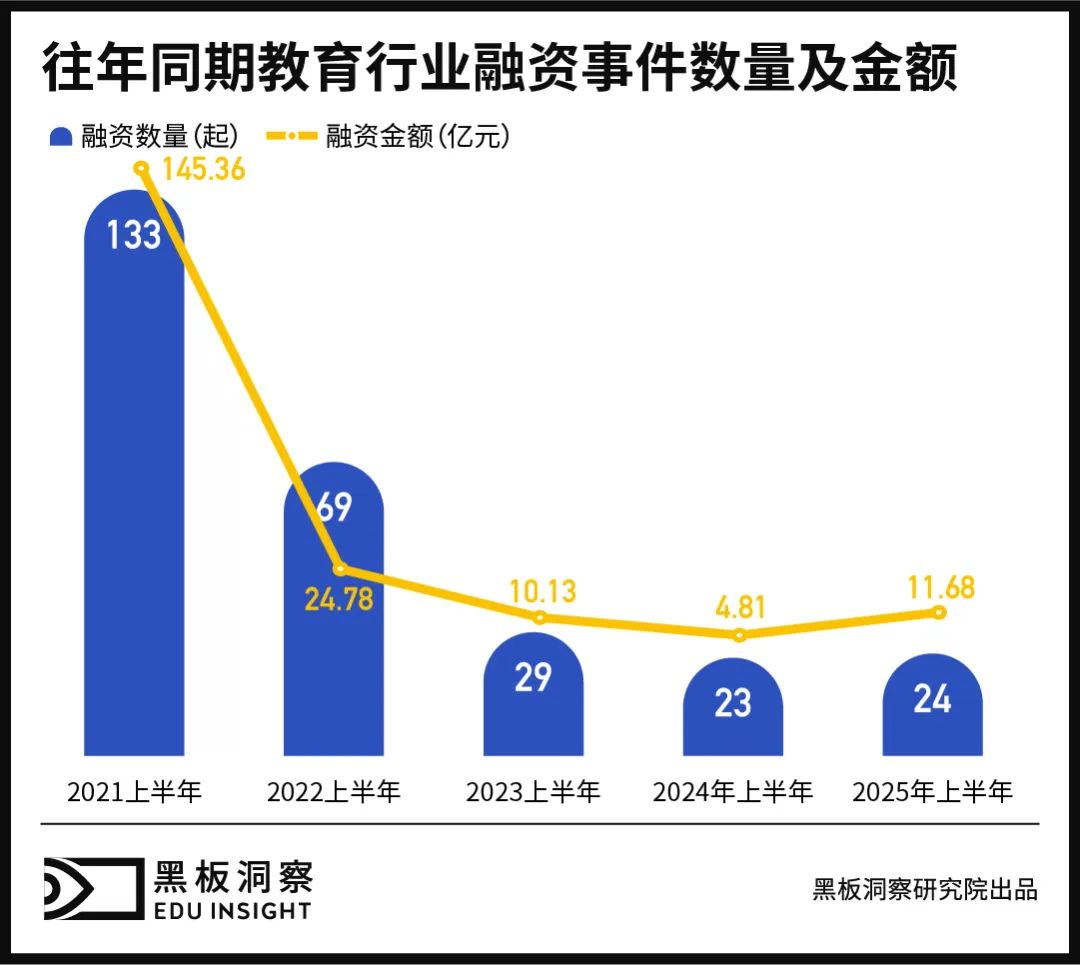
Core Insights - The education industry is experiencing a new pattern of "stable total volume and structural reconstruction" in investment and financing in the first half of 2025, driven by regulatory stabilization, demand transformation, and technological innovation [1][3] - A total of 24 financing events occurred in the first half of 2025, with an overall financing scale exceeding 1.168 billion yuan, surpassing the total amount for the entire year of 2024, indicating a marginal recovery in capital confidence and a focus on "certain tracks" [1][3] - Key investment directions include vocational education, AI empowerment, and quality education, reflecting a shift towards sectors with essential demand and growth potential [1][14] Financing Overview - The education industry's financing heat has been declining over the past five years, with a drop from 133 financing events and 14.536 billion yuan in the first half of 2021 to only 23 events and 481 million yuan in 2024 [3] - In the first half of 2025, although only 24 events were recorded, the financing amount rebounded to 1.168 billion yuan, marking a local recovery with "stable volume and increased amount" [3] Monthly Financing Trends - The financing events in the first half of 2025 were relatively evenly distributed monthly, with a notable spike in June, which accounted for 80.2% of the total financing amount for the half-year [6] - The overall financing frequency remained low, but the concentration of capital significantly increased, with a clear preference for high-certainty targets [6] Financing Rounds Distribution - Early-stage projects dominated the financing rounds, with angel rounds accounting for two-thirds of the events (16 occurrences), indicating sustained interest in innovative projects at the startup stage [9] - There were also 2 mergers and acquisitions and 1 equity investment, suggesting ongoing industry consolidation [9] Regional Financing Distribution - The financing distribution showed a pattern of "strong East, weak West," with Beijing leading with 5 events, followed by Guangdong and Jiangsu with 3 each, highlighting the continued advantage of first-tier and strong provincial cities in resource and capital supply [10] - Regions like Hubei, Hunan, Shanghai, and Zhejiang remained active, while western and central provinces showed minimal activity, indicating significant regional disparities [10] Sector-Specific Financing Distribution - Financing in the first half of 2025 was heavily concentrated in vocational education and enterprise services, which together accounted for over 90% of the total financing amount, reflecting capital's ongoing optimism towards "employment capability enhancement" and "educational toolization" [14] - Other sectors like quality education, study abroad, K12, and early childhood education had limited financing events, indicating challenges in consumer-end project financing [14] Top Financing Events - The top financing events included: - Tianyu Fei Training, an aviation training service company, acquired for 799 million yuan [16] - Cool Xuan Technology, a corporate training service platform, acquired for 180 million yuan [16] - Changxiang World, an art training intelligent service provider, raised 7 million USD in an angel round [16] Conclusion - The education industry's investment and financing landscape in the first half of 2025, while still at a low level, shows signs of structural recovery, with capital shifting focus towards vocational education and enterprise services [17] - The investment logic is transitioning from consumer-driven flow to supply-side value, indicating a move towards a quality-first, long-term oriented reconstruction cycle [17]

非农的三个谜团(国金宏观钟天)
雪涛宏观笔记· 2025-07-07 08:08
Core Viewpoint - The resilience of the U.S. labor market is increasingly challenged by underlying individual vulnerabilities, as highlighted by the recent non-farm payroll data, which shows a complex picture of employment dynamics [1][3][18]. Group 1: Non-Farm Payroll Data Insights - In June, the U.S. non-farm payroll added 147,000 jobs, exceeding the expected 110,000, with an unemployment rate of 4.12%, better than the anticipated 4.3% [3]. - A significant portion of the job growth came from government employment, particularly in education, which accounted for 27% of the total non-farm increase [4][8]. - The surge in education jobs is attributed to the phased reactivation of the ARP-ESSER funding, which has raised concerns about the sustainability of this growth due to budget constraints [6][8]. Group 2: Employment Trends in Education and Healthcare - The education and healthcare sectors remain the only bright spots in private employment, showing stability since 2020 [9]. - However, there are signs of concern, such as a continuous decline in working hours, approaching the lowest levels seen after the pandemic's onset in early 2020 [11]. Group 3: Youth Unemployment and Labor Participation - The decline in the unemployment rate is partly due to a drop in labor force participation, which has reached its lowest level since January 2023 at 62.3% [14]. - The participation rate among 16-19-year-olds has also fallen to its lowest since 2020, indicating a trend of young unemployed individuals opting to "lie flat" [14][15]. - The decrease in labor participation cannot solely be attributed to the absence of illegal immigrants, as high-skilled labor participation has seen a more significant decline compared to low-skilled labor [15]. Group 4: Divergence in Employment Data - There is a divergence between non-farm payroll data and other labor market indicators, such as the ADP small non-farm employment trends and the rising number of unemployment claims, suggesting a weakening private sector job market [18]. - Despite the seemingly strong non-farm report, the underlying trends indicate increasing challenges for the Federal Reserve, particularly with more young and high-skilled workers withdrawing from the job market [18].

上市公司破产重整中的62个疑难问题(附81案例)
梧桐树下V· 2025-06-25 11:15
Core Viewpoint - The article discusses the recent regulatory changes by the China Securities Regulatory Commission regarding bankruptcy reorganization, emphasizing the increased complexity and requirements for companies seeking to revive through this process. Group 1: Key Practical Points of Bankruptcy Reorganization - If a bankrupt entity has lost financial independence due to the unified management of funds, it can undergo consolidated reorganization, followed by a hearing to gather opinions before a ruling [1] - Reorganization and restructuring can proceed simultaneously; if there are many small creditors with low repayment rates, a small creditor group can be established to improve their repayment ratio [1] - The liquidation team should hire intermediaries and experts to ensure asset preservation and value increase, introducing suitable strategic investors to implement the reorganization plan [1] - In cases of multiple related companies in bankruptcy, a competitive method can be used to appoint a joint administrator; for large entities with complete capacity and technical support, industry transformation and investment attraction can be employed [1][2] Group 2: Conditions and Strategies for Reorganization - The conditions for consolidated reorganization include a high degree of confusion among related enterprises' personalities and assets, making it difficult to distinguish between them without harming creditor interests [2] - For projects unsuitable for consolidated reorganization, a "bottom-up" reorganization order can be established, allowing subsidiaries to complete reorganization first, ensuring that lower-tier companies can repay internal loans to upper-tier companies [2] Group 3: Improving Reorganization Success Rates - The pre-reorganization model can enhance the success rate and efficiency of reorganization by incorporating assets and increasing shares to repay debts, thereby improving debt repayment rates and acceptance of the reorganization plan [3] Group 4: Challenges Faced by Companies - The average proportion of current liabilities for private listed companies reached 67% in 2023, significantly higher than the 48% for state-owned enterprises, indicating a reliance on short-term debt financing [7] - Among private enterprises entering reorganization from 2022 to 2024, 62% faced "short-term loans for long-term investments" issues, and 38% involved major shareholder fund occupation, with a secondary reorganization rate of 29% [8] Group 5: State-Owned Enterprises and Reorganization - The proportion of state-owned enterprise reorganization cases increased from 9% in 2022 to 15% in 2024, reflecting significant structural changes in ownership [9] - Supply-side reforms have led to successful transformations, such as a provincial steel group replacing outdated capacity with special steel production lines, improving profit margins [9]

首个“宠物”本科专业招生,教育紧跟宠物经济步伐
Nan Fang Du Shi Bao· 2025-06-21 01:36
Core Insights - The establishment of a specialized undergraduate program in "Animal Science (Companion Animals)" at China Agricultural University aims to address the growing demand for professionals in the pet industry, which is experiencing significant growth in China [1][2] Industry Overview - The pet economy in China is thriving, with the urban pet consumption market expected to exceed 300 billion yuan in 2024, and the number of urban pet dogs and cats surpassing 120 million [1] - The pet market is diversifying, with services such as medical care, grooming, training, and boarding becoming increasingly common, alongside a wide range of products including pet food, health supplements, and toys [1] Talent Gap - There is a notable talent shortage in the pet industry, with approximately 40,000 licensed veterinarians working in pet medical care across over 30,000 pet hospitals, indicating a severe lack of qualified professionals [1] - Positions such as pet groomers, health caregivers, and trainers are in high demand, highlighting the need for specialized education and training in the field [1][2] Educational Initiatives - The new program at China Agricultural University includes courses on companion animal breeding, nutritional metabolism, feed processing, reproductive physiology, welfare, and behavior, aligning with market needs and academic rigor [2] - Graduates will have opportunities in various sectors, including research, technical consulting, and pet food production, contributing to the professionalization of the industry [2] Public Awareness and Knowledge Dissemination - The increasing involvement of pets in public life, such as expanded pet transport services on high-speed trains, underscores the importance of responsible pet ownership and the need for scientific knowledge dissemination [3] - The lack of reliable sources for pet care knowledge often leads to misinformation, making the role of educational institutions crucial in promoting accurate information and improving societal awareness of responsible pet ownership [3]
“含金量”超高!深圳再获政策大礼包
Di Yi Cai Jing· 2025-06-10 15:17
Core Viewpoint - The central government has introduced significant policies to support the reform and opening-up of Shenzhen as it approaches its 45th anniversary, aiming to enhance high-quality economic development and create replicable experiences for national modernization [1][2]. Group 1: Education and Talent Development - The policy emphasizes the integration of vocational skills training with advanced manufacturing, allowing foreign investment in vocational training institutions in Shenzhen [2]. - Shenzhen has made notable progress in higher education reform, with the establishment of prestigious universities, and the policy supports the development of specialized, smaller-scale universities tailored to the characteristics of a megacity [2]. Group 2: Financial and Technological Reforms - The policy supports the integration of technology and finance, proposing pilot projects for credit and financing mechanisms for technology enterprises, including knowledge property securitization [2]. - It allows companies listed on the Hong Kong Stock Exchange within the Greater Bay Area to also list on the Shenzhen Stock Exchange, enhancing the financial ecosystem [2][3]. Group 3: Data and Digital Currency Initiatives - The policy encourages the exploration of mechanisms for data trading and sharing, as well as the application of artificial intelligence in medical devices, under safe and compliant conditions [3]. - It supports the innovation of digital currency applications, including participation in multilateral central bank digital currency projects and allowing certain Hong Kong professionals to practice in designated areas of Shenzhen [3]. Group 4: Urban Development and Governance - The policy proposes reforms for the management of idle land and the establishment of a one-stop international commercial dispute resolution mechanism [4]. - It emphasizes the need for effective coordination and management authority to ensure the successful implementation of the reform measures [4].
私营、非私营单位平均工资差距连续十五年扩大
经济观察报· 2025-05-18 12:12
Core Viewpoint - The economic environment significantly impacts corporate operations, reflected not only in layoffs but also in reduced salaries, with fluctuating wages serving as a buffer against operational pressures [1][6]. Wage Data Overview - As of 2024, the average annual salary for employees in non-private urban units is 124,110 yuan (10,342.5 yuan/month), which is 1.79 times that of private units [2][9]. - The nominal wage growth rates for private and non-private units in 2024 are 1.7% and 2.8%, respectively, down from 8.9% and 9.7% in 2021 [4][12]. Wage Growth Trends - The rapid decline in wage growth rates is attributed to the inclusion of more small and micro enterprises in the wage statistics, which typically have lower wage levels [6][12]. - The wage growth for non-private units has been consistently higher than that of private units since 2015, with non-private unit wages increasing from 3,044.9 yuan/month in 2010 to 10,342.5 yuan/month in 2024, a rise of approximately 7,300 yuan/month [9][10]. Industry-Specific Wage Dynamics - The education sector shows significant wage disparities, with non-private education units averaging 10,513.2 yuan/month in 2024, while private education units average 5,059.9 yuan/month [16]. - The financial and mining sectors have consistently reported high wage totals and growth rates, with both sectors exceeding 10% growth in 2022 and 2023 [16][18]. Negative Wage Growth - In 2024, there is a notable increase in industries experiencing negative wage growth, including healthcare and social work in non-private units, and manufacturing in private units [20].