消费品制造

Search documents
扩消费 惠民生 稳增长 多部门详解如何增强消费品供需适配性
Shang Hai Zheng Quan Bao· 2025-11-27 18:20
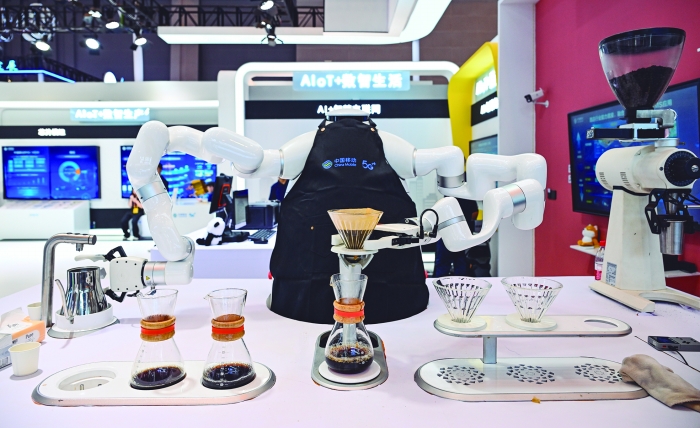
Core Insights - The article discusses a joint implementation plan by six departments, including the Ministry of Industry and Information Technology, aimed at enhancing the adaptability of supply and demand in consumer goods, promoting consumption, benefiting people's livelihoods, and stabilizing growth [2] Group 1: AI in Consumer Goods - The plan emphasizes accelerating the application of new technologies and models, with artificial intelligence (AI) being a key catalyst for reshaping the consumer market [3] - The Ministry of Industry and Information Technology aims to drive product innovation and scene expansion, integrating AI and big data into the consumer goods industry to create a digital ecosystem that connects user demand, intelligent design, flexible production, and precise services [3] - As of mid-2023, the user base for generative AI products in China reached 515 million, indicating strong market demand for AI consumer products [4] Group 2: Automotive and Cultural Consumption - The plan includes initiatives to reform automotive circulation, expand the second-hand car market, and promote various automotive-related services, focusing on green and intelligent directions [6] - The cultural and tourism sector is seeing a surge in demand for trendy and cultural products, with the Ministry of Culture and Tourism planning to enhance the development of cultural creative products and promote non-material cultural heritage [6][7] Group 3: Quality and Safety in Consumer Goods - The plan calls for a comprehensive governance framework for consumer goods quality and safety, with the State Administration for Market Regulation enhancing oversight of online sales and ensuring accountability from e-commerce platforms [8] - The administration is also working on a standard system for consumer goods focused on high-quality development, aiming to increase the supply of quality products to meet consumer needs [9] - Efforts are underway to establish a standard system for elderly products, ensuring that older consumers can confidently purchase and use these goods [9]

权威数读|促消费再放“大招”:到2027年形成3个万亿级消费领域、10个千亿级消费热点
Xin Hua She· 2025-11-27 12:59
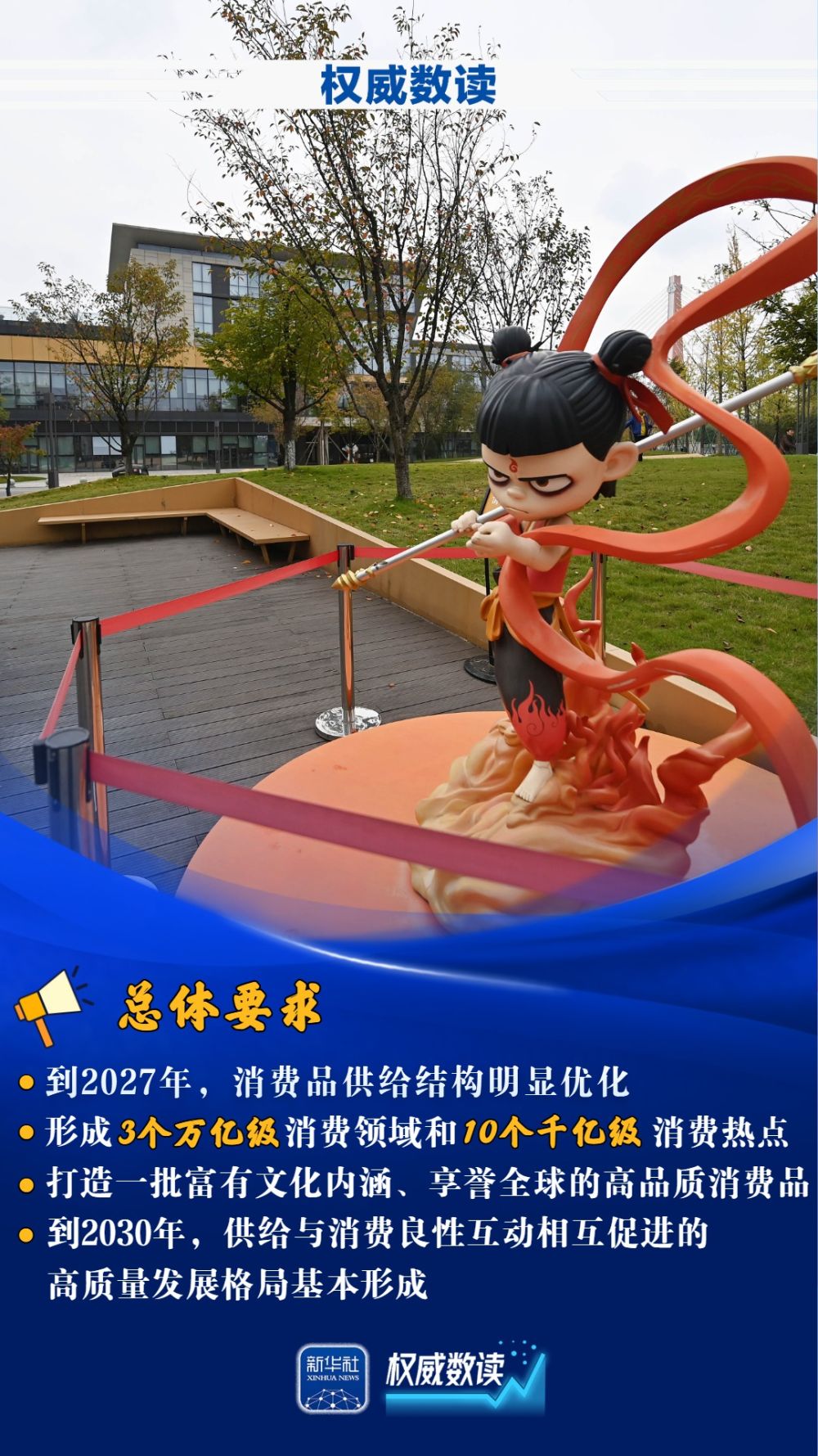
Core Viewpoint - The Ministry of Industry and Information Technology, along with five other departments, has issued an implementation plan aimed at enhancing the adaptability of supply and demand for consumer goods, with a focus on achieving development goals over the next five years [1]. Group 1: Development Goals - By 2030, a high-quality development pattern characterized by positive interaction between supply and consumption is expected to be fundamentally established [3]. Group 2: Key Initiatives - A series of initiatives will be launched, including the creation of high-quality consumer goods with cultural significance that are recognized globally [3]. - The plan includes the promotion of innovative applications of new technologies and models, such as flexible manufacturing and user participation in design [9]. - There will be a focus on expanding the supply of distinctive and new products, including green products, rural consumer goods, leisure and sports products, and health-related innovations [13]. Group 3: Targeted Consumer Segments - The initiative aims to enrich the supply of products for infants and children, enhance the quality of student supplies, and develop products like electronic ink notebooks and AI-based study aids [16]. - There will be an emphasis on optimizing products for the elderly, ensuring that product design meets their specific needs [16]. Group 4: New Consumption Scenarios and Business Models - The plan encourages the development of new consumption scenarios and business models, including the promotion of domestic brands going global and the orderly development of live e-commerce and instant retail [17]. - It also aims to establish a quality certification system for shared consumption products and services [19].
从机械重工到生活消费,实探进博上的“智造”力量
Di Yi Cai Jing· 2025-11-11 05:44
Core Insights - The rapid development of AI technology is driving foreign industrial enterprises to accelerate their establishment of smart factories in China, transforming the manufacturing sector towards intelligence and digitization [1][2]. Group 1: AI in Manufacturing - AI is playing a crucial role across the entire manufacturing chain, from research and development to production, inspection, and operation [1]. - Major companies like Tesla and Michelin are showcasing their advancements in AI-driven manufacturing at the China International Import Expo, highlighting the importance of AI in enhancing production efficiency and precision [2][4]. - Schneider Electric is integrating AI with energy technologies, resulting in an 82% increase in labor efficiency at its Shanghai factory through AI-assisted production planning [5]. Group 2: Investment and Production Capacity - Tesla's Shanghai energy storage super factory, which began operations in February 2023, aims to produce 10,000 Megapack systems annually, with a storage capacity of nearly 40 GWh [2]. - Michelin is investing in the expansion of its Shanghai factory, with the first phase of the "White Magnolia" project expected to increase tire production capacity from 8.5 million to 9.5 million units by the end of 2026 [4]. Group 3: AI in Consumer Goods - AI applications are extending from production to product innovation in the consumer goods sector, enhancing both production efficiency and product quality [6]. - Uniqlo is focusing on regional markets and plans to deepen its presence in China, showcasing new sustainable clothing technologies at the expo [6]. Group 4: AI's Impact on Retail - AI is becoming a strategic lever for the retail industry in China, helping to enhance operational efficiency and drive profitability amid competitive pressures [12]. - A report indicates that by 2030, the global retail sector could see an additional $310 billion in annual operating profits due to the industrial application of AI, representing a nearly 20% increase in overall operating profits [12].


金色进博:这里盛产信任与订单
Ren Min Wang· 2025-11-10 01:08
Core Insights - The 8th China International Import Expo (CIIE) showcases a blend of global goods, cutting-edge technology, and diverse cultures, emphasizing the importance of cooperation and high-quality living standards [1] Group 1: Economic Impact - The CIIE has set up a "Purchaser's Corridor" for the first time, with over 20,000 attendees from nearly 100 central enterprises, resulting in significant contracts, including China National Offshore Oil Corporation signing contracts worth over $13 billion [2] - China Petroleum & Chemical Corporation signed multiple procurement agreements with 34 partners from 17 countries, while China Eastern Airlines signed 19 agreements totaling $1.211 billion with suppliers from 9 countries [2] Group 2: Product Launches and Innovations - The CIIE serves as a platform for the debut of numerous new products and technologies, including industrial sorting robots and advanced painting solutions, reflecting a strong interest in future intelligent living [4] - The event features a dedicated AI section, highlighting the integration of AI in high-end equipment and medical devices, with predictions that AI will drive the next wave of technological transformation in the next three to five years [4] Group 3: International Participation and Trust - The CIIE is recognized as a vital platform for international trade, with representatives from various countries expressing their commitment to strengthening trade relations with China [5] - Many foreign exhibitors view the CIIE as a starting point for deepening their engagement in the Chinese market, gaining not only orders but also long-term confidence in shared market opportunities [6]
美国10月挑战者企业裁员报告全文:同比激增175%!
Jin Shi Shu Ju· 2025-11-06 09:37
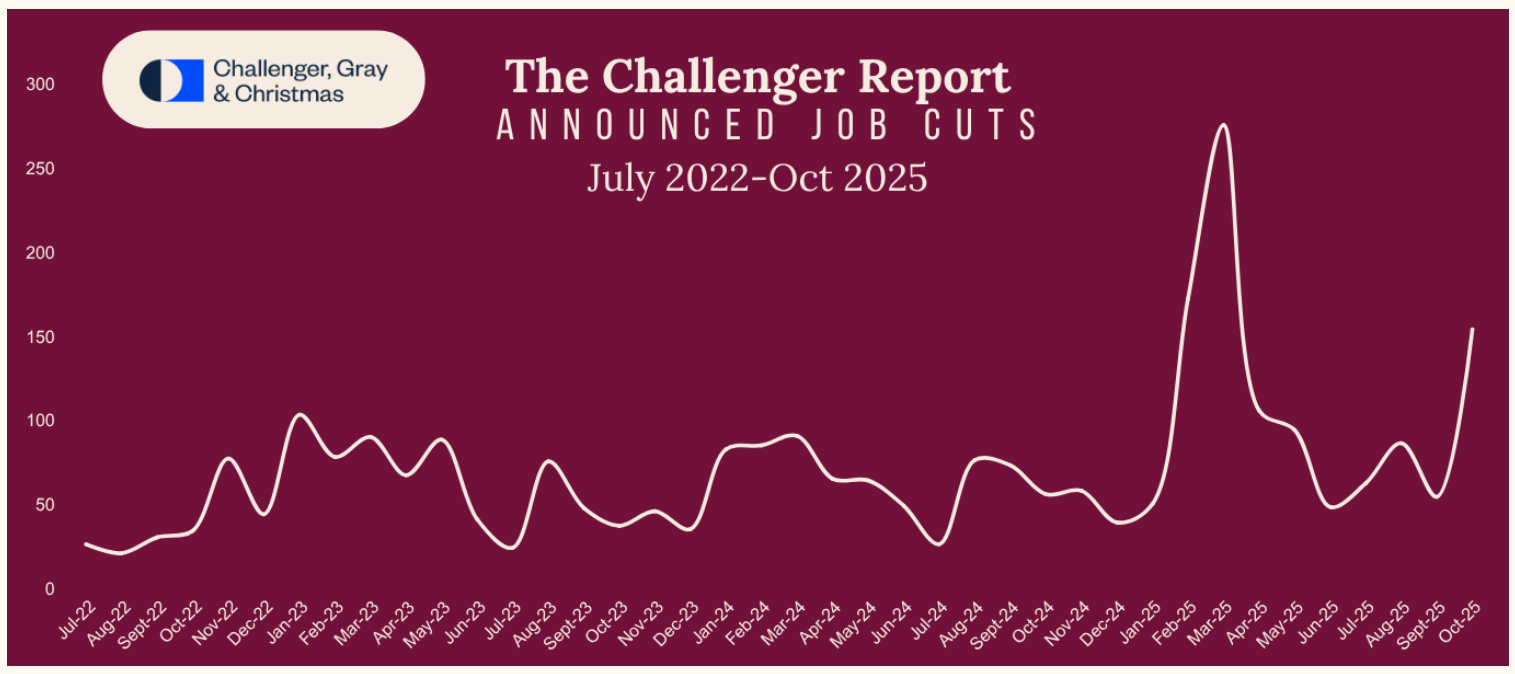
Core Insights - In October, U.S. employers announced layoffs of 153,074, a 175% increase from the same month in 2024 and an 183% increase from the previous month [1][3] - Cumulatively, layoffs for the year reached 1,099,500, a 65% increase compared to the same period in 2024, marking the highest level since 2020 [1][3] Layoff Trends - Nearly 450 independent layoff plans were tracked in October, up from just below 400 in September [3] - October's layoffs were the highest for the month since 2003, with a record of 171,874 layoffs at that time [3] - The trend of announcing layoffs in the fourth quarter has changed, with companies now more willing to disclose layoffs in October, contrary to past practices [3] Industry-Specific Layoffs - The technology sector led private sector layoffs with 33,281 announced in October, a significant increase from 5,639 in September [4] - The retail sector announced 2,431 layoffs in October, a slight decrease from 2,577 in September, but still facing significant challenges [4] - The warehousing industry saw the highest number of layoffs in October, with 47,878, reflecting ongoing restructuring due to overcapacity and automation [4] Reasons for Layoffs - Cost-cutting was the primary reason for layoffs in October, affecting 50,437 individuals, followed by layoffs due to artificial intelligence integration, impacting 31,039 individuals [9] - Market and economic conditions led to 21,104 layoffs in October, with cumulative layoffs for the year reaching 229,331 [9] Recruitment Plans - Employers announced plans to hire 488,077 individuals by October, a 35% decrease from the same period in 2024, marking the lowest level since 2011 [10] - The average monthly recruitment announcement was 48,808, also the lowest since 2011 [10]
中采PMI点评(25.10):10月PMI偏弱的“三大症结”
Shenwan Hongyuan Securities· 2025-10-31 13:18
Group 1: PMI Overview - In October, the manufacturing PMI decreased to 49% from 49.8%, while the non-manufacturing PMI slightly increased to 50.1% from 50%[6][1] - The decline in October PMI is attributed to weak demand and high inventory levels impacting production indices significantly[1][7] - The production index fell to 49.7%, a decrease of 2.2 percentage points, marking a return to contraction territory for the first time in six months[1][7] Group 2: Key Issues Affecting PMI - The production index's significant drop is linked to the end of a "production rush" and high inventory levels, which constrained the PMI's upward movement in October[2][10] - New export orders saw a notable decline of 1.9 percentage points to 45.9%, the second-lowest point this year, influenced by fluctuating tariff policies[2][13] - Domestic demand remains resilient, but investment demand has weakened due to accelerated debt reduction, impacting high-energy industries and construction PMI[3][17] Group 3: Sector Performance - The high-energy sector's PMI fell to 47.3%, reflecting strong pressure on real estate and infrastructure investment due to debt reduction measures[3][17] - The construction PMI decreased by 0.2 percentage points to 49.1%, although the new orders index increased by 3.7 percentage points to 45.9%[4][40] - Service sector PMI improved slightly to 50.2%, driven by holiday travel and pre-"Double Eleven" promotional activities[4][21]
2025年10月PMI点评:双节弱化9、10月制造业PMI表现
CMS· 2025-10-31 09:39
Manufacturing Sector - In October, the manufacturing PMI recorded 49.0, a decrease of 0.8 from the previous month, marking a significant decline and the lowest level for the same period in nearly five years[1] - The production index and new orders index fell to 49.7 and 48.8, down 2.2 and 0.9 respectively, indicating a retreat in production and market demand[1] - New export orders index dropped to 45.9, a decline of 1.9, the second-lowest point this year, only higher than the April figure following the introduction of tariffs[1] Service Sector - The service sector PMI increased by 0.1 to 50.2, showing resilience in service consumption driven by the National Day and Mid-Autumn Festival[1] - The business activity expectation index for services stood at 56.1, indicating strong confidence among service enterprises regarding industry development[1] Construction Sector - The construction PMI fell to 49.1, down 0.2, remaining at the lowest level since 2019, reflecting ongoing demand weakness[1] - However, the civil engineering index rose significantly, exceeding 55, suggesting signs of accelerated infrastructure investment activities[1] Future Outlook - For November, favorable seasonal factors are expected to boost manufacturing PMI due to upcoming domestic and overseas demand events, including "Double Eleven" and Christmas[1] - Infrastructure investment is anticipated to increase in Q4, providing a solid foundation for growth, although the overall construction PMI may remain at historically low levels[1]
中国经济稳中有进为世界增添宝贵的确定性(和音)
Ren Min Ri Bao· 2025-10-21 21:43
Core Viewpoint - China's economy continues to maintain overall stability and progress, contributing valuable certainty to the global economy amid insufficient growth momentum and increasing uncertainties worldwide [1][2][4]. Economic Performance - In the first three quarters of 2023, China's GDP grew by 5.2% year-on-year, accelerating by 0.2 percentage points compared to the previous year and 0.4 percentage points compared to the same period last year, laying a solid foundation for achieving annual targets [1]. - China's goods trade imports and exports increased by 4% year-on-year, demonstrating resilience and the ability to diversify products and markets [1]. Policy and Structural Adjustments - The contribution rate of final consumption expenditure to China's economic growth reached 53.5%, continuing to serve as the main engine for economic growth [2]. - Policies aimed at optimizing industries and promoting new growth drivers are effectively transmitted to the production side, enhancing sectors like equipment manufacturing and green technology [2]. Innovation and High-Quality Development - The integration of technology and industry is deepening, with more innovative results transitioning from laboratories to production lines, injecting new vitality into high-quality development [3]. - Significant growth was observed in renewable energy sectors, with wind and solar power generation achieving double-digit growth, and production of new energy products like lithium-ion batteries for vehicles increasing by 29.7% and 46.9%, respectively [3]. Future Outlook - China is confident in its ability to maintain sustained economic growth and continue providing important support for global economic growth by effectively leveraging policy effectiveness and advancing high-quality development [4].
“稳、进、韧”前三季度中国经济顶压前行
Shang Hai Zheng Quan Bao· 2025-10-20 18:13
Group 1 - The core viewpoint of the articles highlights the resilience of China's economy amid global challenges, with a focus on the positive impact of service consumption and government policies on economic growth [1][3][4] - In the first three quarters, the total retail sales of consumer goods increased by 4.5% year-on-year, while service retail sales grew by 5.2%, indicating a faster growth rate in the service sector [1] - The contribution rate of final consumption expenditure to economic growth reached 53.5%, an increase of 9.0 percentage points compared to the previous year, reinforcing its role as the main engine of economic growth [3] Group 2 - The government has implemented several policies to stimulate consumption, including the issuance of 300 billion yuan in special bonds to support the replacement of old consumer goods, which has shown positive effects [1][2] - The manufacturing purchasing managers' index has shown signs of recovery, and key industrial product prices have been rising, which is beneficial for improving corporate profitability [4] - The macroeconomic policies are expected to enhance the stability of economic growth, with a focus on structural monetary policy tools and support for high-tech industries [4][5]
前三季度消费支出对经济增长贡献率为53.5%|快讯
Hua Xia Shi Bao· 2025-10-20 05:14
Core Insights - The data released by the National Bureau of Statistics indicates that China's consumption potential is being continuously released, with consumption policies effectively boosting service consumption and stabilizing the overall consumption market [2] Group 1: Economic Contribution - In the first three quarters, final consumption expenditure contributed 53.5% to economic growth, driving GDP growth by 2.8 percentage points [2] - In the third quarter, final consumption expenditure's contribution to economic growth increased to 56.6%, contributing 2.7 percentage points to GDP growth [2] - The contribution rate of final consumption expenditure in the first three quarters increased by 9.0 percentage points compared to the entire previous year, reinforcing its role as the main engine of economic growth [2] Group 2: Policy Impact - The government has allocated 300 billion yuan in special long-term bonds in four batches to support the consumption of new goods through trade-in programs, directly aiding the release of consumer demand [2] - Retail sales of household appliances, audio-visual equipment, cultural office supplies, furniture, and communication equipment involved in the trade-in policy have all maintained double-digit growth [2] - As of September 10, over 8.3 million applications for vehicle trade-ins have been submitted nationwide, averaging more than 30,000 applications per day [2] Group 3: Industry Development - The "Two New" and "Two Heavy" policies are continuously transmitting effects to the production side, driving the manufacturing of equipment and consumer goods [3] - These policies are promoting production expansion and technological iteration in smart manufacturing, green manufacturing, and digital technology sectors [3] - The initiatives are accelerating the optimization of industrial structure and the transition from old to new growth drivers [3]