
计算机及办公设备制造

Search documents
全国31省经济数据出炉,东部巩固经济“压舱石”作用中西部稳中求进
Lian He Zi Xin· 2026-02-06 12:33
Economic Overview - By the end of January 2026, all 31 provinces in China had released their 2025 economic data, with GDP rankings remaining stable except for Chongqing surpassing Liaoning[4] - In 2025, the GDP growth rate for Tibet led the nation, while 18 provinces exceeded the national average growth rate of 5.0%, a decrease of 3 from 2024[4] Eastern Region - The eastern region accounted for over 50% of the national GDP, with Guangdong, Jiangsu, and Shandong remaining the top three provinces; Shandong's GDP surpassed 10 trillion for the first time[5] - Guangdong's GDP represented over 10% of the national total, with a new economy value-added ratio of 26.7% and high-tech manufacturing accounting for 34.7% of industrial output[6] Central Region - The central region's total economic output reached 29.91 trillion, with Henan, Hubei, and Anhui leading in growth rates of 5.6%, 5.5%, and 5.5% respectively[10] - In 2025, Henan's strategic emerging industries accounted for over 25% of industrial value-added, significantly contributing to economic stability[10] Western Region - The western region saw most provinces exceed the national average growth rate, with Tibet's growth rate at the top and its GDP surpassing 300 billion for the first time[14] - Gansu's industrial output increased by 9.5%, driven by a 19.5% growth in the non-ferrous metal smelting industry, benefiting from new industry demands[14] Northeast Region - The Northeast region, led by Liaoning, faced significant challenges with a notable decline in economic growth, as it was surpassed by Chongqing in GDP ranking[15] - Liaoning's industrial output growth was only 0.6%, far below the national average of 5.9%, indicating difficulties in transitioning traditional industries[15]
山西2025经济答卷亮眼 2026锚定高质量发展再出发
Zhong Guo Fa Zhan Wang· 2026-02-06 04:09
Core Viewpoint - Shanxi Province is focusing on high-quality economic development and resource-based economic transformation, with a positive outlook for 2026 following a stable performance in 2025 [1][6]. Economic Performance - In 2025, Shanxi's GDP reached 25,495.7 billion yuan, growing by 4.0% year-on-year, which is an increase of 1.8 percentage points compared to 2024 [1]. - The growth rates for primary, secondary, and tertiary industries were 4.5%, 3.1%, and 4.5% respectively, indicating sustained economic resilience [1]. Macroeconomic Policies - Shanxi implemented a series of policies to stabilize growth and promote transformation, with fiscal spending exceeding 600 billion yuan, of which 80.1% was allocated to people's livelihoods [2]. - Tax reductions and refunds for technological innovation and manufacturing totaled 231.8 billion yuan, benefiting 440,000 business entities [2]. - The province's loan balance grew by 7.4%, with average interest rates for new corporate loans and inclusive small and micro loans dropping to 3.41% and 4.35% respectively [2]. Domestic Demand and Investment - Shanxi's "old for new" consumption policy led to a significant increase in retail sales, reaching 8,030.9 billion yuan, a growth of 4.7%, which is 1 percentage point higher than the national average [3]. - Fixed asset investment saw a narrowing decline of 0.4%, which is 3.4 percentage points lower than the national average, supported by 120 "two重" projects [3]. Industrial Structure and Innovation - The province's industrial value added grew by 4.9%, with coal production exceeding 1.3 billion tons, an increase of 2.1% [4]. - New industries such as computer manufacturing and renewable energy saw substantial growth, with the former increasing by 121.6% [4]. - The service sector's contribution to GDP rose by 2.3 percentage points, with information technology services growing by 9.8% [4]. Reform and Development - Shanxi is deepening reforms in key areas, enhancing the competitiveness of state-owned enterprises and fostering innovation through the establishment of 27 national-level innovation platforms [5]. - The province's open economy is improving, with 1,000 China-Europe (Asia) freight trains operating, and 2,471 enterprises engaged in import and export activities, marking an 18.6% increase from the previous year [5]. Social Welfare and Employment - In 2025, Shanxi created 473,000 new urban jobs, exceeding annual targets, and continued to narrow the income gap between urban and rural areas [6]. - The high proportion of fiscal spending on social welfare ensures that development benefits are equitably distributed among the population [6].
最新数据大跌眼镜!
Sou Hu Cai Jing· 2025-11-14 15:45
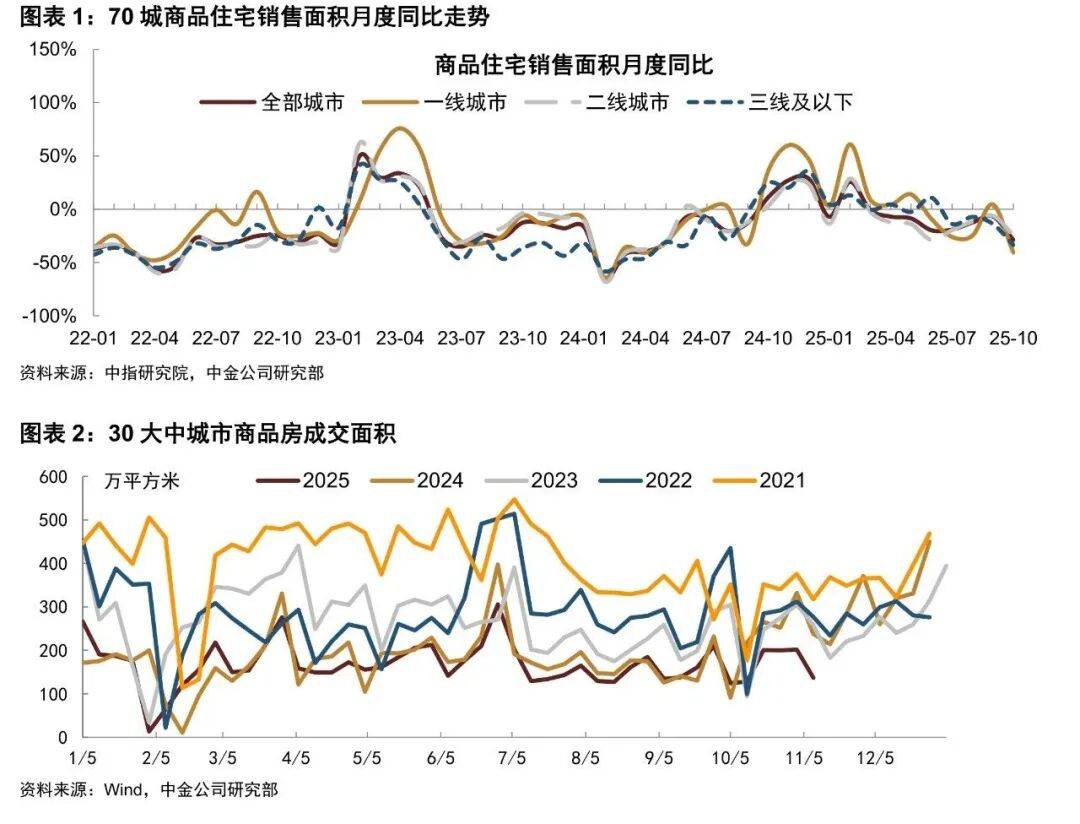
Economic Overview - The economic data for October shows a significant slowdown across multiple sectors, with industrial output, exports, and investments all experiencing declines [2][4] - Industrial value-added growth fell from 6.5% in September to 4.9% in October, while fixed asset investment decreased by 1.7% year-on-year and 1.62% month-on-month [2] - Consumer spending growth was impacted by the withdrawal of government subsidies, with retail sales growth slowing to 2.9% [2] Real Estate Sector - The real estate market continues to face challenges, with both sales volume and sales area declining, indicating a persistent "cold air" in the sector [3][5] - Real estate development investment dropped by 14.7%, with new residential sales area at 71.982 million square meters, down 6.8% year-on-year, and sales revenue at 690.17 billion yuan, down 9.6% [6] - The confidence crisis in the real estate market is more critical than policy changes or interest rate adjustments, affecting both sales and land auction markets [12][15] Investment Trends - Excluding real estate, fixed asset investment actually grew by 1.7%, with private investment showing a slight increase of 0.2% [17] - Notable growth was observed in information services investment, which surged by 32.7%, and aerospace manufacturing, which grew by 19.7% [17] - The shift in economic growth drivers indicates a transition from traditional construction to high-tech industries, marking a significant structural change towards "high-quality development" [17][18] Trade Dynamics - The total import and export volume saw a slight increase of 0.1%, with exports of mechanical and electrical products rising by 8.7%, now constituting 60.7% of total exports [17][18] - Private enterprises accounted for 57% of total exports, reflecting their agility and responsiveness in the current economic climate [17] Future Outlook - The current economic pain is viewed as a necessary adjustment for past development models, while the ongoing transformation is seen as laying the groundwork for future growth [19]

10月固投同比下降1.7%,房地产开发投资下降14.7%|快讯
Hua Xia Shi Bao· 2025-11-14 03:56
Group 1 - In October, national fixed asset investment (excluding rural households) reached 408,914 billion yuan, a year-on-year decrease of 1.7%. Excluding real estate development investment, national fixed asset investment grew by 1.7% [2] - By sector, infrastructure investment decreased by 0.1% year-on-year, manufacturing investment increased by 2.7%, and real estate development investment fell by 14.7%. The sales area of newly built commercial housing was 71,982 million square meters, down 6.8%, while the sales amount was 69,017 billion yuan, a decline of 9.6% [2] - In terms of industries, first industry investment grew by 2.9%, second industry investment increased by 4.8%, and third industry investment decreased by 5.3%. Private investment fell by 4.5%, but excluding real estate development, private investment grew by 0.2% [2] - High-tech industries showed significant growth, with information services, aerospace and equipment manufacturing, and computer and office equipment manufacturing investments increasing by 32.7%, 19.7%, and 4.1% respectively [2] - In October, fixed asset investment (excluding rural households) decreased by 1.62% month-on-month [2] Group 2 - The National Bureau of Statistics indicated that the overall operation of the national economy in October was stable, with solid progress in transformation and upgrading, and new growth drivers continuing to strengthen. However, there are many unstable and uncertain external factors, and significant pressure from domestic structural adjustments, posing challenges to stable economic operation [2] - The next phase will focus on implementing the spirit of the 20th Central Committee's Fourth Plenary Session, emphasizing steady progress, expanding domestic demand, stabilizing employment, enterprises, markets, and expectations, and promoting the effective implementation of macro policies [3]

前三季度郑州市经济运行稳中有进
Sou Hu Cai Jing· 2025-11-01 00:26
Economic Overview - The GDP of Zhengzhou reached 1,118.98 billion yuan in the first three quarters, with a year-on-year growth of 5.4% [1] - The primary industry added value was 15.31 billion yuan, growing by 2.9%; the secondary industry added value was 417.37 billion yuan, growing by 5.6%; and the tertiary industry added value was 686.30 billion yuan, growing by 5.3% [1] Industrial Performance - The industrial sector showed steady growth, with the added value of large-scale industries increasing by 8.8%, surpassing the provincial average by 0.4% [3] - Among 37 major industrial categories, 27 experienced growth, with a growth rate of 73.0%, an increase of 8.1 percentage points from the first half of the year [3] - Key industries such as automotive and electronics saw significant growth, with respective increases of 19.2% and 11.8%, contributing 5.7 percentage points to the overall industrial growth [3] Service Sector Development - The service sector demonstrated robust growth, with revenue from large-scale service industries increasing by 10.4%, exceeding the provincial average by 2.4% [3] - Nine out of ten major service categories reported year-on-year growth, with cultural, sports, and entertainment industries growing by 12.1% and transportation and logistics by 9.4% [3] Investment and Consumption - Fixed asset investment grew by 4.5%, with significant contributions from projects over 100 million yuan, which increased by 12.8% [4] - Private investment rose by 9.5%, higher than the provincial average by 2.0%, accounting for a larger share compared to the previous year [4] - Retail sales of consumer goods reached 490.39 billion yuan, with a year-on-year growth of 5.6%, driven by strong demand in sports and cultural products [4] Foreign Trade and Public Spending - The total import and export volume reached 433.25 billion yuan, growing by 25.3%, which is 6.6 percentage points higher than the provincial average [5] - Public budget expenditures in key areas such as energy conservation and transportation saw significant increases, with respective growth rates of 71.4% and 49.2% [5] Innovation and New Industries - High-tech industries and strategic emerging industries saw added value growth rates of 10.2%, 9.9%, and 9.2% respectively, indicating a shift towards new economic drivers [6][7] - New product outputs, including lithium batteries and electric vehicles, experienced substantial growth, with increases of 49.5% and 15.0% respectively [7] - E-commerce and new consumption models, such as live streaming and social commerce, are rapidly emerging as significant channels for consumer spending [7]
东北首个万亿城市,越来越近了
Mei Ri Jing Ji Xin Wen· 2025-10-24 23:54
Economic Overview - Dalian's GDP for the first three quarters reached 724.82 billion, with a year-on-year growth of 6.0%, consistent with the first half of the year and 0.8 percentage points higher than the national average [1] - The primary industry added value was 37.03 billion, growing by 4.2%; the secondary industry added value was 257.55 billion, increasing by 8.0%; and the tertiary industry added value was 430.24 billion, rising by 4.9% [1] Industrial Performance - The industrial added value of Dalian increased by 12.8% year-on-year, which is 0.3 percentage points higher than the first half of the year and 10.6 percentage points above the provincial average [2] - Key sectors such as petrochemical and equipment manufacturing showed significant growth, with the petrochemical industry increasing by 8.9% and equipment manufacturing by 17.5%, including a remarkable 64.5% growth in the railway and shipbuilding sector [3] Future Outlook - Dalian aims to achieve a GDP of 951.69 billion by 2024, positioning itself close to the trillion-yuan target, with a strong emphasis on high-quality economic growth [1] - The city is focusing on upgrading traditional industries and has introduced initiatives like the "Green Petrochemical Cluster Cultivation and Enhancement Action Plan (2025-2027)" to enhance its industrial capabilities [2]
透过“三季报”看中国经济稳步前行
Ren Min Ri Bao· 2025-10-21 06:28
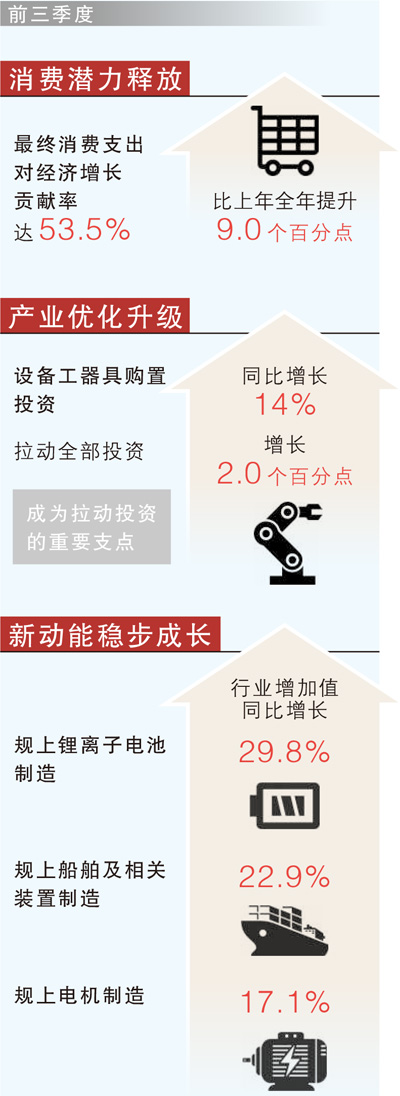
Economic Overview - The GDP growth for the first three quarters is 5.2%, with a third-quarter growth of 4.8%, indicating a stable economic performance [3][4][9] - The economic increment reached 39,679 billion, which is an increase of 1,368 billion year-on-year [4] - The average urban unemployment rate for the first three quarters is 5.2%, remaining stable compared to the first half of the year [4][10] Consumption and Investment - Final consumption expenditure contributed 53.5% to economic growth, an increase of 9.0 percentage points compared to the previous year [6][7] - Investment in equipment and tools increased by 14%, contributing 2.0 percentage points to overall investment growth [7][8] Industry Performance - The added value of the lithium-ion battery manufacturing industry grew by 29.8%, while shipbuilding and related equipment manufacturing increased by 22.9%, and motor manufacturing rose by 17.1% [8] - The proportion of added value from equipment manufacturing and high-tech manufacturing reached 35.9% and 16.7% respectively [5] Trade and International Relations - The total import and export volume increased by 6.0% year-on-year, with foreign exchange reserves maintaining above 3.3 trillion USD [10] - The resilience of foreign trade is highlighted by the historical high in goods import and export scale [4][10] Policy Impact - Macro policies have been effectively implemented to stabilize the economy and support long-term development [6][11] - The government has issued 300 billion yuan in special bonds to stimulate consumer demand through trade-in programs [6][7]
透过“三季报”看中国经济稳步前行(经济新方位)
Ren Min Ri Bao· 2025-10-20 22:10
Economic Overview - The GDP growth for the first three quarters is 5.2%, with a 4.8% growth in the third quarter, indicating a stable economic performance [4][10] - The economic increment reached ¥39,679 billion, which is an increase of ¥1,368 billion year-on-year [5] - The average urban unemployment rate for the first three quarters is 5.2%, remaining stable compared to the first half of the year [5][10] Consumption and Investment - Final consumption expenditure contributed 53.5% to economic growth, an increase of 9.0 percentage points compared to the previous year [7][8] - Investment in equipment and tools increased by 14%, contributing 2.0 percentage points to overall investment growth [7][8] - The retail sales of household appliances and audio-visual equipment, cultural office supplies, furniture, and communication equipment all maintained double-digit growth [8] Industry Performance - The added value of the lithium-ion battery manufacturing industry grew by 29.8%, while shipbuilding and related equipment manufacturing increased by 22.9% [8] - The high-tech manufacturing sector's added value accounted for 16.7% of the total industrial added value, indicating a shift towards high-quality development [6][11] - The production of new energy vehicles and electric bicycles saw significant increases of 29.7% and 27.1%, respectively [8] Trade and International Relations - The total import and export volume increased by 6.0% year-on-year, showcasing strong resilience in foreign trade [11] - Foreign exchange reserves remained above $3.3 trillion, with the RMB exchange rate showing stability [5][11] Policy Impact - The implementation of macroeconomic policies has effectively supported current economic stability and long-term growth potential [7][12] - The government has allocated ¥300 billion in special long-term bonds to stimulate consumer demand through trade-in programs [7][8] - The manufacturing purchasing managers' index (PMI) has shown signs of recovery, indicating improved market conditions [9][11]
国家统计局:宏观政策主动作为和精准发力 主要宏观经济指标总体平稳
Sou Hu Cai Jing· 2025-10-20 05:06
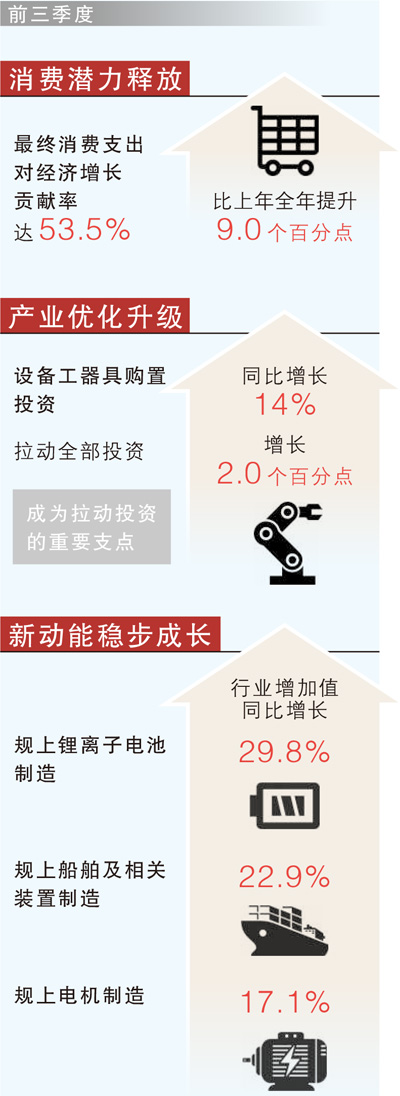
Group 1 - The core viewpoint of the article emphasizes that China's economy has shown resilience and steady progress in 2023, supported by proactive macroeconomic policies and effective implementation of various initiatives aimed at expanding domestic demand and revitalizing the capital market [1][2][3][4] Group 2 - The release of consumption potential is being facilitated through the issuance of 300 billion yuan in special long-term bonds to support consumer goods replacement, contributing to a 53.5% growth in final consumption expenditure's contribution to economic growth, an increase of 9.0 percentage points from the previous year [2] - The optimization and upgrading of industries are being promoted through a combination of fiscal and financial policies, resulting in a 14.0% year-on-year increase in investment in equipment and tools, which has significantly driven overall investment growth [2] - New growth drivers are steadily emerging, with significant increases in the value added of industries such as lithium-ion battery manufacturing (29.8%), shipbuilding (22.9%), and electric motor manufacturing (17.1%) in the first three quarters [3] - The orderly flow of the economic cycle is being enhanced by focusing on expanding domestic demand and improving market competition, leading to a 106.8% year-on-year increase in stock trading volume in the Shanghai and Shenzhen markets [4]
锐财经|实现全年目标任务有信心
Ren Min Ri Bao Hai Wai Ban· 2025-09-30 07:01
Economic Overview - The overall economic operation in China is stable despite external pressures, supported by macro policies and high-quality development efforts [2] - Key sectors such as manufacturing and services are showing positive growth, with significant increases in high-tech manufacturing and service production indices [2] - In August, the value added of major equipment manufacturing and high-tech manufacturing grew by 8.1% and 9.3% year-on-year, respectively, outpacing overall industrial growth [2] Demand Side Analysis - Consumption remains resilient, with retail sales of new energy vehicles increasing over 20% year-on-year in the first eight months [3] - Manufacturing investment grew by 5.1% in the same period, with notable increases in information services and aerospace sectors [3] - Foreign trade showed a 3.5% year-on-year increase in August, with exports to Belt and Road countries rising by 12.8% [3] Artificial Intelligence Initiatives - The government aims for over 70% application penetration of new intelligent terminals and agents by 2027 as part of the "Artificial Intelligence+" initiative [4] - The initiative emphasizes the role of private enterprises in AI development, with significant growth in new AI software companies established [4] - Measures to support private enterprises include promoting innovative operational models for computing power and providing financial incentives for AI research and development [4] "Three North" Project Development - The "Three North" project is the largest ecological restoration initiative globally, with a construction period exceeding 70 years [6] - The new overall plan for the project includes a comprehensive revision based on past experiences and current socio-economic conditions [6] - The project will focus on enhancing ecological quality and developing sustainable industries such as photovoltaic sand control and ecological tourism [6]