
煤炭采选

Search documents
数据点评 | 如何理解8月利润走强?(申万宏观·赵伟团队)
赵伟宏观探索· 2025-09-28 16:03
Core Viewpoint - The significant rebound in profit growth is largely attributed to low base effects and other short-term factors, while cost pressures remain high [2][11][66] Group 1: Profit and Revenue Analysis - In August, industrial profits increased by 21% year-on-year to 19.8%, driven by short-term factors such as expenses and other gains [2][11][66] - The profit margin improvement is mainly due to a notable rise in expenses and other gains, which increased by 3.8% to 2.2% and 24.8% to 18.3% respectively [2][11][66] - The revenue growth for industrial enterprises improved slightly, with a year-on-year increase of 2.3% in August, supported by significant recoveries in sectors like chemical fibers and non-metallic products [5][50][66] Group 2: Cost Pressure and Inventory - Cost pressures for industrial enterprises have not eased, with the overall cost rate at 85.6%, indicating a relative high compared to previous years [3][28][66] - The actual inventory growth showed a slight recovery, with nominal inventory decreasing by 0.1% year-on-year to 2.3%, while actual inventory increased by 0.3% to 7.2% [7][55][66] - Upstream inventory remains at historical highs, while midstream and downstream inventories are relatively low [7][55][66] Group 3: Industry-Specific Insights - The beverage and alcohol sector saw a dramatic profit increase of 234.8% year-on-year, significantly contributing to the overall profit growth of industrial enterprises [2][17][67] - The chemical and metallurgical sectors also contributed positively to profit recovery, with respective profit increases of 58.5% and 52.9% [46][67] - State-owned and joint-stock enterprises experienced substantial profit growth, with year-on-year increases of 53.1% and 30.9% respectively [52][66] Group 4: Future Outlook - Recent policies aimed at stabilizing growth in key industries are expected to alleviate cost pressures, with a focus on the effectiveness of these policies in the coming months [4][39][66] - The ongoing recovery in domestic demand is anticipated to support a continued upward trend in corporate profitability, despite potential negative impacts from rising upstream prices [4][39][66]

数据点评 | 如何理解8月利润走强?(申万宏观·赵伟团队)
申万宏源宏观· 2025-09-27 16:03
Core Viewpoint - The significant rebound in profit growth is largely attributed to low base effects and other short-term factors, while cost pressures remain high [2][11][67] Group 1: Profit and Revenue Analysis - In August, industrial profits increased by 21.9% year-on-year, reaching 20.4%, primarily due to an improvement in operating profit margins [40][68] - The profit margin for industrial enterprises rose by 20.2% month-on-month to 17.5% in August, while the Producer Price Index (PPI) increased by 0.7% to -2.9% [40][68] - Revenue growth for industrial enterprises improved, with a month-on-month increase of 1.2% to 2.3% in August, driven by significant recoveries in sectors like chemical fibers and non-metallic products [49][68] Group 2: Cost and Inventory Insights - The cost pressure for industrial enterprises remains elevated, with an overall cost rate of 85.6%, which is relatively high compared to previous years [27][67] - The actual inventory growth rate slightly rebounded, with nominal inventory decreasing by 0.1% year-on-year to 2.3%, while actual inventory increased by 0.3% to 7.2% [54][68] - Upstream inventory levels are at historical highs, while midstream and downstream inventories are relatively low [54][68] Group 3: Industry-Specific Performance - The beverage and alcohol sector saw a remarkable profit growth of 234.8% year-on-year, significantly contributing to the overall profit increase of industrial enterprises [17][66] - Other sectors such as electric power supply, coal mining, and non-ferrous processing also contributed positively to profit recovery, with respective contributions of 4.9%, 3%, and 2.2% [17][66] - The chemical fiber and non-metallic products sectors experienced substantial revenue growth, with increases of 22.2% and 7.4% respectively [49][68] Group 4: Future Outlook - Recent policies aimed at stabilizing growth in key industries are expected to alleviate cost pressures, with a focus on the effectiveness of these policies in the coming months [4][38] - The ongoing "anti-involution" policies are anticipated to gradually reduce rigid cost pressures, while domestic demand is expected to recover [4][38] - However, attention should be paid to the potential negative impact of rising upstream prices on corporate profitability [4][38]
如何理解8月利润走强?:工业企业效益数据点评(25.08)
Shenwan Hongyuan Securities· 2025-09-27 11:17
Group 1: Profit and Revenue Insights - In August, industrial enterprises' profit increased significantly, with a year-on-year rise of 21.9% to 20.4%[4] - The profit margin improvement was primarily driven by a rise in operating profit margin, which increased by 20.2% to 17.5%[4] - Cumulative revenue for industrial enterprises showed a year-on-year growth of 2.3%, consistent with the previous value[6] Group 2: Cost and Inventory Analysis - The cost rate for industrial enterprises remained high at 85.6%, reflecting a year-on-year increase of 9.3% to -3.4% in profit contribution from costs[23] - Actual inventory growth slightly rebounded, with a year-on-year increase of 0.3% to 7.2%[46] - The accounts receivable ratio rose to 14.6%, indicating a prolonged collection period[30] Group 3: Sector Performance - The beverage and alcohol sector saw a dramatic profit increase of 234.8% to 226.8%, contributing 7.8% to overall industrial profit growth[15] - Chemical fiber and non-metallic products also experienced significant revenue growth, with increases of 22.2% and 7.4% respectively[41] - State-owned and joint-stock enterprises reported substantial profit growth, with increases of 53.1% and 30.9% respectively[44]
一家煤企转型做文旅有多难?
经济观察报· 2025-09-27 05:07
Core Viewpoint - The article discusses the transformation of the coal industry in Shanxi Province towards the cultural tourism sector, highlighting the challenges and opportunities in this transition [6][30]. Group 1: Industry Transformation - Shanxi's coal enterprises are exploring reinvestment of coal profits into cultural tourism to find new growth points amid declining coal resources and rising extraction costs [6][30]. - The cultural tourism industry is seen as a key direction for Shanxi's economic transformation, with government initiatives aiming to elevate tourism's contribution to GDP by 2028 [30][32]. - The average salary in the coal mining industry is approximately 1.26 times higher than the overall industry average, making it a challenging sector for labor transition to tourism [19][30]. Group 2: Project Examples - The Jinhuagong National Mine Park, converted from an abandoned coal mine, has become a popular tourist destination, achieving a peak daily ticket revenue of around 100,000 yuan [5][25]. - The Pengfei Group has invested in the Xiangyu Ancient Castle, aiming to develop it into a 5A-level tourist attraction, while also addressing labor shortages by transitioning coal miners to tourism roles [12][14][27]. - The Xiangyu Ancient Castle project includes a non-heritage workshop offering traditional crafts, enhancing the tourism experience and diversifying revenue streams [24]. Group 3: Employment and Labor Transition - The transition from coal mining to tourism has seen a significant number of former coal miners becoming tour guides, with training programs in place to facilitate this shift [8][21]. - Approximately 130 jobs have been created in the cultural tourism project, with about 50% of the workforce coming from former coal miners [14][20]. - The tourism sector is more inclusive regarding age, gender, and education, which may attract more female workers compared to the coal mining industry [21][32]. Group 4: Challenges and Opportunities - The cultural tourism sector faces challenges such as high initial investment recovery pressure and insufficient visitor numbers, but operational data shows steady improvement [27]. - There is a need for better marketing and management practices in the cultural tourism sector, as many coal enterprises are reluctant to invest in promotion [25][26]. - The article suggests that Shanxi can learn from successful tourism models in other regions to enhance its cultural tourism offerings and attract external investment [27][32].

反内卷在年内如何落地?
2025-09-26 02:28
Summary of Conference Call Records Industry or Company Involved - The conference call discusses the **反内卷 (anti-involution) policy** in the context of the **Chinese economy** for the year **2025**. Core Points and Arguments 1. **Policy Focus and Tools**: The 2025 anti-involution policy emphasizes technical implementation, with ministries primarily using supply-side tools to stabilize prices, such as the Ministry of Industry and Information Technology (工信部) and the National Development and Reform Commission (发改委) stabilizing PPI (Producer Price Index) and CPI (Consumer Price Index) [1][2][4] 2. **Three Main Goals**: The policy has three main objectives: - Stabilize PPI year-on-year growth to prevent worsening corporate debt risks - Maintain positive year-on-year growth in CPI - Optimize the structure of emerging industries [4][12] 3. **Constraints on Policy Implementation**: The implementation of policies is constrained by two main factors: the lack of demand-side interventions and the relatively loose macroeconomic environment in China [5][16] 4. **Impact of Electricity Prices**: An increase in electricity prices by 10% can lead to a 1.9% increase in overall PPI, indicating that electricity prices are a significant driver of PPI [8][10] 5. **Industry Selection for Price Stabilization**: When selecting industries for price stabilization, factors such as industry price elasticity and their ability to influence PPI are crucial. Six key industries (coal mining, oil and gas extraction, energy refining, chemicals, steel, and non-ferrous metals) are identified as having significant influence [9][10] 6. **Challenges in Emerging Industry Capacity Governance**: Governance of emerging industries faces challenges such as coordination difficulties and the need for comprehensive efforts across various departments [15][17] 7. **Future Expectations**: The implementation of the anti-involution policy is expected to focus on price stabilization and capacity governance, with a gradual improvement in corporate profitability anticipated as macroeconomic reforms take effect [16][17][18] Other Important but Possibly Overlooked Content 1. **CPI Stability**: The stability of CPI is heavily reliant on stabilizing pork prices, with current strategies focusing on long-term price stabilization rather than immediate measures [12][14] 2. **PPI and CPI Growth Rates**: Current PPI and CPI growth rates are influenced by low base effects, with core CPI targets showing stability but some sub-items deviating from expected trends [13][14] 3. **Political Will and Policy Tools**: The effectiveness of PPI stabilization is not only dependent on technical measures but also on political will, with current policy efforts being more focused on price control rather than quantity control [11][16]
数据点评 | 为何大宗涨价拉不起PPI?(申万宏观·赵伟团队)
赵伟宏观探索· 2025-09-10 16:04
Core Viewpoints - The transmission effect of upstream price increases to downstream is weakening, with PPI showing marginal improvement in August due to significant recovery in commodity prices [2][10][70] - The overall PPI remained at 0% month-on-month, primarily due to low capacity utilization in downstream sectors, which hindered the reflection of upstream price increases [2][10][70] PPI Analysis - In August, PPI year-on-year decreased by 2.9%, an improvement of 0.7 percentage points from the previous month, aligning with market expectations [2][10][70] - Major commodities like coal and steel continued to rise, contributing positively to PPI, while international oil price declines negatively impacted domestic oil prices [2][10][70] - Downstream sectors are experiencing significant price reductions, with PPI declines in industries such as food and automobiles, which saw respective month-on-month decreases of 0.3% [2][10][70] CPI Analysis - CPI year-on-year fell to -0.4% in August, influenced by a high base from the previous year and weak food prices, with food CPI dropping by 4.3% [3][23][50] - The core CPI is expanding, with core goods CPI rising by 0.1 percentage points to 0.9%, driven by high gold prices and demand from the third batch of national subsidies [3][29][71] - Service CPI showed slight growth, supported by summer travel and healthcare service reforms, while rental prices remained weak due to high youth unemployment [4][33][62] Future Outlook - Commodity prices are expected to continue rising, but excess supply in downstream sectors may limit the transmission of price increases from upstream [4][72] - Year-end PPI is projected to recover to a maximum of -2.1%, while CPI may remain negative in Q3 but could turn positive in Q4 due to policy support for service consumption [4][72]
通胀数据点评:为何大宗涨价拉不起PPI?
Shenwan Hongyuan Securities· 2025-09-10 13:13
Group 1: Inflation Data Overview - In August, the CPI decreased by 0.4% year-on-year, compared to a previous value of 0% and an expectation of -0.2%[7] - The PPI recorded a year-on-year decline of 2.9%, improving from -3.6% previously, aligning with market expectations[7] - The overall PPI month-on-month remained at 0%, primarily due to low capacity utilization in downstream sectors, which hindered price transmission from upstream[2] Group 2: Price Transmission and Sector Analysis - Upstream price increases contributed positively to PPI month-on-month, with a calculated impact of 0.3% from commodity prices[1] - Downstream sectors, particularly in food and automotive industries, saw PPI declines of 0.3% each, reflecting significant price drops[2] - The core CPI for core goods rose by 0.1 percentage points to 0.9%, driven by high gold prices and demand from trade-in programs[3] Group 3: Future Outlook - Commodity prices are expected to continue rising, but excess supply in downstream sectors may limit the transmission of upstream price increases, keeping inflation weak throughout the year[4] - By year-end, PPI is projected to recover to a maximum of -2.1% year-on-year, while CPI may remain negative in Q3 but could turn positive in Q4[4] - Risks include potential tightening in food and energy supplies, which could further impact CPI dynamics[5]
数据点评 | 为何大宗涨价拉不起PPI?(申万宏观·赵伟团队)
申万宏源宏观· 2025-09-10 13:06
Core Viewpoints - The upstream price increase has a positive contribution to PPI month-on-month, but the low capacity utilization in the mid and downstream sectors continues to drag down PPI significantly [2][10][70] - In August, PPI showed marginal improvement, primarily driven by a notable rebound in commodity prices, with PPI month-on-month remaining at 0% [2][10][70] - The overall PPI month-on-month is 0%, mainly due to low capacity utilization in the mid and downstream sectors, which prevents the full transmission of upstream price increases [2][10][70] PPI Analysis - In August, coal and steel prices continued to rise, with coal mining (2.8%), black mining (2.1%), and black rolling (1.9%) showing month-on-month increases [2][10][70] - The international oil price decline negatively impacted domestic oil prices, with copper prices also contributing negatively to PPI [2][10][70] - The mid and downstream sectors are experiencing significant price reductions, with PPI declines in food and automotive sectors both at -0.3% [2][10][70] CPI Analysis - In August, CPI year-on-year dropped to -0.4%, influenced by a high base and weak food prices, with food CPI down 4.3% [3][23][50] - The core CPI continues to expand, with core goods CPI rising 0.1 percentage points to 0.9%, driven by high gold prices and demand from the third batch of national subsidies [3][29][71] - Core service CPI increased slightly, supported by summer travel and medical service reforms, while rental CPI remains weak due to high youth unemployment [4][33][62] Future Outlook - Commodity prices may continue to rise, but the oversupply in the mid and downstream sectors may constrain the transmission of upstream price increases, leading to weak inflation throughout the year [4][41][72] - It is expected that by the end of the year, PPI year-on-year may recover to a maximum of -2.1% [4][41][72] - CPI is anticipated to remain negative in the third quarter, with a potential turnaround in the fourth quarter due to ongoing policies supporting service consumption and demand recovery [4][41][72]
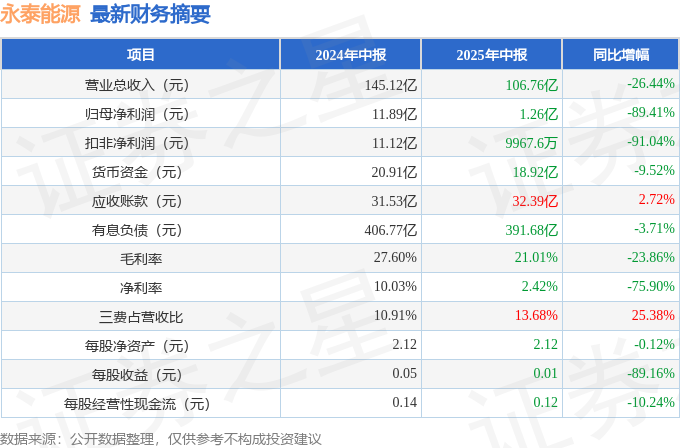
永泰能源2025年中报简析:净利润同比下降89.41%,短期债务压力上升
Zheng Quan Zhi Xing· 2025-08-27 22:33
Core Viewpoint - Yongtai Energy (600157) reported a significant decline in both revenue and net profit for the first half of 2025, indicating financial distress and increased short-term debt pressure [1][17]. Financial Performance Summary - Total revenue for the first half of 2025 was 10.676 billion yuan, a decrease of 26.44% year-on-year [1]. - Net profit attributable to shareholders was 126 million yuan, down 89.41% compared to the previous year [1]. - The gross profit margin fell to 21.01%, a decline of 23.86% year-on-year, while the net profit margin dropped to 2.42%, down 75.90% [1]. - The company's operating cash flow per share was 0.12 yuan, a decrease of 10.24% year-on-year [1]. Expense Analysis - Total selling, administrative, and financial expenses amounted to 1.46 billion yuan, representing 13.68% of revenue, an increase of 25.38% year-on-year [1]. - Selling expenses decreased by 44.86% due to reduced sales costs [4]. - Administrative expenses saw a slight decrease of 4.19% [5]. - Financial expenses also decreased by 7.71% due to lower interest payments [6]. - Research and development expenses increased by 46.92%, indicating a rise in investment in innovation [7]. Cash Flow and Debt Situation - The net cash flow from operating activities decreased by 10.24% due to reduced cash received from sales [8]. - The net cash flow from investing activities increased by 34.28%, attributed to decreased cash outflows for fixed assets and investments [8]. - The net cash flow from financing activities decreased by 13.84%, indicating reduced cash inflows from borrowings [9]. - The liquidity ratio was reported at 0.36, highlighting short-term debt pressure [1][18]. Asset and Liability Changes - Accounts receivable increased by 2.72% to 3.239 billion yuan [1]. - The company reported a 3.71% decrease in interest-bearing liabilities, totaling 39.168 billion yuan [1]. - Significant changes in liabilities included a 78.73% increase in accounts payable due to more bank acceptance bills issued [2]. Investment and Market Position - The company's return on invested capital (ROIC) was 5.2%, indicating average capital returns [17]. - The average expected performance for 2025 is projected at 554 million yuan, with an average earnings per share of 0.03 yuan [18]. - Several ETFs have newly entered the top holdings of Yongtai Energy, indicating growing interest from institutional investors [19].

永泰能源(600157) - 永泰能源集团股份有限公司2025年第二季度主要经营数据公告
2025-08-26 10:19
证券代码:600157 证券简称:永泰能源 公告编号:临 2025-047 以上公告之经营数据未经审计,请投资者审慎使用。 特此公告。 永泰能源集团股份有限公司董事会 二○二五年八月二十七日 2 本公司董事会及全体董事保证本公告内容不存在任何虚假记载、误导性陈述 或者重大遗漏,并对其内容的真实性、准确性和完整性承担个别及连带责任。 根据上海证券交易所《上市公司自律监管指引第 3 号——行业信息披露》的 相关规定和要求,为方便投资者了解公司生产经营情况,现将公司 2025 年第二 季度主要经营数据公告如下: 1 项 目 发电量(亿千瓦时) 上网电量(亿千瓦时) 2025 年 第 2 季度 同比 增减(%) 2025 年 1-2 季度 同比 增减 (%) 2025 年 第 2 季度 同比 增减 (%) 2025 年 1-2 季度 同比 增减 (%) 一、江苏省 49.6447 -12.86 104.8971 -6.55 47.4008 -12.79 100.1991 -6.48 1.燃煤: 38.2855 -15.16 83.0042 -8.36 36.2467 -15.15 78.6878 -8.36 张家港沙 ...