
逆变器

Search documents
逆变器龙头德业股份拟调整6.5亿元募资用途:押注高毛利工商储,新项目预计年净利超7亿元
Mei Ri Jing Ji Xin Wen· 2025-10-31 04:27
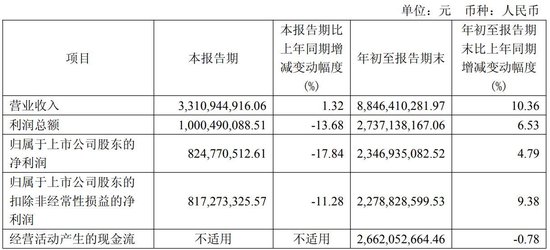
Core Viewpoint - The company, DeYee Co., Ltd. (605117.SH), announced a change in its fundraising project, reallocating 6.51 billion RMB of unused funds from a previously planned inverter production line to a new project focused on commercial energy storage systems, with a total investment of 11.12 billion RMB [1][6]. Financial Performance - In Q3 2025, the company reported a revenue of 3.31 billion RMB, a year-on-year increase of 1.32%, while the net profit attributable to shareholders was 824.77 million RMB, a decrease of 17.84% [2][3]. - The total profit for the period was 1.00 billion RMB, reflecting a decline of 13.68% compared to the previous year [2]. - The basic earnings per share were 0.92 RMB, down 19.30% year-on-year [1]. Investment Projects - The new project, "Annual Production of 7GWh Commercial Storage Production Line," is expected to generate an annual net profit of 734 million RMB upon reaching full production [9]. - The original project aimed at producing 25.5GW of string and storage inverters had a total investment of 19.99 billion RMB, with 14.92 billion RMB planned to be funded through the raised capital [3][5]. - The company has already invested 8.64 billion RMB in the original project, with a progress rate of 57.94% [5]. Market Trends - The inverter market is experiencing a stabilization in demand, with a 5.1% increase in export quantity and a 7.6% increase in export value in the first half of the year [10]. - The commercial storage market is witnessing robust demand, driven by policy support and increasing economic viability, particularly in overseas markets [10][11]. - The global energy storage market is projected to grow at a compound annual growth rate of 23% from 2024 to 2030, with significant demand expected in emerging markets [11]. Profitability Analysis - The gross profit margin for commercial storage products is significantly higher than that of string inverters, with margins of 62.15% for commercial storage inverters compared to 42.80% for string inverters in 2023 [12]. - The company aims to leverage its competitive pricing and product offerings in the energy storage sector to enhance profitability [11][12].


锦浪科技股价涨5%,国都证券旗下1只基金重仓,持有3000股浮盈赚取1.2万元
Xin Lang Cai Jing· 2025-10-31 02:27
Core Viewpoint - Jinlang Technology's stock rose by 5% on October 31, reaching 84.00 CNY per share, with a trading volume of 1.033 billion CNY and a turnover rate of 3.88%, resulting in a total market capitalization of 33.442 billion CNY [1] Company Overview - Jinlang Technology Co., Ltd. is located in Xiangshan Economic Development Zone, Zhejiang Province, and was established on September 9, 2005. The company went public on March 19, 2019. Its main business involves the research, production, sales, and service of string inverters, with the primary product being string inverters [1] - The revenue composition of Jinlang Technology includes: grid-connected inverters (47.97%), household photovoltaic power generation systems (21.28%), energy storage inverters (20.91%), new energy power production (8.01%), and others (1.83%) [1] Fund Holdings - According to data from the top ten heavy stocks of funds, Guodu Securities has one fund heavily invested in Jinlang Technology. Guodu Innovation Drive (002020) held 3,000 shares in the third quarter, accounting for 2.57% of the fund's net value, ranking as the fifth-largest heavy stock. The estimated floating profit today is approximately 12,000 CNY [2] - Guodu Innovation Drive (002020) was established on December 28, 2015, with a latest scale of 10.7923 million CNY. Year-to-date returns are 30.9%, ranking 3055 out of 8154 in its category; the one-year return is 10.56%, ranking 5766 out of 8046; and since inception, it has incurred a loss of 21.61% [2] Fund Manager Performance - The fund managers of Guodu Innovation Drive (002020) are Liao Xiaodong, Zhang Xiaolei, and Wang Yi. As of the report, Liao Xiaodong has a tenure of 5 years and 171 days, with a total fund asset size of 22.455 million CNY, achieving a best return of -24.14% and a worst return of -64.72% during his tenure [3] - Zhang Xiaolei has a tenure of 6 years and 321 days, with the same total fund asset size of 22.455 million CNY, achieving a best return of 80.09% and a worst return of -23.54% during his tenure [3] - Wang Yi has a tenure of 4 years and 139 days, with a total fund asset size of 10.7885 million CNY, achieving a best return of 35.82% and a worst return of -31.14% during his tenure [3]

交银国际每日晨报-20251031
BOCOM International· 2025-10-31 02:11
Group 1: Macroeconomic Insights - The "15th Five-Year Plan" emphasizes the coexistence of strategic opportunities and challenges, highlighting the complexity of the external environment compared to the "14th Five-Year Plan" [5] - The goals of the new plan have expanded from six to seven areas, with a focus on "high-quality development" and "significantly improving the level of technological self-reliance" [5] - The plan aims to enhance domestic consumption and emphasizes the importance of technological innovation for economic growth [5] Group 2: Global Economic Trends - The Federal Reserve's recent decision to cut interest rates by 25 basis points reflects a preventive approach amid uncertainties in the labor market due to the government shutdown [6] - Despite the absence of critical employment data, the Fed's decision indicates a proactive stance against potential economic downturns [6] - The U.S. stock market continues to reach historical highs, suggesting a sustained period of financial easing [6] Group 3: Company-Specific Performance - Gotion High-Tech reported a significant increase in revenue and profit for Q3 2025, with revenue of RMB 10.11 billion and a net profit of RMB 2.17 billion, marking a year-on-year growth of 20.7% and 1434% respectively [11] - The company maintains its annual shipment target of 100 GWh, with a strong performance driven by high demand for its products [11] - Midea Group's Q3 performance exceeded expectations, with revenue and net profit growing by 10.1% and 9.0% respectively, supported by a recovery in overseas markets [14] Group 4: Industry Outlook - The global energy storage market is expected to grow significantly, with a projected annual growth rate of 40-50% through 2026 [16] - The demand for high-energy-density products is anticipated to drive improvements in profit margins for companies in the energy sector [12] - The clean energy sector is showing strong performance, with a 52% increase in revenue for clean energy products, indicating a positive trend for future growth [17]
德业股份(605117)2025年三季报点评:汇兑及延迟确收略有影响 工商储及电池包继续发力
Xin Lang Cai Jing· 2025-10-31 00:39
Core Insights - The company reported its Q3 2025 results, showing a revenue of 8.846 billion yuan, a year-on-year increase of 10.36%, and a net profit of 2.347 billion yuan, up 4.79% year-on-year. The gross margin was 38.55%, down 1.60 percentage points year-on-year [1] Group 1: Financial Performance - For Q3 2025, the company achieved a revenue of 3.311 billion yuan, a year-on-year increase of 1.32% and a quarter-on-quarter increase of 11.51%. The net profit for the same quarter was 825 million yuan, down 17.84% year-on-year but up 1.00% quarter-on-quarter. The gross margin was 40.33%, down 4.17 percentage points year-on-year but up 2.62 percentage points quarter-on-quarter [1][2] - The company’s operating cash flow for Q3 2025 was 1.146 billion yuan, a year-on-year decrease of 15.77% but a quarter-on-quarter increase of 10.27%. As of Q3 2025, inventory stood at 1.449 billion yuan, up 4.99% year-on-year, while contract liabilities were 325 million yuan, down 37.90% year-on-year [2] Group 2: Business Outlook - The company expects continued quarter-on-quarter growth in Q4 2025 for its inverter and battery pack businesses, driven by high demand in the Australian market [2] - The company’s inverter shipments in Q3 2025 saw a slight year-on-year decline but an increase quarter-on-quarter, while battery pack shipments experienced growth in both comparisons, particularly due to demand stimulated by Australian subsidy policies [2] Group 3: Profit Forecast and Investment Rating - The company has slightly lowered its profit forecasts for 2025-2027, now expecting net profits of 3.3 billion, 4.0 billion, and 4.8 billion yuan for those years, representing year-on-year growth of 12%, 21%, and 20%, respectively. The corresponding price-to-earnings ratios are projected to be 22, 18, and 15 times [3] - Given the company’s steady growth and the gradual ramp-up of industrial storage, a target price of 110 yuan is set for 2026, maintaining a "buy" rating [3]
固德威(688390):储能放量+海外拓展下单季利润大增
HTSC· 2025-10-30 12:25
Investment Rating - The report maintains an "Overweight" rating for the company with a target price of 69.93 RMB [6][4]. Core Insights - The company reported a significant increase in profits for Q3 2025, driven by the end of inventory depletion in Europe and growing demand in emerging markets like Australia [1][2]. - The strong performance in the energy storage inverter and battery businesses is attributed to a substantial increase in shipment volumes, with inverter sales reaching approximately 45,000 units and battery sales around 0.3 GWh, both showing over 80% growth quarter-on-quarter [2][3]. - The company is expected to benefit from the global growth in renewable energy and energy storage demand, particularly in Australia and other emerging markets [2][3]. Summary by Sections Financial Performance - In Q3 2025, the company achieved revenue of 2.108 billion RMB, a year-on-year increase of 17.4%, and a net profit of 98 million RMB, reflecting a year-on-year growth of 200.8% [1]. - The gross margin and net margin were reported at 26.2% and 4.63%, respectively, indicating strong profitability [1]. Business Segments - The energy storage inverter segment generated approximately 400 million RMB in revenue, with a gross margin of 40-45%, while the energy storage battery segment also achieved around 400 million RMB, with a gross margin of about 35% [2]. - The company’s grid-connected inverter business remained stable, with revenue estimated at around 700 million RMB, maintaining a gross margin of 24-25% [3]. Future Outlook - The company is projected to see continued growth in net profit, with estimates of 212 million RMB for 2025, 459 million RMB for 2026, and 569 million RMB for 2027 [4]. - The report anticipates that the company’s overseas expansion will lead to further profit growth and cost reductions due to economies of scale [4].

昱能科技前三季度营收9.43亿元同比降38.48%,归母净利润6648.01万元同比降55.52%,毛利率下降5.09个百分点
Xin Lang Cai Jing· 2025-10-30 10:41
Core Insights - YN Technology reported a significant decline in revenue and profit for the first three quarters of 2025, with revenue at 943 million yuan, down 38.48% year-on-year, and net profit at 66.48 million yuan, down 55.52% [1][2] Financial Performance - The company's basic earnings per share for the reporting period was 0.43 yuan, with a weighted average return on equity of 1.83% [2] - The price-to-earnings ratio (TTM) is approximately 66.59 times, the price-to-book ratio (LF) is about 2.37 times, and the price-to-sales ratio (TTM) is around 5.74 times [2] - Gross margin for the first three quarters was 27.48%, a decrease of 5.09 percentage points year-on-year, while net margin was 5.50%, down 4.62 percentage points from the previous year [2] - In Q3 2025, the gross margin was 27.87%, a year-on-year decrease of 0.43 percentage points but an increase of 7.28 percentage points quarter-on-quarter; net margin was -5.92%, down 17.00 percentage points year-on-year and down 16.08 percentage points quarter-on-quarter [2] Expense Analysis - Total operating expenses for Q3 2025 were 165 million yuan, a decrease of 78.20 million yuan year-on-year; the expense ratio was 17.45%, an increase of 1.62 percentage points year-on-year [2] - Sales expenses decreased by 4.96% year-on-year, while management expenses increased by 12.99% and R&D expenses increased by 3.32%; financial expenses saw a dramatic decrease of 2803.45% [2] Shareholder Information - As of the end of Q3 2025, the total number of shareholders was 12,800, an increase of 1,255 households or 10.86% from the end of the previous half [2] - The average market value of shares held per household increased from 581,200 yuan at the end of the previous half to 728,900 yuan, a growth of 25.43% [2] Company Overview - YN Technology, established on March 24, 2010, and listed on June 8, 2022, is located in Jiaxing, Zhejiang Province, specializing in the R&D, production, and sales of component-level power electronic devices for distributed photovoltaic power generation systems [3] - The main business revenue composition includes micro-inverters and energy communication products (54.95%), commercial and industrial energy storage systems (29.14%), smart control disconnectors (8.94%), and others [3] - The company belongs to the power equipment industry, specifically photovoltaic equipment and inverters, and is associated with concepts such as photovoltaic glass, solar energy, specialized and innovative enterprises, margin financing, and energy storage [3]

固德威:Q3净利9771.78万元,同比增200.83%
Ge Long Hui A P P· 2025-10-29 09:58
Core Insights - The company reported a significant increase in revenue and net profit for the third quarter and the first three quarters of the year [1] Financial Performance - In Q3, the company achieved a revenue of 2.108 billion yuan, representing a year-on-year growth of 17.42% [1] - The net profit attributable to shareholders for Q3 was 97.718 million yuan, showing a remarkable year-on-year increase of 200.83% [1] - For the first three quarters, the company recorded a revenue of 6.194 billion yuan, which is a year-on-year growth of 25.30% [1] - The net profit attributable to shareholders for the first three quarters was 811.198 million yuan, reflecting an extraordinary year-on-year increase of 837.57% [1] Drivers of Growth - The substantial growth in performance is primarily attributed to the increased sales of inverters and battery products compared to the same period last year, leading to a significant rise in total profit [1]
万联证券:逆变器出口整体环比回调 关注海外布局完善、市场地位领先的龙头
智通财经网· 2025-10-28 04:03
Core Insights - The long-term outlook for global renewable energy installations is positive, with increasing demand for energy storage driven by rising grid instability [1] - The report highlights regional trends in energy storage demand, indicating a recovery in Europe, strong demand in the US, rapid growth in emerging markets, and stable growth in the Middle East [1] Regional Analysis - **Europe**: The impact of household storage inventory is diminishing, and large-scale storage installations are accelerating, leading to a gradual market recovery [1] - **United States**: There is significant demand for large-scale storage installations, with an expected acceleration in project grid connections, aided by reduced tariff impacts [1] - **Emerging Markets**: Regions such as Asia, Africa, South America, and Oceania show substantial potential for household storage growth, contributing to ongoing demand for energy storage [1] - **Middle East**: Investment in renewable energy is increasing, with accelerated construction of storage projects, particularly in Saudi Arabia and the UAE [1] Inverter Export Data - In September 2025, China's inverter exports amounted to 5.067 billion yuan, reflecting a month-on-month decline of 19.37% but a year-on-year increase of 4.60% [2] - Cumulative inverter exports from January to September 2025 reached 48.322 billion yuan, marking a year-on-year growth of 7.30% [2] Regional Export Performance - **Asia**: Exports to Asia totaled 1.695 billion yuan in September 2025, with a month-on-month decline of 12.70% and a year-on-year decrease of 3.48% [3] - **Europe**: Exports to Europe were 1.881 billion yuan, showing a significant month-on-month decline of 30.11% and a year-on-year decrease of 9.51% [4] - **North America**: Exports to North America were 151 million yuan, continuing a downward trend with a month-on-month decline of 16.9% and a year-on-year decrease of 24.84% [4] - **Latin America**: Exports to Latin America reached 529 million yuan, with a month-on-month decline of 5.07% but a year-on-year increase of 36.60% [5] - **Africa**: Exports to Africa totaled 373 million yuan, reflecting a month-on-month decline of 13.42% but a year-on-year increase of 22.69% [6] - **Oceania**: Exports to Oceania remained high at 456 million yuan, with a month-on-month decline of 7.17% but a year-on-year increase of 288.29% [6] Export Performance by Province - In September 2025, Guangdong, Anhui, Zhejiang, and Jiangsu saw inverter export amounts of 1.825 billion, 464 million, 1.365 billion, and 686 million yuan respectively, with varying month-on-month and year-on-year changes [7]
万联证券万联晨会-20251028
Wanlian Securities· 2025-10-28 01:28
Core Insights - The A-share market saw a collective rise in major indices, with the Shanghai Composite Index up by 1.18%, the Shenzhen Component Index up by 1.51%, and the ChiNext Index up by 1.98% [2][8] - In September, profits of industrial enterprises above designated size in China increased by 21.6% year-on-year, accelerating by 1.2 percentage points compared to August, marking two consecutive months of growth exceeding 20% [3][9] - QFII has increased holdings in cyclical sectors, with a total of 236 A-share companies having QFII as a major shareholder, amounting to 1.021 billion shares valued at 21.283 billion yuan [3][9] Market Review - The total transaction volume in the Shanghai and Shenzhen markets reached 23,399.22 billion yuan [2][8] - The sectors leading the market included telecommunications, electronics, and comprehensive industries, while media, food and beverage, and real estate sectors lagged [2][8] - Concept sectors such as storage chips and AI PC concepts saw significant gains, while horse racing and e-sports concepts experienced declines [2][8] Industry Analysis - In the automotive sector, the revenue growth rate slightly exceeded the profit growth rate, with total revenue of 1,928.764 billion yuan in the first half of 2025, a year-on-year increase of 7.56%, while net profit reached 80.138 billion yuan, up 6.16% [20][21] - The overall gross margin of the automotive sector decreased to 15.56%, while net margin remained stable at 4.34% [21][22] - The inverter export market showed a decline in overall exports, with September exports amounting to 5.067 billion yuan, a month-on-month decrease of 19.37% but a year-on-year increase of 4.60% [24][25] - The electrical equipment export sector reported stable performance, with total exports in September reaching 8.647 billion yuan, a month-on-month increase of 9.17% and a year-on-year increase of 48.97% [30][31] Company Performance - Dongpeng Beverage reported a third-quarter revenue of 6.107 billion yuan, a year-on-year increase of 30.36%, and a net profit of 1.386 billion yuan, up 41.91% [35][36] - The company’s core product, Dongpeng Special Drink, generated revenue of 12.563 billion yuan, reflecting a year-on-year growth of 19.36% [38][39] - The gross margin for Dongpeng Beverage was 45.21%, slightly down by 0.60% year-on-year, while the net margin improved to 22.68% [39][40]
电力设备行业跟踪报告:逆变器出口:整体环比回调,大洋洲保持高景气
Wanlian Securities· 2025-10-27 10:05
Investment Rating - The industry is rated as outperforming the market, with an expected increase of over 10% relative to the market index in the next six months [42]. Core Insights - In September 2025, China's inverter export value was 5.067 billion yuan, a month-on-month decrease of 19.37% but a year-on-year increase of 4.60%. Cumulatively, from January to September 2025, the total export value reached 48.322 billion yuan, reflecting a year-on-year growth of 7.30% [13][10]. - The report highlights a structural adjustment in the Asian market, with notable performance in the UAE and India, while the European market saw significant declines. North America continues to experience weak demand, whereas Latin America shows high growth despite an overall pullback [2][3][28]. Summary by Region Asia - In September 2025, inverter exports to Asia amounted to 1.695 billion yuan, down 12.70% month-on-month and 3.48% year-on-year. The UAE and India showed positive growth, while Saudi Arabia experienced a significant decline [14][2]. Europe - Exports to Europe were 1.881 billion yuan in September 2025, reflecting a month-on-month decline of 30.11% and a year-on-year decrease of 9.51%. The UK market performed well, contrasting with declines in Germany, the Netherlands, and Poland [24][3]. North America - Exports to North America were 151 million yuan, with a month-on-month decrease of 16.99% and a year-on-year decrease of 24.84%. The overall demand in this region remains weak [28]. Latin America - Exports to Latin America totaled 529 million yuan, with a month-on-month decrease of 5.07% but a year-on-year increase of 36.60%. Brazil and Mexico showed mixed results [7][28]. Africa - In September 2025, exports to Africa reached 373 million yuan, down 13.42% month-on-month but up 22.69% year-on-year. South Africa showed strong growth, while Nigeria maintained high year-on-year growth despite a slight month-on-month decline [29]. Oceania - Exports to Oceania were 456 million yuan, with a month-on-month decrease of 7.17% but a year-on-year increase of 288.29%. The Australian market continues to show strong performance [8][28]. Summary by Shipping Origin - In September 2025, inverter exports from Guangdong, Zhejiang, Anhui, and Jiangsu were 1.825 billion, 1.365 billion, 464 million, and 686 million yuan respectively. Guangdong and Anhui saw declines both month-on-month and year-on-year, while Zhejiang and Jiangsu maintained year-on-year growth [9][33].