
零售业

Search documents
“中国游中国购”,这样火起来!
Xin Lang Cai Jing· 2026-02-26 23:51
Core Insights - In 2025, the number of foreign visitors entering and exiting China is expected to reach 82.035 million, a year-on-year increase of 26.4% [1] - The sales volume of goods eligible for tax refunds for departing foreign tourists is projected to grow by 95.9% [1] - The increase in foreign visitors and spending is supported by policy initiatives aimed at boosting inbound consumption [1] Policy Support - In March 2025, the Central Committee and State Council issued a plan to stimulate consumption, emphasizing the development of inbound consumption [1] - The "14th Five-Year Plan" includes fostering international consumption center cities and expanding inbound consumption [1] Visa Policies - As of June 9, 2025, China implemented visa-free policies for Kuwait and three other countries, increasing the total number of countries with unilateral visa exemptions to 48 [5] - The number of foreign visitors entering under visa-free policies reached 30.08 million, accounting for 73.1% of all inbound visitors [5] Payment Facilitation - The payment system in Guangzhou has been enhanced, allowing foreign visitors to use international cards and mobile payment apps like Alipay, leading to over 35 million transactions worth more than 11.3 billion yuan [7] - The growth in payment convenience has contributed to a 57% increase in transaction volume and a 58% increase in transaction value for foreign visitors [7] Tax Refund Optimization - The introduction of centralized tax refund points in major shopping areas has streamlined the refund process for foreign tourists, significantly reducing the time required for refunds [8] - In 2025, the number of foreign tourists eligible for tax refunds increased by 305%, with a corresponding 95.9% increase in sales of tax-refunded goods [9] Evolving Consumer Preferences - Inbound tourists are increasingly seeking immersive and quality travel experiences, with a 300% increase in bookings for intangible cultural heritage workshops and folk performances [12] - The trend is shifting from traditional sightseeing to more authentic experiences, with tourists expressing interest in local customs and lifestyles [13] Service Innovations - The demand for personalized travel planning services has risen, with travel planners catering to the specific needs of inbound tourists [17] - New tourism products and experiences are being developed to meet the evolving preferences of foreign visitors, including cultural and wellness experiences [18] Challenges and Opportunities - Despite the growth in inbound tourism, there are still challenges related to after-sales service for foreign customers, particularly regarding warranty and return policies [19] - Collaborative efforts between government and businesses are needed to enhance the consumer experience and address concerns related to cross-border shopping [19]

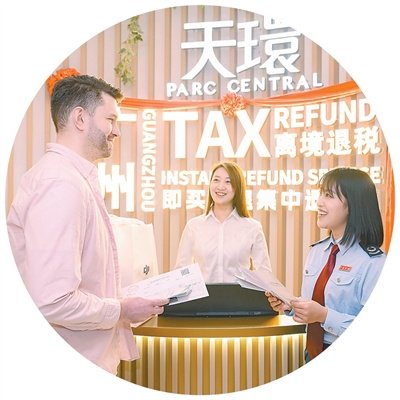
各口岸出入境外国人同比增长26.4%,“中国游中国购”这样火起来
Xin Lang Cai Jing· 2026-02-26 23:51
Core Insights - The article highlights a significant increase in inbound tourism and consumption in China, driven by favorable policies such as visa exemptions and improved payment systems [2][4][5]. Group 1: Inbound Tourism Growth - In 2025, the number of inbound foreign visitors reached 82.035 million, marking a year-on-year increase of 26.4% [2]. - During the Spring Festival holiday, foreign visitors entering China totaled 1.313 million, with a daily average increase of 21.8% compared to the previous year [2]. - The number of foreign visitors benefiting from visa exemption policies reached 4.6 million during the holiday, reflecting a daily average increase of 28.5% [2]. Group 2: Consumption and Tax Refunds - The number of foreign travelers applying for tax refunds increased by 305% in 2025, with tax refund sales growing by 95.9% [4][9]. - The implementation of the "immediate purchase and refund" tax refund model has streamlined the process for tourists, enhancing their shopping experience [8][9]. - In Guangzhou, the establishment of centralized tax refund points has improved efficiency, allowing tourists to complete refund processes quickly [8]. Group 3: Payment Convenience - The payment system for foreign visitors in Guangzhou has been enhanced, with over 35 million transactions made using foreign cards and mobile payments, representing a year-on-year growth of 57% and 58%, respectively [7]. - The availability of ATMs supporting foreign cards and multiple currency exchange points at airports has facilitated easier access to cash for tourists [7]. Group 4: Cultural and Experiential Tourism - There is a growing trend among inbound tourists towards immersive and quality travel experiences, with a 300% increase in bookings for intangible cultural heritage workshops and performances [13]. - Tourists are increasingly interested in authentic cultural experiences, such as traditional crafts and local cuisine, reflecting a deeper engagement with Chinese culture [13][14]. Group 5: Service Innovations - The rise of travel planners catering to inbound tourists has emerged, providing customized itineraries that include local experiences and cultural activities [16]. - New tourism products and services are being developed to meet the evolving demands of international visitors, enhancing the overall travel experience [16][18].
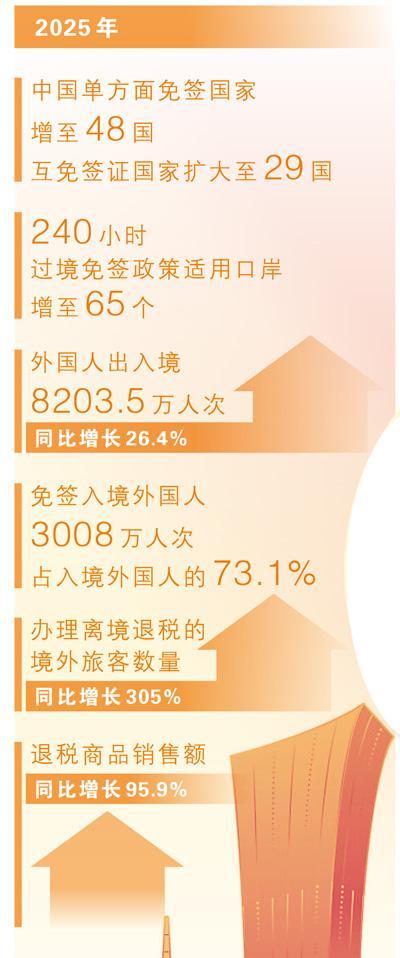
多措并举,从“一时火”到“一直火”(有所思)
Ren Min Ri Bao· 2026-02-26 23:36
Core Viewpoint - Multiple cities in China are implementing innovative measures to boost inbound consumption, aiming to transform temporary spikes in spending into sustained growth [1][2] Group 1: Policy Initiatives - Guangzhou has established "immediate buy and return" centralized refund points, while Tianjin has launched the "Tianjin Traditional Chinese Medicine Tour," and Chongqing has introduced several international brand flagship stores [1] - The "14th Five-Year Plan" suggests cultivating international consumption center cities and expanding inbound consumption [1] Group 2: Market Trends - By 2025, the number of outbound tourists eligible for tax refunds is expected to increase by 305%, with sales of tax-refunded goods projected to rise by 95.9% year-on-year [1] - Topics like "bringing empty boxes to China" have gained traction on overseas social media platforms, indicating a growing interest in Chinese products [1] Group 3: Challenges and Solutions - There are still issues such as insufficient acceptance of foreign cards by small and medium-sized merchants, lack of smooth coordination in visa, customs, and consumption processes, and difficulties in finding change [1] - To enhance the consumption environment, it is crucial to address these bottlenecks and shortcomings, creating a more welcoming atmosphere for foreign tourists [1] Group 4: Supply and Product Development - China possesses a complete industrial system and strong supporting capabilities, enabling the provision of a wide range of high-quality products, which is essential for attracting foreign tourists [1] - Localities should focus on product innovation, developing high-quality goods that meet international aesthetic standards while showcasing regional cultural characteristics, thereby promoting the "Buy in China" brand [1] Group 5: Cultural Integration - Engaging with Chinese culture, such as visiting flower streets in Guangzhou, enjoying crosstalk in Tianjin, and tasting hot pot in Chongqing, is becoming a new trend for foreign tourists [2] - Deepening the integration of traditional Chinese culture, including intangible cultural heritage and performing arts, with the tourism industry can enhance the depth and breadth of foreign tourist spending in China [2] Group 6: Long-term Strategy - Sustaining inbound consumption requires a multi-faceted approach and comprehensive efforts beyond just innovative measures [2] - Promoting high-quality development of inbound consumption not only injects lasting momentum into China's economy but also fosters cultural exchanges, allowing foreign tourists to experience a real, three-dimensional, and comprehensive China [2]
“中国游中国购”这样火起来
Ren Min Ri Bao· 2026-02-26 22:57
Core Insights - The article highlights the significant increase in inbound tourism to China, driven by visa-free policies and enhanced consumer experiences, leading to a notable rise in spending by foreign visitors [6][7][12]. Group 1: Inbound Tourism Growth - By 2025, the number of inbound foreign visitors is projected to reach 82.035 million, a year-on-year increase of 26.4% [6] - During the recent Spring Festival, 1.313 million foreign visitors entered China, marking a daily increase of 21.8% compared to the previous year [6] - The implementation of visa-free policies has allowed 4 additional countries to benefit, bringing the total to 48 countries with unilateral visa exemptions [7] Group 2: Consumer Spending Trends - In 2025, the number of foreign travelers eligible for tax refunds increased by 305%, with sales of tax-refunded goods rising by 95.9% [12] - In Guangzhou, foreign visitors made over 35 million transactions using foreign bank cards and mobile payments, with a total spending exceeding 11.3 billion yuan, reflecting year-on-year growth of 57% and 58% respectively [9] Group 3: Payment and Tax Refund Innovations - The introduction of convenient payment options, including support for foreign bank cards and mobile payment systems, has significantly enhanced the consumer experience for foreign visitors [9] - The establishment of centralized tax refund points in major shopping areas has streamlined the refund process, making it more efficient for tourists [10][11] Group 4: Evolving Tourist Preferences - There is a shift in inbound tourism from traditional sightseeing to immersive and quality experiences, with a 300% increase in bookings for cultural and traditional activities [14] - Tourists are increasingly interested in local experiences, such as traditional food and cultural performances, reflecting a desire for deeper engagement with Chinese culture [15][16] Group 5: Service Innovations - The rise of travel planners catering to inbound tourists has emerged as a response to the demand for personalized travel experiences, with a significant portion of tourists opting for customized itineraries [17] - New tourism products and services are being developed to meet the evolving preferences of inbound visitors, including unique cultural experiences and modern amenities [18][19]

2025年 全国各口岸出入境外国人同比增长26.4% 离境退税商品销售额同比增长95.9% “中国游中国购”这样火起来(人民眼·提振消费)
Ren Min Ri Bao· 2026-02-26 22:19
Core Insights - The article highlights the significant increase in foreign tourist arrivals in China, driven by visa-free policies and enhanced consumer experiences, leading to a boost in both tourism and retail sectors [1][2][5]. Group 1: Visa Policies and Tourist Arrivals - As of 2025, China has implemented visa-free policies for 48 countries, resulting in 30.08 million foreign visitors, accounting for 73.1% of total foreign arrivals [2]. - The number of foreign tourists entering China during the Spring Festival reached 1.313 million, showing a daily increase of 21.8% compared to the previous year [1]. Group 2: Consumer Spending and Payment Innovations - In 2025, foreign visitors in Guangzhou made over 35 million transactions using foreign bank cards and mobile payments, with a total spending exceeding 11.3 billion yuan, reflecting year-on-year growth of 57% and 58% respectively [4]. - The introduction of convenient payment options, including support for foreign cards and mobile payment apps like Alipay, has significantly enhanced the shopping experience for foreign tourists [4]. Group 3: Tax Refund Policies - The number of foreign travelers utilizing tax refund services increased by 305% in 2025, with tax refund sales growing by 95.9% [7]. - New policies have streamlined the tax refund process, allowing tourists to complete refunds at centralized points, enhancing efficiency and customer satisfaction [6]. Group 4: Evolving Tourist Preferences - There is a noticeable shift in foreign tourists' preferences towards immersive and quality travel experiences, with a 300% increase in bookings for cultural and traditional activities [9]. - Tourists are increasingly seeking authentic local experiences, moving away from traditional sightseeing to engage with local culture and lifestyle [10][11]. Group 5: Service Innovations and New Offerings - The rise in demand for personalized travel planning services has led to the emergence of travel planners who cater to specific tourist needs, enhancing the overall travel experience [12]. - New tourism products and experiences, such as themed cultural tours and local culinary experiences, are being developed to meet the evolving preferences of international visitors [13][14].
特朗普拒退相关款项,强硬举动惹全球不满,美媒称中国或减停购美大豆
Sou Hu Cai Jing· 2026-02-26 16:03
Core Viewpoint - The U.S. Supreme Court ruled that the Trump administration's use of the International Emergency Economic Powers Act to impose tariffs on various countries was an overreach of authority, emphasizing that tax powers reside with Congress, not the executive branch [1][3][5]. Group 1: Legal and Regulatory Implications - The Supreme Court's decision on February 20, 2026, declared that the tariffs imposed by the Trump administration were illegal, leading to potential refunds amounting to hundreds of billions of dollars [1][3]. - The ruling highlighted that the use of emergency powers for tariff imposition was not aligned with the original legislative intent of the International Emergency Economic Powers Act [3][5]. - The legal battle has resulted in a surge of lawsuits from companies seeking refunds for tariffs paid since 2025, complicating the refund process due to the need for individual proof of payment [1][10]. Group 2: Economic Impact - The imposition of tariffs has led to increased prices for consumers, with reports of price hikes on everyday goods such as soy sauce and bread, contributing to inflationary pressures [1][9]. - The agricultural sector is particularly affected, with U.S. soybean sales to China declining significantly, leading to inventory buildup and financial losses for farmers [9][15]. - The uncertainty surrounding tariffs has caused importers to hesitate in placing large orders, prompting some to shift production to countries like Vietnam and Mexico [9][10]. Group 3: Political and Strategic Considerations - The Trump administration's approach appears to be a political strategy aimed at rallying support from blue-collar voters ahead of the midterm elections in 2026, despite the adverse effects on businesses and the economy [12][18]. - The new tariffs implemented under the Trade Act of 1974 have drawn international criticism, with countries like Canada and the EU considering retaliatory measures [9][18]. - The ongoing legal and political turmoil has raised questions about the reliability of the U.S. as a trading partner, with allies reassessing their economic strategies in light of the unpredictable tariff landscape [12][18].

特朗普撕破脸,突然昭告全球,包括中俄欧盟,全世界一个不会放过
Sou Hu Cai Jing· 2026-02-26 08:53
Group 1 - The U.S. Supreme Court ruled 6-3 that Trump's large-scale tariffs imposed under the International Emergency Economic Powers Act were unconstitutional, effectively putting a halt to his previous tariff strategy [3] - Trump responded to the ruling by invoking the rarely used Trade Act of 1974, allowing him to bypass Congress and impose a temporary 10% tariff on all imported goods for 150 days, starting February 24 [5] - Within 24 hours, Trump announced an increase of the tariff rate to 15%, causing confusion among both domestic and international stakeholders [7] Group 2 - The new tariffs apply indiscriminately to all countries, including traditional allies like the EU, Canada, and Japan, with exceptions for certain critical goods to avoid domestic supply issues [8][10] - The market reacted negatively to the announcement, with U.S. stock futures dropping and the fear index rising, indicating a lack of confidence in the stability of the global supply chain [12] - U.S. retailers and manufacturers are facing increased pressure due to rising import costs, leading to potential profit compression and delays in investment and hiring plans [14] Group 3 - The EU quickly condemned the tariffs, stating they undermine fair transatlantic trade and warning of significant damage to global market confidence [16] - Canada echoed this sentiment, asserting that Trump's previous tariff actions were unjustified and that the unpredictability of such tariffs hampers business planning [18] - Emerging economies like India and Brazil are also taking measures in response, with Brazil's president criticizing Trump's unilateral approach and calling for solidarity among developing nations [20] Group 4 - Trump's motivations appear to be twofold: to assert his authority against the Supreme Court ruling and to bolster his political standing ahead of upcoming midterm elections [22] - The 15% tariff is temporary and will expire unless Congress approves an extension, prompting Trump to initiate investigations into "unfair trade practices" to maintain pressure on trade partners [24] - The unilateral tariff strategy risks isolating the U.S. diplomatically, as it alienates allies and invites collective resistance from other nations against American trade policies [26]
爱尔兰政府发布循环经济战略
Shang Wu Bu Wang Zhan· 2026-02-26 02:47
Core Viewpoint - Ireland's Climate, Energy and Environment Minister and the Minister for Circular Economy have launched the "Accelerated Action" Circular Economy Strategy, focusing on six key sectors to enhance sustainability and recycling efforts [1] Group 1: Key Sectors and Initiatives - The strategy identifies six key sectors: construction, bio-economy, retail, packaging, textiles, and electronics [1] - Local governments will be supported in establishing reuse, repair, and recycling centers, along with a national pilot repair voucher scheme [1] Group 2: Goals and Targets - The overall targets include achieving a 90% recycling rate for plastic bottles by 2029 [1] - By 2030, the aim is to reach a 12% usage rate of recycled materials and reduce food waste by 50% [1] - Additionally, packaging waste is targeted to be reduced by 5% [1]
纵深推进融入大市场,河南重点这样干
He Nan Ri Bao· 2026-02-25 23:26
Core Viewpoint - The news highlights the strategic initiatives and progress made by Henan Province in integrating into the national unified market, showcasing significant growth in various economic indicators and infrastructure development. Group 1: Infrastructure Development - The construction of the Jiaoluo Ping High-Speed Railway is a key project in Henan's transportation network, contributing to the central region's economic rise [2] - The total length of highways in the province has surpassed 10,000 kilometers, with a comprehensive transportation network reaching 295,000 kilometers [9] - The annual cargo and mail throughput at Zhengzhou Airport has exceeded 1 million tons, marking a significant milestone in logistics [9] Group 2: Economic Indicators - The retail sales of consumer goods in Henan are projected to grow at the second-fastest rate in the country by 2025, with imports and exports expected to exceed 900 billion yuan, a growth of 14.1% [4] - The 2025 index for Henan's integration into the national unified market is set at 119, reflecting a 13.3% increase from 2024, with all five sub-indices showing upward trends [3] Group 3: Business Environment and Market Regulation - The number of business entities in Henan has reached 11.632 million, ranking fifth in the country, supported by comprehensive market regulation and credit management initiatives [7] - The province plans to implement credit restoration measures, aiming to restore 1,003,000 credit records by 2025 [7] Group 4: Innovation and Industry Development - Henan is transitioning from being a participant in the industrial chain to defining key segments, with a focus on enhancing innovation capabilities and developing a modern industrial system [6] - The province aims to establish 200 smart workshops and factories, promoting digital transformation in manufacturing [6] Group 5: Trade and International Cooperation - Henan is enhancing its international trade capabilities, with a focus on expanding the China-Europe Railway Express and improving customs clearance efficiency through the implementation of a "single window" system [5] - The province's service trade is expected to grow at the fastest rate in the country, with significant investments in countries along the Belt and Road Initiative [4][5]

全区民营经营主体达445.4万户
Guang Xi Ri Bao· 2026-02-25 01:59
Group 1: Core Insights - The number of private business entities in Guangxi is projected to reach 4.454 million by the end of December 2025, reflecting a year-on-year growth of 4.25%, accounting for 95.7% of all business entities [1] - The private industrial sector in Guangxi is expected to see a significant increase, with the added value of large-scale private industrial enterprises growing by 9.5% year-on-year, contributing 63.5% to the growth of the overall industrial sector [1] - The private service sector is also showing strong growth, with large-scale private service enterprises' revenue increasing by 15.8% year-on-year, significantly outpacing the overall service sector growth [1] Group 2: Investment and Trade - Private investment in Guangxi has turned positive, with a year-on-year increase of 2.4% in 2025, marking the first rise in its proportion of fixed asset investment since 2019, now at 36.9% [2] - The number of private enterprises involved in foreign trade reached 5,689 in 2025, a 10.1% increase year-on-year, representing 92.4% of all enterprises with import and export records in Guangxi [2] - The total import and export value of private enterprises in Guangxi reached 563.45 billion yuan, a year-on-year growth of 4.7%, accounting for nearly 70% of the region's total foreign trade [2] Group 3: Tax Contributions and Financial Support - By the end of December 2025, the number of private tax-related market entities in Guangxi reached 3.2218 million, a year-on-year increase of 24.8%, making up 97.8% of all tax-related market entities [2] - The private economy in Guangxi contributed to a tax revenue increase of 8.9% year-on-year, accounting for 50.4% of the total tax revenue in the region [2] - Financial services for private enterprises have been enhanced, with a year-on-year growth of 4.62% in loans to the private economy, and individual business loans growing by 6.92%, surpassing the overall loan growth rate [3]