晶圆代工

Search documents
Marvell,主导定制芯片市场
半导体芯闻· 2025-06-20 10:02
Core Insights - Marvell is rapidly emerging as a strong player in the application-specific integrated circuit (ASIC) market, planning to collaborate with TSMC on advanced processes below 3nm [1][2] - TSMC holds over 60% market share in the foundry market and is targeting the emerging application-specific semiconductor manufacturing market driven by AI growth [1] - Application-specific semiconductors are designed for specific functions, offering lower costs, reduced power consumption, and less overall investment compared to general-purpose GPUs, making them attractive in AI data centers, automotive, and IoT markets [1] Group 1 - Marvell's next-generation AI application-specific chips will utilize TSMC's 3nm and 2nm processes, with production of 3nm chips already underway [2] - The company aims to enhance performance through silicon photonics technology, which can increase data transmission speeds by over ten times [2] - Marvell's revenue reached $5.76 billion last year, with AI-related revenue exceeding $1.5 billion, expected to surpass $2.5 billion this year [2] Group 2 - TSMC currently provides over 70% of the production foundry for Broadcom's chips and is increasing collaboration with Marvell to capture the growing application-specific semiconductor market [3] - The application-specific semiconductor market was valued at approximately $20.29 billion last year and is projected to grow to $32.84 billion by 2031 [3] - Marvell has launched data center chips manufactured using TSMC's 3nm process and plans to expand collaboration to include 2nm processes [3] Group 3 - TSMC's global foundry market share reached 67.6% in Q1 this year, significantly outpacing competitors, while Samsung's market share was only 7.7% [4] - Samsung is also collaborating with Broadcom and Marvell on advanced processes but needs to improve yield and performance to enhance its competitive edge [4]


天风证券晨会集萃-20250620
Tianfeng Securities· 2025-06-19 23:45
Group 1 - The report emphasizes the importance of the "congestion degree" indicator, which reflects the proportion of trading volume in a sector relative to the overall market, indicating whether a sector is popular or overheated [3][21][22] - It notes that in the long term, sectors in A-shares that experience "acceleration followed by volume" are likely to underperform in the following month, with exceptions observed during the 2020-2021 core asset era [3][22] - The report suggests that the effectiveness of volume-price logic is steadily increasing post-2023, making volume and technical indicators more significant [3][22] Group 2 - The medical device sector showed a robust growth in May, with a total bid amount of 13.43 billion yuan, representing a 69% year-on-year increase, and a total of 71.45 billion yuan for the first five months, up 72% year-on-year [5] - Domestic brands like Mindray and United Imaging have shown significant growth in bid amounts, with Mindray's total bid amount in May reaching 820 million yuan, a 56% increase year-on-year [5] - Import brands also saw rapid growth, with Philips and Siemens reporting year-on-year increases of 62% and 112% respectively in May [5] Group 3 - The report highlights the strong investment opportunities in the western infrastructure sector, with solid growth in fixed asset investment since 2024, particularly in regions like Inner Mongolia, Xinjiang, and Tibet [10] - It identifies key areas and major projects for investment, such as Sichuan-Chongqing, Tibet, and Xinjiang, which are expected to drive demand for infrastructure construction [10] - The report indicates that the central government's continued financial support and strategic planning will likely sustain the high level of infrastructure investment in the western regions [10] Group 4 - The report on Huahong Semiconductor indicates a positive outlook due to a new price increase cycle, with the company expected to leverage its strong pricing power to enhance profitability [29][30] - The new factory (9th plant) is projected to contribute significantly to revenue, with an estimated future revenue space of 1.277 billion USD if operating at near full capacity [30] - The acquisition of Huali Micro is expected to enhance Huahong's competitive edge, with projections for revenue growth reaching 17.2 billion yuan by 2025 [31]


每日市场观察-20250613
Caida Securities· 2025-06-13 07:49
Market Overview - The market experienced a narrow fluctuation on June 12, with the Shanghai Composite Index rising by 0.01%, the Shenzhen Component Index falling by 0.11%, and the ChiNext Index increasing by 0.26 [2] Industry Performance - The report highlights a shift in market focus from technology and large financial sectors to previously less popular industries such as non-ferrous metals, pharmaceuticals, and insurance, with significant gains observed in large-cap companies within these sectors [1] - The innovative drug, rare earth magnetic materials, and precious metals industries are currently attracting high market attention and showing a certain trend [1] Capital Flow - On June 12, net inflows into the Shanghai Stock Exchange amounted to 5.615 billion, while the Shenzhen Stock Exchange saw net inflows of 5.875 billion [4] - The top three sectors for capital inflow were communication equipment, automotive parts, and chemical pharmaceuticals, while the sectors with the highest capital outflow were liquor, electricity, and semiconductors [4] Industry Dynamics - Douyin e-commerce has announced a new policy allowing new merchants to join the platform with zero deposit, significantly lowering the entry barrier for businesses [8] - According to TrendForce, the global wafer foundry industry is expected to grow by 19.1% in 2025, driven by strong demand for advanced computing chips due to AI applications [9][10] - Shenzhen has opened nearly 300 drone routes and completed over 1.7 million cargo flights, indicating a robust development in the low-altitude economy [10] Fund Dynamics - Over 90% of billion-level private equity firms have achieved positive returns this year, with an average return exceeding 7% as of May 31 [11] - The total scale of the STAR Market ETFs has surpassed 250 billion, reflecting a nearly 60% growth since the introduction of the "STAR Market Eight Measures" [12]
每周观察| 1Q25晶圆代工产业营收达364亿美元;1Q25全球前六大智能手机品牌产量;1Q25全球前十大IC设计厂营收季增6%
TrendForce集邦· 2025-06-13 04:10
Group 1: Wafer Foundry Industry - In Q1 2025, the global wafer foundry industry revenue decreased by approximately 5.4% to $36.4 billion, influenced by international circumstances and early inventory preparations by some companies [1][2] - TSMC remains the market leader with a revenue of $25.5 billion, holding a market share of 67.6%, despite a 5.0% quarter-over-quarter decline [2] - Samsung's revenue dropped by 11.3% to $2.9 billion, reducing its market share to 7.7% [2] Group 2: Smartphone Production - Global smartphone production reached 289 million units in Q1 2025, a decrease of about 3% compared to the same period in 2024, with stable performance across various brands [3][4] - Samsung led production with 64 million units, showing a 21% quarter-over-quarter increase, while Apple experienced a significant decline of 40% to 48 million units [4] Group 3: IC Design Industry - The top ten fabless IC design companies saw a revenue increase of approximately 6% in Q1 2025, totaling $77.4 billion, driven by strong demand for AI and early inventory preparations [6][8] - NVIDIA led the segment with a revenue of $42.4 billion, marking a 12% increase quarter-over-quarter and a 72% year-over-year growth [8]

每周观察| 1Q25晶圆代工产业营收达364亿美元;1Q25全球前六大智能手机品牌产量;1Q25全球前十大IC设计厂营收季增6%
TrendForce集邦· 2025-06-13 04:10
Group 1 - The global wafer foundry industry experienced a seasonal revenue decline of approximately 5.4% in Q1 2025, totaling $36.4 billion, influenced by international market conditions and preemptive inventory stocking by clients [1][2] - TSMC remains the market leader with a revenue of $25.5 billion in Q1 2025, despite a 5.0% quarter-over-quarter decline, increasing its market share to 67.6% [2] - The top ten wafer foundries collectively generated $36.4 billion in revenue, accounting for 97% of the total market share [2] Group 2 - Global smartphone production reached 289 million units in Q1 2025, reflecting a 3% decrease compared to the same period in 2024, with stable production performance across brands [3][4] - Samsung led smartphone production with 64 million units, marking a 21% quarter-over-quarter increase, while Apple saw a significant 40% decline in production to 48 million units [5] Group 3 - The top ten fabless IC design companies reported a revenue increase of approximately 6% in Q1 2025, reaching $77.4 billion, driven by strong demand for AI-related products and preemptive inventory stocking [6][8] - NVIDIA led the fabless market with a revenue of $42.4 billion in Q1 2025, reflecting a 12% quarter-over-quarter growth and a 72% year-over-year increase [8]

台积电在日本建厂,基建跟不上
Huan Qiu Shi Bao· 2025-06-11 22:33
Group 1 - TSMC's first factory in Japan has begun mass production, leading to increased logistics demand in Kumamoto Prefecture as the semiconductor industry gathers [1] - Nissin plans to build a new logistics warehouse in Kumamoto, with an investment of approximately 4 billion yen (about 198 million RMB), aimed at supporting semiconductor manufacturing [1] - Construction delays for Nissin's logistics warehouse are attributed to labor shortages and difficulties in obtaining necessary construction equipment [1] Group 2 - The concentration of the semiconductor industry in the Kyushu region, including Kumamoto, is increasing, but construction delays for factories and warehouses are becoming common due to material and labor shortages [2] - Air Water's logistics center related to semiconductor manufacturing has faced delays, pushing its operational start from summer 2024 to May of this year [2] - TSMC's expansion plans in Kumamoto are slightly delayed due to severe traffic congestion, highlighting challenges faced by semiconductor manufacturing projects in Japan [2]
数字经济周报:博通推出tomahuak6:世界上第一台102.4Tbps交换机-20250610
GUOTAI HAITONG SECURITIES· 2025-06-10 05:21
Semiconductor Sector - Cambricon's private placement application for 4.98 billion yuan has been accepted by the Shanghai Stock Exchange[5] - Broadcom launched the Tomahawk 6, the world's first 102.4 Tbps switch chip, doubling the bandwidth of existing Ethernet switches[7] - GlobalFoundries announced a $16 billion investment in the U.S. to expand semiconductor manufacturing and advanced packaging capabilities[11] Automotive Electronics Sector - Xpeng Motors partnered with Huawei to launch the "Chasing Light Panorama" AR-HUD, enhancing navigation capabilities[13] - NIO delivered 23,231 new vehicles in May, a year-on-year increase of 13.1%[16] - Li Auto's supercharging stations surpassed 2,400, with over 13,200 charging piles deployed across 31 provinces[18] AI Sector - Princeton University's AI Lab introduced the general-purpose agent Alita, achieving a 75.15% pass rate in GAIA validation tests[19] - A new Token budget-aware LLM reasoning framework, TALE, was proposed, reducing inference costs by over 60% while maintaining accuracy[21][23] - The first fully asynchronous reinforcement learning training system, AReaL-boba², achieved a training speed increase of 2.77 times compared to its predecessor[24] Metaverse Sector - JBD's ARTCs image quality engine has been commercialized, significantly improving the visual experience of AR glasses[27][28]


大客户加持,国科微收购中芯宁波助力国产滤波器崛起
Cai Fu Zai Xian· 2025-06-10 02:18
Group 1 - Guokemicro (300672.SZ) announced a major asset restructuring plan to acquire 94.366% of the shares of Zhongxin Integrated Circuit (Ningbo) Co., Ltd. through a combination of issuing shares and cash payments, aiming to establish a dual-driven system of "digital chip design + analog chip manufacturing" in the semiconductor field [1] - Guokemicro is a leader in the domestic integrated circuit design sector, focusing on chip design and R&D, providing solutions for AI, multimedia, automotive electronics, IoT, and data storage, with products widely used in various popular fields [1] - Zhongxin Ningbo operates primarily under a Foundry model, specializing in RF front-end and MEMS semiconductor wafer foundry and customized chip manufacturing services, equipped with 6-inch and 8-inch wafer manufacturing lines [1] Group 2 - Zhongxin Ningbo has established deep cooperation with leading domestic mobile terminal companies, signing a strategic cooperation framework agreement to supply 50% of the RF filters needed for mobile terminal products, indicating strong recognition of its products [2] - China has become the largest RF filter consumption market globally, accounting for nearly 30% of the market size, but domestic companies hold less than 5% of the BAW filter market, which is dominated by US firms like Broadcom and Qorvo [2] - With the deepening of 5G commercialization and accelerated 6G technology development, the demand for high-performance RF front-end devices is increasing, making BAW filters a critical bottleneck [2] Group 3 - The acquisition of Zhongxin Ningbo will enhance Guokemicro's production capabilities in high-end filters and MEMS, while leveraging Zhongxin Ningbo's cooperation with strategic clients to expand into markets such as smartphones and smart connected vehicles [3] - This acquisition extends Guokemicro's industrial chain layout into the high-value core components of RF front-end, enhancing competitiveness in the analog chip market and opening new business growth points [3] - The collaboration between Zhongxin Ningbo and strategic clients will inject strong momentum into the domestic filter industry, promoting the semiconductor industry chain towards self-control and technological innovation, gradually breaking the long-standing monopoly of foreign companies in the high-end filter market [3]

2025Q1全球晶圆代工市场:中芯国际份额升至6%,排名第三!
Sou Hu Cai Jing· 2025-06-09 15:55
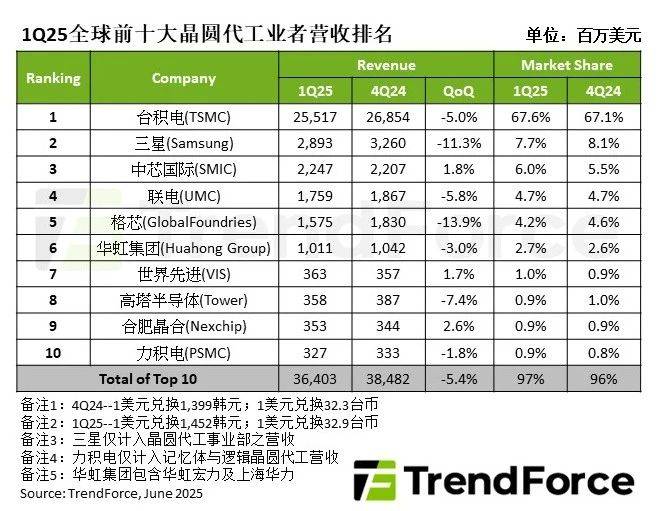
Core Viewpoint - The global wafer foundry market revenue is expected to decline by approximately 5.4% quarter-on-quarter to $36.4 billion in Q1 2025, influenced by international market conditions and preemptive inventory stocking by various manufacturers [1] Group 1: Market Overview - The overall wafer foundry market revenue for Q1 2025 is projected to be $36.4 billion, down from $38.5 billion in Q4 2024 [2] - TSMC remains the market leader with a revenue of $25.5 billion and a market share of 67.6%, despite a 5% decline from the previous quarter [2][4] - Samsung's foundry revenue decreased by 11.3% to $2.89 billion, resulting in a market share drop to 7.7% [4] - SMIC's revenue increased by 1.8% to $2.25 billion, with a market share rise to 6% [4] - UMC's revenue fell by 5.8% to $1.76 billion, maintaining a market share of 4.7% [4] - GlobalFoundries experienced a significant revenue drop of 13.9% to $1.58 billion, with a market share of 4.2% [4] Group 2: Company Performance - Huahong Group's revenue decreased by 3% to $1.01 billion, with a market share of 2.7% [5] - VIS saw a revenue increase of 1.7% to $363 million, achieving a market share of 1% [5] - Tower Semiconductor's revenue declined by 7.4% to $358 million, with a market share of 0.9% [5] - Nexchip's revenue grew by 2.6% to $353 million, maintaining a market share of 0.9% [5] - PSMC's revenue decreased by 1.8% to $327 million, with a market share of 0.9% [5] Group 3: Future Outlook - The second quarter is expected to see a slowdown in momentum as the preemptive inventory stocking due to tariffs concludes, but the continuation of China's trade-in subsidy policy and upcoming smartphone launches are anticipated to drive demand [5]

全球晶圆代工TOP10,最新出炉!
Sou Hu Cai Jing· 2025-06-09 14:32
Core Insights - The global wafer foundry industry is expected to see a revenue decline of approximately 5.4% in Q1 2025, totaling $36.4 billion, influenced by international market conditions and seasonal factors [2][3] - The second quarter is anticipated to show revenue growth for the top ten foundries, driven by China's old-for-new subsidy policy, pre-launch inventory for new smartphone models, and stable demand for AI HPC [2] Company Performance - TSMC remains the market leader with a revenue of $25.5 billion in Q1 2025, a decrease of 5% quarter-over-quarter, holding a market share of 67.6% [3][4] - Samsung's foundry revenue fell by 11.3% to $2.89 billion, with a market share of 7.7%, primarily due to weak mobile chip demand and ongoing inventory adjustments [5] - SMIC reported a revenue increase of 1.8% to $2.25 billion, benefiting from customer pre-orders and domestic consumption subsidies, ranking third in the industry [6] - UMC's revenue decreased by 5.8% to $1.76 billion, maintaining its fourth position, with stable wafer shipments offsetting seasonal impacts [6] - GlobalFoundries experienced a revenue decline of 13.9% to $1.58 billion, while HuaHong Group ranked sixth with stable performance [7] - Vanguard's revenue increased by 1.7% to $363 million, moving up to seventh place, while Tower's revenue decreased by 7.4% to $358 million [7] - Nexchip's revenue grew by 2.6% to $353 million, ranking ninth, while PSMC's revenue slightly decreased by 1.8% to $327 million, placing it tenth [8] Market Trends - TSMC's advanced process technologies, particularly in AI and HPC, are driving revenue growth, with 3nm, 5nm, and 7nm processes contributing 73% of wafer sales [4] - AI chip demand is projected to be a significant growth driver for TSMC, with a forecasted 100% increase in AI accelerator chip sales in 2025 [4] - SMIC anticipates a revenue decline of 4% to 6% in Q2 2025, indicating a challenging market environment ahead [6]