晶圆代工

Search documents
国家大基金减持中芯国际和华虹公司
是说芯语· 2025-05-11 09:03
Core Viewpoint - The semiconductor industry is experiencing a divergence in performance between major players, with SMIC showing significant growth while Hua Hong Semiconductor faces challenges due to increased competition and operational pressures [3][4][9]. Group 1: Financial Performance - SMIC reported a revenue of 16.301 billion yuan, a year-on-year increase of 29.44%, and a net profit of 1.356 billion yuan, reflecting a substantial growth driven by the demand for 12-inch wafers and the release of capacity in mature processes [3]. - Hua Hong Semiconductor's revenue grew by 18.66% to 3.913 billion yuan, but its net profit plummeted by 89.73% to 22.76 million yuan, indicating severe pressure in the mature process segment [4]. Group 2: Market Reactions - The market reacted negatively to the financial disclosures and shareholder reduction, with SMIC and Hua Hong's stock prices dropping by 7% and over 11% respectively [2][8]. - The reduction of holdings by major shareholders, including the National Integrated Circuit Industry Investment Fund, has raised concerns about the future prospects of these companies [5][7]. Group 3: Strategic Insights - SMIC's focus on advanced process breakthroughs, particularly in 14nm and below, is crucial for its future growth, with a planned capital expenditure of $7.5 billion (approximately 54.4 billion yuan) for 2025, 70% of which will be allocated to advanced process R&D [3][9]. - Hua Hong Semiconductor faces the challenge of maintaining its competitive edge in specialty processes while needing to extend into more advanced processes like 40nm to capitalize on opportunities in automotive electronics [4][9]. Group 4: Industry Context - The semiconductor sector is currently in a cyclical fluctuation phase, with uncertainties in market demand and intensified international competition impacting company performance [8]. - The contrasting situations of SMIC and Hua Hong Semiconductor highlight deeper contradictions within China's semiconductor industry, particularly regarding reliance on imported equipment for advanced processes [9].

一周概念股:国产晶圆代工双雄保持定力,面板行业进入平稳运行态势
Ju Chao Zi Xun· 2025-05-10 09:11
Group 1: Semiconductor Industry - SMIC achieved a record sales revenue of $2.2472 billion in Q1 2025, representing a year-on-year growth of 28.4%, with a gross margin remaining stable and an operating profit of $395.71 million, up 12,766.6% year-on-year [3] - For Q2, SMIC projects a revenue decline of 4% to 6% and a gross margin of 18% to 20%, indicating a mixed outlook for the second half of the year [3] - Hua Hong Semiconductor reported Q1 sales revenue of $540.9 million, a year-on-year increase of 17.6%, with a gross margin of 9.2%, up 2.8 percentage points year-on-year [4] - Hua Hong expects Q2 sales revenue to be between $550 million and $570 million, with a gross margin between 7% and 9%, amid uncertainties in customer demand and procurement costs [5] Group 2: Display Panel Industry - In May, domestic panel manufacturers increased production control and reduced utilization rates to stabilize prices, leading to a forecast of stable panel prices for the month [6] - Analysts believe that while end-market demand may experience temporary adjustments, domestic panel companies are well-prepared to respond through dynamic capacity adjustments and product optimization [6] - BOE indicated that the average utilization rate in the LCD industry has been above 80% since Q1 2025, but anticipates flexible adjustments in production lines in response to declining demand in Q2 [7] - The consolidation of the industry is accelerating, with BOE open to acquiring shares in Huacai and TCL completing the acquisition of LGD's Guangzhou factory, which will optimize the industry structure [7] Group 3: Automotive Industry - Geely Auto announced plans to fully merge with Zeekr Technology, aiming to enhance competitiveness in the smart electric vehicle sector through resource integration and cost reduction [8] - Post-merger, Geely's brands will maintain independent positioning while seeking collaborative development in technology, products, and supply chains [8] - Geely's chairman emphasized the importance of adapting to market competition and economic conditions to enhance innovation and profitability, creating long-term value in the global smart electric vehicle market [8]

6000亿芯片龙头,突然跳水大跌,发生了什么?多只高位股跳水,有公司公告:股价严重脱离公司基本面...
雪球· 2025-05-09 04:26
Market Overview - The market experienced fluctuations with the ChiNext index leading the decline, closing down 0.99% while the Shanghai Composite Index fell by 0.26% and the Shenzhen Component Index dropped by 0.84% [1] - The trading volume in the Shanghai and Shenzhen markets was 788 billion, a decrease of 21.6 billion compared to the previous trading day [1] Semiconductor Sector - The semiconductor sector faced a significant downturn, with Huahong Semiconductor dropping over 10% and SMIC falling more than 4% [2][4] - SMIC reported Q1 revenue of 16.301 billion, a year-on-year increase of 29.4%, and a net profit of 1.356 billion, up 166.5% year-on-year, attributed to increased wafer sales and optimized product mix [8] - However, SMIC anticipates a 4%-6% decline in Q2 revenue and a decrease in gross margin to 18%-20%, indicating cyclical pressures in the semiconductor industry [8] - Huahong Semiconductor's Q1 revenue was 3.913 billion, an 18.66% year-on-year increase, but net profit plummeted by 89.73% to 22.763 million [8] High-Position Stocks - Several high-position stocks experienced sharp declines, including Zhongyida, which hit the daily limit down, and Jinlong Electric, which fell over 11% [12][16] - Zhongyida's stock price surged 226.55% since March 10, but the company stated that there were no significant changes in its fundamentals, indicating potential overvaluation and short-term correction risks [16] Banking Sector - The banking sector showed resilience, with major banks like China Construction Bank reaching historical highs, and others like Qingdao Bank and Chongqing Bank rising over 2% [17] - Recent announcements from banks such as China Merchants Bank and CITIC Bank regarding the establishment of financial asset investment companies (AIC) signal a strategic move to support equity investments in technology firms [20] - Analysts suggest that the establishment of AICs is part of a broader financial policy aimed at stabilizing the market and enhancing long-term capital inflow, which could benefit the banking sector amid economic uncertainties [20]

华虹公司第一季度营收同比增长18.66% 今年有望释放更多产能
Zheng Quan Ri Bao Wang· 2025-05-09 03:04
Core Viewpoint - Huahong Semiconductor reported a strong performance in Q1 2025, with significant revenue growth driven by increased wafer shipments and a robust demand for flash memory products [1][2]. Financial Performance - In Q1 2025, Huahong achieved revenue of 3.913 billion yuan, a year-on-year increase of 18.66% [1]. - The net profit attributable to shareholders was 22.76 million yuan, while the net profit excluding non-recurring items was 16.10 million yuan [1]. - The gross margin for Q1 2025 was 9.2%, supported by improved capacity utilization, despite some offset from increased depreciation expenses [2]. Market and Industry Trends - The global wafer foundry industry is expected to grow at a rate of 20% in 2025, driven by strong AI demand and a gradual recovery in non-AI semiconductor applications [2][3]. - Counterpoint Research reported that the wafer foundry industry closed 2024 with a 22% annual growth rate, indicating a strong market outlook [2]. Demand and Capacity Development - The demand for AI applications is a significant driver of industry growth, alongside a recovery in traditional consumer electronics and automotive markets [3]. - Huahong's production capacity is entering a ramp-up phase, with three 8-inch wafer fabs in Shanghai and two leading 12-inch specialty wafer fabs in Wuxi, including the world's first 12-inch power device foundry line [3]. - The company plans to gradually release more capacity from its manufacturing projects, enhancing its ability to meet customer demands [3]. R&D Investment - In Q1 2025, Huahong's R&D investment totaled 477 million yuan, a year-on-year increase of 37.21%, representing 12.19% of its revenue [2].
两大晶圆代工巨头披露一季报:中芯国际净利润大涨,华虹公司增收不增利
Mei Ri Jing Ji Xin Wen· 2025-05-08 12:33
Group 1 - Core viewpoint: The performance of major domestic foundries, SMIC and Hua Hong, shows contrasting trends in Q1 2025, with SMIC experiencing significant growth while Hua Hong faces a sharp decline in net profit [1][2] - SMIC reported Q1 2025 revenue of 16.301 billion, a year-on-year increase of 29.4%, and a net profit of 1.356 billion, up 166.5% [1] - SMIC's EBITDA for Q1 2025 was 9.245 billion, reflecting a growth of 46.9% year-on-year, with a capacity utilization rate of 89.6%, up from 80.8% in the same period last year [1] Group 2 - Hua Hong's Q1 2025 revenue was 3.913 billion, an increase of 18.66%, but its net profit fell to 22.763 million, a decrease of 89.73% [1] - Hua Hong's gross margin for Q1 2025 was 9.2%, significantly lower than SMIC's gross margin of 22.5% [1] - Hua Hong's president stated that the company is seeing steady revenue growth and optimizing its product structure, with capacity utilization remaining full [2]
【美股盘前】三大期指齐涨;国际金价跳水,日内跌超1%;加密货币股普涨,比特币逼近10万美元
Mei Ri Jing Ji Xin Wen· 2025-05-08 09:33
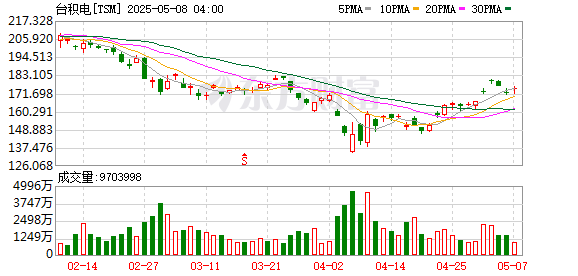
Group 1 - Major stock index futures are rising, with Dow futures up 0.72%, S&P 500 futures up 0.96%, and Nasdaq futures up 1.32% [2] - Bitcoin approaches $100,000 for the first time since February, leading to a pre-market surge in cryptocurrency stocks, including Coinbase Global up 4.28%, Bitfarms up 2.9%, and Strategy up 5.25% [2] - Intel shares rise over 3% in pre-market trading as reports indicate negotiations with Nvidia and Google for wafer foundry services, and Microsoft has placed chip design orders for Intel's 18A process [2] Group 2 - Gold prices have dropped over 1%, with COMEX gold latest at $3351.9 per ounce, down 1.18% from the day's high, amid expectations of a trade agreement announcement between the US and UK [2] - Morgan Stanley reports that the recent appreciation of the New Taiwan Dollar has limited negative impacts on TSMC, maintaining an "overweight" rating, with TSMC shares up over 1% in pre-market [2][3] - Toyota forecasts a more than 34% decline in net profit for the fiscal year 2025 due to the impact of US tariff policies [3] - Arm, a subsidiary of SoftBank, sees its shares drop over 10% in pre-market trading after its earnings guidance falls short of expectations, with projected revenue for Q1 2025 between $1 billion and $1.1 billion, below analyst estimates of $1.1 billion [3] - Boeing plans to deliver the new "Air Force One" aircraft by 2027, after delays due to labor shortages and supply chain issues, with a contract value of $3.9 billion awarded in 2018 [3]
新台币汇率攀升,晶圆代工利润率承压
Sou Hu Cai Jing· 2025-05-08 09:22
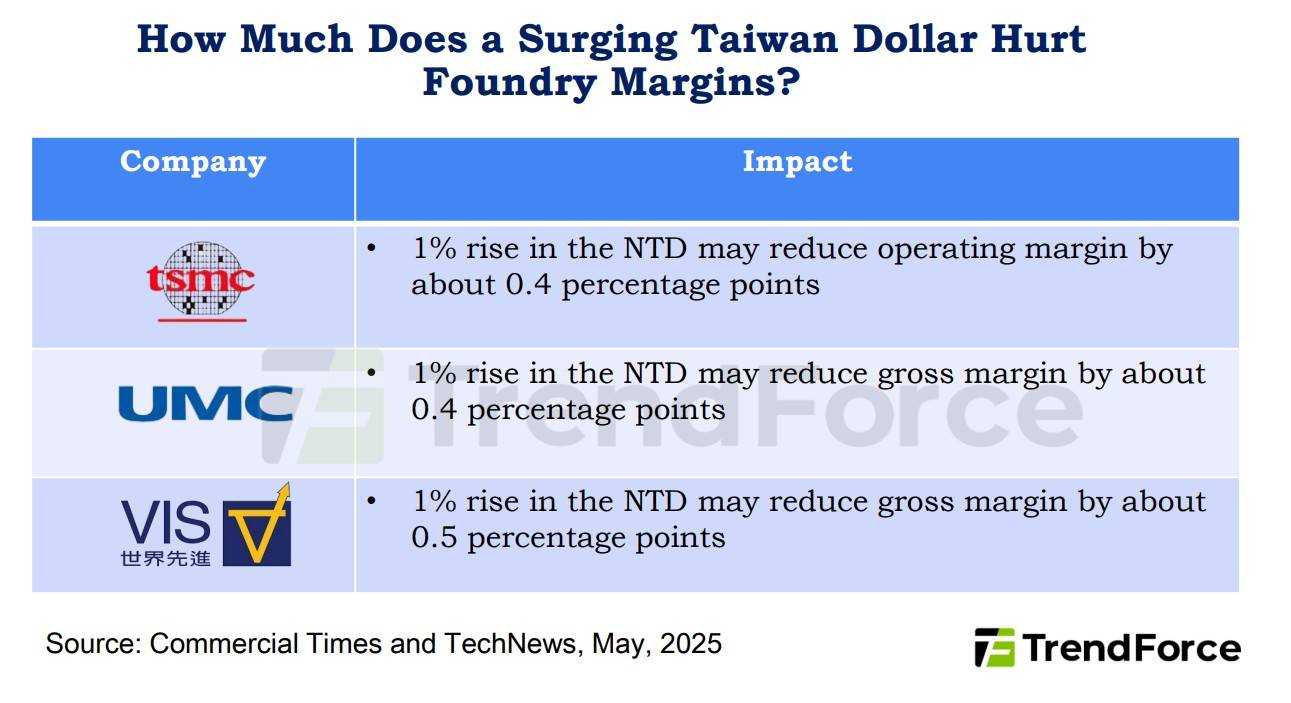
Group 1 - The significant appreciation of the New Taiwan Dollar (NTD) raises concerns about its negative impact on Taiwan's semiconductor industry, particularly for foundries like TSMC, UMC, and Vanguard [1] - A report indicates that for every 1% increase in the NTD, the gross margin of foundries typically decreases by 0.3% to 0.5%, suggesting a potential 3% to 5% hit to profit margins due to a 10% rise in the NTD since early Q2 [1][2] - Vanguard International Semiconductor Corporation (VIS) forecasts moderate growth for Q2, with demand for communication, industrial, and automotive semiconductors recovering [1] Group 2 - Assuming an exchange rate of 30.9 NTD to USD, VIS expects silicon wafer shipments to grow by 3% to 5% compared to the previous quarter, but gross margin is projected to decline from 30.1% in Q1 to between 27% and 29% [2] - UMC estimates that a 1% rise in the NTD will reduce its gross margin by approximately 0.4 percentage points, while World Advanced's gross margin may decrease by about 0.5 percentage points for the same rise [2][4] - TSMC predicts Q2 consolidated revenue of $28.4 to $29.2 billion, with a gross margin of 57% to 59% and an operating margin of 47% to 49%, but further appreciation of the NTD could pressure these margins [2] Group 3 - TSMC has not adjusted its guidance for Q2 or the full year in response to currency impacts and is closely monitoring exchange rate trends [3] - TSMC has requested its suppliers to submit cost reduction plans to mitigate the effects of the strong NTD [3]


中芯国际Fab厂布局
是说芯语· 2025-04-27 03:19
申请入围"中国IC独角兽" 半导体高质量发展创新成果征集 成熟制程(45nm及以上):占公司产能的75%以上,广泛应用于消费电子、汽车电子、物联网等领域。先进制程(28nm及以下):包括14nm FinFET工 艺及等效7nm的N+1技术(受美国制裁影响,先进制程量产受限)。8英寸晶圆:主要用于模拟、功率器件等特色工艺,月产能超23万片。12英寸晶圆: 聚焦先进工艺和高附加值产品,2025年总产能预计突破50万片/月。 在 Fab 厂布局方面,中芯国际在国内多个地区建立了生产基地,构建起庞大且完善的制造网络。 上海地区 上海张江 fab1 :中芯国际起家的地方,也是中国最先进的工艺研发、生产基地。fab1包括了fab1-p1、p2、p3、so1四个洁净室,以前也叫一厂、二厂、三 厂等,so1是洁净室车间+办公室,过去作为8寸0.15umbcd工艺研发及产业化的基地。 上海张江 fab8 :包括fab8p1、fab8p2、fab8p3。其中fab8p1又包括p1a、p1b、p1c,fab8p1a过去叫fab8,之前量产过12英寸工艺,最高到45nm,后来增加 了掩膜版生产线,目前主要生产掩膜版;fab8p1b过 ...

台积电,赢麻了
半导体行业观察· 2025-04-22 00:49
Core Viewpoint - In 2024, TSMC has solidified its position as a leader in the semiconductor industry, driven by the explosive demand for AI-related chips, achieving significant growth in revenue and profitability while expanding its global strategic footprint [1][2][3]. Financial Performance - TSMC's consolidated revenue for 2024 reached $90 billion, a 30% increase year-on-year, with a net profit of $36.5 billion, reflecting a substantial growth of 35.9% [2]. - The gross margin was reported at 56.1%, and the operating margin reached 45.7%, both marking historical highs for the company [2]. Market Position and Client Base - TSMC holds a 34% market share in the IDM 2.0 industry, up from 28% in 2023, reinforcing its leadership in the foundry sector [2]. - The company provided 288 different process technologies to 522 clients, producing 11,878 different products, showcasing a highly diversified client base [3]. Product and Technology Development - Revenue from advanced processes of 7nm and below increased to 69%, significantly higher than the previous year's 58%, driven by demand in AI and high-performance computing [3]. - TSMC's revenue distribution by product platform shows high-performance computing products accounting for 51%, smartphones 35%, IoT 6%, automotive electronics 5%, and consumer electronics 1% [4]. Global Capacity Expansion - TSMC has established four GIGAFAB fabs in Taiwan, with an annual capacity exceeding 12.74 million 12-inch wafers, covering multiple technology nodes from 0.13 microns to 3 nanometers [13]. - The company has also made significant progress in its global manufacturing footprint, including a new fab in Arizona, USA, and a special process fab in Kumamoto, Japan [13][14]. Research and Development - TSMC invested 7.1% of its revenue in R&D in 2024, leading the foundry sector and surpassing many international tech giants [16]. - The company made key advancements in its 2nm platform, completing process definitions and entering yield improvement stages [16]. Advanced Packaging and Integration Technologies - TSMC's TSMC 3DFabric technology platform is crucial for performance enhancement in the post-Moore's Law era, focusing on system integration and advanced packaging solutions [17]. - The CoWoS technology family has been widely adopted in high-performance computing markets, particularly for integrating SoCs and high-bandwidth memory [19]. Emerging Technologies - TSMC is actively exploring new materials and extreme miniaturization techniques, including breakthroughs in carbon nanotube transistors and two-dimensional materials for future logic devices [23][24]. - The company is also developing new storage components optimized for AI edge devices, showcasing a commitment to innovation in high-density and energy-efficient storage solutions [25].
这类芯片,需求强劲
半导体芯闻· 2025-04-21 10:20
Core Viewpoint - Despite increasing macroeconomic uncertainties, TSMC maintains its advanced packaging investment plans based on the strong expected demand for AI semiconductors in the medium to long term [1][2]. Group 1: TSMC's Investment and Strategy - TSMC announced a capital expenditure (CapEx) of $38 billion to $42 billion for this year, maintaining its investment plans despite uncertainties in AI infrastructure investment due to low-cost AI models and tariff pressures from the U.S. [1] - TSMC expects a compound annual growth rate (CAGR) of 45% for AI accelerator-related sales from 2024 to 2029, with this year's sales projected to double compared to last year [2]. Group 2: Advanced Packaging and HBM Demand - TSMC plans to double its CoWoS (Chip on Wafer on Substrate) capacity to 70,000 units per month, which is crucial for high-performance AI accelerators and HBM [2]. - The expansion of advanced packaging investments benefits the HBM memory industry, with companies like SK Hynix supplying HBM to major cloud service providers and AI leaders like NVIDIA [2]. Group 3: HBM Market Dynamics - SK Hynix aims to increase the proportion of its 12-layer products to over half of its total HBM3E shipments in the first half of this year, indicating a strong focus on high-value HBM production [3]. - Samsung and Micron are also expanding their HBM businesses, with Samsung developing an improved version of HBM3E and Micron completing the development of 12-layer HBM3E [3].