
脑机接口

Search documents
喜娜AI速递:今日财经热点要闻回顾|2026年1月16日
Xin Lang Cai Jing· 2026-01-16 11:52
Group 1 - Xibei's Vice President has resigned, and 102 stores will close nationwide, affecting approximately 4,000 employees, due to previous losses exceeding 500 million [2][7] - Central University of Finance and Economics' He Qiang warns of excessive speculation in the stock market, suggesting regulatory measures to prevent a "crazy bull" market [2][7] - Muyuan Foods expects a net profit of 15.1 to 16.1 billion yuan for 2025, with a significant reduction in production costs and plans for international expansion [2][7] Group 2 - Some brokerage firms face a shortage of margin trading quotas, leading to a potential slowdown in leveraged investments as the financing balance exceeds 2.6 trillion yuan [3][8] - Nvidia has lowered its copper demand forecast from 500,000 tons to 200 tons, causing a nearly 3% drop in copper prices, indicating a shift in market expectations [3][8] - A-shares show three signals indicating a cooling market, with a focus on maintaining a "slow bull" market through regulatory actions [3][8] Group 3 - Brain-computer interface company NaoHu Technology has begun construction of a "super factory," indicating a move towards large-scale production in the sector, with related stocks seeing increased investment [4][9] - The China Securities Regulatory Commission has outlined tasks for 2026, focusing on market stability, regulatory enforcement, and promoting company development [4][10] - CITIC Securities predicts an influx of 1.5 trillion yuan in new capital for A-shares in 2026, supporting a slow bull market [4][10] Group 4 - Multiple A-share companies have reported positive earnings forecasts for 2025, with SAIC Motor expected to see a profit increase of 438% to 558%, reflecting a recovery in industry conditions [5][10]

A股脑机接口概念风起:十日涨出千亿市值,多只个股坐上“过山车”
Bei Ke Cai Jing· 2026-01-16 11:29
Core Viewpoint - The brain-computer interface (BCI) sector in the A-share market has shown significant activity at the beginning of 2026, with a cumulative increase of 18.04% in the BCI theme index as of January 16, 2026, indicating a strong interest and potential for commercialization in this emerging industry [2][4]. Industry Overview - The BCI industry is projected to reach a market size of trillions, transitioning from laboratory research to commercial applications, driven by advancements in technology and supportive government policies [3]. - The Ministry of Industry and Information Technology and other departments have emphasized the importance of BCI in their strategic plans, including its inclusion in the "14th Five-Year Plan" for future industrial development [3]. Market Performance - As of January 16, 2026, the total market capitalization of 26 listed companies in the BCI sector has increased by approximately 108.7 billion yuan over ten trading days [8]. - Notable companies like Innovation Medical and Meihua Medical have experienced significant stock price fluctuations, reflecting the volatile nature of the market and investor sentiment towards BCI technologies [5][7]. Company Developments - Innovation Medical's subsidiary, Boling Brain Machine Technology, has launched products aimed at rehabilitation for stroke patients, although it reported operating losses of 6.6 million yuan and 8.66 million yuan in 2023 and 2024, respectively [6]. - Meihua Medical, a leader in cochlear implants, is actively collaborating with BCI clients to facilitate the transition from laboratory research to commercial production, highlighting the interconnectedness of BCI and existing medical technologies [7]. Strategic Collaborations - Companies like Yahui Long and Shenzhen Brain Machine Star Chain Technology have entered strategic partnerships to develop BCI-related products, aiming to enhance diagnostic and treatment capabilities in central nervous system diseases [9]. - Aipeng Medical is also expanding its business into BCI applications, focusing on pain management and sleep disorders, indicating a broader trend of diversification within the medical device sector [9]. Technical Insights - The core technological barriers in the BCI industry are concentrated in the upstream supply chain, including hardware components and surgical techniques, with significant potential for growth in domestic market penetration and localization [10].



四中全会精神在基层|一间实验室,何以攀登“脑机接口”高峰?
Xin Hua She· 2026-01-16 11:15
Core Insights - The Tianjin University Brain-Machine Interaction and Human-Machine Integration Haihe Laboratory has developed a wearable device called "Shengong-Lingxi Finger," which allows users to control it using their thoughts, aiding in rehabilitation for patients with motor function impairments [1][2] - The laboratory focuses on non-invasive brain-machine interface technology and aims to drive technological innovation and industrial application, particularly in aerospace and rehabilitation medicine [1][2] - The laboratory has established a special fund targeting a scale of 10 billion yuan for the development of the brain-machine interface industry, indicating a strong commitment to integrating technological innovation with industrial practices [3] Research and Development - The laboratory has assembled a research team covering various aspects of brain-machine interfaces, human-computer interaction theories, device systems, and application transformations, emphasizing the importance of aligning research with market needs [2] - The laboratory is exploring the potential of brain-machine interfaces and aims to implement the spirit of the 20th National Congress of the Communist Party of China by promoting the transformation of cutting-edge scientific achievements [2] - The laboratory is advancing a new technology branch called on-chip brain-machine interfaces, which is expected to contribute to the development of mixed intelligence and brain-like computing [2] Industrialization Efforts - The laboratory has incubated Tiankai Suishi (Tianjin) Intelligent Technology Co., which has been recognized as a national high-tech enterprise and a technology-based small and medium-sized enterprise [3] - The laboratory's efforts align with the "14th Five-Year Plan" that emphasizes the deep integration of technological and industrial innovation, positioning the laboratory as a catalyst for industrial transformation [3]
融资18亿!奥特曼杀入马斯克脑机地盘
Sou Hu Cai Jing· 2026-01-16 10:51
Group 1 - Sam Altman, CEO of OpenAI, has successfully raised $252 million (approximately 1.8 billion RMB) in seed funding for Merge Labs, a brain-computer interface company, significantly exceeding the early funding scale of most neurotechnology companies [2][3] - Merge Labs is focusing on a non-invasive technology approach, utilizing ultrasound and other methods to send and receive information without implanting electrodes in the brain, contrasting sharply with Elon Musk's invasive strategy with Neuralink [2][3] - The competition between Altman and Musk in the brain-computer interface sector represents a broader trend in the global brain-computer interface industry, which is experiencing rapid growth due to technological breakthroughs, supportive policies, and increased capital investment [6][9] Group 2 - OpenAI is the largest investor in Merge Labs' recent funding round, indicating a potential integration of OpenAI's core algorithms with brain-computer interface technology, which distinguishes Merge Labs from other companies in the field [4] - Merge Labs aims to connect biological intelligence with artificial intelligence to maximize human capabilities and experiences, developing a new paradigm of brain-computer interfaces for high-bandwidth interaction with advanced AI [4] - The global brain-computer interface market is projected to grow from approximately $2.62 billion in 2024 to $12.4 billion by 2034, with China's market expected to increase from 3.2 billion RMB in 2024 to 5.58 billion RMB by 2027, reflecting a compound annual growth rate of about 20% [6]


财经聚焦丨2026年地方国企改革发展路线图明确
Xin Hua Wang· 2026-01-16 10:22
Group 1 - The core focus of the meeting held by the State-owned Assets Supervision and Administration Commission (SASAC) is to enhance the technological innovation capabilities of state-owned enterprises (SOEs) and deepen the reform of state-owned assets and enterprises [1][3] - Local SOEs are increasingly strengthening technological innovation through various initiatives, such as establishing public welfare funds for research and forming partnerships with educational institutions [1][3] - SASAC emphasizes the need for SOEs to improve their innovation capabilities, particularly in the context of rapid technological changes and shorter industry iteration cycles [1][3] Group 2 - SASAC Director Zhang Yuzhuo highlighted the importance of creating high-value application scenarios and enhancing the procurement of first-time equipment and materials to accelerate the iteration of new technologies and products [3][5] - There is a strong push for optimizing the layout and structure of state-owned enterprises, with examples including the establishment of intelligent coal mines and the development of strategic emerging industries [3][4] - The focus on traditional industries includes promoting high-end, intelligent, and green development, with a particular emphasis on artificial intelligence as a key variable [5][6] Group 3 - The meeting outlined the key tasks for 2026, which include improving the modern enterprise system with Chinese characteristics and clarifying the responsibilities of governance bodies [8] - There is a call for deepening market-oriented operational mechanisms and enhancing the effectiveness of incentive policies for technology-driven enterprises [8][9] - The transformation of organizational structures is encouraged, with a focus on creating agile and efficient innovative organizations to adapt to the knowledge economy [9]

马斯克领衔,脑机接口商业化元年来了?
Tai Mei Ti A P P· 2026-01-16 08:14
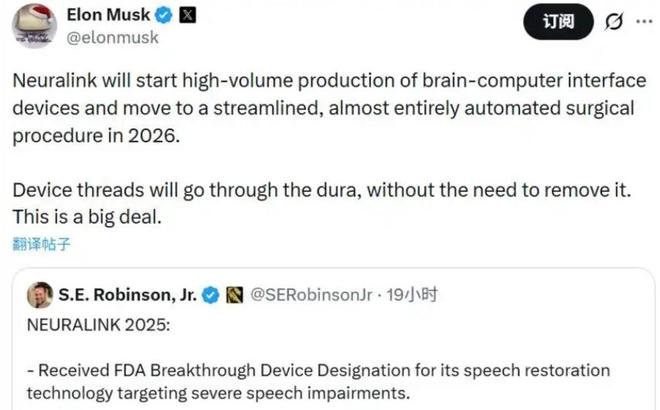
Core Insights - The announcement by Elon Musk regarding Neuralink's plans for large-scale production and fully automated surgeries in 2026 marks a significant step towards the commercialization of brain-machine interfaces (BMIs) [1][2] - The excitement in global capital markets is evident, with related stocks in the A-share market experiencing significant gains, indicating a strong investor interest in the BMI sector [2] Group 1: Technological Advancements - Neuralink is leading the invasive BMI sector by integrating AI into the entire process, significantly reducing surgery time from 6-8 hours to approximately 30 minutes, which is described as a "production line" approach [3][4] - The R1 surgical robot developed by Neuralink utilizes AI for real-time navigation, achieving micro-level precision in electrode placement, thus minimizing surgical trauma [3] - Neuralink's devices can decode neural signals with over 95% accuracy, allowing paralyzed individuals to perform tasks like gaming and social media interaction using only their thoughts [4] Group 2: Competitive Landscape - Chinese companies are exploring different technical routes in the BMI space, with firms like Boryeong and BrainTiger focusing on semi-invasive and flexible electrode technologies to balance signal quality and safety [5][6] - Boryeong's NEO system has successfully completed surgeries on 36 spinal injury patients, demonstrating the potential for restoring motor functions [5] - BrainTiger has made strides in real-time Chinese language decoding, achieving a 71.5% accuracy rate in clinical trials, showcasing advanced capabilities in high-level brain function decoding [6] Group 3: Market Challenges - Despite the technological advancements, the BMI industry faces significant hurdles in transitioning from innovative technology to a mature business model, with current clinical trials being limited in scope [7][8] - The market for BMIs is highly specialized, targeting severe neurological conditions, which may limit its immediate commercial viability [8] - The long-term reliability of implanted devices is a concern, as immune responses can lead to signal degradation, posing challenges for sustained use [9] Group 4: Ethical and Regulatory Considerations - The collection and use of neural data raise ethical questions regarding privacy and data security, with a lack of established regulations in place [10][11] - The potential for misuse of technology and risks associated with hacking highlight the need for a robust ethical framework to guide the commercialization of BMIs [10][11] - The balance between investor enthusiasm and the practical realities of the BMI market will be crucial for the industry's future [11]
2026投资风口解析:“0到1”的刺激与“1到N”的确定性
Mei Ri Jing Ji Xin Wen· 2026-01-16 06:52
Core Viewpoint - The article discusses the investment opportunities and risks associated with emerging sectors in 2026, emphasizing the importance of identifying "wind" sectors for investment strategies [1][2]. Group 1: Investment Phases - Industries typically progress through three stages: "0 to 1," "1 to n," and "n+," with the first two stages being critical for identifying investment opportunities [1]. - The "0 to 1" stage is characterized by rapid growth but high uncertainty, while the "1 to n" stage represents a more stable growth phase [2]. Group 2: Current "0 to 1" Opportunities - Current sectors in the "0 to 1" phase include commercial aerospace, brain-computer interfaces, and solid-state batteries, which are still in early development stages [1][2]. - The brain-computer interface market is limited, with a potential global market size of only a few billion dollars, yet companies in this space have valuations exceeding this potential [2]. Group 3: Transition to "1 to n" - Successful transition from "0 to 1" to "1 to n" can lead to super wind sectors, but failure to transition can result in investment losses [2]. - Artificial intelligence is highlighted as a sector currently in the "1 to n" phase, with significant growth potential and lower uncertainty compared to "0 to 1" sectors [3][4]. Group 4: AI and Computing Power - In the AI sector, focus should be on upstream computing power, which is essential for AI applications [5]. - The demand for computing power is expected to grow exponentially, driven by major tech companies deploying large-scale computing clusters [6]. Group 5: Semiconductor Equipment - The semiconductor equipment ETF (159516) has seen significant price increases due to advanced process expansions and rising storage prices [8]. - The growth in the semiconductor sector is linked to the need for advanced manufacturing equipment, particularly for high-performance storage chips [8][9]. Group 6: Future Trends - The "光入柜内" (optical integration into cabinets) trend is anticipated to expand the market size for optical modules significantly by 2027 [7]. - The semiconductor industry is advised to focus on upstream equipment and materials, as these areas are likely to benefit first from industry expansion [7].

OpenAI砸巨资投脑机接口,Altman又要和马斯克较量了
Hua Er Jie Jian Wen· 2026-01-16 04:09
Core Insights - Merge Labs, co-founded by OpenAI CEO Sam Altman, has raised $252 million in funding, with OpenAI as the largest investor, aiming to develop brain-computer interface devices to seamlessly connect humans with AI [1] - The funding round was led by Bain Capital, with other investors including Gabe Newell, co-founder of Valve Corporation [1] - Merge plans to initially focus on medical applications before expanding to consumer products, although it has not disclosed its valuation [1] Company Overview - Merge aims to develop non-invasive brain-computer interface devices, differentiating itself from competitors like Neuralink, which focuses on invasive implants [2] - The company is positioned as a research lab to tackle complex scientific and engineering challenges associated with high-bandwidth devices that can process large amounts of data [2] - Merge currently has fewer than 50 employees and is planning to continue hiring, without a designated president or CEO [5] Competitive Landscape - The launch of Merge intensifies the competition between Altman and Elon Musk, who were once close business partners and co-founders of OpenAI [3] - Musk founded Neuralink in 2016 to develop implantable devices aimed at enhancing human capabilities and preventing obsolescence in the age of AI [4] Industry Dynamics - The brain-computer interface sector has seen rapid growth, with over $2 billion in funding in the U.S., driven by advancements in AI that provide the necessary computational power for brain implants [5] - Companies are exploring non-surgical products, such as external headsets, which are perceived as more attractive to consumers [5]
OpenAI押注CEO奥特曼脑机公司Merge Labs,与马斯克Neuralink正面交锋
Huan Qiu Wang· 2026-01-16 03:19
Group 1 - OpenAI has made a controversial investment by leading a $250 million seed round in Merge Labs, valuing the company at $850 million, which focuses on non-invasive brain-computer interface technology [3] - Merge Labs aims to integrate biological intelligence with AI, contrasting with Neuralink's invasive surgical approach, and is positioned to enhance human capabilities [3][4] - The investment intensifies competition in the brain-computer interface sector, with Neuralink having a $9 billion valuation and focusing on medical applications, while Merge Labs adopts a Silicon Valley-style vision of "superhuman" capabilities [3] Group 2 - The collaboration between OpenAI and Merge Labs creates a closed-loop business model, where Merge Labs can leverage OpenAI's foundational models and AI tools to accelerate development, potentially making their brain-computer interface products a natural entry point for OpenAI's software [3] - OpenAI's investment is expected to increase the valuation of Merge Labs, aligning the interests of Sam Altman, the CEO of OpenAI, with those of the startup [3]
爱朋医疗20260115
2026-01-16 02:53
Summary of Aipeng Medical Conference Call Company Overview - Aipeng Medical focuses on the commercialization of non-invasive brain-computer interfaces, particularly in intraoperative anesthesia monitoring, achieving over 10 million yuan in revenue. However, progress has been hindered by medical cost control measures, prompting the company to actively explore new applications [2][6]. Key Points and Arguments Revenue Projections - The company anticipates that new applications targeting treatment systems for refractory insomnia and multimodal ADHD could generate tens of millions of yuan in revenue by 2026, with 2027 potentially marking a turning point in performance, contingent on a solid commercialization foundation in hospitals [2][6]. Product Offerings and Market Penetration - Aipeng Medical's perioperative brain state monitoring product is available in approximately 20 provinces, charging around 300 yuan per session, and is not covered by medical insurance. Similar models are used for the refractory insomnia and pediatric ADHD treatment systems [2][7]. - The intraoperative anesthesia monitoring product has been adopted in over 100 hospitals, with a target of exceeding 200 by 2026. The refractory insomnia treatment system has partnered with two hospitals, while the pediatric ADHD treatment aims to cover the top 100 pediatric clinics in China [2][8]. Research and Development - A semi-invasive epilepsy warning product is in the prototype research phase, expected to have a prototype by the end of 2026 and enter animal clinical trials in 2027, collaborating with research institutions [2][9]. Strategic Partnerships - Aipeng Medical holds a stake in Ruishen An, a company focused on implantable neurostimulation devices, which has received 15 product certifications and is projected to exceed 100 million yuan in revenue by 2025, ranking among the top three to four in the domestic neurostimulation field [4][11]. Competitive Landscape - The company differentiates its strategy by focusing on pain, anesthesia, sleep, and attention disorders, contrasting with competitors that emphasize rehabilitation or motor imagery. Aipeng Medical plans to accumulate clinical validation through hospital channels before gradually promoting products to the consumer market [5][13]. - Non-invasive and semi-invasive brain-computer interface technologies each have their advantages. Non-invasive products are expected to commercialize rapidly within 2-3 years, while semi-invasive and fully implanted devices will become significant as technology advances and costs decrease [5][14]. Future Outlook - Aipeng Medical aims to enhance its stake in Ruishen An through share transfers, with expectations of results in the first half of the year, despite lengthy processes for state-owned capital exits [4][12]. - The company expects gradual recovery and stable growth in its pain management business by 2026, despite initial impacts from centralized procurement policies. The nasal care business faces challenges but is anticipated to rebound as the economy improves [15]. Additional Important Information - The company’s non-invasive products are currently not covered by medical insurance, which affects their market penetration and pricing strategy [7]. - Aipeng Medical's approach emphasizes building strong clinical data and partnerships with hospitals to establish a competitive edge in the medical field [14].