软件

Search documents
高盛推出“抗AI冲击”主题投资组合:做多算力与安全,做空可被替代的软件股35/64
美股IPO· 2026-02-14 04:12
Core Viewpoint - Goldman Sachs has launched a new software stock long-short portfolio, betting on companies that are less likely to be replaced by AI or that will benefit from the growth in AI demand, while shorting companies that may be automated or replaced internally due to AI advancements [1][3]. Group 1: Long Position - The long side of the portfolio focuses on companies that require physical execution, are heavily regulated, or need human accountability, which makes them less susceptible to AI disruption [3]. - Companies included in the long position are Cloudflare, CrowdStrike, Palo Alto Networks, Oracle, and Microsoft, which are expected to benefit directly from the rising adoption of AI [3][4]. Group 2: Short Position - The short side targets software-driven companies whose workflows may increasingly be automated or rebuilt internally due to AI capabilities. Companies in this category include Monday.com, Salesforce, DocuSign, Accenture, and Duolingo [3][4]. - The recent launch of AI tools by companies like Anthropic and Altruist has led to significant declines in the stock prices of legal and financial software firms, indicating a shift in market sentiment towards a defensive stance [4]. Group 3: Market Sentiment and Valuation - The recent sell-off has reset valuation levels, with the price-to-earnings ratio for software stocks dropping from approximately 51 times a year ago to about 27 times currently [5]. - Despite the decline in valuations, earnings expectations remain stable, with the software and services sub-sector projected to achieve around 14.1% earnings growth by 2026, which is lower than the overall tech sector's expected growth of 31.7% but still above the S&P 500's 13.7% growth forecast [5].



书讯 |《科技共和国》:美国和西方未来数十年的战略走向
Xin Lang Cai Jing· 2026-02-14 04:05
Core Argument - The book "The Technological Republic" discusses the strategic direction of the U.S. and the West for the coming decades, highlighting concerns over technological transformation and geopolitical competition [1][3]. Group 1: Critique of Current State - The author criticizes the U.S. elite's loss of direction in technology and innovation, stating that Silicon Valley has lost its way and that American technological innovation has become "hollowed out" over the past two decades [3][4]. - The book argues that the U.S. has failed to establish a clear collective identity or value system, leading to a crisis of purpose and direction among its elite [5][6]. - The author condemns the "technological neutrality" perspective, asserting that many talented individuals have moved away from critical areas that impact collective welfare and national defense [5][6]. Group 2: Structure of the Book - The book is divided into four parts: "The Software Century," "The Hollowing Out of the American Spirit," "Engineering Thinking," and "Rebuilding the Technological Republic," comprising 18 chapters [4][7]. - In "The Software Century," the author posits that the era of nuclear deterrence is ending, and a new deterrent age based on artificial intelligence is emerging, which will dominate future wars [4][7]. - The second part analyzes the cultural decline in the U.S. and the West, attributing it to internal crises of spirit and identity [5][6]. Group 3: Call for Action - The author emphasizes the need for Silicon Valley to engage with public service and national missions, arguing that technology should be a force for rebuilding collective beliefs and national direction [7][8]. - The book suggests that the U.S. must integrate "engineering thinking" into its governance to transition from the atomic age to the algorithmic age [7][8]. - The author calls for a re-establishment of national culture and values to foster collective identity and shared goals, warning against the current "innovation desert" in various sectors [7][8]. Group 4: Future Implications - The core argument throughout the book is that the software industry must rebuild its relationship with the government and redirect its resources towards developing technological and AI capabilities to address pressing national challenges [8][9]. - The author posits that the future global competition will center on institutional, technological, and national will, rather than mere market competition [9][10]. - The book provides insights into understanding the evolution of global power dynamics over the next twenty years, emphasizing that AI will reshape industry landscapes and international order [9][10].

“我们正在目睹一场AI创造性破坏席卷全球各行各业”!高盛合伙人:本质上,这是一次“护城河检查”
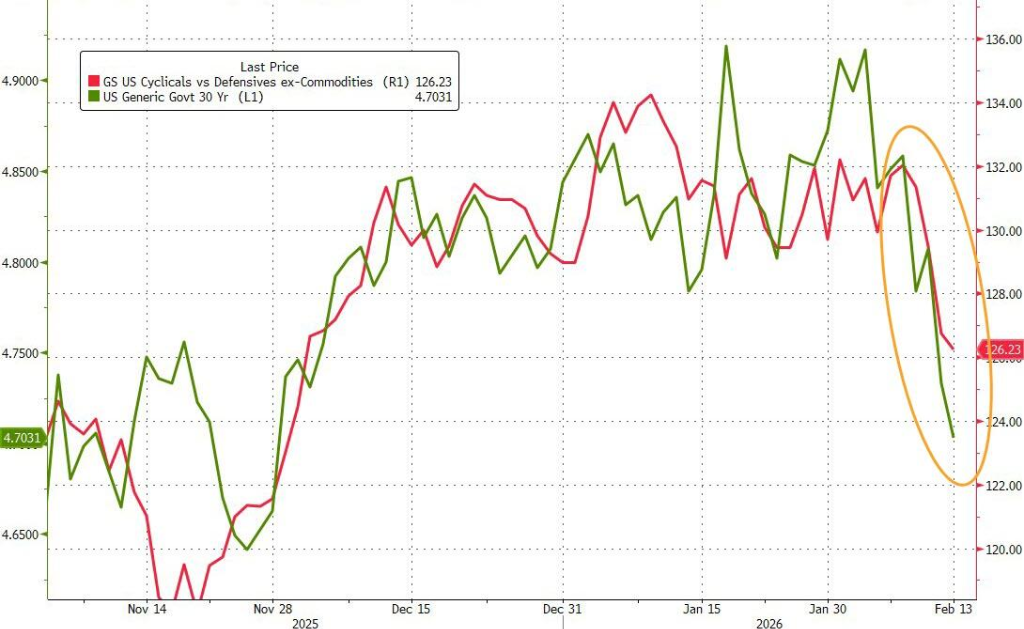
Hua Er Jie Jian Wen· 2026-02-14 03:24
Core Insights - A wave of "creative destruction" driven by artificial intelligence (AI) is testing the competitive advantages of companies across various industries, with significant impacts observed in sectors such as software, insurance, wealth management, real estate services, and logistics [1][2][4][5] Group 1: Market Dynamics - The sentiment of "sell first, ask questions later" is spreading in the market, leading to accelerated sell-offs, primarily driven by AI concerns without clear catalysts [2] - Goldman Sachs estimates that Commodity Trading Advisors (CTAs) will sell between $1.5 billion to $2 billion worth of U.S. stocks in the coming week [2][14] - The software sector is experiencing valuation pressure, as AI is challenging traditional business models and undermining previously established competitive moats [3][5] Group 2: Valuation Concerns - Valuation multiples are difficult to anchor, and once they are questioned, it is hard to stop the downward trend; public company valuations have dropped from over 30 times earnings to just above 20 times [6] - The turmoil is spreading from public markets to private equity and private credit, particularly affecting the leveraged loan market [6] Group 3: Economic Signals - Recent market signals indicate a growth shock, with U.S. Treasury yields declining and cyclical stocks being sold off relative to defensive stocks [7][9] - The U.S. Consumer Price Index (CPI) for January showed a year-over-year increase of 2.4%, lower than expected, with core CPI at its lowest level in four years, reducing inflation concerns [9] Group 4: Investment Recommendations - Investors are advised to focus on companies with genuine competitive moats and tangible assets, as these are likely to perform better in the current environment [11][12] - The aerospace sector is seen as a favorable investment opportunity, particularly in companies like Airbus, while industrial stocks should be selected based on their benefit from the investment cycle [12] - Real estate investment trusts (REITs) in European residential properties are favored, while office REITs are advised against due to potential risks [12] Group 5: CTA Trigger Points - There is a need to monitor the CTA trigger points in major U.S. indices, with the Nasdaq 100 expected to experience the most severe sell-off [13][14] - The S&P 500 has fallen below its 50-day moving average and is approaching critical thresholds that could accelerate selling pressure [14]
新一轮俄美乌会谈即将举行!国内金属市场节前普遍收跌
Qi Huo Ri Bao· 2026-02-14 03:07
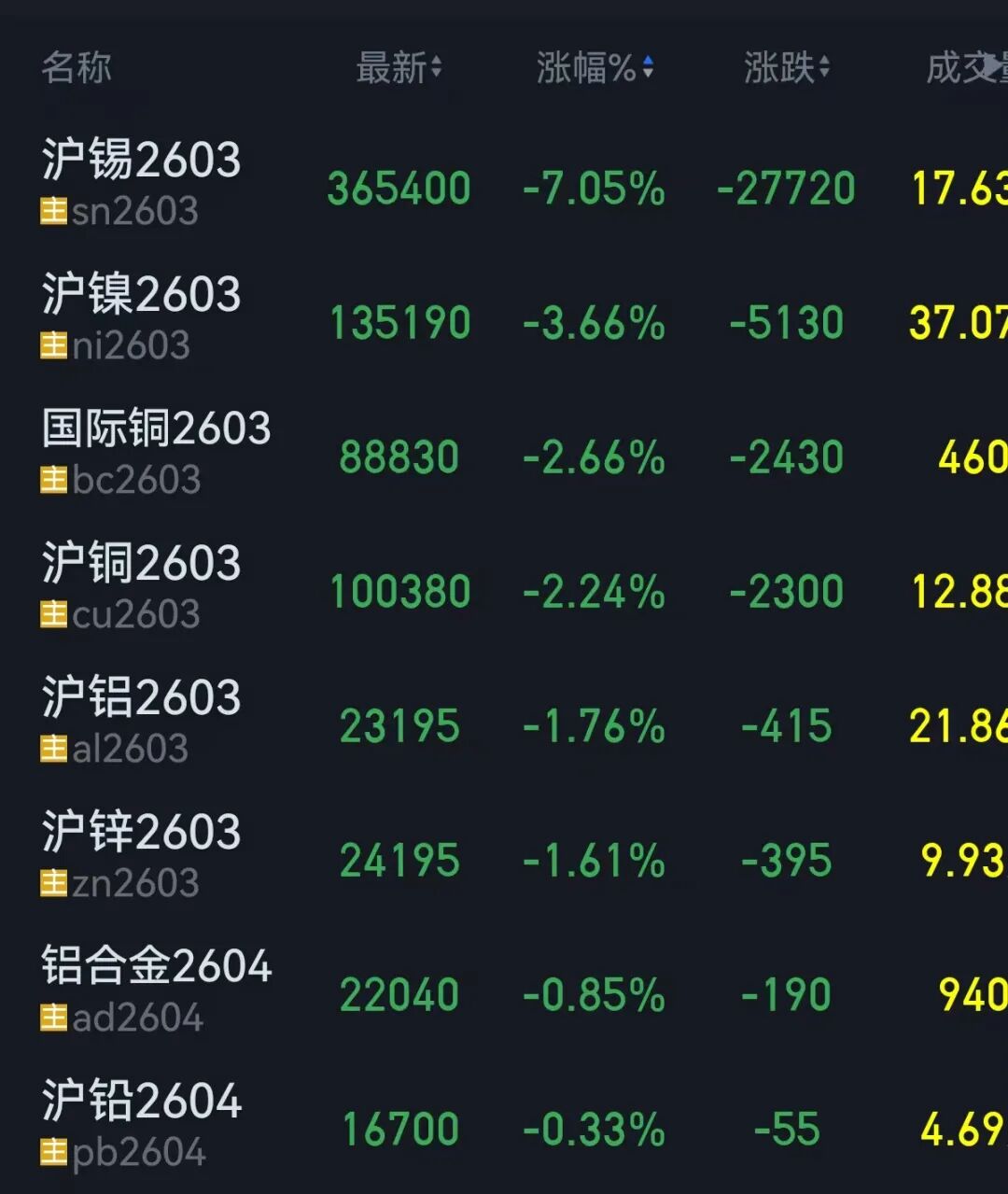
Market Performance - COMEX gold futures rose by 2.17% to $5050.50 per ounce, while COMEX silver futures increased by 1.98% to $77.180 per ounce [1] - The three major US stock indices closed mixed, with the Dow Jones up 0.10%, the Nasdaq down 0.22%, and the S&P 500 up 0.05% [1] - Major tech stocks like Apple and Nvidia fell over 2%, while Google and Meta dropped more than 1% [1] Domestic Metal Market - The domestic metal market saw a general decline before the Spring Festival, with significant drops in prices for tin and silver [3] - Shanghai gold futures fell by 1.61% to 1110.10 yuan per gram, while Shanghai silver futures dropped by 5.52% to 19782 yuan per kilogram [3] - The decline in gold and silver prices is attributed to weakened market sentiment and risk appetite, exacerbated by a significant drop in US stocks [3][4] Employment Data Impact - The US non-farm payroll data for January showed an increase of 130,000 jobs, significantly exceeding the market expectation of 70,000 [4] - This strong employment data has reduced the perceived necessity for the Federal Reserve to lower interest rates in the short term [4] - However, the total projected job growth for 2025 was revised down by 898,000, indicating that one month's data may not reflect a complete turnaround in the job market [4] Market Sentiment and Future Outlook - Analysts suggest that the gold and silver markets are currently in a "rebalancing" phase, with prices expected to remain volatile in the short term [5] - Long-term factors such as high global debt, geopolitical tensions, and structural shortages in silver are expected to support higher prices after adjustments [5] - The upcoming release of key macroeconomic data during the holiday period is anticipated to significantly influence precious metal prices post-holiday [6][7]
新“次贷危机”?美国PE的“软件业贷款敞口”比财报显示的更大
Hua Er Jie Jian Wen· 2026-02-14 02:51
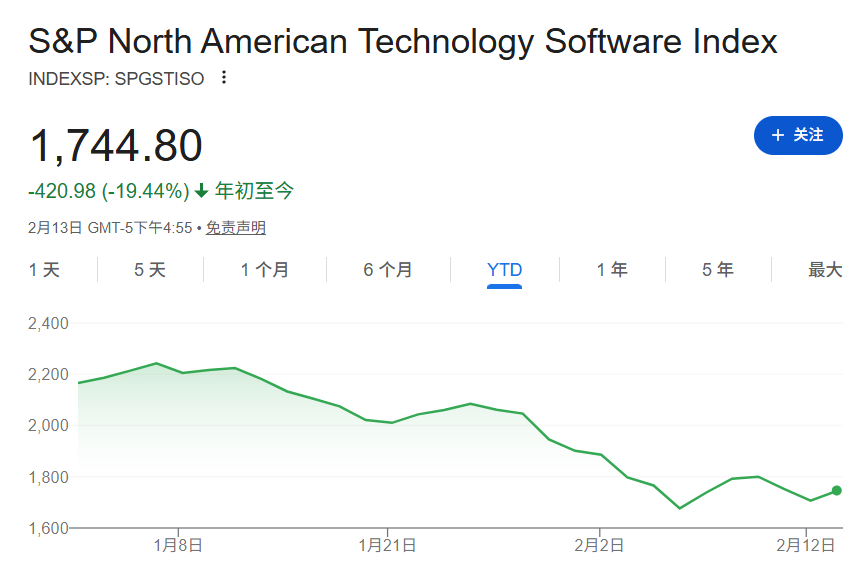
Core Insights - The private credit industry's actual loan exposure to the software sector may significantly exceed disclosed levels, with at least 250 investments worth over $9 billion not classified as software loans despite being defined as such by other lenders or sponsors [1][2] - The software sector has become the largest single industry exposure for Business Development Companies (BDCs), accounting for approximately 20% of all loans held by BDCs, compared to 13% in the broader leveraged loan market [2][6] - The classification inconsistencies among BDCs complicate the assessment of risk exposure, especially as AI technologies threaten traditional software business models [1][7] Group 1: Classification Issues - A review of disclosures from major BDCs revealed that software companies are often categorized under different industry classifications, leading to a lack of clarity regarding their actual exposure [3][4] - For instance, companies like Pricefx and Kaseya, which identify as software firms, have been classified as "business services" and "professional retail" respectively by their lenders, highlighting the discrepancies in classification standards [3][4] - This inconsistency extends even within the same company, as seen with Blue Owl Capital, where the same firms are classified differently across various funds [5] Group 2: Market Risks and Concerns - The influx of private equity funds into the software sector has been significant, with approximately 30% of private equity capital flowing into this industry over the past decade, and software accounting for 40% of all sponsor-backed private credit [6] - Recent advancements in AI technology have raised concerns about the future of software businesses, with the S&P North American Software Index dropping over 20% this year, indicating heightened market anxiety [7][10] - Analysts warn that the ongoing AI revolution is fundamentally altering the software industry, rendering historical classification guidelines obsolete and increasing scrutiny on private credit managers [10]


市领导看望慰问在宁院士专家 让各类人才在南京安心舒心创新创造
Nan Jing Ri Bao· 2026-02-14 02:25
Group 1 - The city leaders, including Zhou Hongbo and Li Zhongjun, visited and extended New Year greetings to various experts and academicians, emphasizing the importance of their contributions to technological and industrial innovation in Nanjing [1][2][3] - Zhou Hongbo highlighted the need for a practical and solid approach to innovation, aligning with Xi Jinping's expectations for scientific workers during his visit to Nanjing [1] - Li Zhongjun acknowledged the significant role of academicians like Chen Guang in materials science and engineering, encouraging the integration of core technology research with industry [2] Group 2 - Li Zhongjun expressed the city's commitment to providing high-quality services to academicians and experts, aiming to create a conducive environment for research and development [2] - The city leaders, including Zhang Baojuan and Lü Deming, actively engaged with various experts to understand their needs and promote the development of their respective fields [2][3] - The emphasis was placed on fostering a strong relationship between academia and industry to facilitate the practical application of research outcomes in Nanjing [2][3]
索罗斯Q4调仓路线图:猛砍Snowflake,狂买微软、英伟达,新建仓黄金股
Zhi Tong Cai Jing· 2026-02-14 02:05
Group 1: Core Investment Strategy - Soros Fund Management significantly increased its exposure to core technology stocks, including adding 161,000 shares of Microsoft (MSFT.US), 118,000 shares of Nvidia (NVDA.US), and approximately 66,000 shares of Apple [1] - The fund also made moves in the software and mobility sectors, increasing positions in Atlassian (TEAM.US) by approximately 216,000 shares, Salesforce (CRM.US) by about 55,000 shares, and Uber (UBER.US) by around 119,000 shares [1] - In defensive and growth sectors, the fund increased its holdings in utility company Exelon (EXC.US) by approximately 488,000 shares and gaming giant Electronic Arts (EA.US) by about 318,000 shares [1] Group 2: Reduction and Caution - The fund reduced its positions in high-volatility and financial stocks, significantly cutting 168,000 shares of Snowflake (SNOW.US) and 151,000 shares of Circle Internet Group (CRCL.US) [2] - A notable reduction was also seen in Interactive Brokers (IBKR.US), with a decrease of 813,000 shares, indicating a cautious stance towards the financial brokerage sector [2] Group 3: New Positions and Exits - Soros Fund Management opened new positions in gold-related assets such as New Gold (NGD.US) and established positions in DigitalBridge (DBRG.US), Blue Owl Capital (OWL.US), Exact Sciences (EXAS.US), and Xcel Energy (XEL.US) [3] - The fund completely exited positions in KeyCorp (KEY.US), CareTrust REIT (CTRE.US), Cipher Mining (CIFR.US), and KKR & Co. (KKR.US), indicating a shift away from traditional banking and certain cryptocurrency mining stocks towards more stable or defensive sectors [3] - Overall, the fund's strategy reflects a clear intention to embrace AI and core technology assets while avoiding high-volatility cloud and data companies like Snowflake, and hedging against macroeconomic uncertainties by investing in gold stocks [3]


能源、必选消费和美债领涨2026!华尔街的“AI交易”被“AI颠覆”了
Hua Er Jie Jian Wen· 2026-02-14 01:49
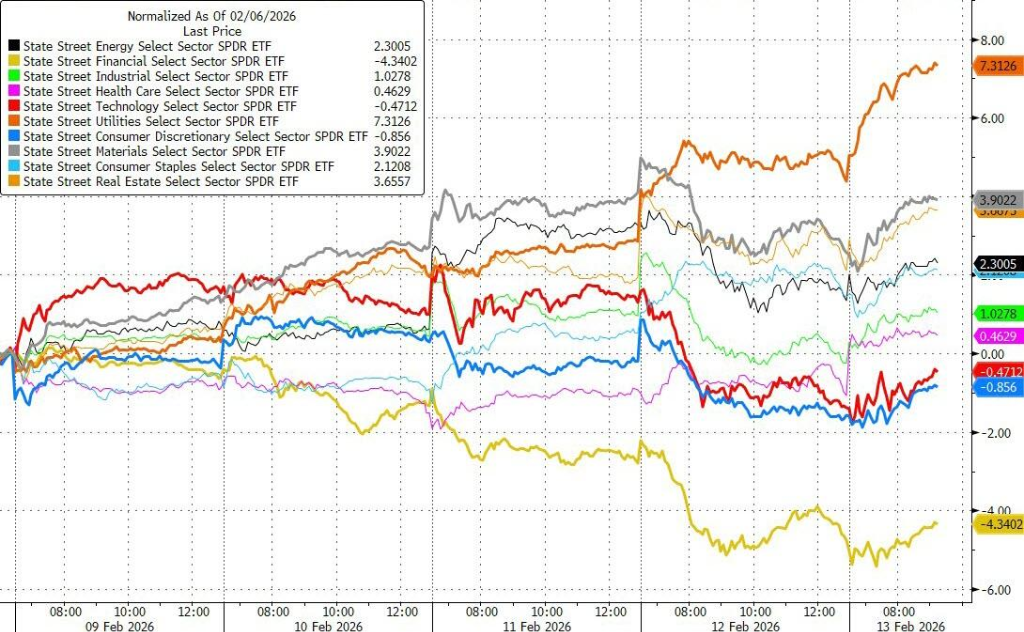
Core Viewpoint - AI, initially seen as a strong investment theme for the year, has shifted to a source of market uncertainty, particularly impacting light-asset companies that may be replaced by AI technology [1][4]. Group 1: Market Performance - The S&P 500 index experienced its worst performance since November until a rebound occurred following mild inflation data on Friday [1]. - The utility sector outperformed as a safe haven against AI impacts, while the financial sector was the worst performer of the week [2]. - Wall Street's previously confident bets have failed over six weeks, with cash allocations at a historic low and hedge levels at their lowest since 2018 [3]. Group 2: AI Impact and Investor Sentiment - Investors are questioning the return timelines on large capital expenditures by tech giants and whether remaining cash can continue to support stock buybacks [4]. - The sentiment is that more stocks have been harmed by AI than benefited, leading to concerns about potential contagion effects across sectors [4]. - The market is undergoing a repricing, particularly in the software industry, raising fears of broader impacts [4]. Group 3: Market Volatility - Two forces are exacerbating volatility in the U.S. stock market: low cash allocations and interconnected leveraged positions that can trigger widespread sell-offs [5]. - The VIX index recently surpassed the critical 20 mark, indicating rising market pressure despite not showing panic signals [6]. - The put-call ratio has surged since January, reflecting increased hedging activity among investors [9][10]. Group 4: Investment Strategy Adjustments - Despite current volatility, the S&P 500 remains near historical highs, and credit spreads are at ten-year lows, indicating that a market collapse has not yet occurred [9]. - There has been a significant inflow of $3.6 billion into ETFs tracking high shareholder return companies this month, suggesting a shift in investment focus [10].
新一轮俄美乌会谈即将举行!特朗普证实,部署第二艘航母!国内金属市场节前普遍收跌
Qi Huo Ri Bao· 2026-02-14 00:45
Market Performance - COMEX gold futures rose by 2.17% to $5050.50 per ounce, while COMEX silver futures increased by 1.98% to $77.180 per ounce [2] - The U.S. stock market showed mixed results, with the Dow Jones up 0.10%, the Nasdaq down 0.22%, and the S&P 500 up 0.05%. Notably, major tech stocks like Apple and Nvidia fell over 2% [3] Domestic Metal Market - The domestic metal market experienced a general decline before the Spring Festival, with significant drops in prices for tin and silver. Specifically, Shanghai gold futures fell by 1.61% to 1110.10 yuan per gram, and Shanghai silver futures dropped by 5.52% to 19782 yuan per kilogram [4][6] - The decline in gold and silver prices is attributed to weakened market sentiment and risk appetite, exacerbated by a significant drop in U.S. stocks [6] Employment Data Impact - The U.S. non-farm payroll data for January showed an increase of 130,000 jobs, significantly exceeding the market expectation of 70,000. This data alleviated concerns about a deteriorating job market and reduced the perceived necessity for the Federal Reserve to lower interest rates in the short term [7] - However, the total projected job growth for 2025 was revised down by 898,000, indicating that one month's data may not be sufficient to determine a trend reversal in the job market [7] Gold and Silver Market Outlook - Analysts suggest that the gold and silver markets are currently in a "rebalancing" phase, with prices expected to remain volatile in the short term. However, long-term factors such as high global debt and geopolitical tensions are likely to support upward price movements for gold and silver [8] - The upcoming U.S. PCE and GDP data during the holiday period are anticipated to significantly influence market pricing for U.S. economic conditions and inflation [8]
美股三大指数周线齐跌
财联社· 2026-02-14 00:39
Market Overview - The three major indices showed mixed performance, with the Dow Jones up 0.10% to 49,500.93 points, the S&P 500 up 0.05% to 6,836.17 points, and the Nasdaq down 0.22% to 22,546.67 points [3] - All three indices recorded weekly declines, with the S&P 500 down 1.4%, the Dow down 1.2%, and the Nasdaq down 2.1% [3] Economic Indicators - The U.S. Bureau of Labor Statistics reported that the January CPI rose 2.4% year-over-year and 0.2% month-over-month, both below market expectations [3] - The core CPI, excluding volatile food and energy prices, increased by 2.5% year-over-year and 0.3% month-over-month, aligning with market expectations [3] - Phil Blancato, Chief Market Strategist at Osaic, indicated that this data could pave the way for interest rate cuts and inflation control if the trend continues [3] Sector Performance - Concerns over AI disruption led to market sell-offs, affecting various sectors including software, real estate, trucking, and financial services [6] - Financial stocks such as Charles Schwab and Morgan Stanley fell by 10.8% and 4.9%, respectively, while software company Workday dropped 11% and commercial real estate firm CBRE fell 16% [6] - The media sector was also impacted, with Disney down approximately 3% and Netflix down 6% [7] Technology Stocks - Major tech stocks mostly declined, with Nvidia down 2.21%, Apple down 2.27%, Microsoft down 0.13%, Google down 1.06%, and Amazon down 0.41% [7] - Tesla saw a slight increase of 0.09%, while Oracle rose by 2.34% and Netflix increased by 1.33% [7] Chinese Stocks - The Nasdaq Golden Dragon China Index fell by 0.10%, with Alibaba down 1.89%, JD.com down 1.38%, and Pinduoduo up 0.06% [7] - NIO remained flat, while Xpeng rose by 1.36% and Li Auto fell by 1.81% [7]