家用电器

Search documents
年内507家深市公司中期分红,累计超1291亿元
2 1 Shi Ji Jing Ji Bao Dao· 2025-11-11 13:40
Core Viewpoint - The willingness of A-share listed companies to return profits to investors has significantly increased, with a notable rise in mid-term dividends amid ongoing reforms in the capital market [1][2][3] Group 1: Dividend Distribution - As of October 2025, 507 companies in the Shenzhen market have announced or implemented mid-term dividends, totaling 129.11 billion yuan, a substantial increase compared to the same period last year [1] - Nearly 40% of companies have a dividend payout ratio exceeding 30%, with 98 companies surpassing 50%, indicating strong profitability and willingness to return to shareholders [1] - The trend of multiple dividends within a year is becoming more normalized, driven by regulatory guidance to optimize investor return mechanisms [1] Group 2: Industry Performance - The consumer sector, particularly the pharmaceutical, food and beverage, and home appliance industries, has shown remarkable performance in dividend distribution, with each sector's total dividends exceeding 10 billion yuan [1] - Leading companies such as Wuliangye, Gree Electric Appliances, and Midea Group have emerged as major contributors, with cash distributions of 10.007 billion yuan, 5.585 billion yuan, and 3.798 billion yuan respectively [1] Group 3: Notable Company Actions - Luxshare Precision announced a cash dividend of 1.6 yuan per 10 shares, totaling 1.165 billion yuan, marking the company's first profit distribution plan for the first three quarters [2] - Lens Technology followed with a plan to distribute 1 yuan per 10 shares, amounting to 498 million yuan [2] - Companies like Mindray Medical and CATL have demonstrated strong cash flow and profitability, with Mindray's cumulative cash dividends reaching 4.935 billion yuan and a payout ratio exceeding 60% [2]

年内507家深市公司中期分红,累计超1291亿元
21世纪经济报道· 2025-11-11 12:57
Core Viewpoint - The willingness of A-share listed companies to return profits to investors has significantly increased, with a notable rise in mid-term dividends as a result of ongoing reforms in the capital market [1][2]. Group 1: Dividend Distribution - As of October 2025, 507 companies in the Shenzhen market have announced or implemented mid-term dividends, totaling 129.11 billion yuan, a substantial increase compared to the same period last year [1]. - Nearly 40% of companies have a dividend payout ratio exceeding 30%, with 98 companies surpassing 50%, indicating strong profitability and willingness to return to shareholders [1]. - The consumer sector, particularly the food and beverage, household appliances, and pharmaceutical industries, has shown remarkable performance, with total dividends exceeding 10 billion yuan in some cases [1]. Group 2: Notable Companies and Their Dividends - Leading companies such as Wuliangye, Gree Electric Appliances, and Midea Group have made significant contributions to the dividend pool, with cash distributions of 10.007 billion yuan, 5.585 billion yuan, and 3.798 billion yuan respectively [1]. - Luxshare Precision announced a cash dividend of 1.6 yuan per 10 shares, totaling 1.165 billion yuan, marking its first profit distribution plan for the third quarter [2]. - Mindray Medical has distributed 4.935 billion yuan in cash dividends, with a payout ratio exceeding 60%, demonstrating a stable and predictable return mechanism [2]. Group 3: Trends in Dividend Policies - High dividend payouts have become a notable feature of mid-term distributions in 2025, with Dong'e Ejiao proposing a cash dividend of 12.69 yuan per 10 shares, amounting to 817 million yuan, which represents 99.94% of its net profit for the first half of the year [2]. - Gree Electric Appliances continues its tradition as a "dividend giant," proposing a cash dividend of 10 yuan per 10 shares, totaling 5.585 billion yuan, with cumulative dividends exceeding 177.6 billion yuan since its listing [2]. - The shift in investment culture from "heavy financing" to "heavy returns" is fostering a more mature and stable shareholder return mechanism among listed companies [3].


深市中期分红规模大幅增长 507家公司派发超千亿红包
Zheng Quan Shi Bao Wang· 2025-11-11 10:07
Core Insights - The Shenzhen Stock Exchange has seen a significant increase in mid-term dividends, with 507 companies declaring or implementing dividends by the end of October 2025, totaling 129.11 billion yuan [1] - The trend of multiple dividends per year is becoming the norm as companies recognize the importance of returning value to investors [1] Group 1: Dividend Performance - Nearly 40% of companies distributing mid-term dividends have a payout ratio exceeding 30%, with 98 companies having a payout ratio above 50% [2] - The consumer sector is the leading contributor to dividends, with the pharmaceutical, food and beverage, and home appliance industries each exceeding 10 billion yuan in total dividends [2] - Major companies like Wuliangye (100.07 billion yuan), Gree Electric (55.85 billion yuan), and Midea Group (37.98 billion yuan) are significant players in the dividend distribution [2] Group 2: Notable Dividend Cases - Lixun Precision (11.65 billion yuan) and Lens Technology (4.98 billion yuan) have announced substantial cash dividends, reflecting a commitment to shareholder returns [3] - Gree Electric's mid-term profit distribution plan includes a cash dividend of 10 yuan per 10 shares, totaling 55.85 billion yuan, showcasing its long-standing high dividend policy [4] - Dong'e Ejiao's near-full payout of 99.94% of its net profit for the first half of 2025, with a total cash dividend of 8.17 billion yuan, has garnered market attention [4] Group 3: Market Implications - The substantial growth in mid-term dividends indicates a steady improvement in corporate profitability and a growing awareness among listed companies regarding shareholder returns [4] - The trend of multiple dividends per year is expected to enhance the investment value of the capital market, contributing to its long-term healthy development [4]

深市公司分红力度持续加码 多元优秀案例彰显回报诚意
Zheng Quan Ri Bao Wang· 2025-11-11 09:45
Core Viewpoint - The A-share market, particularly the Shenzhen Stock Exchange, is experiencing a significant increase in dividend distributions, with a total of 507 companies announcing or implementing mid-term dividends, resulting in a cumulative dividend amount of 129.11 billion yuan as of October 2025 [1] Group 1: Dividend Trends - The mid-term dividend distribution in the Shenzhen market shows a positive trend, with nearly 40% of the 507 companies having a dividend payout ratio exceeding 30%, and 98 companies surpassing 50%, indicating a strong commitment to sharing profits with shareholders [2] - The consumer sector, particularly the food and beverage and home appliance industries, has emerged as the main force in dividend distributions, with total dividends exceeding 10 billion yuan in these sectors [2] Group 2: Leading Companies - Major companies are setting examples in dividend distribution, such as Shenzhen Mindray Bio-Medical Electronics Co., Ltd. distributing 4.935 billion yuan with a payout ratio over 60%, and CATL distributing 4.411 billion yuan in a single payment [3] - Gree Electric Appliances announced a mid-term dividend of 10 yuan per 10 shares, totaling 5.585 billion yuan, and has distributed over 177.6 billion yuan since its listing [4] Group 3: Notable Cases - The electronics and manufacturing sectors are showcasing significant dividend cases, with Luxshare Precision announcing a first-time profit distribution of 1.6 yuan per 10 shares, totaling 1.165 billion yuan [4] - Dong-E E-Jiao Co., Ltd. set a record for high payout ratios, proposing a dividend of 12.69 yuan per 10 shares, amounting to 817 million yuan, which represents 99.94% of its net profit for the first half of 2025 [5]
深市中期分红突破千亿元,一年多次分红渐成常态
2 1 Shi Ji Jing Ji Bao Dao· 2025-11-11 07:52
Group 1 - The willingness of A-share listed companies to return profits to investors has significantly increased, with 507 companies in the Shenzhen market announcing or implementing mid-term dividends totaling 129.11 billion yuan, a substantial increase compared to the same period last year [1] - Nearly 40% of companies have a dividend payout ratio exceeding 30%, with 98 companies surpassing 50%, indicating strong profitability and willingness to return [1] - The consumer sector, particularly in pharmaceuticals, food and beverages, and home appliances, has shown remarkable performance, with total dividends exceeding 10 billion yuan in both food and beverage and home appliance industries [1] Group 2 - The electronics industry is also actively responding to the "multiple dividends per year" policy, with Luxshare Precision announcing a cash dividend of 1.6 yuan per 10 shares, totaling 1.165 billion yuan, marking the company's first profit distribution plan for the first three quarters [2] - Leading companies in the Shenzhen market are demonstrating a strong exemplary effect, with Mindray Medical achieving a cumulative cash dividend of 4.935 billion yuan and a payout ratio exceeding 60%, establishing a stable and predictable return mechanism [2] - High dividend ratios have become a notable feature of mid-term distributions in 2025, with Dong'e Ejiao proposing a cash dividend of 12.69 yuan per 10 shares, amounting to 817 million yuan, which accounts for 99.94% of its net profit for the first half of the year [2] Group 3 - The mid-term dividends in 2025 reflect a more mature and stable shareholder return mechanism among Shenzhen companies, transitioning the investment culture from "heavy financing" to "heavy returns" [3] - Continuous and transparent profit distribution is injecting more confidence and vitality into the market [3]
总裁赖育文离职 万和电气职业经理人道路能否走通
Bei Ke Cai Jing· 2025-11-11 05:30
Core Viewpoint - The resignation of Lai Yuwen, the non-independent director and president of Wanhe Electric, is not expected to impact the company's normal operations, and the board will promptly nominate a new candidate [1] Group 1: Leadership Changes - Lai Yuwen has resigned from all positions due to personal reasons and did not hold any shares in the company [1] - Lai Yuwen joined Wanhe Electric in September 2022 and was appointed president in November 2022 after the previous president, Lu Yucai, resigned [1] - Wanhe Electric is perceived as a family business, and prior to Lai's appointment, the founder emphasized the transition to a professional management structure [1] Group 2: Strategic Developments - Lai Yuwen outlined a strategic shift from gas appliances to a multi-energy layout focusing on heating and hot water, as well as enhancing kitchen and bathroom appliances [2] - The company aims to strengthen its research and manufacturing capabilities for heat pump products and provide solutions for various industrial clients [2] Group 3: Financial Performance - For the first three quarters of 2025, Wanhe Electric reported a total revenue of 5.524 billion yuan, a year-on-year increase of 5.54%, and a net profit attributable to shareholders of 479 million yuan, up 5.57% year-on-year [2] - The company has faced growth bottlenecks over the past seven to eight years, with revenues fluctuating between 6 billion and 7.5 billion yuan and net profits around 500 million yuan [2] Group 4: Growth Strategy - Lai Yuwen emphasized the necessity for growth, stating that being stuck at a revenue scale of 5 billion yuan could lead to cost rigidity and lack of innovation [3] - The company’s growth strategy involves focusing on product refinement at the 5 billion yuan scale, expanding market reach at the 10 billion yuan scale, and integrating resources at higher scales [3] - Chairman Lu Yucai praised Lai's willingness to experiment and adapt quickly to changes, highlighting the importance of a fault-tolerant organizational culture [3]

上海誉瑞祥家用电器有限公司成立 注册资本50万人民币
Sou Hu Cai Jing· 2025-11-10 21:14
天眼查App显示,近日,上海誉瑞祥家用电器有限公司成立,法定代表人为孙仕春,注册资本50万人民 币,经营范围为一般项目:家用电器销售;非电力家用器具销售;货物进出口;技术进出口;家用电器 安装服务;日用电器修理;信息咨询服务(不含许可类信息咨询服务);企业管理咨询;企业形象策 划;市场营销策划;国内货物运输代理;专业保洁、清洗、消毒服务;普通货物仓储服务(不含危险化 学品等需许可审批的项目);互联网销售(除销售需要许可的商品)。(除依法须经批准的项目外,凭 营业执照依法自主开展经营活动)许可项目:燃气燃烧器具安装、维修。(依法须经批准的项目,经相 关部门批准后方可开展经营活动,具体经营项目以相关部门批准文件或许可证件为准)。 ...
消费赛道复苏预期升温多只消费股估值具备优势
Zheng Quan Shi Bao· 2025-11-10 18:20
Core Viewpoint - The consumer sector is experiencing a collective rebound, driven by government policies aimed at boosting consumption and supporting key industries [1][3]. Group 1: Market Performance - As of November 10, 2023, various consumer indices, including food and beverage, beauty care, and retail, have shown less than 10% growth year-to-date, underperforming the Shanghai Composite Index [2]. - The food and beverage sector has been the weakest performer, with its index in a downward trend for the year [2]. Group 2: Institutional Optimism - Institutions are gradually becoming optimistic about the future performance of the consumer sector, with several brokerages identifying potential investment opportunities [3]. - Open Source Securities notes that the food and beverage sector is nearing a bottom, with recovery expectations rising as negative factors have largely been released and policy impacts are slowing [3]. - Huachuang Securities highlights that service consumption is in a transformative phase, supported by strong policy guidance, making it a promising investment focus [3]. - Galaxy Securities emphasizes the importance of enhancing consumer power and expanding quality supply during the 14th Five-Year Plan period, with new consumption trends emerging as key growth points [3]. Group 3: Valuation Advantages - Many consumer stocks currently exhibit valuation advantages, with 123 stocks having a rolling P/E ratio below 30 and underperforming the Shanghai Composite Index year-to-date [4]. - Notable large-cap stocks include Kweichow Moutai, Midea Group, and Wuliangye, among others [4]. - 23 stocks have seen a cumulative decline of over 10% this year, with Ganyuan Food experiencing the largest drop at 33.79% [4]. Group 4: Upside Potential - From an institutional perspective, several consumer stocks with low rolling P/E ratios have significant upside potential, with 43 stocks projected to rise over 20% [5]. - Proya Cosmetics leads with a projected upside of 49.05%, supported by its international expansion plans [5]. - Xueda Education follows with an expected increase of 48.6%, driven by its clear business expansion strategy in personalized education [5][6].
大消费行业周报(11月第1周):海南封关渐近迎发展契机-20251110
Century Securities· 2025-11-10 15:12
Investment Rating - The report does not explicitly state an investment rating for the industry, but it highlights potential opportunities in the tourism and duty-free sectors due to upcoming policy changes and market demand [1]. Core Insights - The consumer sector showed mixed performance in the week of November 3-7, with textile and apparel, retail, and social services sectors experiencing slight gains, while food and beverage, home appliances, and beauty care sectors faced declines [1]. - The announcement of extended holiday periods, including a 9-day Spring Festival, is expected to significantly boost the tourism sector, with early indicators showing a 63% increase in flight bookings for the 2026 Spring Festival compared to the previous year [1]. - The upcoming closure of Hainan's free trade port on December 18, 2025, is anticipated to reshape the local industry landscape and expand the duty-free market, with recent data indicating a recovery in duty-free sales [1]. Summary by Sections Market Weekly Review - The consumer sector's performance varied, with notable stock movements in various sub-sectors, including significant gains for companies like Anji Food (+13.87%) and Kangsheng Co. (+21.05%), while others like Jinzi Ham (-6.22%) and Haili B shares (-13.44%) faced declines [1][13][14]. Industry News and Key Company Announcements - The government has announced a new holiday schedule for 2026, which includes an extended Spring Festival, likely to drive consumer spending and tourism [15][17]. - The Hainan free trade port is set to officially close on December 18, 2025, with new policies aimed at enhancing the duty-free shopping experience, which has already shown signs of recovery in sales figures [1][15]. - Companies in the tourism and duty-free sectors are recommended for investment focus, particularly those with strong market positioning and unique offerings [1].
临沂商城10月份月价格指数分析报告
Zhong Guo Fa Zhan Wang· 2025-11-10 08:26
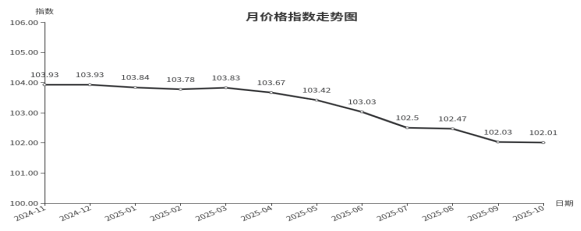
Core Insights - The overall price index for Linyi Mall in October is 102.01 points, showing a slight decrease of 0.02 points month-on-month and a year-on-year decline of 2.00 points [1] Price Index Summary - Among 14 categories of goods, 7 categories saw price increases, 1 remained stable, and 6 categories experienced price declines. The top two categories with price increases are household appliances and audio-visual equipment, and building decoration materials [3] Household Appliances and Audio-Visual Equipment - The price index for household appliances and audio-visual equipment is 102.85 points, reflecting a month-on-month increase of 0.35 points. Subcategories such as refrigeration appliances and purification appliances increased by 0.53 and 0.01 points respectively, while kitchen appliances and water heaters decreased by 0.32 and 0.08 points. The market for household appliances showed mixed trends, with increased sales for refrigeration appliances and water heaters, while kitchen appliances faced declining sales [5] Building Decoration Materials - The price index for building decoration materials is 105.63 points, with a month-on-month increase of 0.22 points. Most subcategories saw price increases, including decorative materials, structural installation materials, and specialized materials. The index initially declined before rising, influenced by increased upstream raw material costs, particularly aluminum [8] Ceramic Products - The price index for ceramics is 105.86 points, showing a month-on-month decrease of 0.49 points. The sanitary ceramics category decreased by 2.29 points, while building ceramics saw a slight increase. The overall market for ceramics is sluggish due to a downturn in the real estate market, leading to reduced demand for new home renovations [10] Furniture - The price index for furniture is 88.21 points, reflecting a month-on-month decrease of 0.39 points. Categories such as beds and bedding, seating, and cabinets saw price declines, while tables experienced a slight increase. The furniture market had a brief peak due to promotional activities, but overall prices fell due to insufficient demand for standardized products [11] Price Index Table - A detailed table of the price indices for various categories shows fluctuations, with household appliances and audio-visual equipment, and building decoration materials experiencing increases, while ceramics and furniture faced declines [12]