
智能汽车

Search documents
全场景创新点亮2025数智科技生态大会 华为鸿蒙生态构建智慧新生态
Cai Jing Wang· 2025-12-06 09:38
Core Insights - The 2025 Digital Intelligence Technology Ecological Conference was held in Guangzhou, showcasing Huawei's innovations in smart terminals and intelligent ecosystems, emphasizing the theme "Smart Navigation, Intelligent Coexistence" [1][5] Group 1: Exhibition Highlights - Huawei's exhibition area covered 468 square meters, featuring a "1+8" product matrix, HarmonyOS intelligent vehicles, and comprehensive smart home solutions [1] - The exhibition design was highly technological, with distinct areas for product displays, including the 1+8 product display table, HarmonyOS intelligent vehicle area, and smart home solutions [2][3] Group 2: Product Innovations - The HUAWEI Mate XTs showcased a lightweight foldable design with a near-crease-free screen, enhancing portability and durability [2] - The HUAWEI Mate80 series offered significant upgrades in performance and imaging, featuring a new processor and advanced imaging systems for professional-grade photography [2] - The HUAWEI WATCH Ultimate 2 provided real-time health monitoring and a new adventure mode for outdoor safety [3] - The HUAWEI MateBook Fold featured a versatile foldable screen design, enhancing user experience across different scenarios [3] Group 3: Intelligent Automotive Solutions - The HarmonyOS intelligent cockpit in three showcased models (Wenjie M9, Xiangjie S9, Zhijie R7) enabled seamless connectivity with personal devices, enhancing user experience [4] - Advanced driving assistance systems in these vehicles provided features like automatic avoidance, lane keeping, and smart parking for safer driving [4] Group 4: Smart Home and Enterprise Solutions - The HarmonyOS smart home solutions allowed users to control home devices remotely, enhancing convenience and security [4] - Huawei's enterprise solutions aimed to improve operational efficiency and reduce costs for businesses through digital transformation [4][5]
小鹏汽车-W(09868):2026年看点梳理,从汽车走向AI科技!-20251206
Soochow Securities· 2025-12-06 07:14
Investment Rating - The report maintains a "Buy" rating for the company [1] Core Insights - The company is transitioning from automotive manufacturing to AI technology, with significant growth expected in revenue and profit margins by 2026 [1][8] - The company plans to launch seven new models in 2026, focusing on both pure electric and extended-range vehicles, while expanding its global presence [8][41] - The Robotaxi segment is anticipated to reshape the Chinese transportation market, with commercial operations expected to accelerate in 2026 [8][50] Summary by Sections C-end Smart Vehicles - The company aims to build a "mass production capability" for multiple successful vehicle models, leveraging a platform-based technology approach [14][15] - The introduction of the X9 EREV model highlights the company's focus on long-range capabilities and efficient energy consumption [23][30] - The company has achieved significant growth in monthly deliveries, indicating a successful product strategy [20][41] B-end Robotaxi - The company is positioned to benefit from favorable policies and technological advancements in the Robotaxi market, with expectations for commercial operations to begin in 2026 [50] - The Robotaxi project is expected to leverage the company's AI capabilities and innovative business models to capture market share [8][50] Collaboration with Volkswagen - The partnership with Volkswagen has evolved from joint vehicle development to deeper collaboration on electronic architecture and AI technology [8][24] - The collaboration is expected to enhance the company's market position as a provider of intelligent technology solutions [8][24] Robotics and Flying Cars - The company is advancing its robotics initiatives, with plans for commercial applications of its IRON robot in various service scenarios by 2026 [8][24] - The flying car project is nearing production, with successful test flights and significant pre-orders indicating strong market interest [8][24]
华为HMS for Car智行论坛举办,携手全球伙伴探索生态共赢之路
Xin Lang Cai Jing· 2025-12-05 15:14
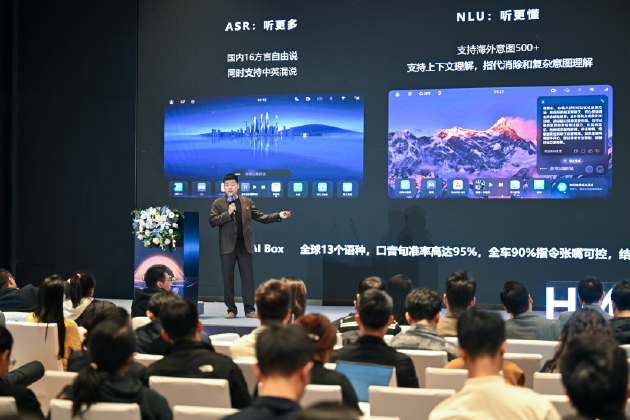
Core Insights - The automotive industry is rapidly transitioning towards digitalization, intelligence, connectivity, and electrification, with a focus on building a globally competitive intelligent in-car service system [1] - Huawei's HMS for Car aims to enhance the localization experience of smart cockpits to meet diverse regional market needs, moving from merely supporting car companies to integrating into local ecosystems [2] Group 1: HMS for Car Capabilities - HMS for Car integrates four core capabilities: maps, voice, ecosystem, and connectivity services, providing a comprehensive intelligent in-car solution that has already supported multiple car manufacturers [1] - The AI Box upgrade allows for proactive understanding and natural communication, achieving a 90% accuracy rate in recognizing local accents and supporting 16 Chinese dialects and 13 global languages [4] - Service Box acts as a bridge for local ecosystem adaptation, enhancing user familiarity with local applications and supporting diverse interaction methods [4] - Net Box enhances network stability for in-car services, covering over 100 countries and integrating resources from 150 operators [4] Group 2: Navigation and Mapping Enhancements - Map Box focuses on creating a differentiated product experience with real-time updates, supported by local research institutes in Munich and the Netherlands [5] - The collaboration with overseas map providers has resulted in over 280 million Points of Interest (POI) data, improving navigation accuracy and efficiency [5] Group 3: Integration and User Experience - HMS for Car is evolving into a "personal travel assistant," integrating various services such as navigation, vehicle control, and entertainment into a seamless user experience [7] - The system can understand the entire travel cycle, automatically planning routes and recommending services along the way [7] - Over 70 vehicle models globally have successfully integrated HMS for Car solutions [7] Group 4: Collaborative Innovations - The partnership with automaker Seres has led to the development of a smart automotive ecosystem, enhancing user experience through AI algorithms and multi-scenario intelligent functions [8] - Long-term collaboration with Great Wall Motors has resulted in significant improvements in navigation precision and stability, with new capabilities set to debut in December [10] - Collaborations with content partners like Tencent Music have led to the creation of an AI music recommendation system tailored to user travel scenarios [13] Group 5: Parking and Navigation Solutions - The partnership with Shenzhen Shunyi Tong has resulted in a convenient parking experience through features like space reservation and voice-activated payment [15] - TomTom's integration of radar perception and data fusion has enhanced the accuracy and reliability of global map data for the "live map" capabilities [17] Group 6: Future Outlook - The forum highlighted the evolution of HMS for Car from "going out" to "going in," emphasizing ongoing upgrades and partnerships to create new intelligent travel experiences [19]

AIE上的“首发经济”:从同台竞技到抢占全球话语权
2 1 Shi Ji Jing Ji Bao Dao· 2025-12-05 12:13
Core Viewpoint - The AIE (Global Intelligent Machinery and Electronic Products Expo) showcases the rapid development and innovation of companies in the Greater Bay Area, highlighting their confidence in leading the global market with new technologies and products [1][4]. Group 1: Product Launches - The Yingling A1, the world's first panoramic drone, was launched at an altitude of 1500 meters, priced from 6499 yuan after national subsidies [1]. - The AIE event featured the global debut of several products, including GAC Aion's i60 smart connected vehicle and Vivo's new generation 5G/6G terminal [1][2]. - The Dolphin 3 water rescue robot from Zhuhai Yunzhou Intelligent Technology was also showcased, attracting interest from international buyers [2]. Group 2: Industry Trends - The AIE aims to facilitate international orders and showcase the rise of technology companies in the Greater Bay Area, driven by market demand and a robust industrial ecosystem [3][4]. - The event attracted over 70,000 international and domestic buyers, emphasizing the importance of the intelligent machinery and electronics industry as a competitive field globally [5]. Group 3: Economic Impact - The Greater Bay Area is becoming a hub for smart manufacturing, producing 40% of the world's smartphones and 70% of consumer drones, with significant contributions from Guangdong's industrial clusters [5][7]. - Guangdong's R&D expenditure reached approximately 510 billion yuan last year, surpassing that of major manufacturing countries like Japan and Germany [7]. Group 4: Future Goals - AIE aims to establish itself as a leading international electronics exhibition, comparable to CES in the USA and IFA in Germany, enhancing China's influence in global industry standards [7].


理想汽车盘前续涨超1% 近日发布首款AI智能眼镜Livis
Jin Rong Jie· 2025-12-05 09:59
Core Viewpoint - Li Auto (LI.US) has seen a stock increase of 0.86% yesterday and a further rise of 1.48% in pre-market trading today, reaching $17.85. The company officially launched its first AI smart glasses, Livis, priced starting at 1999 yuan, with a government subsidy of 15% available for orders placed before December 31, reducing the price to 1699 yuan. The Livis glasses weigh 36 grams, have a battery life of 18.8 hours, and come with a charging case that supports wireless charging and a Type-C charging port [1]. Company Summary - Li Auto's stock performance shows a positive trend with a 0.86% increase yesterday and a 1.48% increase in pre-market trading today, indicating investor confidence [1]. - The launch of Livis smart glasses marks a significant product expansion for Li Auto, showcasing its entry into the AI technology market [1]. - The pricing strategy includes a government subsidy, making the product more attractive to consumers, which could drive sales [1]. - The specifications of Livis, including its lightweight design and long battery life, position it competitively in the smart glasses market [1].

中科创达常衡生:未来的车会变成机器人加超级助理的组合
Xin Lang Cai Jing· 2025-12-05 06:13
Core Insights - The 2025 New Automotive Cooperation Ecosystem Exchange Conference will be held in Suzhou on December 5-6, focusing on the future of automotive development towards embodied intelligence [1] - The Executive President of Zhongke Chuangda, Chang Hengsheng, emphasized that the future of cars will evolve towards embodied intelligence, with significant advancements in AI integration [1] Group 1: AI Integration in Automotive - There are two major scenarios for AI in vehicles: autonomous driving, where cars will gradually become self-driving robots, and in-car assistance, where vehicles will transition from mere function providers to super assistants [1] - The concept of cars evolving into a combination of robots and super assistants highlights the transformative potential of AI in the automotive industry [1]


理想汽车发布AI眼镜Livis,可语音控车续航18.8小时
Zhong Guo Jing Ying Bao· 2025-12-05 04:47
Core Viewpoint - Li Auto has officially launched its first AI glasses, Livis, marking a significant expansion from the smart automotive sector into the smart wearable device market [1] Group 1: Product Features - Livis glasses weigh 36 grams and can operate continuously for 18.8 hours under typical usage scenarios [1] - The glasses are equipped with a 12-megapixel camera and features such as EIS electronic stabilization and automatic horizon correction [1] Group 2: Integration with Automotive Technology - Livis can execute voice commands through the "Li Xiang Classmate" system, allowing users to perform tasks like turning on the air conditioning and heating the steering wheel without needing to use their phones [1] Group 3: Strategic Vision - The Senior Vice President of Product at Li Auto, Fan Haoyu, stated that the company has been exploring smart device forms that can naturally and continuously accompany users, emphasizing that glasses are the most natural interaction entry point due to their long wear time [1]

深夜,中国资产爆发
证券时报· 2025-12-04 15:54
中概股盘初大涨。 当地时间12月4日晚间,美股三大指数集体高开,随后震荡走低,三大股指一度纷纷转跌,小幅探底后震荡回升。截至发稿,道指涨0.04%,标普500指数跌0.01%, 纳指跌0.1%。 | 代码 | 名称 | 现价 | 涨跌 | 涨跌幅 | | --- | --- | --- | --- | --- | | DJI | 道琼斯工业平均 | 47899.83 | 16.93 | 0.04% | | IXIC | 纳斯达克指数 | 23429.61 | -24.48 | -0.10% | | SPX | 标普500 | 6849.21 | -0.51 | -0.01% | 经济数据方面,美国上周失业救济申请人数创下 2022 年 9 月以来的最低水平,截至11月29日当周(含感恩节假期),初请失业金人数减少2.7万,至19.1万人,预估 为22万人,前值为21.6万人。 芝商所美联储观察工具最新数据显示,市场对下周三降息的定价概率较昨日(90%)小幅下降,但仍有87%,远高于几周前水平。目前,华尔街普遍认为美联储将 在年内最后一次议息会议上降息25个基点。 个股方面,Meta盘初一度涨超5%,截至发稿涨 ...


12月投资事件早知道(12月4日-12月31日)
Sou Hu Cai Jing· 2025-12-04 12:28
Macro Policy and Global Market - The Federal Reserve is expected to implement a "rate cut + balance sheet reduction" strategy, with a 25 basis point rate cut anticipated at the December FOMC meeting, supported by softening inflation data and weak labor market indicators [2][3] - The probability of a 25 basis point rate cut by the Federal Reserve has risen to 89% as of December 4, 2023, indicating a shift in monetary policy that may weaken the dollar's long-term strength and benefit non-USD assets [2] - The launch of the Hainan Free Trade Port on December 18 is a significant event for China's opening-up strategy, expected to release policy dividends that will benefit industries such as duty-free consumption and cross-border trade [3] Industry and Sector - The AI industry is entering a critical phase of application explosion, with significant advancements in robotics, computing power, AI chips, and brain-computer interfaces [5] - The penetration of smart technology in the automotive sector continues to rise, with companies like Leap Motor being recognized in major indices, indicating market confidence in smart electric vehicle manufacturers [6] - AI is significantly lowering content creation costs in the film and gaming industries, with several major releases scheduled for December, showcasing the transformative impact of AI on creative processes [6] - The biopharmaceutical sector is focusing on innovation and integration, with key conferences scheduled to discuss advancements in oncology and high-end manufacturing technologies [6] Company Analysis - Certain companies are positioned to benefit from recent market events, such as the listing of a domestic AI chip company on December 5, which marks a milestone in the domestic GPU/AI chip sector [8] - Leap Motor's inclusion in the Hang Seng Technology Index on December 8 is expected to enhance liquidity and market attention, affirming the company's fundamentals and growth prospects [8] - The R&D day for a biopharmaceutical company on December 8 serves as a critical window to showcase pipeline progress and technological capabilities [8] - A company is set to release a co-branded AI glasses product on December 29, indicating a shift from concept to consumer-grade AI hardware, which will be closely monitored for product performance and sales [8]
12.4犀牛财经晚报:银价年内暴涨超90% 飞天茅台最新批价跌至1545元/瓶
Xi Niu Cai Jing· 2025-12-04 10:30
Group 1: Private Equity and Investment Trends - In November, the number of newly registered private equity products surged by nearly 30%, marking the second-highest monthly registration this year, with a total of 1,285 products registered [1] - Stock strategy products dominated the private equity market, accounting for 66.07% of the total, with the top firms being Shiji Qianyan and Xing Shi Investment [1] Group 2: Silver Market Dynamics - Silver prices have increased by over 90% this year, driven by strong demand from cultural and industrial sectors, alongside tight supply conditions [2] - India, the largest consumer of silver, has seen a significant rise in demand, with approximately 4,000 tons consumed annually, primarily for jewelry and artifacts [2] - The global silver supply has been under pressure, with a decline in silver mine production over the past decade, leading to a forecasted price of $100 per ounce by the end of next year [2] Group 3: DRAM Market and AI Impact - A new storage chip price surge is driven by AI and server applications, with predictions that 70% of DRAM capacity will be consumed by AI-related demands by 2027 [3] - The price of DDR4 memory chips has been rising, with a reported increase of 10.73% for a specific type, while NAND market prices are also experiencing upward adjustments [3] Group 4: Polysilicon Production Trends - Major polysilicon manufacturers are reducing production as year-end approaches, with November output at 114,600 tons, a decrease of 14.48% from October [4] - The anticipated production for December is expected to decline further, indicating a potential inventory accumulation pressure in the market [4] Group 5: Mobile Robotics and AI Integration - The mobile robotics industry is experiencing accelerated growth due to advancements in AI and wireless charging technologies, enhancing operational efficiency and expanding application scenarios [5] Group 6: Pig Farming Market Conditions - Pig farmers are facing significant losses, with reported losses of approximately 200 yuan per pig sold, driven by cyclical market pressures [6] - Analysts predict a potential decline in pig prices post-Spring Festival due to reduced demand, although a temporary price increase may occur around the winter solstice [6] Group 7: Domestic HPV Vaccine Launch - The first domestically produced nine-valent HPV vaccine has been launched in Beijing, providing a more comprehensive and cost-effective option for cervical cancer prevention [7] Group 8: Real Estate Market Developments - Beijing Lianjia has been deregistering multiple branch companies, indicating potential restructuring or downsizing within the real estate brokerage sector [8] Group 9: Automotive Technology Innovations - Li Auto has launched its first AI glasses, enhancing its product offerings and marking a significant step in diversifying from smart vehicles to wearable technology [9] Group 10: Financial and Investment Activities - LeEco plans to invest 180 million yuan in stock trading to generate additional revenue, despite facing significant debt levels [10] - Godson Technology is set to establish a semiconductor industry fund with a total scale of no less than 200 million yuan, focusing on critical equipment and materials [11]