
银行业

Search documents
远期售汇业务外汇风险准备金率降至0
Ren Min Ri Bao· 2026-02-28 00:07
Core Viewpoint - The People's Bank of China (PBOC) has decided to lower the foreign exchange risk reserve ratio for forward foreign exchange sales from 20% to 0% effective March 2, 2026, to promote the development of the foreign exchange market and support enterprises in managing exchange rate risks [1][2]. Group 1 - The adjustment is a response to the previous increase in the foreign exchange risk reserve ratio to 20% in September 2022 [1]. - The reduction is expected to lower the cost of forward foreign exchange purchases for enterprises, thereby enhancing their willingness to engage in foreign exchange hedging [2]. - The PBOC aims to guide financial institutions in optimizing exchange rate hedging services for enterprises and maintain the stability of the RMB at a reasonable and balanced level [2].
人民币跨境同业融资有新规范
Ren Min Ri Bao Hai Wai Ban· 2026-02-28 00:02
Core Viewpoint - The People's Bank of China (PBOC) has issued a new regulation to enhance the management of cross-border interbank financing in Renminbi, aiming to improve the offshore market and facilitate capital flow [1][2][3] Group 1: New Regulation Overview - The new regulation, effective immediately, supports domestic banks in conducting cross-border interbank financing with foreign institutions, including account financing and bond repurchase [1] - The regulation emphasizes a principle of "substance over form," covering all existing types of cross-border interbank financing and any future similar business [1] Group 2: Mechanism and Management - A key highlight of the new regulation is the introduction of a counter-cyclical adjustment mechanism, linking the net financing balance of domestic banks to their capital levels and funding strength [2] - Parameters for this mechanism will be adjusted based on market demand, cross-border capital flow conditions, and the operational status of banks [2] Group 3: Impact on the Market - The implementation of the new regulation is expected to significantly enhance the rules and transparency of cross-border interbank financing management, facilitating stable offshore Renminbi liquidity [3] - The regulation allows banks to flexibly adjust their business structure within an overall net financing balance limit, promoting a risk-neutral approach among banks [3]
每日债市速递 | 地方化债成绩单出炉
Sou Hu Cai Jing· 2026-02-27 23:46
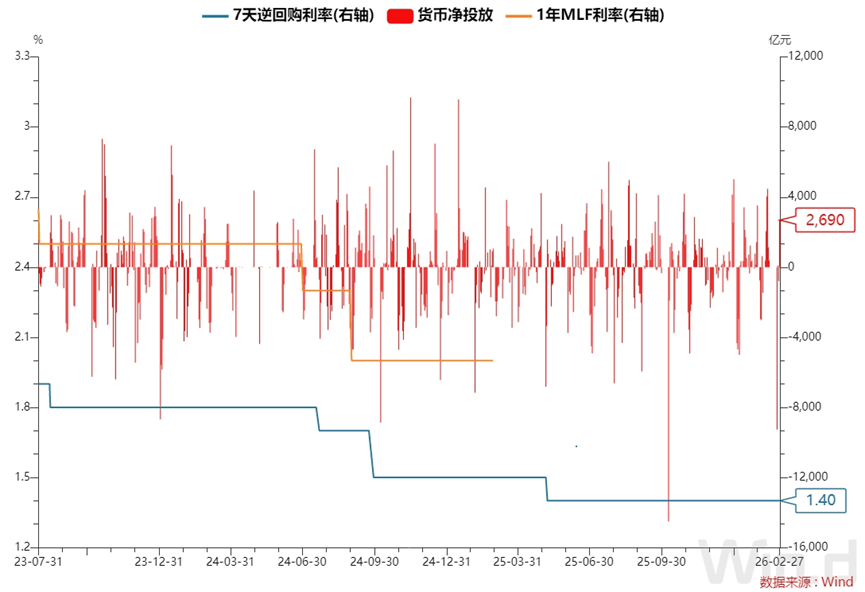
Monetary Policy Operations - The central bank announced a 7-day reverse repurchase operation on February 27, with a fixed rate and quantity tendering, amounting to 269 billion yuan at an interest rate of 1.40%, resulting in a net injection of 269 billion yuan for the day [1] Market Liquidity - The interbank market liquidity remains stable and slightly easing, with the DR001 weighted average rate declining by 2 basis points to around 1.34%. Overnight quotes on the anonymous click system (X-repo) fell to 1.33%-1.34%, indicating ample supply [3] - Non-bank institutions needed to borrow funds for three days in advance due to a holiday, quoting around 1.55%-1.58% using credit bonds as collateral, reflecting a balanced supply and demand [3] Interbank Certificates of Deposit - The latest transaction for one-year interbank certificates of deposit among major banks is around 1.58%, showing a slight decrease from the previous day [7] Government Bonds and Futures - The closing prices for government bond futures showed mixed results, with the 30-year main contract down by 0.07%, while the 10-year, 5-year, and 2-year main contracts increased by 0.05%, 0.04%, and 0.03% respectively [9] Local Government Bonds - As of February 25, the issuance of local government bonds has exceeded 2 trillion yuan, with several provinces planning to issue approximately 2.28 trillion yuan in bonds in the first two months of the year, representing a 22% increase compared to the same period last year [10][11] - Specific bond issuances include 449.76 billion yuan in refinancing special bonds from Fujian Province and 182.48 billion yuan in general bonds from Henan Province, with various maturities [11] Global Economic Insights - Federal Reserve Governor Milan advocates for early and significant interest rate cuts, suggesting a need for a 100 basis point reduction by 2026 to mitigate potential economic downturn risks [12] - A White House official indicated that executives from major tech companies will participate in a meeting to ensure that energy demands from new AI data centers do not increase electricity prices for ordinary Americans [12]

华尔街见闻早餐FM-Radio | 2026年2月28日
Hua Er Jie Jian Wen· 2026-02-27 23:32
Market Overview - The US January PPI reignited inflation concerns, leading to a decline in US stocks, with the S&P 500 down 0.4% and the Dow Jones dropping over 1% [3] - Nvidia shares fell over 4% post-earnings, while Netflix surged nearly 14% [3] - Bitcoin dropped 3% for the fifth consecutive month, and Ethereum fell over 5% [3] - Gold prices rose 1.8%, nearing $5,300, marking the seventh consecutive month of gains [3] - WTI crude oil prices increased by 2.88%, continuing a two-month upward trend [3] Key Developments in China - The Central Committee of the Communist Party of China discussed the "14th Five-Year Plan" and government work report, emphasizing a proactive fiscal policy and moderate monetary policy [4][11] - The China Securities Regulatory Commission is planning key measures for high-quality development in the capital market during the "14th Five-Year Plan" [11][12] - The People's Bank of China announced a reduction in the forward foreign exchange risk reserve ratio from 20% to 0%, effective March 2 [12] - Zhongji Xuchuang expects a net profit growth of 108.81% by 2025, driven by demand for high-speed optical modules [12] - Cambrian Technology achieved its first annual profit, projecting a net profit of 2.06 billion yuan in 2025, with revenue surging 4.5 times [13] - Moore Threads anticipates a revenue increase of 243.37% in 2025, with flagship GPU production narrowing losses by 36.7% [13] - Domestic GPU production is accelerating, with Muxi Co. projecting a 121% revenue increase in 2025 and a 44% reduction in losses [14] Key Developments Overseas - The US January core PPI saw its fastest growth in a year, complicating the Federal Reserve's monetary policy [15] - OpenAI completed a $110 billion financing round, achieving a valuation of $730 billion, with Amazon investing $50 billion [6][18] - Meta has shifted from relying solely on Nvidia to renting Google TPU for AI training, indicating a diversification in supplier strategy [18] - SpaceX is considering filing for an IPO as early as March, aiming for a June listing with a target valuation exceeding $1.75 trillion [18] - The collapse of UK private credit giant MFS has raised concerns about the fragility of private credit markets, with major banks exposed to significant risks [9][20]

21评论丨关注沃什时代的两个超预期风险
Sou Hu Cai Jing· 2026-02-27 22:33
Core Viewpoint - The appointment of Kevin Walsh as the Federal Reserve Chairman, despite his previous opposition to quantitative easing, creates a controversial dynamic between the White House's push for rate cuts and Walsh's hawkish tendencies, leading to uncertainty in market expectations regarding future monetary policy direction [1][3]. Group 1: Short-term Alignment and Long-term Conflict - The White House and Walsh share a short-term alignment on the need for interest rate cuts, with Walsh now supporting a reduction of the federal funds target rate to around 3% [3]. - Despite this short-term agreement, there exists a fundamental long-term conflict regarding the Federal Reserve's independence and mission, with Walsh advocating for a narrow focus on price stability, contrasting with the White House's broader goals of fiscal expansion and job stimulation [4][5]. Group 2: Market Implications and Policy Framework - The upcoming June meeting will be a critical test for Walsh's policy framework, with expectations for a potential 25 basis point rate cut and a detailed explanation of his "balance sheet reduction + rate cut" strategy [4]. - If Walsh's framework is implemented, it could lead to a steepening of the yield curve, benefiting short-duration U.S. Treasuries and bank stocks, while long-duration Treasuries may face pressure [4][7]. Group 3: Risks and Future Outlook - The potential for a significant economic or financial crisis during Walsh's tenure could exacerbate the existing conflicts, as the government may demand aggressive monetary support, which Walsh may resist due to his aversion to balance sheet expansion [5][6]. - Investors should monitor the initial months of Walsh's chairmanship for signs of policy consistency, with a focus on the June and September meetings to assess the viability of his proposed framework [7].

促进外汇政策回归中性 远期售汇业务外汇风险准备金率下调为0
Shang Hai Zheng Quan Bao· 2026-02-27 19:03
Group 1 - The People's Bank of China announced a reduction of the foreign exchange risk reserve ratio for forward foreign exchange sales from 20% to 0%, effective March 2, 2026, to promote the development of the foreign exchange market and support enterprises in managing exchange rate risks [1] - This adjustment is seen as a reasonable exit from previous measures, aiming to return foreign exchange policy to a neutral stance [1][2] - Experts believe that this reduction will lower the forward purchasing costs for enterprises and enhance their willingness to engage in foreign exchange hedging, thereby supporting better management of exchange rate risks [2] Group 2 - In 2025, the hedging ratio for enterprises reached 30%, with nearly 30% of goods trade settled in RMB, indicating that 60% of enterprises are less affected by exchange rate risks in foreign trade exports [3] - The future outlook suggests that these ratios may further increase, contributing to exchange rate stability [3] - Experts caution that the external environment remains complex and uncertain, with geopolitical conflicts potentially increasing volatility in the global foreign exchange market, which could impact the RMB exchange rate [3]
每日机构分析:2月27日
Xin Hua Cai Jing· 2026-02-27 16:54
Group 1: US Housing Market - The average interest rate for a 30-year fixed mortgage in the US fell to 5.98% as of February 26, down from 6.01% the previous week and significantly lower than 6.76% a year ago. This decline is primarily attributed to the drop in the 10-year Treasury yield. However, economists believe this decrease is insufficient to materially stimulate housing demand [1] - The current decline in mortgage rates is seen as a result of market volatility rather than strong economic fundamentals, raising questions about its sustainability. Analysts emphasize that the shortage of housing inventory remains a core constraint on market recovery, indicating that merely lowering rates will not drive demand unless supply improves [1] - Despite the lower rates, there has been a noticeable increase in mortgage refinancing activity [1] Group 2: UK Government Bonds - UK government bond prices have risen due to market expectations that the Office for Budget Responsibility will announce a reduction in bond issuance for the current fiscal year and further cuts in the 2027 fiscal year. Analysts suggest that strong tax revenues early in the year may lead to a downward revision of bond issuance expectations [2] Group 3: Japan Inflation - In February, Tokyo's core consumer prices, excluding fresh food, rose by 1.8% year-on-year, slightly above economists' median forecast of 1.7%. The inflation rate is cooling as the impact of government measures to lower utility bills becomes evident and food cost increases slow down [2] Group 4: South Korea Exports - South Korea's exports are expected to grow for the ninth consecutive month in February, driven by a surge in chip demand amid a global AI investment boom. Analysts predict a 24.0% year-on-year increase in exports, with semiconductor prices rising faster than expected and low inventory levels supporting strong export momentum [2] - There is a high likelihood that semiconductor export growth will exceed 100% in the first half of the year [2] Group 5: Singapore Trade Performance - Singapore's manufacturing and trade performance may be adversely affected by uncertainties in US trade policy by 2026. Potential trade tensions and geopolitical conflicts among major economies could raise production costs and exacerbate global economic policy uncertainty, ultimately dampening global investment flows and trade activities [2]
不想还38万亿债务,特朗普决定自曝家丑,把枪口对准了国内最大的债主美联储!与此同时,全球银行正在疯狂抛售美债
Sou Hu Cai Jing· 2026-02-27 16:40
Group 1: U.S. Federal Debt and Budget Deficit - The U.S. federal government debt has reached $38 trillion, with annual interest payments exceeding $1 trillion, surpassing the total military spending [1] - The Congressional Budget Office predicts that the federal budget deficit will reach $1.9 trillion in FY 2026, accounting for 5.8% of GDP, with public debt projected to exceed 101% of GDP by 2026 and 120% by 2036 [3] - The International Monetary Fund warns that the growing federal budget deficit poses an increasing stability risk, with annual deficits potentially reaching $3 trillion in the next decade under current policies [3] Group 2: Federal Reserve's Role and Interest Rates - The Federal Reserve is the largest holder of U.S. Treasury bonds, and interest rates directly impact the government's interest payment obligations [4] - President Trump has called for interest rate cuts to reduce borrowing costs, claiming that a 1% reduction could save nearly $400 billion in annual interest payments [4] - The Federal Reserve, led by Chairman Powell, has only implemented limited rate cuts, citing inflation and employment data as key factors [4] Group 3: Global Investor Sentiment and Debt Holdings - Global investors are shifting their stance on U.S. Treasury bonds, with a reported reduction of $884 billion in holdings, marking a break from previous net inflow trends [6] - Major foreign holders, including Japan, the UK, and China, have simultaneously reduced their U.S. debt holdings, with China decreasing its holdings by 47% since its peak in 2013 [6] - Central banks are increasingly moving assets from U.S. debt to gold, with global official gold reserves surpassing $3.93 trillion, becoming the largest reserve asset [6] Group 4: Currency and Trade Dynamics - Several countries are advancing the use of local currencies in international trade, with Indonesia planning to initiate transactions centered around the Chinese yuan [8] - The dollar's dominance in global foreign exchange reserves has declined, falling below 60% for ten consecutive quarters, while gold's share has risen to 20% [9] - The U.S. government has responded to these trends with threats of tariffs against countries that seek to replace the dollar in trade [8] Group 5: Future Projections and Economic Concerns - The Federal Reserve's net interest expenses are projected to exceed $1 trillion in FY 2026, rising to over $2.1 trillion by 2036, which will account for a significant portion of federal spending [11] - The IMF has warned that U.S. debt could reach 140% of GDP within five years if current fiscal policies continue, urging the government to reduce budget deficits [11] - The U.S. national debt has increased by $2.25 trillion over the past year, raising concerns about long-term fiscal sustainability [11]

巴西央行下调通胀指标至3.97%
Shang Wu Bu Wang Zhan· 2026-02-27 16:11
Group 1 - The Central Bank of Brazil has lowered its inflation forecast for the broad consumer price index (IPCA) for the end of 2026 from 3.99% to 3.97% [1] - The inflation forecast for 2027 remains unchanged at 3.8%, while the expectations for 2028 and 2029 are both set at 3.5% [1] - This marks the fifth consecutive week of downward adjustments to the 2026 inflation forecast, which is now within the Central Bank's target range [1]
“沪七条”落地后,楼市新动向
Shang Hai Zheng Quan Bao· 2026-02-27 16:07
Group 1 - The core viewpoint of the article highlights a significant recovery in Shanghai's second-hand housing market, with transaction volumes exceeding 20,000 units for three consecutive months, specifically reaching 20,300 units in January 2026, a year-on-year increase of 26.69% [1][3] - The People's Bank of China (Shanghai headquarters) reported that household loans increased by over 33.3 billion yuan in January, with short-term loans rising by 1.75 billion yuan and medium to long-term loans increasing by 31.575 billion yuan, indicating a rebound in residential mortgage demand [1][3] - The new housing policy "Shanghai Seven Measures" implemented on February 26 has led to a noticeable increase in bank mortgage inquiries, with banks reporting a significant uptick in consultations regarding loan policies and eligibility [1][2] Group 2 - Real estate agents noted a broader potential buyer demographic, with increased activity from clients who were previously hesitant, including those holding Shanghai residence permits without social security and young non-local residents with social security [2] - The new policy has prompted mixed reactions among homeowners, with some accelerating the listing of properties while others are raising prices or delaying sales, reflecting a shift in market sentiment [2] - Industry experts believe that the implementation of the new policy will further stimulate housing consumption demand and balance supply and demand, reinforcing the current positive trend in the housing market [3]