
私募

Search documents
专题报告:Beta-Alpha监测显示对冲与CTA增配窗口再现
Zhao Shang Qi Huo· 2025-11-13 08:46
1. Report Industry Investment Rating - Not provided in the given content 2. Core Views of the Report - As of November 7, 2025, the top three best - performing strategies in terms of cumulative returns this year are CSI 2000 Index Enhancement (+59.70%), CSI 1000 Index Enhancement (+45.60%), and CSI 500 Index Enhancement (+40.64%); the worst - performing are Option Put - biased (+1.53%), Option Arbitrage - biased (+4.15%), and ETF Arbitrage (+4.16%). The top three in terms of excess performance are CSI 2000 Index Enhancement (+26.10%), CSI 1000 Index Enhancement (+19.31%), and Quantitative Stock Selection (+13.71%); the worst are CSI 300 Index Enhancement (+6.12%), CSI A500 Index Enhancement (+7.06%), and CSI 500 Index Enhancement (+12.94%) [6] - The equity prices of major Sino - US indices have reached the 90% quantile levels of the past five or even ten years, and the on - site trading enthusiasm for Sino - US equity assets still exists. A - share investors are optimistic about the prospects of China's Science and Technology Innovation Board. China maintains a low - interest - rate environment, while the US is in a relatively high - interest - rate environment. The overall core strategy β environment is unfavorable for pure long - only stock strategies but favorable for CTA trend strategies, arbitrage strategies, and hedging strategies [6] - It is recommended to gradually increase the allocation of CTA, with trend strategies as the main focus and cross - sectional and arbitrage strategies as supplements. The overall attitude towards long - only stock strategies is neutral to cautious, while the attitude towards stock hedging strategies (neutral strategies) is neutral to optimistic [6] 3. Summary by Relevant Catalogs 3.1 Core Strategy β Environment Tracking - **Sino - US Equity Assets**: Most Sino - US equity assets have reached the double 90% quantile levels. In terms of structural opportunities, it is recommended to overweight CSI 300, A500, and Hang Seng Tech and underweight CSI 500. The trading enthusiasm in the on - site market remains high, and A - share investors are optimistic about the prospects of China's Science and Technology Innovation Board [8][9][20] - **Sino - US Bond Assets**: China maintains a low - interest - rate environment, while the US is in a high - interest - rate environment. The trading attribute of China's bond market interest rate is stronger than the allocation attribute this year, and the US bond real interest rate remains high and is on a downward trend [21][29] - **Commodity Assets**: Except for precious metals and non - ferrous metals, commodities show obvious low - valuation characteristics. The market's attention to commodity assets remains undiminished [33][37] - **Sino - US Exchange Rate**: The RMB exchange rate has been in an appreciation range this year [39] 3.2 Private Equity Review - **Sub - strategy Monthly Performance Comparison**: As of November 7, 2025, the performance of different sub - strategies varies greatly. For example, in terms of cumulative returns this year, CSI 2000 Index Enhancement performs well, while Option Put - biased performs poorly [45] - **Major Index Monthly Performance Comparison**: As of November 7, 2025, the best - performing indices are the Micro - cap Index (+76.79%), ChiNext Index (+45.50%), and Science and Technology Innovation 50 Index (+38.99%); the worst - performing are CSI Dividend (+3.74%), CSI 300 (+17.53%), and Shanghai Composite Index (+17.57%) [48] 3.3 CTA Strategy Environment Tracking - **Commodity Futures Market**: Most commodity sector index net values and volatilities have declined. As of November 7, 2025, the average trading volume of commodity futures is 1.95 trillion yuan (a marginal decrease of 0.29 trillion yuan), the average open interest is 2.41 trillion yuan, and the average trading - to - open - interest ratio is 0.81, which is at a normal level [50][55] - **Stock Index Futures Market**: Most stock index futures indices have risen, and volatilities have generally declined. As of November 7, 2025, the average trading volume of stock index futures is 0.71 trillion yuan (a marginal decrease of 0.05 trillion yuan), the average open interest is 1.34 trillion yuan, and the average trading - to - open - interest ratio is 0.53, which is at a normal level [57][61] - **Treasury Bond Futures Market**: The net values of treasury bond futures indices have generally declined, and most volatilities have decreased. As of November 7, 2025, the average trading volume of treasury bond futures is 0.32 trillion yuan (a marginal decrease of 0.09 trillion yuan), the average open interest is 0.88 trillion yuan, and the average trading - to - open - interest ratio is 0.37, which is at a relatively low level [62][66] - **Short - and Medium - Term Cycle Strategy Market Environment**: Intra - day liquidity remains at a high level, and volatility has slightly declined [68] - **Long - and Medium - Term Cycle Strategy Market Environment**: The smoothness of trends has continued to decline, and volatility has continued to increase [70] 3.4 Stock Strategy Environment Tracking - **Major Broad - based Index Review**: Most broad - based indices have risen this week, and volatilities have generally declined. The short - term market activity is at a medium - to - high level and has increased marginally [74][77] - **Equity Industry Index Review**: This week, 61.3% of industries have achieved positive returns, and the Power Equipment sector leads the way. The top three industries in terms of weekly returns are Power Equipment (4.98%), Coal (4.52%), and Petroleum and Petrochemicals (4.47%); the bottom three are Medicine and Biology (- 2.40%), Computer (- 2.54%), and Beauty Care (- 3.10%) [80] - **Trading Congestion**: As of November 7, 2025, the trading heat of the TMT sector is 0.29 (a marginal decrease of 10.1%), in the lower range; the trading heat of sectors such as micro - caps is 0.12 (a marginal increase of 3.2%), in the normal range; the total market trading volume is 1.96 trillion yuan (a marginal decrease of 2.8%), in the extremely high range [84] - **Neutral and Index Enhancement Strategy Intra - day Alpha Environment Monitoring**: It is generally unfavorable for intra - day Alpha accumulation due to the net outflow of funds from the stock market this week [85][88] - **Neutral and Index Enhancement Strategy Trading - type Alpha Environment Monitoring**: It is generally favorable for trading - type Alpha accumulation as trading volume, margin trading balance, etc. are at relatively high levels [90][95] - **Neutral and Index Enhancement Strategy Holding - type Alpha Significance Environment Monitoring**: It is slightly unfavorable for Alpha accumulation as the stock style is the large - cap style and the proportion of stocks outperforming the market index is still relatively low [96][101] - **Stock Index Futures Market Review**: The basis of IF, IC, and IM has widened. The estimated impacts on the average returns of neutral products through different contract hedging methods vary [102][108] - **Option Market Review**: The implied volatility has generally declined this week, which is expected to be unfavorable for option buying and arbitrage strategies. The option sentiment dimension shows that the sentiment towards CSI 1000, CSI 300, and CSI 500 is generally bearish [110][114] - **Private Equity Index Enhancement Component Stock Decomposition**: The exposure to micro - caps has dropped to a safe level, and the quantitative selection shows a relatively high exposure to micro - caps [115]
百亿量化私募再增10家!幻方年内业绩再夺亚军!超量子、翰荣、无量位列前10
私募排排网· 2025-11-13 04:15
Core Viewpoint - The A-share market has shown a trend of steady upward movement in October, with accelerated sector rotation and a balanced performance between large and small caps, leading to a notable recovery in quantitative long products, with 10 new billion-yuan quantitative private equity firms added in a single month [2] Group 1: New Billion-Yuan Quantitative Private Equity Firms - Six new quantitative private equity firms have entered the billion-yuan club, including Niuda Investment, Square and Investment, Super Quantum Fund, Shanghai Xiaoyong Private Equity, Dadao Investment, and Xiyue Investment [2] - The total number of billion-yuan quantitative private equity firms has reached 55 as of the end of October 2025, with a net increase of 10 firms compared to the end of September [2] Group 2: Performance and Strategy of Quantitative Private Equity - The new billion-yuan private equity firms primarily consist of quantitative managers who attract talent and invest in new technologies and hardware to maintain effective strategies and sustained performance [5] - The average return of the 37 billion-yuan quantitative private equity firms with at least three qualifying products has reached ***% this year [6] - Notable firms with high returns include Ningbo Huansheng Quantitative, Stable Investment, Chengqi Asset, Evolutionary Capital, and Tianyan Capital [6] Group 3: Geographical Distribution and Employee Count - Shanghai has the highest number of billion-yuan quantitative private equity firms, totaling 28, accounting for over 50% of the total, followed by Beijing with 11 firms [6] - Among these firms, 13 have more than 100 employees, with two firms, including Jiankun Investment, having over 150 employees [6] Group 4: Notable Firms and Their Achievements - Ningbo Huansheng Quantitative ranks second in returns for the year, maintaining its position from the previous month, with an average return of ***% across 11 products [10] - Super Quantum Fund, established in June 2015, has the highest returns among the new billion-yuan firms, with an average return of ***% across three products [10] - Cloudrise Quantitative leads the 50-100 billion category with a return of ***%, focusing on technology-driven and data-driven investment strategies [13] Group 5: Performance in Smaller Private Equity Categories - In the 20-50 billion category, Hanrong Investment and Xiangmu Asset achieved the top two positions, with significant performance increases noted [14] - In the 10-20 billion category, Longyin Tiger Roar, Wuliang Capital, and Yibei Investment ranked first, second, and third respectively [18] - In the 0-5 billion category, Jingying Zhito achieved a notable return of ***%, leading the segment [26][29]

为什么宏观策略是不用择时的?
雪球· 2025-11-12 08:46
Core Viewpoint - The article discusses the challenges of timing investments in different asset classes and suggests that a macro strategy, which diversifies across multiple assets, can mitigate the need for precise timing [4][5][6]. Market Overview - The A-share market has been fluctuating between 3800 and 3900 points for the past two months, and after breaking through 4000 points, it faces a new directional choice [5]. - Investors are currently conflicted about whether to invest in stocks, fearing high prices, or in stable bonds, worrying about missing out on potential gains [5]. Asset Performance Analysis - Historical data indicates that no single asset class consistently outperforms; different asset classes have strong and weak years [7][9]. - Over the past decade, A-shares outperformed other assets only in 2019 and 2020, while U.S. stocks also faced significant downturns in 2022 [9]. - Bonds showed stability with good returns last year but faced some pullbacks this year, while commodities had a brief bull run in 2021 and 2022 but performed poorly in other years [10]. Asset Class Characteristics - The core returns of different asset classes are driven by distinct underlying logic: - Stocks benefit from corporate profit growth, performing well in a stable economic environment [12]. - Commodities gain from supply-demand imbalances and inflation, thriving during high inflation or economic overheating [12]. - Bonds rely on fixed interest and price appreciation from falling interest rates, excelling during economic slowdowns or deflationary expectations [12]. Timing and Strategy - Timing investments is crucial for achieving satisfactory returns in single asset investments, with two main objectives: trend following and identifying undervalued assets [13]. - Macro strategies, which are multi-asset in nature, do not require timing as they inherently balance risk across various asset classes [14]. - A well-structured macro strategy can capture both rising and undervalued assets, providing better safety margins and lower costs [15]. Long-term Performance of Strategies - Historical performance of private equity strategies shows that without timing, achieving ideal returns is challenging, often leading to significant volatility [17]. - In contrast, macro strategies tend to yield satisfactory returns regardless of the timing of entry, with relatively lower volatility and better holding experiences [17].

量化多头超额收益显著修复!蒙玺、幻方、量创今年业绩位列前3
私募排排网· 2025-11-12 07:00
Core Insights - The A-share market has entered a volatile rotation phase since October, with significant recovery in the returns of quantitative products [2] - Among the 825 quantitative long products with performance data, the average return for the year is 41.02%, with an excess return of 14.36% [3] Summary by Category Performance of Strategies - Quantitative long products have the highest average return in October among all stock strategy products, reaching 0.93% with an average excess return of 1.5% [2] - The performance of various strategies is as follows: - Quantitative long: 825 products, average return 41.02%, monthly return 0.93% [3] - Subjective long: 2156 products, average return 36.11%, monthly return -1.35% [3] - Macro strategy: 201 products, average return 27.17%, monthly return 0.96% [3] - Composite strategy: 409 products, average return 25.66%, monthly return 1.11% [3] - Other derivative strategies: 15 products, average return 25.63%, monthly return 4.45% [3] Top Performing Products - In the quantitative long category, the top products by excess return include: - CSI 1000 index enhancement: 158 products, average return 45.51%, excess return 15.48% [4] - Quantitative stock selection: 329 products, average return 39.25%, excess return 15.56% [4] - CSI 500 index enhancement: 201 products, average return 42.07%, excess return 10.96% [4] - CSI 300 index enhancement: 38 products, average return 25.62%, excess return 6.52% [4] - Other index enhancements: average return 43.55%, excess return 18.52% [4] Notable Fund Managers - The top products in the CSI 1000 index enhancement category are managed by notable fund managers from large private equity firms, with the highest returns coming from companies like Jintong Investment and Luxiu Investment [5][9] - In the quantitative stock selection category, the top products are managed by firms such as Longqi Technology and Jiuming Investment [10][12] - The CSI 500 index enhancement products are led by managers from Guobiao Asset and Zhaoxin Private Fund [13][16] - The CSI 300 index enhancement products are managed by firms like Hainan Pengpai Private Fund and Ningbo Huansquare Quantitative [17][20] - Other index enhancement products are managed by firms such as Liangchuang Investment and Yangshi Asset [21][23]
界面新闻×浙江浩坤昇发:女性基金经理李佳佳的“脱颖而出”心法,深度揭秘
Sou Hu Cai Jing· 2025-11-12 04:38
导读: 过去一年,浙江浩坤昇发资产在各大私募平台排行榜的绩优榜单上身影频现,收获了私募圈大量关注, 公司规模因此实现了爆发式增长,从不足5亿,到如今突破18亿规模。 "洞见先机,灵动制胜。"浙江浩坤昇发资产合伙人李佳佳仅用一句话便概括了她的投资理念,恰如其分 地揭示了一位干脆利落而严谨求实的优秀女性基金经理如何在私募战场上凯旋。 在谈到投资策略时,李佳佳表示践行"养家心法"。所谓"养家心法",指的是知名投资人"炒股养家"总结 的投资心法,其核心要义是要理解市场运行的本质,加强对市场博弈的推演,更加看重投资的实战效 果。 李佳佳称,在投资领域沉淀的11年时间里,"炒股养家"老师是她的"投资导师"。在多年前,在进行调研 军工行业研究时,与之相识,后多次进行当面线下请教,顿悟到了其投资之道,又融入自己的投资风 格。 李佳佳以"养家心法"为起点,逐步构建了洞见先机灵动制胜的思维框架。该策略体系强调以深入研究为 基础,积极布局强势股并根据市场趋势灵活调整仓位,核心在于尊重市场的客观规律,当预测与市场实 际表现冲突时,采取无条件尊重市场的原则,迅速调整仓位以降低风险。建仓和减仓均有一套独到的规 则,能够在短时间内完成仓位 ...
主观超越量化!但斌的东方港湾业绩再提升!远信、复胜、望正居百亿私募前3!
私募排排网· 2025-11-12 03:33
Core Viewpoint - Subjective private equity funds rely on human judgment for investment decisions, contrasting with quantitative funds that depend on models. This approach allows for early positioning in potential growth areas and the identification of undervalued quality assets [2]. Group 1: Market Performance - The A-share market has shown strong performance, with the Shanghai Composite Index reaching a nearly 10-year high and a year-to-date increase of approximately 18%, while the ChiNext Index has risen nearly 49% [2]. - Various sectors such as AI computing, robotics, semiconductors, new energy, non-ferrous metals, and gaming have performed well in this market environment [2]. Group 2: Subjective Private Equity Overview - As of October 2025, there are 5,339 subjective private equity firms, accounting for over 70% of the securities investment category. Among these, 350 firms have at least three products displayed on the private equity performance platform [2]. - The average return for 350 subjective private equity firms from January to October this year is higher than that of quantitative funds [3]. Group 3: Top Performing Firms - The top three firms in the 100 billion yuan category are Yuanxin, Fusheng, and Wangzheng, with a notable mention of Dan Bin's commentary on the AI bubble [4]. - In the 50-100 billion yuan category, the top firms include Tongben Investment, Ruiyang Investment, and Shengqi Asset [12]. - The top firms in the 20-50 billion yuan category are Beijing Xiyue Private Equity, Qiantu Investment, and Luyuan Private Equity [17]. Group 4: Notable Strategies and Insights - Yuanxin Investment, established in September 2014, focuses on growth logic and has a management team with an average of over 20 years of experience [11]. - Dongfang Port Bay, led by Dan Bin, has 80 products displayed, with a significant increase in returns in October, emphasizing a bullish stance on AI stocks [11]. - Shengqi Asset, founded by Zeng Wenkai, emphasizes value investing and has a strong focus on gold and copper investments due to macroeconomic conditions [15][16]. Group 5: Emerging Trends - The trend of subjective private equity funds focusing on technology and innovation continues, with firms like Jingyan Private Equity maintaining a strong emphasis on this direction [24]. - The long-term bullish outlook on gold is highlighted by firms like Luyuan Private Equity, which has been actively investing in this sector [20].
业绩分化下的共识:百亿私募掘金结构性慢牛
2 1 Shi Ji Jing Ji Bao Dao· 2025-11-11 12:45
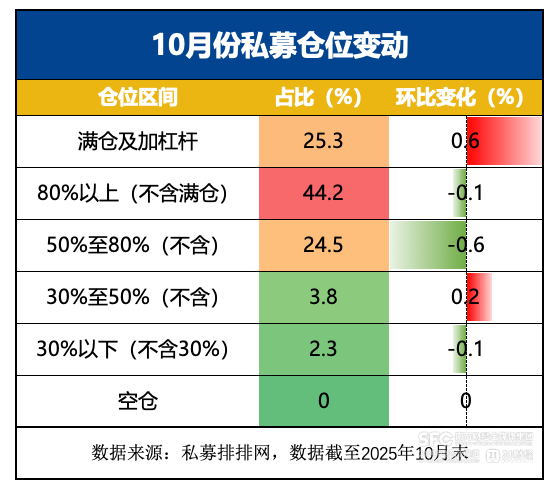
Core Viewpoint - The recent reports from major private equity firms indicate a cautious yet optimistic outlook on the market, with a focus on structural opportunities rather than broad market rallies [1][15]. Summary by Sections Private Equity Fund Positioning - As of the end of October, the average position of subjective long-biased private equity funds was 78%, consistent with high levels seen in recent years [1]. - The proportion of funds fully invested or using leverage increased to 25.3%, while over 90% of private equity funds maintained positions above 50% [2]. Performance Review - Most private equity products achieved positive returns by the end of October, but performance varied significantly among them [4]. - Notable performers included a product from淡水泉 with over 70% annual return and products from勤辰资产 with returns exceeding 30% [5][6]. - High毅资产 showed diverse performance across its funds, with some achieving over 25% annual returns while others lagged behind [6][7]. Tactical Adjustments - Private equity firms exhibited a common strategy of "rebalancing," reducing exposure to overvalued assets while increasing positions in those with higher potential [9][10]. -淡水泉 and邓晓峰 both indicated a strategy of locking in profits from rapidly appreciating holdings [10]. Sector Focus - There is a notable shift towards technology and healthcare sectors, with firms like淡水泉 and高毅资产 increasing their allocations to these areas [12][21]. - Some firms are also exploring undervalued domestic sectors such as real estate and consumer goods, anticipating potential excess returns [14][22]. Market Outlook - The consensus among private equity firms is a "structural slow bull" market, driven by in-depth analysis of industry trends and company fundamentals [15][16]. - While there is optimism, some firms caution about potential bubbles in certain sectors, particularly among small-cap stocks [16][17]. Sector Preferences - The technology sector is viewed positively by many firms, with a focus on domestic replacements and improvements in fundamentals [18]. - The healthcare sector is widely regarded as a long-term investment opportunity, with several firms increasing their exposure [21]. - The financial sector remains a stronghold for some firms, with significant allocations noted in their portfolios [23].
300位全球金融大佬齐聚香港!2025国际金融领袖峰会释放三大重磅信号
Sou Hu Cai Jing· 2025-11-11 12:39
Group 1 - The fourth International Financial Leaders Investment Summit took place in Hong Kong from November 3 to 5, gathering over 300 international financial leaders to discuss new opportunities and challenges in global finance [1][3] - The summit featured over 100 top executives from major global financial institutions, highlighting Hong Kong's status as an international financial center and showcasing China's commitment to financial market openness and development [1][3][10] - The event received strong support from the central government, with high-ranking officials from key financial regulatory bodies present to discuss the latest developments in mainland financial regulations [3][7] Group 2 - Key topics of discussion included the impact of global economic changes, the evolution of private equity markets, and the blending of public and private investment strategies [7][8] - Digital finance and technological innovation were emphasized as significant areas for growth, with discussions on the potential of fintech to enhance financial service coverage and operational efficiency [8] - The summit also addressed alternative investments in the context of energy transitions and the future of asset management, reflecting the evolving landscape of global finance [8] Group 3 - Hong Kong's role as a financial hub was reaffirmed, with its strong economic performance, including a 3.8% growth in the third quarter and robust export figures, contributing to its attractiveness for global investors [10][12] - The summit is expected to provide long-term momentum for Hong Kong's economic recovery and enhance its position in the global financial governance system [10][13] - The event also coincided with the hosting of significant sports events in Hong Kong, further boosting the city's profile and vitality [13]

113家!百亿私募阵营破百 量化私募首超主观
Jing Ji Guan Cha Bao· 2025-11-11 11:49
Core Insights - The number of domestic private equity firms with assets exceeding 10 billion yuan has reached a historic high of 113, marking an increase of 17 firms in October alone, with quantitative private equity leading the expansion [1][2] - The internal structure of the 10 billion private equity sector is changing, with quantitative firms now numbering 55, surpassing the 47 subjective firms, indicating a shift in market dynamics [2][3] Growth Factors - The concentration of industry resources towards leading firms is a consensus, with large private equity firms attracting more capital due to their comprehensive advantages in research and risk control [2][3] - The overall strong performance of the stock market, with major indices surpassing 4000 points, has led to increased capital inflow into the private equity sector, particularly favoring high-performing quantitative firms [3][4] - The private equity industry has shown impressive overall performance, with most firms achieving positive returns, further boosting investor confidence in allocating assets to private equity [3][4] - Enhanced regulatory environments have improved operational transparency for private equity firms, increasing investor trust and facilitating rapid expansion for leading firms [3][8] Performance Analysis - As of October 31, 2025, the average return for 74 billion private equity firms with performance records has reached 29.57%, with 97.30% of these firms reporting positive returns [4][5] - Among the 45 billion quantitative private equity firms, the average return is 32.88%, significantly outperforming the 25.12% average return of 23 subjective firms [5][6] Market Dynamics - The rise of quantitative private equity raises questions about the future of traditional subjective investing, with concerns about strategy capacity and market style shifts becoming prominent [7][9] - Despite the current dominance of quantitative strategies, subjective investing retains its core competitive advantages in understanding macro trends and long-term value extraction [7][9] - The future of the private equity industry is expected to be characterized by diversification, with different investment models coexisting and complementing each other [7][9]
每日市场观察-20251111
Caida Securities· 2025-11-11 06:12
Market Performance - On November 10, the Shanghai Composite Index rose by 0.53%, the Shenzhen Component increased by 0.18%, while the ChiNext Index fell by 0.92%[3] - The total trading volume in the Shanghai and Shenzhen markets was approximately 2.2 trillion yuan, an increase of about 200 billion yuan compared to the previous Friday[1] Economic Indicators - In October, the Consumer Price Index (CPI) rose by 0.2% month-on-month and year-on-year, while the core CPI (excluding food and energy) increased by 1.2% year-on-year, marking the sixth consecutive month of growth[6][7] - The Producer Price Index (PPI) saw a month-on-month increase of 0.1%, the first rise this year, with a year-on-year decline of 2.1%, narrowing by 0.2 percentage points from the previous month[6] Sector Trends - The consumer sectors such as tourism, food and beverage, and retail are showing signs of strength, indicating a shift in market funds towards previously lagging sectors[1] - Major inflows of funds were observed in the liquor, securities, and general retail sectors, while outflows were noted in battery, auto parts, and components sectors[4] Investment Insights - The A-share market has shown resilience, with a shift from a focus on technology stocks to a rotation among dividend and consumer sectors, suggesting increasing investor confidence[1] - The Shanghai Composite Index is expected to maintain above 4000 points, with potential for further upward movement as sectors rotate[1] Fund Dynamics - The number of private equity firms with over 10 billion yuan in assets surged to 113, with 18 new firms entering this category in October alone[12] - The domestic bond ETF market has seen a net inflow of approximately 427 billion yuan this year, with the total scale surpassing 700 billion yuan, marking a significant growth in this sector[13]