
电子代工

Search documents
DeepSeek-V3.1正式发布!云计算ETF汇添富(159273)冲高回落!资金高度青睐,上市12天有10天获净流入!
Xin Lang Cai Jing· 2025-08-21 09:58
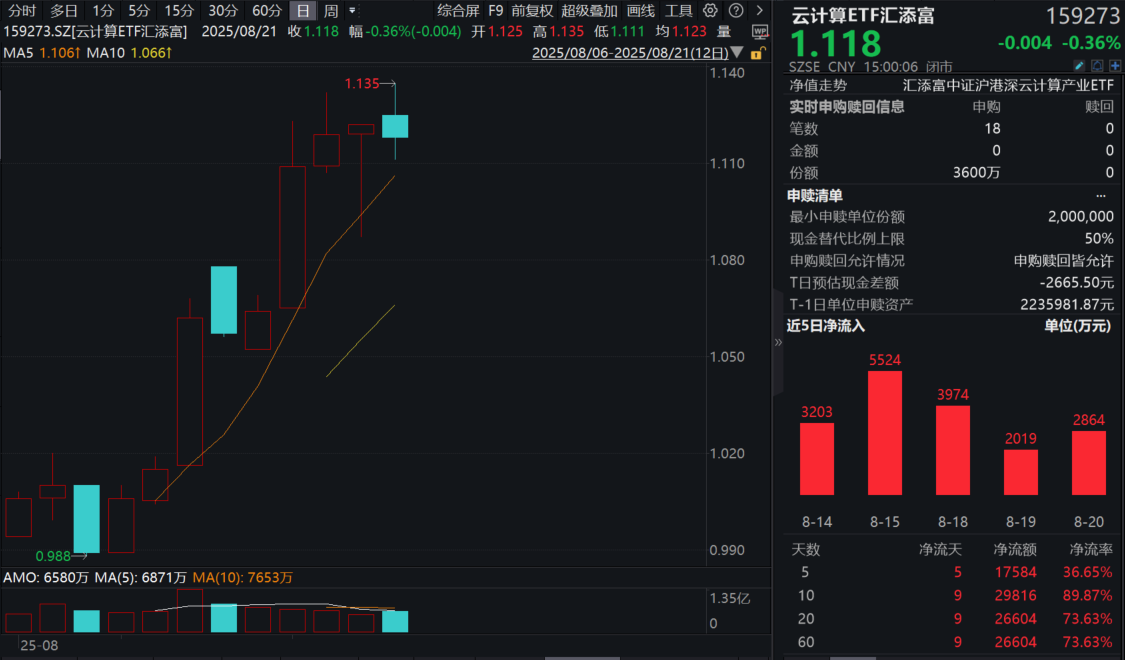
Group 1 - The cloud computing ETF Huatai (159273) experienced a slight decline of 0.36% with a trading volume exceeding 650 million yuan, indicating increased market activity [1][2] - The fund has seen a net inflow of over 400 million yuan throughout the day, marking 10 out of 12 days with net inflows, accumulating over 3 billion yuan since its launch [1][2] - Major stocks within the cloud computing ETF, such as Alibaba and Zhongke Shuguang, saw declines of over 1%, while stocks like Xinyi and Hengsheng Electronics experienced slight gains [2][4] Group 2 - The AI boom is driving rapid development in the computing power supply chain, with a projected compound annual growth rate of 46.2% from 2023 to 2028 for intelligent computing scale in China [5] - The market for intelligent computing services is expected to exceed 26.69 billion USD by 2028, with strong growth in segments like intelligent computing integration services and GenAIIaaS [5] - The semiconductor industry is experiencing high demand due to AI, with TSMC raising its revenue growth forecast from around 25% to 30% due to sustained AI demand [6]


三重动能支撑行情延续、国内算力规模高速增长、扩内需政策接力托底
Tebon Securities· 2025-08-19 07:30
Market Overview - The A-share market continues to rise, driven by growth sectors, with a healthier rotation structure observed[4] - The market is supported by three pillars: fundamentals, liquidity, and policies, with a focus on the strength of incremental capital and market profitability feedback[4] High-end Manufacturing - The global AI boom is driving rapid growth in the computing power industry, with an expected compound annual growth rate of 46.2% from 2023 to 2028[4] - The smart computing service market is projected to exceed $26.69 billion by 2028, with strong growth in integrated smart computing services and GenAI IaaS[4] Consumer Sector - In July 2025, the total retail sales of consumer goods reached 3.88 trillion yuan, with a year-on-year growth rate of 3.70%, down from 4.80% in June[34] - The July retail sales growth rate for goods was 4.00%, showing a decline of 1.30% month-on-month, while dining revenue growth was at 1.10%[40] Risks and Challenges - Risks include macroeconomic fluctuations, market competition, and potential underperformance in product innovation[4] - The impact of U.S. tariff policies on supply chains and demand remains uncertain for the second half of the year[4]
第二个富士康?关掉120亿园区,10万工人失业,央媒早有预警
Xin Lang Cai Jing· 2025-08-17 06:25
Group 1 - Changshuo Technology is reportedly planning to shut down its Shanghai factory, with some operations moving to Kunshan and most production lines relocating to Southeast Asia due to lower costs [1][3] - The company has faced a significant drop in orders, with many workers experiencing reduced hours and income, leading to a workforce decline [3][5] - The situation reflects a broader trend of foreign companies relocating from China, with media in India and Vietnam suggesting a shift in the global manufacturing center [5] Group 2 - The decline in orders and workforce has resulted in idle factory spaces and increasing operational costs, making it difficult for Changshuo to sustain its operations [5] - Despite the challenges, data indicates that China's average monthly income for urban workers is around 7000 yuan, while Southeast Asian wages are significantly lower, prompting some foreign investments to shift [5][6] - The outflow of low-end manufacturing may lead to short-term economic fluctuations, but it is seen as an opportunity for China to focus on high-tech and high-value industries for long-term growth [5][12] Group 3 - The migration of companies like Changshuo and Foxconn is not viewed as the end of China's manufacturing capabilities but rather as a transition towards high-end manufacturing and innovation [12] - China's manufacturing sector is reportedly experiencing growth in high-tech areas, with significant exports in solar batteries and breakthroughs in aerospace technology [12] - The current geopolitical climate, particularly actions from the West, is seen as a catalyst for accelerating China's industrial upgrade [10][12]

服务器业务首超iPhone!富士康Q2利润飙升27%超预期 AI营收看涨逾170%
Zhi Tong Cai Jing· 2025-08-14 08:49
Core Viewpoint - Foxconn, the world's largest electronics contract manufacturer, reported a 27% year-on-year profit increase in Q2, driven by strong demand for AI servers, exceeding market expectations [1] Financial Performance - In the period from April to June, the company achieved a net profit of NT$44.4 billion (approximately $1.48 billion), surpassing analyst expectations of NT$38.8 billion [1] - Revenue for the same quarter grew by 16% year-on-year to NT$1.79 trillion (about $59.73 billion), marking a historical high [1] - The company anticipates significant revenue growth in Q3, with AI server business revenue expected to surge over 170% year-on-year [1] Business Segments - Foxconn's cloud and networking business, including AI servers, has now outperformed its smartphone and consumer electronics segments in revenue [1] - The company has adjusted its expectations for the smart consumer electronics business, predicting a decline rather than flat performance for the year [2] Strategic Developments - Foxconn is expanding its AI infrastructure through a strategic partnership with TECO Electric & Machinery to build data centers [2] - The company is also actively pursuing opportunities in the electric vehicle sector, although progress has faced challenges, including the recent sale of the Lordstown automotive plant for $375 million [2] Market Position and Risks - Foxconn's primary production base remains in mainland China, which may be affected by global trade uncertainties, despite a recent 90-day extension of the tariff truce between the U.S. and China [1] - The company has issued a warning regarding exchange rate fluctuations, estimating that a NT$1 appreciation against the U.S. dollar could reduce revenue by approximately 3% [2] Stock Performance - Year-to-date, Foxconn's stock price has increased by 8.4%, outperforming the Taiwan Weighted Index's 5.2% rise [2]
苹果iPhone提前拉货效应 和硕第3季营运恐“旺季不旺”
Jing Ji Ri Bao· 2025-08-13 23:45
Core Viewpoint - Hon Hai Precision Industry Co., Ltd. (also known as Foxconn) reported disappointing performance in Q2 2023, with expectations for Q3 indicating a decline in communications product shipments, primarily due to earlier inventory buildup to avoid U.S. tariffs [1][2] Group 1: Q2 Performance and Q3 Outlook - In Q2 2023, Hon Hai's performance was below expectations, with a forecast for Q3 indicating a seasonal decline in communications products, which are primarily related to iPhone assembly [1] - Analysts noted that this decline is unusual and may be attributed to Apple's strategy of pulling forward orders in the first half of the year to mitigate tariff risks [1] - Typically, September marks the launch of new iPhone models, which boosts revenue for Hon Hai and other manufacturers; however, the current outlook suggests a "weak peak season" for Q3 [1] Group 2: Revenue Composition and Impact - As of Q2 2023, Hon Hai's revenue composition was as follows: information products accounted for 13%, consumer electronics for 7%, and communications products for 60%, with other businesses making up 20% [1] - Given the significant revenue share of communications products, a decline in this segment is expected to lead to an overall revenue decrease for Q3, contradicting the typical seasonal growth [1] - The usual revenue recognition from new iPhone launches in September is anticipated to be less impactful this year due to the cautious outlook on overall iPhone demand [2]
钧崴电子:公司与业内知名代工企业建立了稳定的合作关系
Zheng Quan Ri Bao Wang· 2025-08-08 11:41
Core Viewpoint - Junwei Electronics (301458) has established stable partnerships with well-known industry OEMs, indicating a strong position in the market for GPU graphics cards and power supply modules [1] Group 1 - The company responded to investor inquiries on August 8, confirming its collaboration with reputable OEMs in the industry [1] - The products of the company are applicable in GPU graphics cards and power supply modules, showcasing its diverse product offerings [1] - The company advised stakeholders to monitor future periodic announcements for specific supply details [1]
甩卖工厂,富士康美国造车颓败
Zhong Guo Qi Che Bao Wang· 2025-08-08 01:21
Core Viewpoint - Foxconn is selling its electric vehicle factory in Lordstown, Ohio, for $375 million, marking a significant retreat from its ambitions in the U.S. electric vehicle market [1] Group 1: Background and Initial Plans - The Lordstown factory, built in 1966, was once a hub for General Motors and later became a site for electric vehicle production under Lordstown Motors, which ultimately went bankrupt in 2023 due to financial issues [3][4] - Foxconn acquired the factory in 2022 for $230 million, aiming to replicate its success in electronics manufacturing within the automotive sector [3][4] - Initial plans included partnerships with several electric vehicle startups to establish a major manufacturing base in North America [4] Group 2: Challenges and Strategic Shift - Foxconn faced significant challenges as its partners, including Lordstown Motors, IndiEV, and Fisker, all encountered financial difficulties, leading to a decline in Foxconn's electric vehicle ambitions [4][6] - The company decided to divest from the factory, selling it for approximately $88 million and its equipment for about $287 million, indicating a strategic shift away from electric vehicle production in North America [6] - Despite the sale, Foxconn plans to reinvest the proceeds into its U.S. operations and may still utilize the factory for other strategic products, such as AI servers [6] Group 3: Market Conditions and Future Directions - Changes in U.S. government policies, including reduced tax incentives for clean energy and the termination of electric vehicle subsidies, have contributed to a less favorable outlook for the electric vehicle market [7] - Foxconn is not abandoning the electric vehicle sector entirely but is shifting its focus towards Japan, where it aims to collaborate with Japanese automakers and develop new electric vehicle models [8][10] - The company's strategy reflects a pragmatic approach to the evolving global electric vehicle landscape, demonstrating flexibility in its business operations [10]

27亿元甩卖美国工厂,这家巨头为何屡屡冲刺造车却铩羽而归?
Zhong Guo Qi Che Bao Wang· 2025-08-07 02:54
Core Insights - Foxconn's ambitious electric vehicle manufacturing dream has faced significant setbacks in the U.S. market, culminating in the sale of its Ohio factory for $375 million, which it had acquired for $230 million two years prior [2][3][4] Group 1: Company Actions and Decisions - The sale of the Ohio factory is framed as a strategic shift towards AI and data, but it highlights the challenges Foxconn has faced in the automotive sector [2][3] - The factory, once seen as a key asset for Foxconn's entry into electric vehicle manufacturing, has been described as an "electric vehicle graveyard" due to its underperformance [6][8] - The sale agreement includes a leaseback clause, allowing Foxconn to retain operational control while alleviating the financial burden of heavy capital investment [3][4] Group 2: Market Context and Challenges - The U.S. electric vehicle market is highly competitive, with established players like Tesla and traditional automakers accelerating their electric transitions, creating immense pressure on new entrants [6][9] - Regulatory complexities and varying state policies in the U.S. add to the operational challenges, increasing compliance costs for new manufacturers [6][9] - Foxconn's reliance on external partners for technology and its lack of core vehicle development capabilities have hindered its ability to adapt to the automotive industry's unique demands [8][9] Group 3: Lessons and Industry Implications - The experience of Foxconn serves as a cautionary tale for other companies considering entry into the automotive sector without a deep understanding of its complexities [9] - Industry experts emphasize the need for a return to fundamental manufacturing principles, moving away from speculative approaches to ensure sustainable growth [9]

富士康美国造车梦碎,27亿甩卖工厂
汽车商业评论· 2025-08-05 23:08
Core Viewpoint - Foxconn's sale of the Lordstown factory marks a significant shift in its strategy from electric vehicle manufacturing to focusing on AI and data center products, indicating the end of its electric vehicle ambitions in the U.S. market [4][23][24]. Group 1: Sale Details - Foxconn announced the sale of the Lordstown factory in Ohio for $375 million (approximately 2.7 billion RMB) to a newly registered company, Crescent Dune LLC [5][6]. - The factory, previously owned by Foxconn for over three years, did not achieve any scale in electric vehicle production [5][9]. - The sale includes the factory and equipment, with Foxconn planning to continue producing products for the automotive industry at the site [7][20]. Group 2: Background and Challenges - The Lordstown factory was once a General Motors assembly plant and was acquired by Foxconn in 2021 with ambitions to become a major electric vehicle manufacturing hub [9][12]. - Foxconn faced significant challenges in the electric vehicle sector, with multiple partners, including Lordstown Motors, declaring bankruptcy [13][14]. - The company underestimated the complexities of automotive manufacturing, which differ greatly from its traditional electronics assembly business [15][17]. Group 3: Strategic Shift - The sale of the Lordstown factory is part of Foxconn's broader strategy to pivot towards higher-value sectors such as AI and data centers, moving away from electric vehicle production [23][24]. - Future plans for the factory may include the production of AI-related products, as indicated by Foxconn's ongoing partnerships and investments in data center technologies [21][22]. - This transition reflects Foxconn's need to adapt to changing market conditions and the challenges faced in the automotive sector [24].

隔夜全球要闻【机会与风险】
Ge Long Hui· 2025-07-30 19:04
Group 1: Macro Events and Market Impact - The Chinese Ministry of Commerce confirmed that both sides will continue to promote the extension of the 24% reciprocal tariffs and China's countermeasures, which is beneficial for export-dependent Chinese companies such as Haier and Midea, potentially boosting their valuations [2] - The IMF raised China's GDP growth forecast for 2025 from 4% to 4.8%, primarily due to better-than-expected exports and lower-than-expected actual tariffs, which may attract foreign investment into Chinese assets, particularly in sectors like renewable energy and infrastructure [3] - The conflict at the Thailand-Cambodia border has escalated, impacting the Southeast Asian supply chain and benefiting defense and safe-haven assets while negatively affecting manufacturing sectors like electronics and rubber [4] Group 2: Key Industries and Stock Opportunities - Apple's AI team is experiencing turmoil with the departure of key members, which may hinder its self-developed AI progress and increase reliance on third-party models, benefiting partners like Microsoft and Google [5] - The approval of the "Blue Sky" plan by the U.S. Department of Transportation for JetBlue and United Airlines enhances customer loyalty and may catalyze global airline alliance integration, with a focus on Chinese airlines' international cooperation [7] - Novo Nordisk's stock plummeted by 22% due to weak growth of its weight-loss drug Wegovy, leading to a downward revision of its 2025 sales and profit guidance, which negatively impacts global weight-loss drug stocks while benefiting competitors in the GLP-1 space [8] Group 3: Commodities and Monetary Policy - WTI crude oil prices surged nearly 4% to $69.21 per barrel, driven by easing trade tensions and U.S. pressure on Russian energy exports, benefiting oil service and exploration companies [9] - The Chilean central bank cut its benchmark interest rate by 25 basis points to 4.75%, signaling a potential easing of monetary policy in Latin America, which is favorable for copper mining companies [10] Group 4: Investment Strategy Recommendations - The current investment strategy suggests increasing allocations in resource stocks (oil/copper) and AI technology beneficiaries while being cautious of geopolitical conflicts and potential valuation corrections in the pharmaceutical sector [11]