电视

Search documents
格局重塑!TCL控股索尼电视业务
Guan Cha Zhe Wang· 2026-01-22 13:28
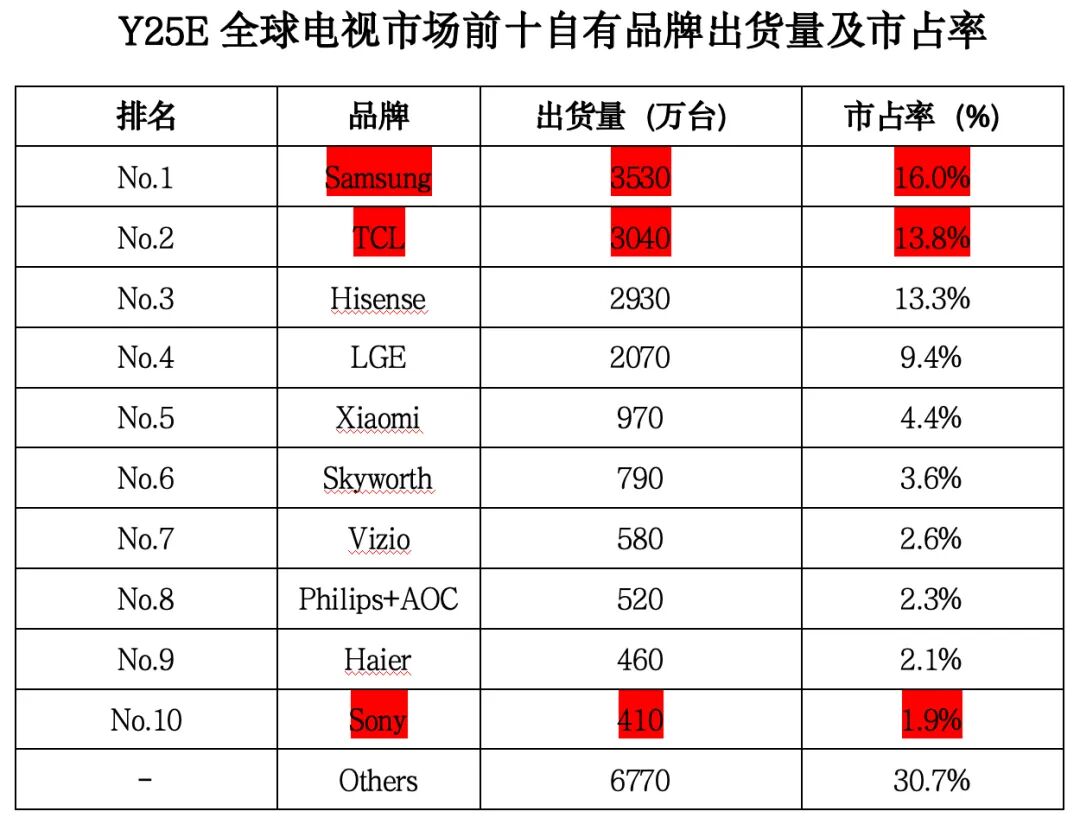
Core Viewpoint - The collaboration between Sony and TCL represents a strategic response to the shifting dynamics of the global television industry, moving from incremental expansion to a focus on existing market competition and complementary advantages [1][3]. Group 1: Company Collaboration - Sony and TCL announced plans to establish a joint venture, with TCL holding 51% and leading operations, while Sony retains 49% ownership [1]. - The new company will take over Sony's global television and home audio equipment business, including R&D, design, manufacturing, sales, logistics, and customer service, while continuing to use the Sony and BRAVIA brands [1][4]. - The partnership is seen as a necessary adaptation to the challenges posed by rising costs and declining profits in the television market, with both companies aiming to leverage their respective strengths [3][4]. Group 2: Market Context - The global television market is projected to see a slight decline in shipment volume, with an expected 2.21 million units in 2025, down 0.7% year-on-year [3]. - Sony's global television shipment is forecasted to be around 4.1 million units in 2025, giving it a market share of 1.9%, ranking it tenth globally [3]. - TCL is expected to ship approximately 30.4 million televisions in 2025, capturing a market share of 13.8%, making it the second-largest player after Samsung [4]. Group 3: Strategic Advantages - Sony's focus on high-end markets and its technological advantages, such as the XR cognitive chip, allow it to maintain premium pricing in the OLED segment, despite challenges in profitability [3][4]. - TCL's strengths lie in its scale and supply chain capabilities, particularly in Mini LED technology, where it holds over 40% of the global market share [4]. - The collaboration is expected to combine Sony's brand and technology with TCL's manufacturing and operational expertise, creating a synergistic effect that enhances competitiveness in the market [5].


索尼退场,日本电视全军覆没
远川研究所· 2026-01-22 13:17
Core Viewpoint - Sony's decision to form a joint venture with TCL for its home entertainment business marks a significant shift in the global television market, indicating the complete exit of Japanese companies from the competitive landscape of television manufacturing [4][10]. Group 1: Sony's Strategic Move - Sony will transfer its television business and the BRAVIA brand to TCL, with TCL holding a 51% stake in the new joint venture [4]. - This move reflects Sony's inability to produce display panels, which are crucial for profitability in the television market, relying instead on LG and TCL for panel supply [4][10]. - Sony's market share in the global television sector has been consistently low, often categorized under "others," indicating a lack of competitive presence [5][10]. Group 2: TCL's Positioning - For TCL, acquiring Sony's brand equity is a strategic advantage, allowing it to leverage its panel production capabilities to challenge Samsung's dominance in the global market [9]. - TCL is currently the only domestic television brand in China with display panel production capabilities, positioning itself uniquely in the industry [25]. Group 3: Decline of Japanese Brands - The exit of Sony signifies the end of an era for Japanese television brands, which have been in decline since the 2010s, with major players like Sharp and Toshiba also having sold their television businesses [10][13]. - The loss of panel production capabilities has been a critical factor in the decline of Japanese brands, as they have lost pricing power and market relevance [29]. - The shift in focus for Japanese companies has been towards higher-margin components rather than low-margin consumer electronics, reflecting a strategic pivot in response to competitive pressures [16][17]. Group 4: Historical Context - The rise and fall of Japanese television brands can be traced back to their initial dominance in the 1990s, where they controlled over 90% of the global market, primarily due to their advanced panel production technologies [20]. - The financial crisis of 2008 and subsequent strategic missteps led to significant losses for these companies, prompting a reevaluation of their business models [15][16]. - The transition from being manufacturers of consumer electronics to component suppliers has been a common theme among Japanese firms, as they adapt to the changing landscape of the electronics industry [29].
TCL拟重组并购索尼电视业务,这是一笔好生意吗?
Sou Hu Cai Jing· 2026-01-22 09:04
Core Viewpoint - TCL Electronics and Sony are considering forming a joint venture to manage Sony's home entertainment business, including televisions and home audio products, in a highly competitive market [2][5]. Group 1: Joint Venture Details - The joint venture will be owned 51% by TCL Electronics and its subsidiaries, while Sony will hold 49% [3]. - The partnership may involve arrangements regarding technology, patents, and brand licensing between TCL and Sony [4]. Group 2: Market Context and Strategic Rationale - The television market is described as a "red ocean," raising questions about TCL's decision to continue investing in this sector and its choice to partner with Sony [5]. - Sony's television business has faced significant challenges since the 2008 fiscal year, with a reported revenue decline of 12.87% and a net loss of approximately 989.38 billion yen [6][8]. - Sony's television sales have continued to decline, with a reported revenue drop of 9.63% in the 2024 fiscal year [9]. Group 3: Benefits for TCL - The joint venture aims to leverage Sony's technological expertise and brand strength alongside TCL's display technology and cost efficiency, potentially enhancing TCL's competitive position in the high-end market [9][10]. - Analysts suggest that the acquisition could significantly boost TCL's global television sales, aiding its goal to surpass Samsung in market share [11]. - TCL's acquisition strategy may also help absorb excess panel production capacity from its subsidiary, Huaxing Optoelectronics [11]. Group 4: Industry Trends and Future Outlook - The global television market is projected to see a decline in shipments, with an expected drop of 0.7% in 2025 [16]. - Despite domestic market challenges, TCL may find opportunities for growth in international markets, particularly through its competitive pricing and product offerings like Mini LED technology [17]. - The industry is expected to shift focus towards technological innovation and premium product offerings to stimulate consumer demand, moving away from aggressive discounting strategies [18].
TCL控股索尼电视,日系电视从全球霸主到“集体退场”
Tai Mei Ti A P P· 2026-01-22 06:37
TCL电子在公告中提到,意向备忘录设置了排他期条款。索尼同意并承诺在意向备忘录日期起至2026年 3月31日止期间,其将不会直接或间接与任何第三方就与潜在交易类似或相当的交易进行任何讨论或谈 判。 另据索尼中国官网披露消息,双方计划于2026年3月底前就订立具有法律约束力的最终协议进行磋商。 在最终协议签署并取得相关主管部门批准等条件满足后,新公司预计将于2027年4月开始运营。 2026年伊始,全球电视行业的竞争格局,因为一项中日企业的合作被彻底改变。 1月20日晚,TCL电子在港交所公告,公司与Sony Corporation(索尼)签订意向备忘录。双方拟成立一 家承接索尼家庭娱乐业务的合资公司,由TCL电子持股51%、索尼持股49%。 这意味着,TCL将成为索尼全球家庭娱乐业务的控股方,承接索尼的电视机和家庭音响业务,涵盖从开 发、设计、制造到销售、服务的全链条运营。 图 片来源:索尼官网 电视业务,已成索尼的拖累 公开数据显示,2025年全球电视出货量预计为2.206亿台,同比小幅下滑0.7%,市场进入存量竞争与结 构升级并行的新阶段。 | Rank | Own brand | | Sell-in V ...
TCL电子(1070.HK):索尼战略合作催化价值重估 业绩预告大超预期
Ge Long Hui· 2026-01-22 05:44
Group 1 - The core viewpoint is that the strategic cooperation between TCL Electronics and Sony is expected to catalyze a revaluation of TCL's value, alongside anticipated strong growth in 2025 and continued leadership in AI innovation through Thunderbird [1] - TCL and Sony have signed a Memorandum of Understanding (MOU) to establish a joint venture, with TCL holding 51% and Sony 49%, to take over Sony's home entertainment business, aiming for operational launch by April 2027 [1][2] - The joint venture will leverage Sony's high-quality imaging and audio technology, brand value, and operational experience, combined with TCL's advanced display technology and global scale advantages [2] Group 2 - TCL's forecast for 2025 indicates an adjusted net profit between HKD 2.33 billion and HKD 2.57 billion, representing a year-on-year growth of 45-60%, exceeding the upper limit of the equity incentive target [2] - The collaboration with Sony is expected to enhance TCL's revenue significantly, with estimates suggesting that Sony's television revenue could reach RMB 24.8 billion in 2024, contributing to an overall revenue exceeding RMB 30 billion [2] - The company anticipates that the integration of AI applications and the upcoming major sporting events will improve profitability and market share, particularly in overseas markets [3] Group 3 - TCL's investment in Thunderbird Innovation, which has a leading position in the AR glasses market, is expected to boost its valuation, with Thunderbird holding a 24% market share in Q3 2025 [3] - The company is positioned to benefit from the withdrawal of competitors in the LCD panel market, with expectations of price stability and increased market share through innovative MiniLED technology [3] - The strategic focus on high-end and global markets is driving product optimization and innovation, leading to improved efficiency and profitability [4]
两大巨头“联姻”
Nan Fang Du Shi Bao· 2026-01-21 16:00
备忘录明确,合资公司将获授权在全球范围内使用"Sony"和"BRAVIA"品牌。这意味着,尽管运营主体发 生变更,消费者仍将在终端市场看到索尼品牌产品。 目前,双方已进入排他性谈判阶段,计划在2026年3月底前就最终协议进行磋商。在通过相关监管审批 后,合资公司预计将于2027年4月正式开始运营。 对于此次合作的商业逻辑,公告指出,合资公司将融合索尼在音视频领域的品牌价值与技术积累,同时利 用TCL电子的全球规模优势、垂直供应链及端到端成本效率。 1月20日晚间,全球电视行业迎来一则重磅消息。TCL电子控股有限公司(01070.HK,下称"TCL电子")发布 公告称,公司已与Sony Corporation(索尼)签署非法律约束力意向备忘录,拟成立合资公司接管索尼全球家 庭娱乐业务。 根据公告,TCL电子拟持有合资公司51%的股权,索尼持有49%。双方预计在2026年3月底前签署最终协 议,新公司预计将于2027年4月正式开始运营。 业内人士分析,若交易顺利完成,这或将成为近二十年来全球电视市场最具影响力的品牌并购案例之一, 中国企业或将首次实质性冲击全球电视市场份额第一的宝座。 拟2027年4月运营,保留" ...

TCL牵手索尼,冲击全球电视市占率第一
21世纪经济报道· 2026-01-21 14:09
Core Viewpoint - The strategic partnership between TCL and Sony aims to reshape the global television market, with a focus on creating a joint venture that will enhance both companies' competitive positions and market shares in the home entertainment sector [1][6][11]. Group 1: Strategic Partnership Details - TCL and Sony have signed a memorandum of understanding to establish a joint venture focused on home entertainment, including television and audio products [1]. - The joint venture will operate globally, covering the entire value chain from R&D to customer service, with TCL holding 51% and Sony 49% of the shares [1]. - The joint venture is expected to start operations in April 2027, with plans for collaboration on patents, technology, and brand licensing, retaining the "Sony" and "BRAVIA" brands for products [1][6]. Group 2: Market Impact and Projections - In 2025, Sony's global television shipments are projected to decline by 13.3% to 4.1 million units, while TCL's shipments are expected to grow by 6.4% to 30.7 million units [6]. - The combined market share of TCL and Sony could reach 16.7%, potentially surpassing Samsung's 16.2% and making TCL the leading global television brand for the first time [6][8]. - The partnership is seen as a significant shift in the competitive landscape of the television market, which has historically been dominated by Japanese and Korean brands [6][8]. Group 3: Historical Context and Competitive Landscape - The last 20 years have seen a decline in Japanese brands and a rise of Chinese brands like TCL, which has become the second-largest player in the global market by 2023 [7][8]. - The television market is characterized by intense competition, and the strategic timing of this partnership is crucial for both companies to achieve market leadership [7][8]. - Sony's brand is associated with high-end technology, while TCL's strengths lie in supply chain integration and global manufacturing capabilities, making their collaboration potentially powerful [7][8]. Group 4: Future Outlook and Industry Trends - The partnership is expected to enhance TCL's competitiveness in the high-end television market and improve its overall sales through the integration of Sony's technology and brand prestige [7][8][11]. - The collaboration may lead to a restructuring of the global LCD TV panel supply chain, as TCL's panel manufacturing capabilities could complement Sony's needs [7][8]. - The joint venture represents a broader trend of Chinese companies increasingly acquiring and partnering with established global brands to enhance their market positions [11][12].
TCL李东生一举拿下索尼电视,有望缔造千亿级巨头
2 1 Shi Ji Jing Ji Bao Dao· 2026-01-21 13:55
0:00 李东生一举改写 全球电视产业版图 1月20日 TCL电子与索尼签署意向备忘录 计划成立一家合资公司 新主体由TCL持股51% 即由李东生一方控制 其将承接索尼家庭娱乐业务 涉及电视、音响等产品 据索尼2024财年数据 其显示、音响业务营收 高达400亿人民币左右 李东生若能如愿控股 将大幅提升业务规模 且拥有Sony等高端品牌 公开数据显示 此次合作主体TCL电子 聚焦电视等智能终端 2025全年净利 约20.8亿元-23亿元 营收预计站上1000亿大关 一旦合并索尼业务 TCL的终端事业规模 可能达到1400亿规模 一跃成为全球电视王者 预估在2026年3月完成 顺利的话 合资公司将于2027年 开始投入运营 李东生团队实现 2025年全球电视出货量 累计达3070万台 已位列第二 已达成意向的交易 ...
对手变盟友!索尼、TCL联手背后的算盘
Guo Ji Jin Rong Bao· 2026-01-21 12:57
Core Viewpoint - The collaboration between TCL and Sony marks a significant shift in the global television market, indicating the decline of Japanese brands in the industry and the rise of Chinese companies like TCL and South Korean giants Samsung and LG [1][2]. Group 1: Partnership Details - TCL and Sony have signed a non-binding memorandum of understanding to establish a joint venture, with TCL holding 51% and Sony 49% [1]. - The new company will focus on Sony's home entertainment business, including the development, manufacturing, sales, and customer service of televisions and home audio products [1]. - A timeline has been set for finalizing the legal agreement by March 2026, with the new company expected to commence operations by April 2027 [1]. Group 2: Market Position and Trends - Sony's television business is facing significant challenges, with a projected shipment of only 410,000 units in 2025, resulting in a market share below 2% [4]. - In contrast, TCL is expected to ship 3.04 million units in 2025, achieving a 13.8% market share, narrowing the gap with Samsung [3][4]. - The global television market is entering a phase of inventory competition, with a slight decline in overall shipment volume expected [2]. Group 3: Strategic Implications - The partnership is seen as a necessary move for Sony, which has shifted its focus towards more profitable sectors like gaming and entertainment, leading to underinvestment in its television business [6]. - TCL's advantage lies in its vertical integration, with nearly 60% of its TV panels sourced from its subsidiary, TCL Huaxing, compared to Sony's reliance on external suppliers [6]. - If the joint venture succeeds, it could lead to a combined market share of 16.7% for TCL and Sony, potentially surpassing Samsung and reshaping the competitive landscape of the global television market [7].
TCL索尼合资深耕家庭娱乐,中国电视迎“Walkman时刻”
2 1 Shi Ji Jing Ji Bao Dao· 2026-01-21 10:51
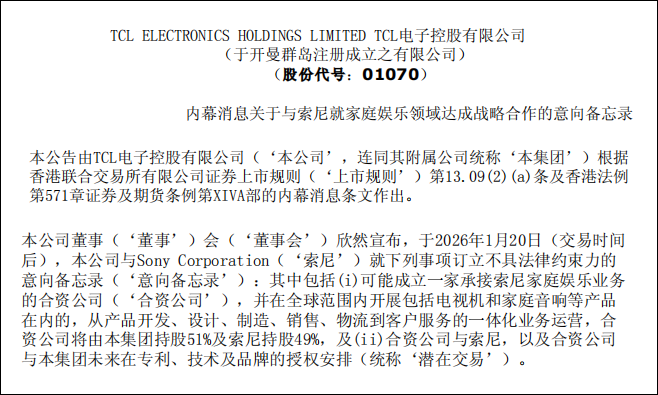
消费电子产业再起风云。 2026年1月20日,TCL电子和索尼公司发布公告称,双方签署了意向备忘录,在电视等家庭娱乐领域达成战略合作。 双方核心合作规划包括两大方面。一是两者计划成立一家合资公司,承接索尼的家庭娱乐业务。 这家合资公司将在全球范围内开展一体化业务运营,覆盖电视机、家庭音响等产品的研发、设计、生产、销售、物流及客户服 务全链条。股权结构方面,TCL将持有合资公司51%的股份,索尼持有49%的股份。 (图源:TCL电子公告) 二十年电视市场未有之变局 二是约定合资公司未来将在专利、技术及品牌授权方面达成相关合作安排。其中,电视和家庭音响等产品将沿 用"Sony"和"BRAVIA"品牌。若交易顺利,新的合资公司预计在2027年4月开始运营。 基于双方的战略合作,索尼通过逐步释放电视等业务实现经营方向转型,TCL等中国品牌则乘势而上,争夺更广阔的全球份额 和行业地位。 TCL索尼联盟冲击全球第一 群智咨询(Sigmaintell)向21世纪经济报道记者提供的数据显示,2025年Sony(索尼)全球电视出货规模为410万台,同比下降 13.3%。2025年TCL全球电视出货规模将达3070万台,同比逆势 ...