
锂离子电池

Search documents
磷酸铁锂“涨价潮”背后:成本上涨叠加供需转暖 企业谋求提价减亏
Zhong Guo Zheng Quan Bao· 2025-12-16 20:19
Core Viewpoint - The price of lithium iron phosphate, a key material in the new energy industry, is rising due to increased demand and higher raw material costs, prompting manufacturers to seek price increases to alleviate losses [1][2]. Group 1: Market Dynamics - The lithium iron phosphate industry is currently operating at full capacity, indicating a tight supply-demand balance [1]. - The price of lithium iron phosphate has increased from 31,800 yuan/ton at the end of June to 41,200 yuan/ton by mid-December, reflecting a recent monthly increase of 2,600 yuan/ton [2]. - The industry is experiencing a shift towards supply-demand balance, with companies actively negotiating price increases with downstream customers [2]. Group 2: Cost Factors - The core driver of the recent price increase in lithium iron phosphate is the rapid rise in raw material costs, including phosphoric acid and iron sulfate [3]. - The average price of phosphoric acid rose by 6.9%, while other key raw materials saw increases of 8.5% and 3.1%, respectively, contributing to higher production costs for lithium iron phosphate [3]. - Companies are facing a situation where the cost increase is greater than the price increase passed on to downstream customers, leading to continued financial strain [3]. Group 3: Industry Outlook - The lithium iron phosphate market is expected to grow significantly, with production capacity projected to reach 4.7 million tons in 2024, a 34% increase year-on-year [1]. - The demand for lithium iron phosphate is bolstered by the rapid growth of the electric vehicle market and a 60% year-on-year increase in energy storage installations [4]. - Despite the price recovery, the industry remains in a loss-making situation, with prices still below production costs, necessitating a sustainable pricing model for long-term viability [5]. Group 4: Technological Advancements - Companies are focusing on technological upgrades and supply chain integration to enhance competitiveness, with some diversifying into advanced materials like manganese iron phosphate and solid-state battery components [5]. - The industry is encouraged to innovate and transition from scale competition to quality competition to foster sustainable growth [5].
湖南裕能:11月26日召开董事会会议
Mei Ri Jing Ji Xin Wen· 2025-11-26 13:54
Group 1 - Hunan YN's second board meeting was held on November 26, 2025, to discuss amendments to the company's articles of association and related documents [1] - For the first half of 2025, Hunan YN's revenue composition was 98.04% from lithium-ion battery cathode materials and 1.96% from other businesses [1] - As of the report date, Hunan YN's market capitalization was 51.1 billion yuan [1]

31省份三季度经济数据出炉 经济大省继续“挑大梁”
Zhong Guo Jing Ying Bao· 2025-11-20 14:20
Core Insights - The GDP of China grew by 5.2% year-on-year in the first three quarters of 2023, with significant contributions from major economic provinces like Guangdong and Jiangsu, both surpassing 10 trillion yuan in GDP [1][2] - The economic performance of the eastern coastal provinces remains strong, while the central and western provinces show promising growth rates, particularly Tibet leading at 7.1% [2][3] Economic Performance by Region - Guangdong and Jiangsu lead the nation with GDPs of 105.18 billion yuan and 102.81 billion yuan respectively, followed by Shandong at 77.12 billion yuan [1] - Shanghai and Hunan have both crossed the 4 trillion yuan mark in GDP for the first time, indicating a rising threshold for the top ten provinces [1] Growth Rates - Tibet's GDP growth rate of 7.1% is the highest in the country, followed by Gansu at 6.1% and Hubei at 6% [2] - A total of 21 provinces have growth rates that either exceed or match the national average, with 13 of these being from the central and western regions [2] Sectoral Contributions - High-tech and emerging industries are crucial for the provinces with leading growth rates, with Hubei's high-tech manufacturing and equipment manufacturing increasing by 13.5% and 10.9% respectively [2] - In Henan, the value added by strategic emerging industries grew by 11.6%, marking the highest growth rate since 2022 [2] Regional Economic Stability - The Yangtze River Delta region, comprising Jiangsu, Zhejiang, Anhui, and Shanghai, shows robust economic performance with combined GDP growth rates above the national average [3] - The region's economic growth is supported by exports, economic transformation, and consumer demand, with Shanghai's leading industries like AI and integrated circuits experiencing rapid growth [3] Future Outlook - The National Bureau of Statistics emphasizes the need for continued efforts to achieve annual economic targets, balancing short-term growth with long-term development [4]
湖南裕能:接受东吴证券等投资者调研
Mei Ri Jing Ji Xin Wen· 2025-11-19 01:29
Core Viewpoint - Hunan YN's revenue is heavily reliant on lithium-ion battery cathode materials, which accounted for 98.04% of its total revenue in the first half of 2025 [1] Group 1: Company Overview - Hunan YN held an investor meeting on November 18, 2025, where executives, including the Vice General Manager and Board Secretary, addressed investor inquiries [1] - The company's revenue composition for the first half of 2025 shows a significant focus on its core business, with minimal contribution from other operations [1]

21社论丨经济呈现稳中有进,新动能持续积累壮大
21世纪经济报道· 2025-11-15 00:37
Economic Overview - The national economy in October shows a stable and progressive development trend, with basic stability in production supply and overall employment situation [1] - The industrial added value for large-scale enterprises increased by 4.9% year-on-year, a decrease from the previous 6.5% [1] - Exports fell by 1.1% year-on-year, a significant drop from the previous month's growth of 8.3% [1] - Retail sales of consumer goods grew by 2.9% year-on-year, slightly below the previous 3.0% [1] Price Trends - The Consumer Price Index (CPI) turned from a decrease of 0.3% last month to an increase of 0.2%, indicating a gradual recovery in domestic demand [1] - Core CPI, excluding food and energy, rose by 1.2% year-on-year, with the growth rate expanding for six consecutive months [1] - The Producer Price Index (PPI) decreased by 2.1% year-on-year, but the decline has narrowed for three consecutive months, with a slight month-on-month increase of 0.1% [1] Investment Insights - Fixed asset investment decreased by 1.7% year-on-year from January to October, with the decline in the tertiary industry investment being a major factor [2] - Investment in the real estate sector dropped by 14.7%, significantly impacting overall investment growth [2] - Manufacturing investment grew by 2.7% year-on-year, indicating structural optimization, with high-tech manufacturing investment increasing rapidly [3] Consumption Dynamics - Service consumption is becoming a key driver of consumer growth, with manufacturing upgrades leading to increased demand for productive services [3] - There is a notable investment opportunity in the tertiary sector, which contrasts with the rising demand in the service industry [3] - The need for policy guidance and investment support in both living and productive service sectors is emphasized to foster high-quality economic development [3]

欣旺达股价跌5%,国联安基金旗下1只基金重仓,持有4.08万股浮亏损失6.94万元
Xin Lang Cai Jing· 2025-11-14 06:43
Core Viewpoint - XINWANDA experienced a 5% decline in stock price, trading at 32.30 CNY per share, with a total market capitalization of 59.673 billion CNY as of the report date [1] Company Overview - XINWANDA Electronic Co., Ltd. is located in Shenzhen, Guangdong Province, and was established on December 9, 1997, with its listing date on April 21, 2011 [1] - The company specializes in the research, design, production, and sales of lithium-ion battery modules [1] - Revenue composition includes: Consumer batteries 51.47%, Electric vehicle batteries 28.18%, Other 16.63%, Energy storage systems 3.72% [1] Fund Holdings - Guolianan Fund has a significant holding in XINWANDA, with the Guolianan Chuang Technology ETF (159777) holding 40,800 shares, representing 2.13% of the fund's net value, ranking as the ninth largest holding [2] - The ETF has a current scale of 64.8754 million CNY and has achieved a year-to-date return of 58.43%, ranking 335 out of 4216 in its category [2] Fund Manager Information - The fund managers of Guolianan Chuang Technology ETF are Huang Xin and Zhang Zhenyuan, with tenures of 15 years and 11 years respectively [3] - Huang Xin's fund has a total asset scale of 42.587 billion CNY, with the best return during his tenure being 184.04% and the worst being -35.8% [3] - Zhang Zhenyuan's fund has a total asset scale of 41.491 billion CNY, with the best return during his tenure being 387.76% and the worst also being -35.8% [3]

资金回归中国制造业股
日经中文网· 2025-11-13 02:46
Group 1 - The core viewpoint of the article indicates that the Chinese manufacturing sector is experiencing a recovery, with manufacturing profits increasing by 22% year-on-year in September, marking the highest growth rate since November 2023 [2][8] - The Shanghai Composite Index has risen approximately 20% compared to the end of 2024, with semiconductor company Cambricon Technologies seeing its stock price more than double this year, driven by advancements in AI and technology-related stocks [4] - The trend of rising manufacturing stock prices is expanding, with about 90% of the top 100 stocks projected to increase by mid-2025 being from the manufacturing sector [4] Group 2 - The background of this trend is the Chinese leadership's push to correct excessive competition, referred to as "involution," with policies introduced to limit unproductive price-based competition [5] - The expectation of profit recovery due to the elimination of excess capacity is evident, as seen in the stock price surges of companies like Sungrow Power Supply, which increased nearly threefold in the second half of the year [7] - Overall, the industrial stock price index on the Shanghai Stock Exchange rose over 20% in the second half of the year, surpassing the 16% increase of the Shanghai Composite Index, indicating a shift in market focus from shareholder returns to manufacturing performance recovery [7] Group 3 - Macroeconomic statistics show that fixed asset investment decreased by 7% year-on-year in August and September, indicating a significant reduction in manufacturing investment activities [8] - The Chinese government is focusing on boosting consumption as part of its economic strategy for 2026-2030, with the effectiveness of the "anti-involution" policy being crucial for stimulating domestic demand [10] - The sustainability of stock price increases remains uncertain, as the balance between eliminating inefficient production and stimulating consumption is delicate [10]
刘彦龙:2025年我国锂离子电池产业发展形势报告
Sou Hu Cai Jing· 2025-11-06 06:12
Core Insights - China is the largest producer of lithium-ion batteries globally, with a market share of 76% in 2024 and an expected increase to over 80% in the first seven months of 2025 [1][6][9] - The lithium-ion battery industry in China has seen rapid growth since 2015, with production reaching 1170 GWh in 2024, a 28.6% increase from 2023 [1][6][9] - The competitive landscape is dominated by a few key players, with the top 10 companies accounting for 95.6% of the installed capacity in 2024 [2][11] Production and Market Structure - In 2024, the production of power batteries was 823 GWh, making up 70.3% of the total lithium-ion battery production [2][9] - Energy storage batteries are experiencing significant growth, with a production of 254 GWh in 2024, a 64% increase year-on-year [2][9] - Exports of lithium-ion batteries were valued at $61.12 billion in 2024, accounting for 91.3% of total exports [2][24] Competitive Landscape - The top two companies, CATL and BYD, dominate the power battery market, with a combined market share of 69.8% in 2024 [2][11] - In the global context, six out of the top ten power battery companies are Chinese, holding a market share of 67.1% [2][16] - The industry is facing intense competition, leading to a decline in revenue for 150 listed lithium battery companies, with a 12.97% drop in total revenue in 2024 [2][11] Development Trends and Challenges - Technological innovation is a key focus, with trends moving towards low-cobalt and high-nickel batteries, and solid-state batteries becoming a research priority [3][11] - The industry is adapting to trade protection policies from Europe and the U.S., with companies increasing overseas production, particularly in Southeast Asia [3][11] - The industry is also working on improving safety standards and enhancing self-regulation to promote high-quality development [3][11]



“不止稀土,中国还有三招能掐住美国”
Guan Cha Zhe Wang· 2025-11-06 01:57
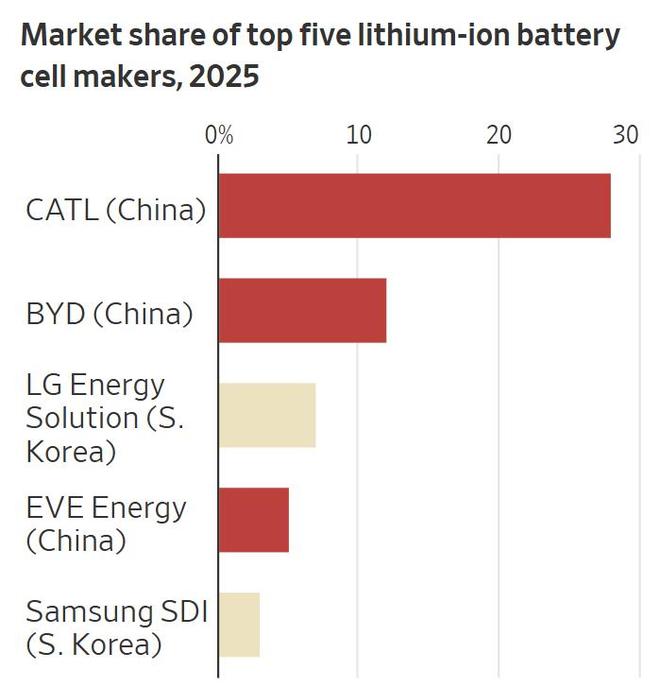
Core Viewpoint - The article discusses China's strategic dominance in critical industries such as rare earths, lithium-ion batteries, semiconductors, and pharmaceuticals, emphasizing its ability to leverage this position against the U.S. amid ongoing geopolitical tensions [1][14]. Group 1: Rare Earths and Supply Chain Control - China has established a leading position in the supply chain for rare earths, which are crucial for both military and civilian applications, and has implemented export controls as a common international practice [1]. - The U.S. media has suggested that China's control over rare earths has forced negotiations with former President Trump, highlighting the perceived "weaponization" of supply chains [1][14]. Group 2: Lithium-Ion Batteries - China produces 79% of the world's battery cathode materials and 92% of anode materials, controlling 63% of the market for refined lithium products, 80% of refined cobalt, and 98% of refined graphite [2]. - The two largest battery manufacturers globally are Chinese companies, CATL and BYD, which dominate the electric vehicle and energy storage markets [5]. Group 3: Semiconductor Industry - China accounts for approximately one-third of the global capacity for mature process semiconductors, which are essential for automotive, consumer electronics, and defense industries [5]. - The country has invested billions to enhance its semiconductor manufacturing capabilities, aiming for self-sufficiency [5]. Group 4: Pharmaceutical Sector - A significant portion of active pharmaceutical ingredients (APIs) used in U.S. medications is sourced from China, including key ingredients for widely used drugs like acetaminophen and ibuprofen [12]. - China has prioritized the development of its pharmaceutical and medical device industries, aiming to innovate and reduce reliance on foreign imports [12][14]. Group 5: Strategic Self-Sufficiency - Over the past two decades, China has systematically pursued economic self-sufficiency, reducing dependence on Western imports and establishing a robust industrial base [14][16]. - The Chinese government continues to strengthen its industrial capabilities, emphasizing the importance of a resilient supply chain and a modernized manufacturing system [14].
2025 BNEF上海峰会 | 揭晓完整议程与领袖视角
彭博Bloomberg· 2025-11-04 06:04
Core Insights - The Bloomberg New Energy Finance (BNEF) annual summit will take place in Shanghai on November 25-26, 2025, marking its 11th anniversary and coinciding with the transition from the 14th Five-Year Plan to the 15th Five-Year Plan [2] - The summit aims to gather leaders and decision-makers from various sectors including energy, transportation, industry, finance, and technology to shape a cleaner and more competitive future [2] Agenda Highlights - The summit will feature a keynote speech, welcome addresses, and policy dialogues on the first day [4] - On the second day, discussions will focus on the energy transition of data centers, highlighting the pressure on operators to decarbonize amid rising digital demands and the significant role of tech giants in clean energy purchasing agreements [5] Industry Trends - Over the past 11 years, the BNEF summit has witnessed significant evolution in China's energy sector, driven by technological innovation, policy guidance, financial capital, and strategic corporate decisions [7] - The energy transition is closely linked to macroeconomic factors and global policies, serving as a powerful engine for new economic development [7] Recent Developments - The energy sector has experienced significant changes, including shifts in global trade tariffs affecting energy trade patterns and supply chain dynamics [9] - Key policy changes include the impact of the COP29 climate financing progress and the release of the "Document 136" in China, which will influence future industry demand and investment decisions [9] - Technological advancements in the solar industry and a 20% drop in lithium-ion battery prices by the end of 2024 are accelerating the global electrification process [9] - The rise of AI and data centers presents unprecedented opportunities and challenges for the energy sector [9]
