软件和信息技术服务

Search documents
麦迪科技:11月24日召开董事会会议
Mei Ri Jing Ji Xin Wen· 2025-11-25 09:16
Group 1 - The core point of the article is that Madi Technology (SH 603990) announced the results of its board meeting held on November 24, 2025, which included the proposal for the reappointment of the financial audit and internal control audit institutions for the year 2025 [1] - For the year 2024, Madi Technology's revenue composition is as follows: software and information technology services account for 49.97%, the photovoltaic industry accounts for 36.18%, medical services account for 13.27%, and other businesses account for 0.58% [1] - As of the time of reporting, Madi Technology has a market capitalization of 4.8 billion yuan [1] Group 2 - The article also mentions that another company, identified by the code 688496, is under investigation by the China Securities Regulatory Commission due to a significant loss exceeding 100 million yuan shortly after its IPO, with its main customer reducing purchases for self-use [1]

【宏观经济】一周要闻回顾(2025年11月19日-11月25日)
乘联分会· 2025-11-25 09:01
Core Viewpoint - The article highlights the positive impact of e-commerce in China from January to October 2025, emphasizing its role in boosting consumption, promoting modern industrial systems, and expanding high-level openness to the outside world [3][4]. E-commerce Development - In the first ten months of 2025, China's online retail sales increased by 9.6% year-on-year, driven by digital consumption and quality e-commerce [3]. - Smart products and online services saw significant growth, with smart wearables like AI glasses and smartwatches growing by 23.1%, and online service consumption increasing by 21% [4]. - Instant e-commerce also thrived, with sales rising by 24.3%, particularly in the restaurant sector where online coupons for in-store experiences grew by 25.1% [4]. Industrial E-commerce - Industrial e-commerce is facilitating the digital transformation of small and medium-sized enterprises, with over 400 matching events held by major e-commerce platforms [4]. - Key sectors such as textiles and pharmaceuticals experienced e-commerce transaction growth of 5.5% and 3.4%, respectively [4]. - Agricultural products and rural online retail sales grew by 9.5% and 7.5%, respectively, indicating a strong push for e-commerce to empower local agricultural products [4]. International Cooperation - The "Silk Road E-commerce" initiative is fostering high-quality cooperation along the Belt and Road, with 12 innovative practice cases being replicated nationwide [5]. - Activities promoting the Chinese market as a global opportunity included 36 events, with significant sales growth in imported goods, such as a 73.7% increase in Uzbek candy and a 39.9% increase in Thai mangosteen [5]. Foreign Investment - In the first ten months of 2025, China established 53,782 new foreign-invested enterprises, a year-on-year increase of 14.7%, while actual foreign investment amounted to 621.93 billion yuan, a decrease of 10.3% [11]. - The manufacturing sector attracted 161.91 billion yuan, while the service sector received 445.82 billion yuan in foreign investment [11]. - High-tech industries saw a significant increase in foreign investment, with e-commerce services growing by 173.1% [11].


企业数据资产入表规模增长、增速放缓,高市值公司入表增多
Di Yi Cai Jing· 2025-11-25 07:49
Core Insights - The implementation of data asset recognition for companies has shown steady growth, but the growth rate has slowed down since its initiation on January 1, 2024 [1][2] Summary by Category Listed Companies - The number of A-share listed companies recognizing data resources increased from 40 in mid-2024 to 109 by mid-2025, with total recognized amounts rising from 1.36 billion to 2.64 billion yuan [1] - The "intangible assets" category remains the primary disclosure method, with 101 companies reporting data resources as intangible assets totaling 1.71 billion yuan [1] - Most data resources in intangible assets are generated through self-development, with straight-line amortization over 3-5 years being the mainstream practice [1] Industry Distribution - The financial sector saw a significant increase in the number of listed companies recognizing data assets, up 33% from the end of 2024, with a total amount of 0.54 million yuan, primarily from banks and securities firms [2] - The three major telecom operators contributed significantly, with a total recognition amount of 1.6 billion yuan, accounting for 60.7% of the market total [2] - Data asset recognition has expanded to cover 25 provincial administrative regions, with an increasing number of high-market-cap companies participating [2] Non-Listed Companies - As of September 30, 2025, 375 non-listed companies have disclosed data asset recognition, with a total financing amount of 1.899 billion yuan [2][3] - Local state-owned enterprises are the main contributors, accounting for 82.67% of the total recognized companies, with a cumulative financing amount of 1.71 billion yuan [3] - The leading industries for non-listed companies recognizing data assets include information transmission, software and IT services, and transportation [3] Challenges and Considerations - There is a gap between top-level design and practical implementation, with many ambiguities in specific rights confirmation, valuation standards, and auditing criteria [4] - Companies face challenges in matching investments with expected returns, as the complexity of data asset recognition requires significant resources [5] - Balancing information disclosure with commercial confidentiality is crucial, as excessive disclosure may risk revealing core algorithms and user data [5]
斥资15亿!上海“新生”企业拿下上市公司
Sou Hu Cai Jing· 2025-11-25 07:29
Core Viewpoint - The recent announcement by He Sheng New Materials regarding the transfer of 18% of its shares to Moer Zhixin marks a significant change in control, with implications for the company's strategic direction towards the semiconductor industry [1][3][12]. Group 1: Share Transfer Details - He Sheng New Materials' controlling shareholder Zhao Dongming and others plan to transfer 44.66 million shares (18% of total shares) to Moer Zhixin at a price of 33.71 yuan per share, totaling approximately 1.505 billion yuan [1][6]. - After the transaction, Moer Zhixin will become the controlling shareholder, and the actual controller will change to Xie Haiwen [3][5]. - The share transfer price represents a discount of about 13% compared to the market price of 38.82 yuan per share, valuing He Sheng New Materials at approximately 9.632 billion yuan [6][7]. Group 2: Company Background and Performance - He Sheng New Materials, established in 2002, specializes in the research, production, and sales of composite materials for home appliances, with a stable supply relationship with major brands like Samsung and LG [8][9]. - The company has shown steady revenue growth, with reported revenues of 2.269 billion yuan in 2021 and projected revenues of 2.526 billion yuan in 2024, alongside a significant profit increase of 67.9% in the first three quarters of the current year [8][9]. Group 3: New Controlling Shareholder and Strategic Direction - Moer Zhixin, established in August 2025, focuses on cutting-edge technology sectors, including integrated circuit design and artificial intelligence, indicating a strategic shift for He Sheng New Materials towards technology and semiconductor industries [10][12]. - The new controlling shareholder's background in finance and industry, particularly Xie Haiwen's experience in investment and project incubation, is expected to enhance He Sheng New Materials' competitive edge [11][12]. - The acquisition is seen as a signal for He Sheng New Materials to accelerate its transformation into the semiconductor field, with plans to leverage its existing resources for further development in this area [12][13].

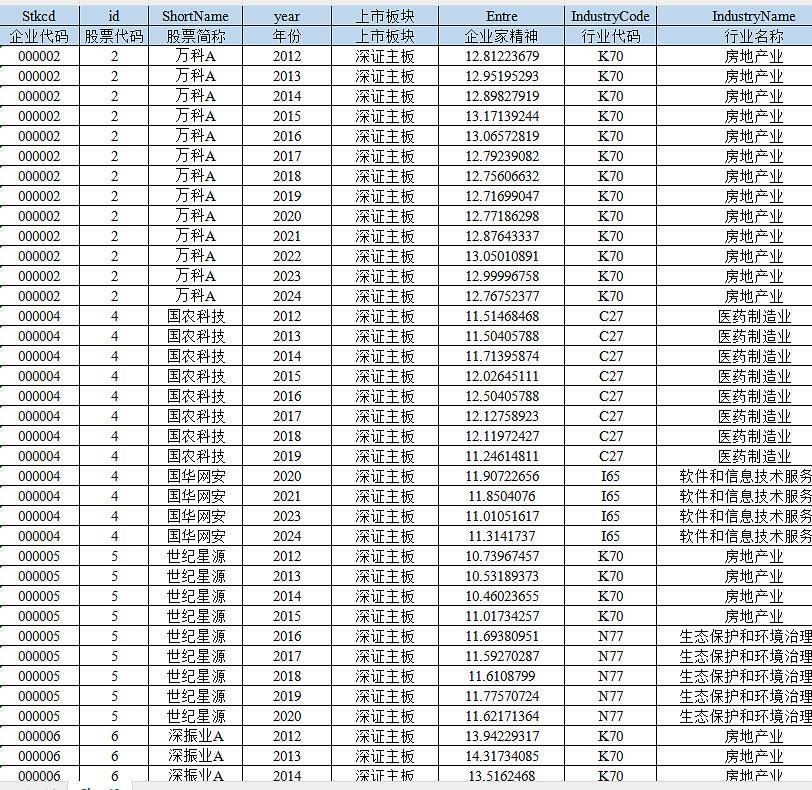
上市公司企业家精神数据2012-2024年
Sou Hu Cai Jing· 2025-11-25 00:57
Core Insights - Entrepreneurial spirit is defined as the ability and willingness of entrepreneurs to exhibit innovation, risk-taking, opportunity recognition, and resource integration during the digital transformation and supply chain integration of enterprises [1] - The core characteristics of entrepreneurial spirit include creativity, decision-making ability, risk-taking, and adaptability to change [1] Data Overview - The data covers listed companies' entrepreneurial spirit from 2012 to 2024, including metrics such as company code, stock code, stock name, year, listing segment, entrepreneurial spirit score, industry code, and industry name [2] - The entrepreneurial spirit score is calculated using the entropy weight method based on indicators like the number of patent applications, per capita fixed assets, per capita income, per capita intangible assets, and board independence [1][2] Company Performance - For example, the company "力科A" (Stock Code: 000002) shows a fluctuating entrepreneurial spirit score from 12.81223679 in 2012 to 12.99996758 in 2023, with a peak of 13.17139244 in 2015 [2] - "国农科技" (Stock Code: 000004) has a score that peaked at 12.50405788 in 2016 but decreased to 11.3141737 in 2024 [2] - "世纪星源" (Stock Code: 000005) demonstrated a score increase from 10.73967457 in 2012 to 11.77570724 in 2019, followed by a slight decline [2] Industry Insights - The data includes various industries such as real estate, pharmaceutical manufacturing, and software and information technology services, indicating the entrepreneurial spirit across different sectors [2] - The real estate industry, represented by companies like "力科A" and "深振业A," shows varying scores, with "深振业A" reaching a high of 14.31734085 in 2013 [2]



国家能源局数据显示 截至10月底全国累计发电装机容量37.5亿千瓦
Zhong Guo Zheng Quan Bao· 2025-11-24 20:16
Core Insights - The National Energy Administration reported that as of the end of October, the total installed power generation capacity in China reached 3.75 billion kilowatts, representing a year-on-year growth of 17.3% [1] - Solar power generation capacity reached 1.14 billion kilowatts, with a significant year-on-year increase of 43.8%, while wind power capacity reached 590 million kilowatts, growing by 21.4% [1] - Total electricity consumption in China for the first ten months was 86,246 billion kilowatt-hours, reflecting a year-on-year increase of 5.1% [1] Installed Capacity - Total installed power generation capacity: 3.75 billion kilowatts, up 17.3% year-on-year [1] - Solar power capacity: 1.14 billion kilowatts, up 43.8% year-on-year [1] - Wind power capacity: 590 million kilowatts, up 21.4% year-on-year [1] Electricity Consumption - Total electricity consumption: 86,246 billion kilowatt-hours, up 5.1% year-on-year [1] - Electricity consumption by the primary industry: 1,262 billion kilowatt-hours, up 10.5% year-on-year [1] - Electricity consumption by the secondary industry: 54,781 billion kilowatt-hours, up 3.7% year-on-year, with industrial electricity consumption increasing by 3.9% [1] - Electricity consumption by the tertiary industry: 16,671 billion kilowatt-hours, up 8.4% year-on-year, with rapid growth in the charging and swapping service industry and information transmission, software, and IT services [1] Sector-Specific Insights - The charging and swapping service industry experienced a significant increase in electricity consumption, with the internet data service sector growing by 43.2% year-on-year [2] - The wholesale and retail sector's charging and swapping service industry saw a year-on-year increase of 47.0% in electricity consumption [2]
大盘震荡回调,指数短期性价比凸显
Sou Hu Cai Jing· 2025-11-21 12:42
Market Overview - The A-share market experienced a significant decline on November 21, 2025, with the Shanghai Composite Index falling by 2.45% to close at 3834.89 points, and the Shenzhen Component Index down by 3.41% to 12538.07 points. The ChiNext Index dropped by 4.02% to 2920.08 points, while the Hang Seng Index decreased by 2.38% to 25220.02 points, and the Hang Seng Tech Index fell by 3.21% to 5395.49 points. Overall, 5071 stocks declined against 351 that rose, with total trading volume reaching 1.98 trillion yuan [1]. Economic Indicators - The National Energy Administration reported that in October, the total electricity consumption reached 857.2 billion kilowatt-hours, marking a year-on-year increase of 10.4%. By sector, the primary industry consumed 12 billion kilowatt-hours (up 13.2%), the secondary industry consumed 568.8 billion kilowatt-hours (up 6.2%), and the tertiary industry consumed 160.9 billion kilowatt-hours (up 17.1%). Notably, residential electricity consumption rose by 23.9% to 115.5 billion kilowatt-hours [2]. Federal Reserve Insights - The minutes from the Federal Reserve's October meeting indicated that many participants believe the next meeting should maintain interest rates, while a minority suggested a potential 25 basis point cut. The minutes emphasized that further data validation regarding labor market concerns is necessary before considering another rate cut. The absence of key employment data has led to increased market speculation that the likelihood of a rate cut in December has diminished [1][2]. AI Sector Analysis - Nvidia's earnings report exceeded expectations; however, there are concerns regarding diminishing marginal returns in the AI sector. The sustainability of AI's growth is contingent upon new narratives and key players, as the current marginal utility is declining [1][2]. Investment Strategy - In the context of limited liquidity and weak fundamentals in the AI sector, it is advisable to avoid industries that have seen excessive gains. Short-term investment strategies should focus on dividend-paying assets such as banks, insurance, electricity, and coal to mitigate net asset volatility and secure relative returns. Despite short-term adjustments, the long-term outlook for the A-share market remains bullish [2].
推进实体经济和数字经济深度融合
Qi Lu Wan Bao· 2025-11-21 12:04
Core Viewpoint - The Shandong Provincial People's Congress has passed the "Shandong Provincial Digital Economy Promotion Regulations," which will take effect on January 1, 2026, marking a significant milestone in the development of the digital economy in Shandong [1] Group 1: Digital Economy Development - The regulations emphasize the transformation and upgrading of traditional industries through digitalization, aiming to enhance the scale and capability of the digital industry [2] - The regulations outline the acceleration of the development of core digital economy industries, including electronic information manufacturing, software and IT services, internet services, and communication services [2] - The digital economy's contribution to Shandong's GDP is projected to exceed 50% by the end of this year, with a year-on-year growth rate of 18% in digital industry revenue [4] Group 2: Data Management and Security - The regulations establish a comprehensive data resource management mechanism to promote the orderly flow and utilization of public, enterprise, and personal data [3] - Specific measures are included to enhance digital governance across various sectors, ensuring the safe and regulated flow of data as a core support for the healthy development of the digital economy [3] - The regulations align with national laws on cybersecurity, data security, and personal information protection, establishing a robust regulatory framework [3] Group 3: Implementation and Outreach - The regulations are designed to be applicable across various sectors, focusing on high-quality development while ensuring high-level security [5] - There will be increased efforts to promote and interpret the regulations to enhance public awareness and compliance [5] - The regulations incorporate successful measures from recent years and draw on best practices from advanced provinces, particularly in emerging fields like artificial intelligence and big data [5]
赛力斯凤凰智创取得基于AutosarAP平台动态加载服务的通道和实例的方法和装置专利
Jin Rong Jie· 2025-11-21 01:57
Group 1 - The core viewpoint of the article highlights that Chongqing Silis Phoenix Intelligent Technology Co., Ltd. has obtained a patent for a method and device based on the AutosarAP platform for dynamic loading services, with the patent announcement number CN 119496815 B and an application date of October 2024 [1] - Chongqing Silis Phoenix Intelligent Technology Co., Ltd. was established in 2023 and is located in Chongqing, primarily engaged in software and information technology services [1] - The company has a registered capital of 122,225 million RMB and has participated in one bidding project, with a total of 2,647 patent information entries and 2 administrative licenses [1]

【早报】投资者正在等候,本周重要事件将至;两只牛股宣布停牌核查
财联社· 2025-11-17 23:09
早 报 精 选 4、中芯国际:公司承接了大量模拟、存储、MCU等急单,目前存储行业供应存在缺口预计高价位态势将持续。 5、宁德时代第三大股东黄世霖本次询价转让价格为376.12元/股,较昨日收盘价折价3.8%。 宏 观 新 闻 1、 2025年11月17日,中国国务院副总理何立峰与德国副总理兼财政部部长克林拜尔在北京共同主持第四次中德高级别财金对话。 声明中提到,双方欢迎符合条件的上海证券交易所、深圳证券交易所上市公司在法兰克福证券交易所发行全球存托凭证。声明还提 到,双方支持加强在证券、期货及衍生品领域的交流合作。 2、日前,个别日本政客称中方对高市早苗涉台错误言论"反应过度"。日本内阁官房长官也辩称,日本政府在台湾问题上的立场没有 改变,与1972年《中日联合声明》一致。对此,外交部发言人毛宁表示,中方敦促日方本着对历史和双边关系负责的态度,停止越 线玩火,收回错误言行,切实把对华承诺体现在实际行动上。 3、据《金融时报》报道,美国白宫国家安全备忘录以及相关声明称,阿里巴巴集团向中国军方提供了针对美国目标的技术支持。外 交部发言人毛宁在昨日的例行记者会上表示,有关企业已经作出了回应。中国政府高度重视并依法 ...