房地产业

Search documents
每日投资策略-20250915
Guodu Securities Hongkong· 2025-09-15 02:07
Market Overview - The Hang Seng Index rose by 301 points, closing at 26,388.16, marking a weekly increase of 970 points or 3.82% [3][4] - The total market turnover for the day was 320.734 billion HKD, with a net inflow of 7.331 billion HKD from northbound trading [3] Key Companies Performance - Among the 88 blue-chip stocks, 55 saw an increase, with China Hongqiao (01378) rising by 7% to 26.84 HKD, making it the second-largest gainer [3] - HSBC Holdings (00005) increased by 1.1% to 106.3 HKD, while Hong Kong Exchanges and Clearing (00388) rose by 1% to 448.4 HKD [3] - Chow Tai Fook (01929) was the weakest blue-chip, declining by 2.9% to 16 HKD [3] Industry Insights - The automotive industry is projected to achieve annual sales of approximately 32.3 million vehicles in 2025, reflecting a year-on-year growth of about 3%, with new energy vehicle sales expected to reach around 15.5 million units, growing by about 20% [10] - The "impact investing" sector is gaining traction globally, with managed funds estimated to reach 1.6 trillion USD last year and expected to grow to 6 trillion USD by 2031 [7] Strategic Developments - Sai Crystal Technology (00580) has signed a strategic cooperation framework agreement with Sanan Semiconductor, ensuring stable supply and competitive pricing for semiconductor products [13] - 361 Degrees (01361) is exploring the use of stablecoins for payments and settlements in overseas markets, aiming to enhance payment efficiency and reduce costs for cross-border e-commerce [14]
现在到底是现金为王还是资产为王?告诉大家答案,早了解早受益
Sou Hu Cai Jing· 2025-09-14 23:41
Group 1 - The core debate in wealth management for 2024 revolves around whether to prioritize cash or diversify into assets, with individuals like Aunt Li facing dilemmas in their investment strategies [1][3] - The macroeconomic environment in 2024 is prompting a reevaluation of wealth management strategies among the public, emphasizing the need for personalized approaches based on individual circumstances [3][5] Group 2 - Cash is highlighted for its liquidity and stability, with data showing that as of 2024, household savings in China reached 143.8 trillion yuan, growing at a rate of 7.8% [5][6] - The potential income from cash holdings is illustrated, with a million yuan yielding 32,000 yuan in interest at a 3.2% annual rate, emphasizing the low risk of capital loss [5][6] - However, inflation poses a risk to cash's purchasing power, with the CPI increase at 2.4% in 2024, indicating a gradual erosion of cash value [6] Group 3 - Asset allocation is presented as a strategy to combat inflation and enhance value, with historical data showing that stocks, real estate, and gold have outperformed inflation over the past decade [7][8] - Real estate, despite recent price adjustments, has an average annual growth rate of 8.7% over the last twenty years, indicating its long-term investment value [8] - The stock market shows significant variability, with some stocks reaching new highs while others decline, underscoring the importance of stock selection and long-term investment [8] Group 4 - Gold has performed well in 2024, with prices rising from $2,000 to $2,180 per ounce, a 9% increase, reflecting its status as a safe-haven asset amid economic uncertainty [8] - The mutual fund industry has grown significantly, with total public fund assets reaching 28.7 trillion yuan by 2024, providing diverse investment options for ordinary investors [10] Group 5 - Different age groups exhibit distinct preferences for cash versus assets, with younger individuals favoring higher-risk investments, while older individuals tend to prefer cash and low-risk products [11] - Income levels also influence asset allocation strategies, with higher-income individuals diversifying more, while lower-income households tend to hold more cash [11] Group 6 - A recommended "core-satellite" investment strategy suggests maintaining 6 to 12 months of living expenses in cash while diversifying the rest into stocks, funds, and real estate [12] - The "100 minus age" rule is proposed as a guideline for asset allocation, adjusting the proportion of risk assets based on age [12] Group 7 - Investment knowledge and experience are crucial, with a recommendation for those less familiar with investing to maintain a higher cash ratio while gradually increasing asset allocation [13] - Market timing is emphasized, suggesting that increasing asset allocation during downturns and cash during booms can yield better returns [13] Group 8 - Liquidity needs, tax implications, and inflation expectations are critical factors in asset allocation decisions, with a focus on maintaining sufficient cash for upcoming large expenses [14] - Economic cycles should inform investment strategies, with risk assets performing well in expansion periods and cash becoming more valuable during contractions [14] Group 9 - Policy changes can significantly impact asset performance, necessitating regular reviews and adjustments to investment strategies based on evolving regulations [15] - Personal circumstances, such as income changes or health issues, should prompt reassessment of asset allocation [15] Group 10 - Successful wealth management often involves a combination of clear financial goals, reasonable asset allocation, and a commitment to continuous learning [16] - Technological advancements are transforming wealth management, making it more accessible and efficient [16] Group 11 - Investing in education and health is increasingly recognized as vital, with returns on knowledge investments potentially surpassing traditional financial assets [17] - Building and maintaining a strong social network can also yield unexpected opportunities and benefits [17] Group 12 - The most effective wealth managers adapt their strategies flexibly to changing environments, avoiding extremes of cash hoarding or asset liquidation [18] - Diversification is a key principle, with recommendations against concentrating investments in a single asset type [18] Group 13 - A practical investment strategy for Aunt Li involves allocating 200,000 yuan in cash for emergencies, 200,000 yuan in stable mixed funds, and 100,000 yuan in gold ETFs, balancing liquidity and growth potential [19] - This gradual approach to investing is encouraged as a learning process, emphasizing the importance of patience and strategy refinement over time [19]


深圳楼市,新消息!
Zheng Quan Shi Bao· 2025-09-13 08:27
Core Viewpoint - Shenzhen has introduced new housing market policies that optimize and adjust personal housing credit policies, allowing banks to no longer differentiate between first and second home loans in their interest rate pricing mechanisms [1] Group 1: Policy Changes - The new policy allows banks to set commercial personal housing loan interest rates based on the Shenzhen market interest rate pricing self-discipline mechanism, without distinguishing between first and second homes [1] - Multiple banks, including China Construction Bank's Shenzhen branch, have announced that they will implement this policy immediately, adjusting interest rates accordingly [1] Group 2: Impact on Existing Loans - The new policy has triggered dynamic adjustment mechanisms for some existing mortgage clients, allowing those with interest rates exceeding the average new loan rates by 30 basis points to apply for adjustments [2] - According to research, the new interest rates for second home loans in Shenzhen have decreased by 40 basis points, potentially reducing total repayment costs by nearly 80,000 yuan and monthly payments by approximately 220 yuan for a 1 million yuan loan over 30 years [2] Group 3: Market Response - Following the implementation of the new policy, the second-hand housing market in Shenzhen has shown a significant increase in activity, with a 45% rise in transaction volume within six days post-policy compared to the previous six days [3] - The Luohu district has experienced a remarkable 109% increase in second-hand housing transactions, attributed to its mature infrastructure and competitive pricing compared to other districts [3]
Fed Rate Cut Looms Large on the Market
ZACKS· 2025-09-12 15:51
Economic Overview - The U.S. economy is showing signs that it may be ready for an interest rate cut at the upcoming Federal Open Market Committee (FOMC) meeting, driven by milder inflation data and a surge in jobless claims [1][4] - The Consumer Price Index (CPI) for August reported a headline increase of +0.4%, which is slightly above expectations, while the inflation rate remains at +2.9%, indicating persistent high retail prices [2][5] - The Producer Price Index (PPI) fell to -0.1% month over month, suggesting that future CPI figures may also remain mild [3] Labor Market Insights - A significant increase in Initial Jobless Claims, particularly due to a one-time event in Texas, has reinforced expectations for a rate cut by the Fed [4] - The Fed has been data-dependent and has previously observed a stable labor market, but recent downward revisions indicate a loss of 911,000 jobs over the past year [5] Market Reactions - Stock market indexes are reaching record highs, with investors optimistic about potential rate cuts, which could stimulate sectors like housing that have been affected by high mortgage rates [6] - The anticipation of rate cuts is creating a positive sentiment in the market, although there are concerns about the sustainability of this optimism [7] Consumer Impact - Despite the potential for rate cuts, there are warnings that prices may not decrease, which could lead to consumers curbing spending or accumulating debt [8][9] - The gradual introduction of tariffs may further impact prices, posing challenges for consumers in the future [8][9]
Stock Market On Top of the World Ahead of Fed Meeting
ZACKS· 2025-09-12 15:16
Economic Overview - The U.S. economy is showing signs that it may be ready for an interest rate cut at the upcoming Federal Open Market Committee (FOMC) meeting, driven by milder inflation data and a surge in jobless claims [1][4]. Inflation Data - The Consumer Price Index (CPI) for August reported a headline increase of +0.4%, which is 10 basis points higher than expected, but generally aligns with trends observed over the past three years. The current inflation rate stands at +2.9%, still above the Federal Reserve's target [2]. - The Producer Price Index (PPI) has decreased to -0.1% month over month for both headline and core, indicating that tariffs are not significantly impacting wholesale prices. This suggests that future CPI figures may also remain mild [3]. Labor Market Insights - Initial Jobless Claims have seen a significant increase, largely due to a one-time event in Texas that accounted for 15,000 claims. This development has solidified expectations for a rate cut by the Fed [4]. - The Fed has been cautious in its approach, having previously observed a stable labor market before a recent downward revision of -911,000 jobs over the past year [5]. Market Reactions - Stock market indexes are reaching record highs, with the Dow and S&P 500 seeing profit bookings at these peaks. Anticipated rate cuts could stimulate sectors like housing, which have been hindered by high mortgage rates [6]. - There is a prevailing optimism in the market regarding the potential for rate cuts, although there are concerns that prices may not decrease significantly even with lower rates [7]. Consumer Impact - The expectation of rate cuts may not translate into lower prices for consumers, who are already beginning to limit spending and may be accumulating debt. The gradual introduction of tariffs could further exacerbate price increases [8]. - The economic landscape remains uncertain, with signs that prices may become increasingly unaffordable for consumers despite market excitement [9].
【立方债市通】央行公布重要数据/超六成融资平台隐性债务已清零/河南38笔新增债券资金用途调整
Sou Hu Cai Jing· 2025-09-12 13:03
Key Points - Over 60% of financing platforms have cleared their hidden debts, indicating accelerated reform and transformation in the financing platform sector [1] - The Ministry of Finance has issued 4 trillion yuan of the 6 trillion yuan special debt limit, reducing average debt interest costs by over 2.5 percentage points, saving over 450 billion yuan in interest expenses [1] - The National Development and Reform Commission is promoting the expansion of the REITs market, focusing on infrastructure assets such as toll roads and clean energy [1][2] - The People's Bank of China has announced a new evaluation method for primary dealers, effective from 2025, to enhance monetary policy transmission [4] - The State Council is implementing measures to promote private investment, focusing on expanding access and removing barriers for private capital in new infrastructure and emerging service sectors [6] - As of August, M2 growth was 8.8% and M1 growth was 6%, indicating a narrowing gap between the two [7] - The People's Bank of China will conduct a 600 billion yuan reverse repurchase operation, indicating ongoing liquidity management [9] - The Ministry of Finance plans to issue 2.42 trillion yuan in government bonds, including 820 billion yuan in ultra-long-term special bonds [20] - The issuance of green corporate bonds and other innovative debt instruments is on the rise, reflecting a focus on sustainable financing [17][22]

8月金融数据预测:社融增速如期调整
CMS· 2025-09-11 12:04
Financial Data Forecast - In August, the expected new social financing (社融新增) is approximately 1.98 trillion RMB, with a growth rate of 8.7%[7] - The forecast for new credit (信贷新增) in August is around 350 billion RMB, with a growth rate of 6.7%[4] - M2 growth is projected at 8.6% year-on-year, with an estimated increase of 12,985 billion RMB in total M2[10] Loan and Financing Insights - Expected new household loans are around -100 billion RMB, significantly lower than the previous year's 190 billion RMB[4] - Corporate loans are anticipated to be approximately 6,500 billion RMB, with a notable decline from the previous year's average of 3,000 billion RMB[4] - The total expected new loans from non-bank financial institutions is about 3,500 billion RMB, down from an average of 12,000 billion RMB over the past three years[10] Government Debt and Financing - Government net financing is estimated at 13,290 billion RMB for 2025, with a breakdown of 8,489 billion RMB from national bonds and 4,801 billion RMB from local bonds[8] - In August, the net financing from government bonds is projected to be around 13,000 billion RMB, compared to 18,000 billion RMB in the same month last year[10] Market Trends - The real estate market remains weak, with a decline in average daily transaction area for new homes in 30 cities by 0.1% month-on-month[4] - The auto market shows improvement, with a 22% year-on-year increase in wholesale sales of passenger cars[4]
泰舜观察|9月上旬大事点评及债市思考
Xin Lang Cai Jing· 2025-09-11 10:34
Group 1: US Economic Data and Market Reactions - The ADP employment data for August showed an increase of 54,000 jobs, significantly below the market expectation of 68,000, indicating a cooling labor market [1] - Following the disappointing employment report, the FOMC is expected to lower interest rates by 50-75 basis points this year, with potential further cuts in March and June 2026 [1] - US stock markets declined, with the Dow Jones Industrial Average falling by 220.43 points (0.48%) and the Nasdaq Composite down by 7.3 points (0.03%) [1] Group 2: Trade Policies and Tariffs - A confidential memorandum revealed that Japan agreed to let Trump decide the investment direction of its $550 billion in capital in the US to avoid high tariffs [2] - Trump signed an executive order adjusting the scope of import tariffs, allowing for zero tariffs on certain goods that cannot be produced in the US or are in short supply [3] Group 3: Domestic Economic Policies - China's foreign exchange reserves increased to $332.22 billion as of the end of August, up by $29.9 billion (0.91%) from July [4] - The People's Bank of China conducted a 1 trillion yuan reverse repurchase operation to maintain liquidity in the banking system, indicating a supportive monetary policy stance [7] - Shenzhen announced new real estate policies to stimulate housing demand, allowing non-residents to purchase two homes in certain districts and removing restrictions on corporate purchases [5] Group 4: Market Trends and Bond Yields - The bond market saw rising yields, with 1Y, 10Y, and 30Y government bond yields at 1.3959%, 1.8260%, and 2.1123% respectively, indicating a widening yield spread [8] - The stock market's strong performance may continue to attract funds, potentially diverting investment away from the bond market [9]

万达集团被执行超4亿元
Zheng Quan Shi Bao Wang· 2025-09-11 10:11
突发。 中国执行信息公开网显示,近日,大连万达集团股份有限公司新增一则被执行人信息,执行标的4亿余元,执行法院为北京金融法院。 | | 中国执行信息公开网 | | --- | --- | | | 司法为民 司法便民 | | 被执行人 | | | 被执行人姓名/名称: 大连万达集团股份有限公司 | | | 身份证号码/组织机构代码: | 24128139-2 | | 执行法院: | 北京金融法院 | | 立案时间: | 2025年09月08日 | | 案号: | (2025)京74执1517号 | | .. | | 天眼查显示,大连万达集团股份有限公司成立于1992年9月,法定代表人为王健林,注册资本10亿元人民币,经营范围包括商业地产投资及经营、酒店建 设投资及经营、连锁百货投资及经营、电影院线等文化产业投资及经营;货物进出口、技术进出口、国内一般贸易等。 | VIP | | | | | | | | --- | --- | --- | --- | --- | --- | --- | | 丁商信息 历史工商信息 | | | | | | ■ 导出 | | 企业名称 | 大连万达集团股份有限公司 | | | | | ...
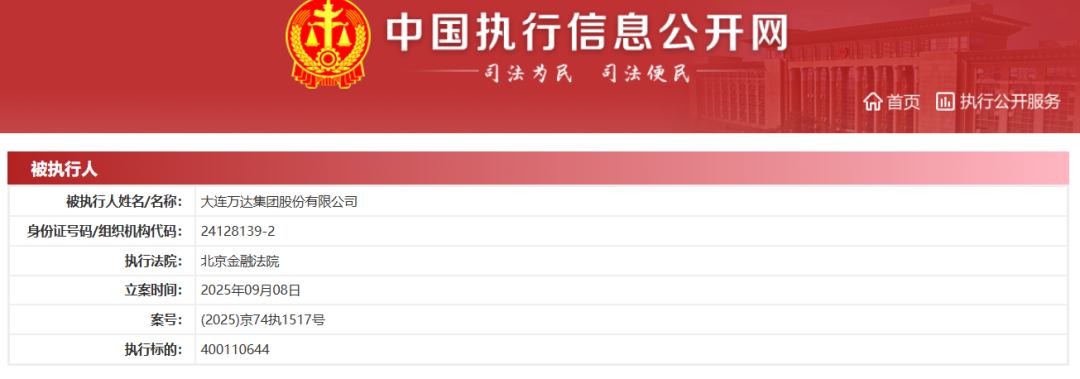
万达集团被执行超4亿元
证券时报· 2025-09-11 09:36
中国执行信息公开网显示,近日,大连万达集团股份有限公司新增一则被执行人信息,执行标的4亿余元,执行法院为北京金融法院。 | | 中国执行信息公开网 | | --- | --- | | | 司法为民 司法便民 山 执行公井服务 | | 被执行人 | | | 被执行人姓名/名称: 大连万达集团股份有限公司 | | | 身份证号码/组织机构代码: | 24128139-2 | | 执行法院: | 北京金融法院 | | 立案时间: | 2025年09月08日 | | 案号: | (2025)京74执1517号 | 天眼查显示,大连万达集团股份有限公司成立于1992年9月,法定代表人为王健林,注册资本10亿元人民币,经营范围包括商业地产投资及经营、酒店建设 投资及经营、连锁百货投资及经营、电影院线等文化产业投资及经营;货物进出口、技术进出口、国内一般贸易等。 | VIP 工商信息 历史工商信息 | | | | | & ■ 商官网快照 | 한 음료 | | --- | --- | --- | --- | --- | --- | --- | | 企业名称 | 大连万达集团股份有限公司 | | | | | | | 法定代表人 ...