
石化

Search documents
海合会国家中间体产能增势强劲
Zhong Guo Hua Gong Bao· 2025-12-16 03:09
Core Insights - The Gulf Cooperation Council (GCC) countries' petrochemical industry is focusing on digital transformation, sustainable development, and enhancing downstream value through high-value product development [2] - The production capacity of petrochemical intermediates in the GCC is expected to expand significantly, with high-value chemicals projected to grow from a low base in selected niche areas [2] - Basic chemicals and agricultural chemicals remain the core output of the GCC, with the top ten products, including ethylene, urea, and ammonia, accounting for approximately 65% of the region's total capacity [2] Industry Trends - The GCC petrochemical companies are gradually extending downstream and shifting towards high-value products due to ongoing overcapacity issues with products like ethylene [2] - Currently, high-value and specialty chemicals account for less than 2% of the total capacity in the region, contributing only 8% to the industry's total revenue [2] - The GCC's strategy emphasizes economic resilience and scalability, leveraging low-cost raw materials to maintain a leading position in basic chemicals while expanding intermediate production to unlock downstream value [3] Market Dynamics - The GCC petrochemical sector is actively seeking growth through innovation, diversification, and strengthened trade cooperation in a complex global environment [3] - China and India are currently the main export destinations for GCC petrochemical products, accounting for 28% and 23% of exports, respectively, while Africa and Latin America are expected to become growth engines for non-Asian exports in the next five years [3]
天津南港乙烯项目迎首船进口乙烷
Xin Hua Wang· 2025-12-16 01:16
Group 1 - The core viewpoint of the news is the successful arrival of the first shipment of 31,000 tons of ethane at the Tianjin Nangang Industrial Zone, marking the commencement of raw material supply for the Tianjin Nangang Ethylene Project [1][3] - The Tianjin Nangang Ethylene Project is a key national project under the "14th Five-Year Plan," focusing on an annual capacity of 1.2 million tons of ethylene and the development of a high-end new materials industry cluster [3] - This project addresses the gap in high-end petrochemical production capacity in northern China, and the arrival of the first ethane shipment signifies the operational readiness of the raw material supply system, laying a solid foundation for the project's full production and efficiency [3]


恒逸石化(000703.SZ):第四期员工持股计划股票出售完毕
Ge Long Hui A P P· 2025-12-15 12:40
格隆汇12月15日丨恒逸石化(000703.SZ)公布,近日,接第四期员工持股计划管理委员会的通知,公司 第四期员工持股计划持有的公司股票113,754,600股于2025年12月15日通过大宗交易方式全部出售完毕, 占公司总股本的3.16%。大宗交易的受让方为公司控股股东浙江恒逸集团有限公司。 ...

上市公司砍97%收入来源!三年亏17亿押注化学原料,能续命吗?
Sou Hu Cai Jing· 2025-12-15 09:03
说句实在话,一家上市公司把97%的收入来源直接"砍掉",这可不是普通调整,而是背水一战。 咱们今天聊的这事,主角是一家曾靠注入资产起死回生、如今又濒临退市边缘的老牌企业。 它现在想用一个"风口上"的新业务来续命,可问题是,这个新故事,真的能讲下去吗? 断臂求生:三年亏17亿,只能赌一把 从2022年开始,这家公司的净利润就没见过正数,三年多累计亏损超17亿元。 核心业务是丙烷制丙烯,听起来高大上,实则被原材料和产品价格"两头夹击":丙烷价格居高不下,丙 烯却卖不动价。 毛利率从2020年的20%一路滑到2025年前三季度的-12.18%,几乎每卖一吨都在亏钱。 周叔翻了翻财报,2025年上半年,它97.71%的营收都来自这家即将被卖掉的子公司。 换句话说,这不是优化资产,是彻底换血。 而推动这一切的,正是背后的地方国资——眼看着上市平台快保不住了,干脆来个"腾笼换鸟"。 押注TMA:踩在周期顶点上的豪赌 那么,新选中的"救命稻草"是谁?是一家主营偏苯三酸酐(TMA)的新三板公司。 这家公司过去两次冲击IPO都被否,理由很一致:毛利率高得离谱,又解释不清。 泰达新材业绩 但2024年,它突然"开挂"——净利润从 ...
院士专家建言石化行业低碳发展
Zhong Guo Hua Gong Bao· 2025-12-15 03:14
中化新网讯 绿色低碳发展是化工行业实现高质量发展的必由之路,必须通过科技创新和系统变革,才 能构建清洁低碳、安全高效的现代产业体系。这是11月22日在大连举行的2025中国化工学会化工碳中和 技术专业委员会第二届学术年会上达成的行业共识。 关于具体落地路径,会议提出了原料替代与创新体系构建两大方向。华东理工大学王辅臣教授分析了生 物质化工的技术前景,指出需突破原料适应性等瓶颈,并依据具体场景选择产业化路径。中国化工学会 化工碳中和技术专业委员会主任委员谢在库院士则从动力机制出发,强调需构建产学研用深度融合的创 新体系。国家自然科学基金委化学科学部五处处长张国俊从支持机制上回应,表示基金委将持续加大对 该领域基础研究和原创性项目的支持力度。 此次大会由中国化工学会主办,大连理工大学、中国科学院大连化学物理研究所承办。来自政府部门、 行业组织、重点企业、科研院所的500余位代表参加了会议。 与会专家普遍认为,实现碳中和是一项宏大的系统工程,必须从顶层设计着手。中国化工学会副理事长 兼秘书长方向晨指出,行业处于转型升级关键期,需以系统性思维推动变革。中国科学院大连化学物理 研究所所长刘中民院士对此深表赞同,他强调需 ...
SABIC呼吁石化行业加强协作应对挑战
Zhong Guo Hua Gong Bao· 2025-12-15 03:01
Core Insights - The petrochemical industry needs to enhance collaboration, including public-private partnerships, to address challenges such as overcapacity, regulatory changes, and technological disruptions [1] Industry Overview - The Gulf Cooperation Council (GCC) is projected to see a 5.7% year-on-year increase in petrochemical production capacity in 2024, reaching 165.4 million tons [1] - The average operating rate of plants is expected to decline from 93.4% in 2023 to 89.5% in 2024, indicating a situation where new capacities are coming online while global demand recovery is slowing [1] - The increase in capacity is primarily attributed to new and upgraded projects in Saudi Arabia and Oman [1] Financial Performance - The total sales revenue of the petrochemical industry in the GCC is forecasted to decrease by 6.5% year-on-year, falling to $80.1 billion in 2024 [1] - Approximately three-quarters of the petrochemical products from GCC member states are used for export, highlighting the region's critical role in the global petrochemical value chain [1]
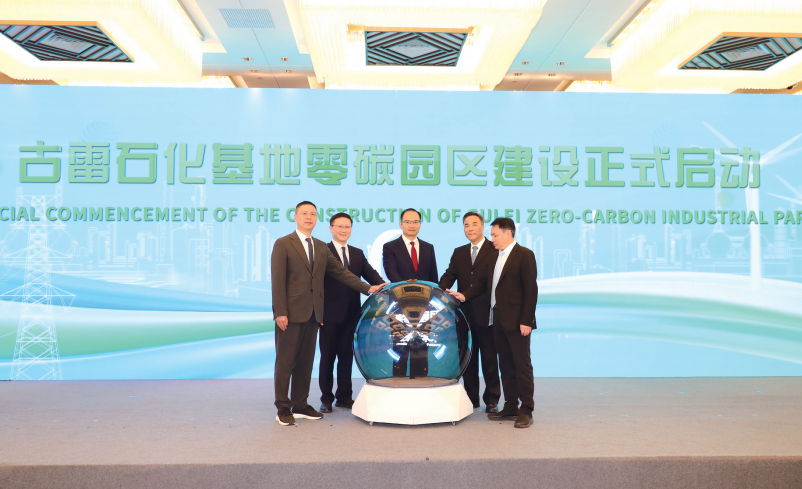
古雷零碳园区建设启动
Zhong Guo Hua Gong Bao· 2025-12-15 02:29
Core Viewpoint - The launch of the zero-carbon park construction at the Gulei Petrochemical Base aims to create a leading national and internationally recognized model for low-carbon development in the petrochemical industry, integrating green energy, low-carbon processes, circular economy, and digital governance [2]. Group 1: Project Overview - The Gulei Petrochemical Base will follow a "two-step" strategy for low-carbon and zero-carbon transformation, with the first phase aiming to establish a fine chemical zero-carbon park by 2029, targeting a carbon emission reduction to 0.25 tons per ton of standard coal [5]. - The second phase, set to be completed by 2035, will expand the successful model to the entire base, achieving a national standard zero-carbon park goal of 0.3 tons per ton of standard coal [5]. Group 2: Implementation Strategies - Key tasks for the Gulei development zone include increasing the proportion of green clean electricity, replacing thermal energy with clean alternatives, enhancing energy efficiency in the petrochemical sector, improving zero-carbon transportation infrastructure, and boosting carbon management capabilities [5]. - The Gulei development zone has already made significant progress during the 14th Five-Year Plan period, reducing energy consumption per unit of industrial added value from 4.3 tons of standard coal per 10,000 yuan in 2020 to 2.02 tons by 2024, a decrease of over 50% [5]. Group 3: Collaborations and Initiatives - New projects signed at the conference include green aromatic production from carbon dioxide hydrogenation, sustainable aviation fuel from green electricity and carbon dioxide, and ethylene production from green electricity and carbon dioxide [6]. - The Gulei development zone has partnered with Jilin University and Tianjin University to enhance talent development and research cooperation, promoting the transition to zero-carbon through technological innovation [6].
经济观察|海南自贸港封关在即:解码开放“财富密码”
Zhong Guo Xin Wen Wang· 2025-12-15 01:57
Group 1 - Hainan Free Trade Port will implement full island closure operations on December 18, marking a significant step in China's high-level opening-up and the construction of an open world economy [1] - The "zero tariff" policy will see the proportion of imported goods increase from 21% to 74%, significantly reducing operational costs for businesses [2] - Companies like Laozunxing (Hainan) Technology Co., Ltd. are capitalizing on the favorable policies by importing luxury vehicles, saving approximately 150 million RMB in taxes [1][2] Group 2 - The processing and value-added tax exemption policy will be further relaxed, allowing companies to enjoy greater tax benefits and operational flexibility [2] - Hainan's unique natural conditions combined with open policies are expected to foster multiple industry upgrades, including digital economy, high-end materials, and biomedicine [3] - The establishment of platforms like PlayOL in Hainan is facilitating the expansion of gaming companies, allowing them to save on costs related to overseas server setups [3]
国内高频指标跟踪(2025年第49期):内需仍待提振
GUOTAI HAITONG SECURITIES· 2025-12-14 07:33
Consumption - Overall commodity consumption is weak, with automotive sales declining and high-end liquor prices continuing to fall[1] - Seasonal recovery in textile and apparel demand is insufficient compared to the same period last year[1] - Service consumption shows stable population movement, with Shanghai's amusement consumption performing well in the off-season[1] Investment - Investment remains weak, with infrastructure construction slowing down and new home transactions marginally declining[1] - The area of new homes sold in 30 cities continues to decrease, with a slight narrowing of the year-on-year decline[14] - The proportion of second-hand home transactions has increased to 65.94%[14] Production - Production is expected to improve mainly due to year-end rush work, with coal inventory at ports continuing seasonal replenishment[1] - The operating rate of asphalt has slightly decreased to 27.8%, remaining at historical lows[14] - The operating rate of carbonates has increased, but remains at a relatively low level compared to the same period last year[23] Trade - The number of ships departing from ports has shown seasonal recovery, with domestic and international freight rates continuing to diverge due to demand differences[1] - Export value has increased, with a year-on-year growth rate of 17.3%[20] Prices - Industrial product prices have declined, with the PPI dropping by 0.97%[33] - CPI growth rate has decreased by 0.02 percentage points, with significant price increases in food and healthcare services[33] Liquidity - The US dollar index has fallen by 58 basis points to 98.4, influenced by the Federal Reserve's interest rate cuts[36] - The central bank's net currency injection was 4.7 billion yuan in the week of December 13[36]
冲刺万亿GDP城市,温州胜算最大
Sou Hu Cai Jing· 2025-12-14 01:33
Core Viewpoint - Wenzhou is expected to surpass a GDP of 1 trillion yuan this year, with Xuzhou and Dalian also aiming for this milestone, indicating a trend of ordinary prefecture-level cities joining the ranks of trillion-yuan cities in China [1][3][4]. Group 1: Economic Progress of Cities - Wenzhou's GDP for the first quarter was 240.37 billion yuan, with a growth rate of 6.7%, and it is projected to reach 1 trillion yuan this year [2]. - Xuzhou's GDP for the first three quarters was 729.812 billion yuan, with a growth rate of 6.0% [2]. - Dalian's GDP for the first three quarters was 724.82 billion yuan, with a growth rate of 6.0% [2]. Group 2: Characteristics of Trillion-Yuan Cities - The expansion of trillion-yuan cities includes ordinary prefecture-level cities, with Wenzhou and Xuzhou being notable examples [2][3]. - Cities with GDPs between 700 billion and 800 billion yuan, such as Shaoxing, Yangzhou, Yancheng, and Jiaxing, are expected to be the main drivers for future growth towards the trillion-yuan mark [2][16]. Group 3: Implications for Urban Economic Structure - The trend of expanding trillion-yuan cities reflects a shift in China's urban economic landscape, moving from provincial capitals and sub-provincial cities to ordinary prefecture-level cities [3][17]. - The focus on high-quality urban development emphasizes the need for structural upgrades in industries, income levels, and green development, rather than just quantitative growth [3][18]. Group 4: Wenzhou's Economic Foundation - Wenzhou's economic growth is supported by a robust manufacturing base and a strong private sector, with 83% of its GDP generated by the private economy [7]. - The city aims to establish a dual trillion-yuan industrial cluster by 2025, combining traditional industries with emerging sectors such as digital economy and new materials [7]. Group 5: Future Prospects for Dalian and Xuzhou - Dalian aims to become a trillion-yuan city by 2025, focusing on high-quality development and modernizing its industrial structure [10][12]. - Xuzhou's government has set a target to exceed 1 trillion yuan by 2025, with a focus on becoming a regional hub in Jiangsu province [14][15].
