
银行理财

Search documents
公募费率改革影响债基投资银行理财“喜忧参半”
Shang Hai Zheng Quan Bao· 2025-09-21 18:08
Core Viewpoint - The third phase of public fund fee reform has been implemented, leading to the end of the "7-day exemption" for bond fund redemptions, which increases short-term redemption costs for banks' wealth management products, creating a mixed impact on the industry [1][2]. Summary by Sections Impact on Bank Wealth Management - Banks are pleased that their wealth management products do not charge redemption fees, enhancing their liquidity advantage over bond funds [1][2]. - However, banks are concerned about the increased trading costs associated with investing in bond funds, as high-frequency trading strategies become less viable [1][3]. Changes in Investment Strategy - Analysts suggest that the investment strategy for bank wealth management will shift from "short-term arbitrage and liquidity hedging" to "long-term holding and structured usage" [1][5]. - In a low-interest-rate environment, enhancing equity investments to boost returns is becoming increasingly important for banks [1][6]. Market Trends and Data - Data shows that as of September 19, the scale of bank wealth management products increased by approximately 105.9 billion yuan compared to August, indicating a shift of funds from public funds to bank wealth management products [4]. - Most bank wealth management products do not charge subscription or redemption fees, with management fees generally kept below 0.5%, making them more cost-effective than public bond funds [4][6]. Future Directions - The fee reform is expected to push bank wealth management companies to enhance their credit research and liquidity management capabilities [5][7]. - There is a structural shift anticipated in the allocation of wealth management funds from short-term bond funds to ETFs and other investment vehicles that are not affected by the new redemption fee rules [7][8].
平安理财破局:“工业化+平台化”筑牢回撤防线
Zheng Quan Shi Bao· 2025-09-21 17:06
Core Viewpoint - The article emphasizes the importance of stable returns and effective risk management in the banking wealth management sector, particularly through the practices of Ping An Wealth Management, which aims to provide a robust investment experience for clients amidst market volatility [1][2][3]. Group 1: Investment Performance - As of the end of July this year, Ping An Wealth Management's fixed income and fixed income+ products achieved an average annualized return of 3.46% over the past three years, ranking among the top in the industry [2]. - The probability of positive returns for investors holding fixed income and fixed income+ products until maturity is 98% and 99%, respectively [2]. - The proportion of products with negative returns is only 0.55%, significantly lower than the industry average, indicating effective management of drawdowns [2][3]. Group 2: Risk Management Strategy - Ping An Wealth Management has established a strong focus on drawdown management, aiming to control net value fluctuations while maintaining competitive returns [3][4]. - The company has adopted an "industrialization + platformization" investment management model to enhance efficiency and consistency in risk-return characteristics across its product offerings [4][5]. Group 3: Product Development and Branding - The company has launched a new product system called "An+Xin Stable and Long-term," which includes four product series: "Anxin" for cash management, "Anwen" for absolute return fixed income products, "Anzhi" for multi-asset strategies, and "Anyuan" for mixed products aimed at long-term value appreciation [7]. - This product upgrade aims to better meet the increasingly diverse wealth management needs of investors by providing clearer product positioning and richer functional scenarios [7]. Group 4: Strategic Growth and Market Position - Ping An Bank is focusing on enhancing its asset management scale (AUM) through a strategic shift towards wealth management, particularly in basic wealth management products, which are seen as a reservoir for high-quality AUM growth [6]. - The bank is adjusting its structure to increase the proportion of basic wealth management products, aligning with trends in resident wealth allocation preferences and enhancing the resilience of its AUM structure [6].

商务部发布19条措施促进服务消费
Sou Hu Cai Jing· 2025-09-21 12:02
Group 1: Service Consumption Policies - The Ministry of Commerce, along with eight other departments, released a document outlining 19 specific measures to promote service consumption growth, focusing on enhancing high-quality service supply capabilities [1] - Key initiatives include launching "Service Consumption Season" activities, supporting cross-industry collaborations, expanding pilot programs in telecommunications and healthcare, and optimizing student holiday arrangements [1] - The document emphasizes the establishment of pilot cities for new consumption formats, models, and scenarios to stimulate market vitality, reflecting the government's commitment to the service consumption market [1] Group 2: Mergers and Acquisitions - Local state-owned capital merger funds are becoming significant market players, with regions like Shanghai, Shenzhen, Fujian, and Zhejiang establishing or planning such funds, aligning with national strategic directions [2] - The introduction of policies like the "Six Merger Guidelines" indicates an improved policy environment for mergers and acquisitions, assigning these funds a crucial role in driving industrial upgrades and regional transformations [2] Group 3: Financial Market Developments - The China Securities Regulatory Commission is seeking public opinion on new regulations for the management of public fund sales expenses, which may impact the performance of short-term bond funds [2] - The Federal Reserve recently lowered the federal funds rate by 25 basis points to a range of 4.00%-4.25%, marking its first rate cut in nine months, amid concerns over employment and economic growth [2] Group 4: SoftBank's Strategic Adjustments - SoftBank Group announced a nearly 20% reduction in its Vision Fund team, focusing remaining resources on founder Masayoshi Son's AI projects, particularly the $500 billion Stargate initiative [3] - This restructuring reflects SoftBank's strategy to adapt to challenges while maintaining a focus on high-potential investment areas [3] Group 5: Market Performance Overview - Major global stock markets saw an upward trend, with notable performances from China's Shenzhen Component Index and the Hang Seng Index, while the U.S. stock indices also reported gains [3] - The bond market showed mixed results, with slight declines in short-term yields and increases in longer-term yields, indicating varied investor sentiment [3] Group 6: Fund Market Trends - The bank wealth management market is dominated by fixed-income funds, with 328 funds representing 51.09% of the total, reflecting investor preference for stable returns [5] - Bank wealth management subsidiaries lead in new product issuance, accounting for 73.99% of new products and 96.33% of total scale, indicating their competitive advantage in the market [5] - The demand for low-risk and innovative products is rising, supported by a favorable policy and regulatory environment, which enhances the performance of fixed-income assets [5]
发行热度加温!银行理财为何瞄准指数型产品?
Guo Ji Jin Rong Bao· 2025-09-19 15:59
Core Viewpoint - The rise of passive index investment strategies has led banks to actively develop index-based wealth management products, which are characterized by high transparency, low fees, and risk diversification [1][4]. Group 1: Product Overview - There are currently 116 index-related wealth management products available for sale, with issuers including 12 bank wealth management subsidiaries such as China Merchants Bank Wealth Management and Huaxia Wealth Management [1]. - Index-based wealth management products are designed to replicate index components directly or indirectly [2]. Group 2: Performance Analysis - Index-based wealth management products show impressive annualized returns across various risk levels. For instance, the "Huiying Xiang Fixed Income Enhanced" product from Xinyin Wealth Management achieved annualized returns of 15.17% over one month, 8.79% over three months, and 8.92% since inception [3]. - Huaxia Wealth Management's "Digital Infrastructure Index" product, with a risk rating of PR5, reported a year-to-date increase of 14.46% and a total increase of 52.33% since inception [3]. Group 3: Market Trends and Insights - The development of index-based products is supported by regulatory encouragement for long-term capital market participation, especially in a low-interest-rate environment where traditional fixed-income asset yields are declining [4]. - The advantages of index-based products include high transparency, low fees, and risk diversification, which meet investors' needs for clear understanding of product structures and return sources [4]. Group 4: Future Outlook - The future of index-based products is viewed positively, with suggestions for investors to understand the investment strategies and risks associated with these products, and to adopt a long-term investment perspective [5]. - Challenges remain, as the overall risk tolerance of bank wealth management investors is relatively low, which may limit acceptance of higher-risk index-based products [6].
权益市场回暖提升混合类理财产品收益
Zheng Quan Ri Bao· 2025-09-19 15:43
Core Insights - The performance of mixed financial products has been strong, with at least 20 products achieving an annualized return of over 10% since inception [1][2] - The success of these products is attributed to their flexible asset allocation strategies and the recovery of the stock market, which has created profitable opportunities [1][3] Group 1: Performance and Characteristics - Mixed financial products have shown significant returns, with some achieving an annualized return of 45.46% over a three-month period [2] - These products are defined as those investing in various asset classes without any single asset class exceeding 80% [2] - The flexibility in asset allocation allows for effective risk diversification and capturing market opportunities [3][4] Group 2: Advantages and Market Positioning - Mixed financial products balance risk and return by combining stable bond yields with higher potential equity returns, making them suitable for moderately risk-tolerant investors [4][5] - They typically have flexible liquidity arrangements, with minimum holding periods often around 60 days, catering to both return and liquidity needs [4][6] - The products are positioned to meet diverse investor needs, particularly in a low-interest-rate environment, emphasizing their low volatility and enhanced return characteristics [6] Group 3: Future Development Recommendations - Banks' wealth management subsidiaries are encouraged to optimize product design, risk control, and customer targeting to enhance mixed financial products [5][6] - Recommendations include offering a variety of holding periods and clearly distinguishing between different types of mixed products to better match investor risk preferences [5][6] - Emphasis on dynamic asset adjustment capabilities and the application of financial engineering techniques to improve risk management and return potential [6]
美联储降息,美元理财还能上车吗?
Guo Ji Jin Rong Bao· 2025-09-19 15:09
Core Insights - The Federal Reserve's interest rate cut has sparked discussions about the future of dollar-denominated financial products, with many investors questioning whether to redeem their investments [1][2] - Current annualized yields for dollar financial products are around 3.6%, with expectations for further declines in the future [2][4] - Experts emphasize the importance of considering exchange rate risk, interest rate decline risk, and liquidity risk when investing in dollar financial products [1][4] Yield Expectations - Recent consultations with bank representatives indicate that the annualized yield for dollar financial products has been between 3.66% and 3.7% over the past six months, but is expected to drop to a range of 3.2% to 3.4% due to the interest rate cut [2][3] - Compared to similar risk-level RMB financial products, dollar financial products have historically shown better performance [2] Risk Considerations - The primary concern for investors is not the declining yields but the potential losses from exchange rate fluctuations, which could negate any gains from financial products [3][4] - Investors are advised to be cautious about redeeming dollar investments if the costs of currency exchange result in losses [3] Asset Allocation Strategies - Experts suggest that banks and financial institutions should optimize product structures by incorporating floating-rate bonds and multi-currency assets to enhance resilience against market cycles [4][5] - There is a recommendation for the introduction of inflation-protected securities and products that dynamically hedge against exchange rate risks [4][5] - Long-term strategies should focus on building a resilient multi-dimensional asset portfolio to navigate the new normal of declining interest rates [5]
徽商银行APP推荐产品热衷量化选基,广银高收益产品回报走低
2 1 Shi Ji Jing Ji Bao Dao· 2025-09-19 12:29
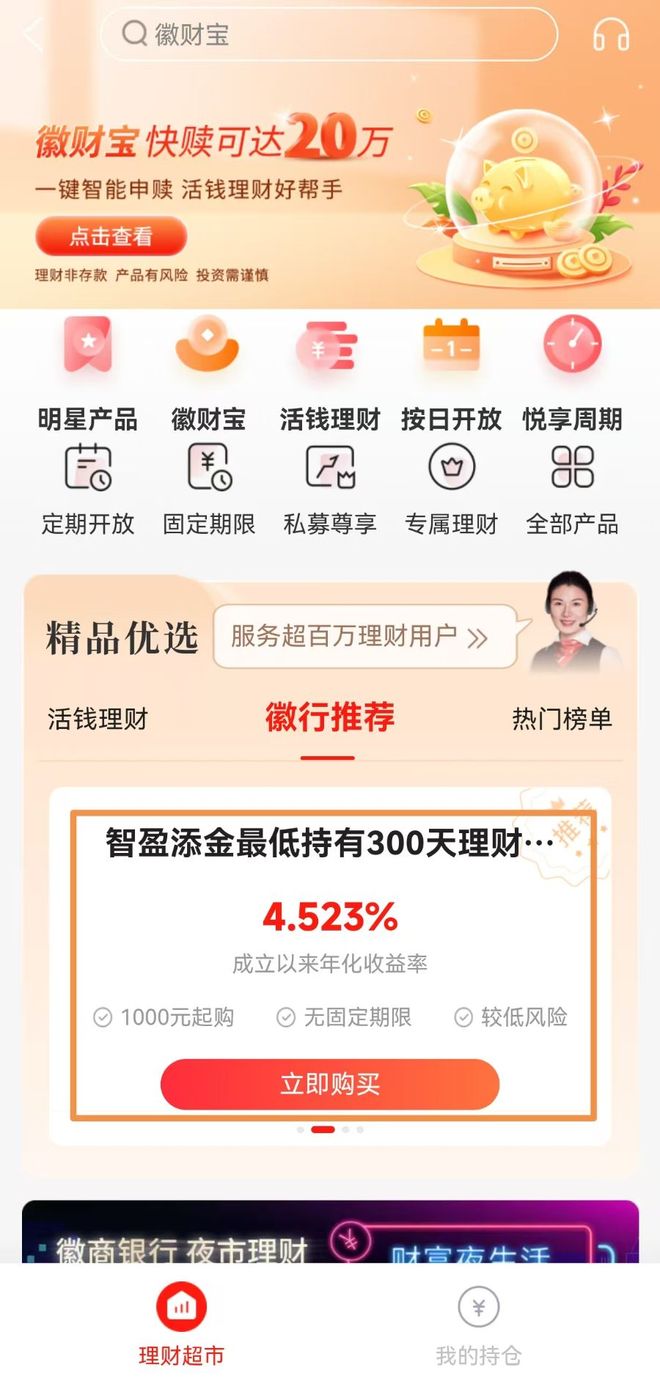
Core Viewpoint - The recent performance of the bond market shows a slight rebound, while the stock market faces some resistance, leading to a primarily fluctuating trend in investments [1] Product Overview - The product "智盈添金最低持有300天理财产品2号" from Huishang Bank has a minimum holding period of 300 days and focuses on fixed income investments [6] - As of the end of Q2 this year, the product's investment in funds reached 62.71%, which is significantly higher than typical fixed income products that primarily invest directly in bonds [4][13] Investment Strategy - The product employs a strategy that includes quantitative fund selection, with the top ten holdings consisting entirely of public funds, indicating a reliance on fund manager selection capabilities [4][13] - The product's investment strategy is categorized into three main approaches: asset allocation strategy, fund investment strategy, and bond investment strategy [17] Performance Metrics - The average yield of the "智盈添金" series products was 2.13% last year, with a net value growth rate of 1.42% in the first half of this year, annualized to approximately 2.84% [5] - The product scored 25 in yield, 92 in risk control, 11 in risk-adjusted return, and 58 in comprehensive fee rate, ranking it 128th, 238th, 189th, and 192nd respectively among 356 similar products [5] Risk and Fee Structure - The product has a risk level classified as secondary (medium-low), with a maximum drawdown since inception of 10.63% [12][18] - The new redemption fee structure introduced by the CSRC on September 5 requires a minimum redemption fee of 1.5% for holdings less than seven days, which may impact the product's fund investments [4] Comparative Analysis - The product's annualized return since inception is 4.52%, outperforming 67.13% of similar products, while its recent one-month annualized return is 2.41%, beating 40.17% of similar products [11][12] - The product's overall performance is considered average compared to peers, particularly due to the recent underperformance of some funds within its portfolio [8][17]

平安理财的“阳谋”:低回撤信仰刻入考核,撬动母行高质AUM
Zheng Quan Shi Bao Wang· 2025-09-19 01:31
Core Insights - The article emphasizes the importance of absolute returns in the current investment landscape, particularly for bank wealth management products, which are heavily influenced by low-risk preferences [1][2][3] - Ping An Wealth Management has established a strong focus on managing drawdowns and achieving stable returns, with a notable average annualized return of 3.46% over the past three years for its fixed income products [1][3] - The company is transitioning towards a more industrialized and platform-based investment management model to enhance efficiency and consistency in risk-return profiles across its product offerings [6][7][8] Group 1: Investment Strategy and Performance - Ping An Wealth Management has maintained a low proportion of negative returns, with only 0.65% of products breaking net asset value and 0.55% showing negative returns as of July [1] - The company has created a product structure that aligns with customer risk preferences, offering various products with different holding periods and risk profiles [4][10] - The "启航增强稳盈定开" series of fixed income products achieved an average annualized return of 3.41% since its inception, demonstrating resilience in a low-interest-rate environment [5] Group 2: Market Position and Future Growth - Ping An Bank is focusing on enhancing its wealth management capabilities to capture a larger share of the retail investment market, particularly through its wealth management product offerings [2][9] - The bank aims to increase the proportion of basic wealth management products to improve the quality of its assets under management (AUM) and adapt to changing consumer preferences [9][10] - The newly launched "安+心稳致远" product system aims to meet diverse investor needs by providing clear product positioning and a variety of investment strategies [10]
存款减少超千亿、理财产品增加 上市公司也在“存款搬家”?
2 1 Shi Ji Jing Ji Bao Dao· 2025-09-18 23:44
Core Viewpoint - The trend of "deposit migration" among residents and companies is highlighted, with a significant decrease in resident deposits and an increase in wealth management products due to lower deposit rates and a recovering equity market [1][2]. Group 1: Deposit Trends - In August, new resident deposits decreased by 110 billion yuan, down 600 billion yuan year-on-year, while new non-bank deposits increased by 11.8 billion yuan, up 5.5 billion yuan year-on-year [1]. - The overall scale of listed companies' wealth management has shown a downward trend, with a total subscription amount of 1.10 trillion yuan in the past year, a decrease of 26.17% from the peak of 1.49 trillion yuan in 2022 [2]. Group 2: Wealth Management Preferences - Listed companies are increasingly favoring wealth management products, with a notable shift towards structured deposits and bank wealth management products, which now account for 9.93%, 6.87%, and 2.07% of their investments, respectively [2][4]. - The demand for wealth management among listed companies is driven by the need for stable returns and liquidity, especially as companies mature and experience cash accumulation [3]. Group 3: Market Dynamics - The decline in deposit rates has made bank wealth management products more attractive, with average annualized yields for cash management products at 1.32% and long-term fixed income products at 1.39% [6][7]. - The total investment in structured deposits by listed companies was approximately 681.12 billion yuan, although this has decreased by around 100 billion yuan year-on-year [7]. Group 4: Corporate Financial Strategies - Companies are increasingly focusing on optimizing their capital structure and improving asset return efficiency, necessitating flexible management of idle funds to mitigate liquidity risks [5]. - The recovery in corporate profits is expected to lead to a restoration of the total scale of funds used for wealth management, as net profits for all A-share listed companies rose to 3.21 trillion yuan in the first half of 2025, up 2.23% year-on-year [8]. Group 5: Asset Management Opportunities - Asset management institutions are actively positioning themselves to meet the growing demand for corporate wealth management, with a focus on customized and flexible product offerings [9][10]. - The trend towards institutionalization and professionalization in the listed company wealth management market presents significant opportunities for asset management firms to enhance their competitive capabilities [11].


更好满足投资者多样化需求
Jing Ji Ri Bao· 2025-09-18 23:43
Core Viewpoint - The recent addition of two fixed-income personal pension financial products by China Post Wealth Management reflects the ongoing expansion and innovation in the personal pension market, which aims to meet diverse investor needs and enhance retirement planning options [1][2][3]. Group 1: Product Development - The newly introduced personal pension products have minimum holding periods of 18 months and 2 years, with a risk level classified as moderate (level 2) [1]. - These products primarily invest at least 80% in low-risk fixed-income assets while allowing up to 20% in equities to enhance returns, utilizing strategies like preferred stock allocation and hedging tools to reduce volatility [1][2]. - As of August 2023, the scale of personal pension financial products from China Post Wealth Management has surpassed 20 billion yuan, serving nearly 400,000 investors [2]. Group 2: Market Potential - The personal pension system, as the "third pillar" of China's pension insurance framework, is supported by government policies and aims to provide supplementary retirement benefits [2]. - Recent reports indicate that personal pension financial products have generated over 390 million yuan in returns for investors, with an average annualized return exceeding 3.4% [3]. - There is a significant market potential for personal pension products, as the current supply from bank wealth management subsidiaries remains relatively low compared to investor demand [3]. Group 3: Innovation and Future Outlook - Financial institutions are encouraged to innovate in three key areas: product variety, asset allocation, and service integration, to better cater to different age groups and risk appetites [4]. - The development of a diverse range of pension products will enhance the personal pension financial market, making it a crucial component of retirement finance in China [4].