
银行理财

Search documents
城商行理财子现金类产品收益领跑,2家近3月收益均值超1.7%
2 1 Shi Ji Jing Ji Bao Dao· 2025-09-17 08:01
Overall Performance - The average seven-day annualized yield for RMB public cash management products is 1.383%, while for USD cash products, it is 3.910% as of September 11 [2] - There are a total of 6087 RMB public cash management products, with only 39 products (0.64%) having a yield above 2% in the last three months [2] - 1209 products (19.86%) fall within the yield range of 1.5% to 2%, while most products yield between 1% and 1.5% [2] - Notably, 22 cash products have a yield below 1%, including those from China Merchants Bank and Minsheng Bank [2] Highlighted Product Analysis - Among institutions, Su Yin Wealth Management, Bei Yin Wealth Management, and Nan Yin Wealth Management have the highest average yields over the last three months, at 1.760%, 1.710%, and 1.614% respectively [3] - Su Yin Wealth Management's "Qi Yuan Cash No. 4 N" and "Qi Yuan Currency No. 2 (ESG Theme) F" lead the rankings with average yields of 2.885% and 2.849% [3] - The "Zhao Win Daily Gold No. 96 A" from China Merchants Bank, launched on May 27, has a seven-day annualized yield of 2.19% and a risk rating of PR1 [3]
ESG投资周报:本月新发4只ESG基金,流动性环比收窄-20250917
GUOTAI HAITONG SECURITIES· 2025-09-17 06:32
Market Performance - The A-share market showed signs of recovery with the CSI 300 index rising by 1.38% and the ESG 300 index increasing by 1.37% during the week of September 8-12, 2025[5] - The average daily trading volume for the entire A-share market was approximately 2.34 trillion yuan, indicating a contraction in liquidity compared to previous periods[5] ESG Fund Issuance - Four new ESG funds were launched in September 2025, with a total issuance of 3.468 billion units, primarily focused on social responsibility and environmental protection[8] - Over the past year, a total of 247 ESG public funds were issued, amounting to a total of 175.072 billion units[8] - As of September 14, 2025, there are 923 existing ESG funds, with the largest share being ESG strategy funds at 50.48% of the total net asset value of 1,028.855 billion yuan[10] Fund Performance - The top-performing fund for the week was the Zhongjia Low-Carbon Economy Six-Month Holding A, achieving a weekly return of 13.47% and a year-to-date return of 72.57%[11] - Other notable funds included Manulife Growth A and Manulife Revitalization A, with returns of 12.70% and 12.20% respectively for the week[12] Green Bond Market - A total of 84 ESG bonds were issued in September 2025, with an issuance amount of 36.3 billion yuan[15] - The total issuance of ESG bonds over the past year reached 1,059 bonds, totaling 1,172 billion yuan[15] - The existing ESG bond market consists of 3,672 bonds, with green bonds making up the largest share at 61.71% of the total outstanding amount of 5.57 trillion yuan[15] Bank Wealth Management Products - In September 2025, 37 new ESG bank wealth management products were launched, with a total of 1,091 products issued over the past year[21] - The existing ESG bank wealth management products total 1,087, with pure ESG products comprising 56.03% of the total[21] Risk Factors - Potential risks include insufficient policy support for ESG initiatives, lack of standardized data reporting, and lower-than-expected product issuance volumes[24]
近3个月涨幅超10% 股市回暖带动这类理财产品收益率大幅提升
Mei Ri Jing Ji Xin Wen· 2025-09-16 14:52
Core Viewpoint - The recent surge in equity market activity has led to a significant increase in the yields of mixed financial products, with many achieving annualized returns exceeding 10% in the past month, driven by a shift towards equity investments in the wealth management industry [1][2][5]. Group 1: Performance of Mixed Financial Products - Several mixed financial products have reported annualized returns over 10% in the last month, with some achieving a 3-month increase of over 10%, corresponding to an annualized yield as high as 40% [1][2]. - For instance, a product from Minsheng Wealth Management, "Minsheng Wealth Silver Bamboo Mixed Flexible A-Share Opportunity Financial Product," recorded a 3-month increase of 10.03% and an annualized yield of 40.26% [2]. - The product's risk rating is classified as high risk (level four), with an absolute return target of 20% during the closed period and 4%-8% post-closure [2]. Group 2: Investment Strategies and Asset Allocation - The mixed financial products utilize diversified multi-strategy investment approaches to mitigate systemic risks and achieve yield targets [2]. - As of the end of the first half of 2025, the product's indirect equity investment accounted for 13.65% of total assets, while indirect fund investments made up 69.33%, with bonds and money market funds comprising 32.36% [2]. - The flexibility of mixed financial products allows for adjustments in asset allocation based on market conditions, enhancing both stability and potential returns compared to other financial products [3]. Group 3: Market Trends and Regulatory Environment - The trend of "deposit migration" continues as residents shift funds from traditional savings to investment products amid declining deposit rates and a recovering equity market [4][5]. - Recent regulatory changes have facilitated the participation of bank wealth management products in the equity market, including eligibility for participating in A-share IPOs, which enhances the competitiveness of mixed financial products [5][6]. - The necessity for equity investments in wealth management products has become more pronounced in the context of declining interest rates, with mixed products being a key avenue to attract long-term investments [6].
周报 |“股债跷跷板”再现,近两成理财产品近一周收益为负
2 1 Shi Ji Jing Ji Bao Dao· 2025-09-16 11:32
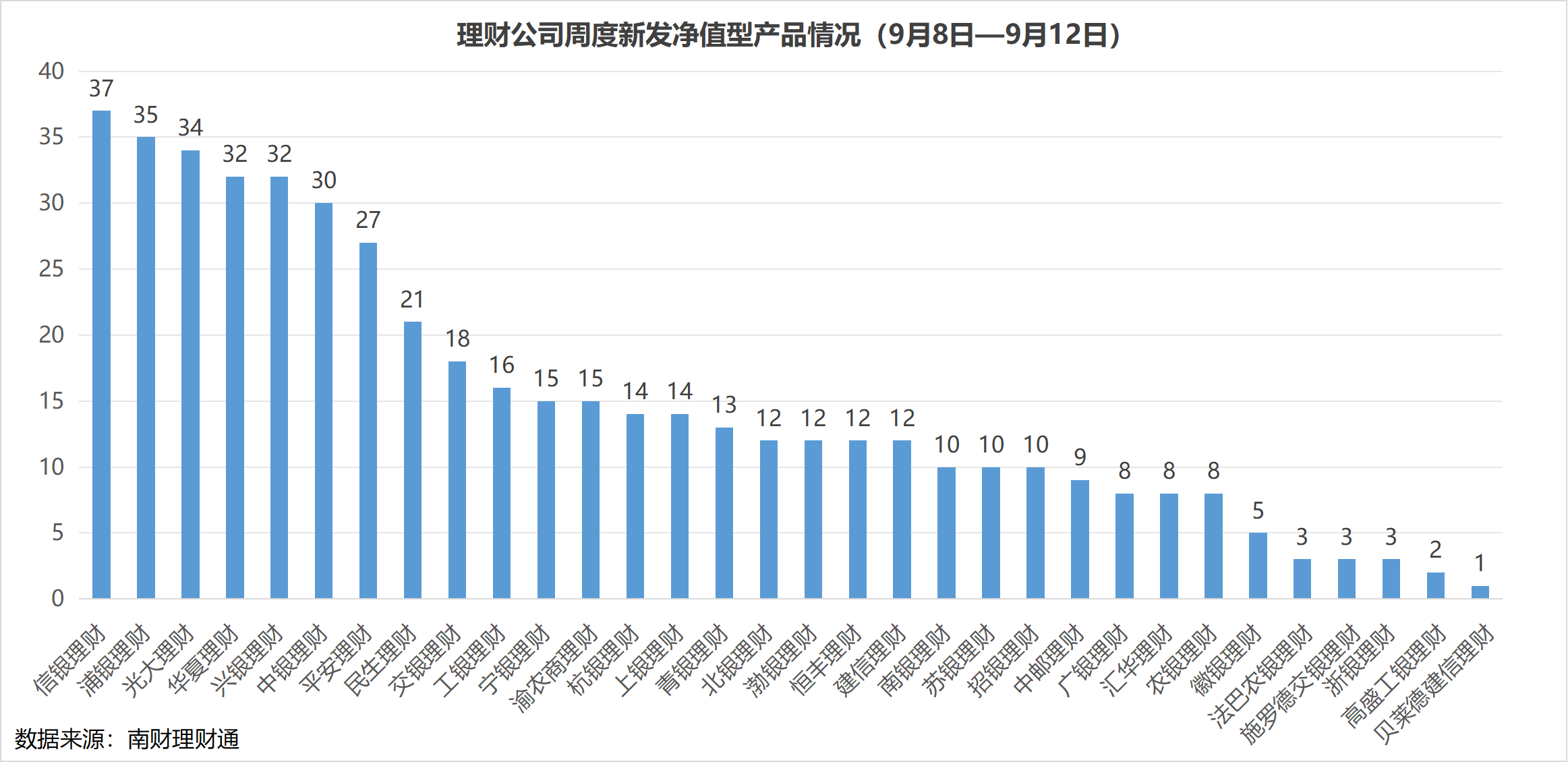
编者按:《机警理财日报》作为南财集团、21世纪经济报道、南财理财通的金牌理财专栏,目前细分了现金、纯固收、固收+期权、固收+权益、混合、权 益、衍生品七大类,已实现对银行理财市场的每日追踪。为了进一步反映银行理财行业发展现状,南财理财通课题组增设机警理财周报专题,力求及时准确 研判理财行业趋势、洞悉理财产品表现,以期为银行理财行业转型发展带来参考价值。 【市场回顾】 上周债市震荡偏弱,资金面均衡偏紧。9月12日DR007加权均价为1.4575%,10年期国债收益率收至1.87%。A股震荡上行,科创50指数周涨幅达5.48%,上证 指数、沪深300指数周涨幅分别为1.52%、1.38%,电子、房地产、农林牧渔板块周涨幅居前。 【破净情况】 【新发情况】 产品数量:南财理财通数据显示,32家理财公司上周(9月8日—9月12日)合计发行了481只理财产品(同一产品登记编码下不同份额合并计算),股份行理 财公司产品发行量居前,信银理财发行了37只产品,浦银理财和光大理财分别发行了35只、34只。 产品特点:理财公司上周新发产品仍以R2(中低风险)、封闭式净值型、固收类公募型产品为主,混合类产品发行数量为1只,权益类产 ...

从“黑盒”走向“白盒” 银行理财竞逐指数化赛道
Zhong Guo Jing Ying Bao· 2025-09-15 23:03
Core Viewpoint - The rise of index-based products in the wealth management sector is driven by the need for transparency, diversification, and adaptability in a low-interest-rate environment, enhancing investor trust and participation in capital markets [1][4][5]. Group 1: Index Product Development - Financial institutions like交银理财 and 招银理财 are launching various index products, including multi-strategy asset allocation indices, to optimize investment configurations and provide clearer selection paths for investors [1][2]. - The total scale of index products in the fund industry has surpassed 5 trillion yuan, indicating rapid growth and adoption of index-based investment strategies [1]. Group 2: Benefits of Indexation - Index-based benchmarks allow for dynamic adjustments based on the investment scope, improving clarity on returns and volatility for investors, thus reducing discrepancies between expected and actual performance [2][4]. - The introduction of index products is seen as a response to the low-interest-rate environment, enabling wealth management firms to seek enhanced returns while managing risks through diversified asset allocation [2][5]. Group 3: Market Trends and Regulatory Support - Regulatory bodies are encouraging long-term capital market participation, with initiatives like the 2025 action plan aimed at optimizing the index investment ecosystem, presenting new opportunities for index-based investment in the banking wealth management sector [4][6]. - The characteristics of index products, such as transparency, low fees, and diversified investments, are gaining recognition in the market, aligning with investor demands for clearer understanding and lower costs [4][6]. Group 4: Investor Guidance - Investors are advised to choose index products based on their risk tolerance and investment goals, with recommendations to consider asset correlation and historical performance metrics when selecting indices [7][8]. - The trend towards indexation is reshaping the industry, emphasizing the importance of understanding personal risk profiles and adapting investment strategies accordingly [8].
宁银理财姚爽:含权理财的绝对回报之道
Jing Ji Guan Cha Wang· 2025-09-15 07:15
Core Insights - The article highlights the increasing popularity of wealth management products with equity investments, particularly those with a 20%-45% allocation to equity assets, as the stock market reaches new highs [1][2] - The investment philosophy of the equity investment manager at Ningyin Wealth Management emphasizes three principles: focusing on win rates, balanced diversification, and left-side trading [1][2][3] - The performance of various wealth management products managed by the company has been strong, with notable annualized returns, such as 8.5% for a mixed fund since its inception and 10.6% for a Hong Kong stock strategy product [1][2] Investment Strategy - The investment range for wealth management products is broader than that of public funds, allowing for more diverse asset allocation and risk management strategies [2] - The absolute return assessment model used by wealth management firms helps managers focus on the quality of listed companies and balanced asset allocation rather than short-term market trends [2][3] - The "left-side trading" principle is crucial in investment decisions, where the manager evaluates the growth prospects of equity assets before making buy or sell decisions [3] Market Trends - The article notes a shift in the dividend strategy landscape, with a focus on three categories: stable dividend stocks, cyclical dividend stocks, and individual stock exploration [4][5] - The stable dividend stocks provide consistent returns but may see a decline in yield as prices rise, while cyclical stocks are expected to benefit from economic recovery and increased cash flow [4] - The new policy allowing wealth management products to participate directly in IPOs and private placements is seen as a significant advantage, enhancing potential returns [6] Performance Metrics - The performance of the wealth management products has been commendable, with specific products achieving annualized returns of 6.8% since their inception [5] - The focus on maintaining a favorable ratio of annualized absolute return to maximum drawdown is emphasized as a key metric for attracting investors [3][5] - The company is committed to continuously optimizing asset allocation strategies based on market conditions to ensure sustained, robust returns for investors [3][6]
理财资金借道含权产品入市“潮涌” 规模扩张引发收益挑战
Jing Ji Guan Cha Bao· 2025-09-13 04:53
Core Insights - The banking wealth management market is experiencing a shift towards equity-linked products, with a notable increase in the proportion of equity investments in these products [1][2][3] - The trend of reallocating funds from pure fixed-income products to equity-linked products is driven by the need to adapt to declining market interest rates and the challenges faced in selling traditional fixed-income products [2][8] - High-net-worth investors are actively adjusting their investment strategies, favoring equity-linked products with a central equity investment ratio of at least 30% [4][5] Group 1: Market Trends - The total scale of wealth management products in August reached 31.2 trillion yuan, remaining stable compared to the previous month, indicating a trend of internal circulation of funds [1] - There is a significant net inflow of funds into equity-linked products with an equity investment ratio between 20% and 45% [2] - The issuance of mixed products by banking wealth management subsidiaries has increased, with 45 new products launched in July, surpassing the average monthly issuance in the first half of the year [7] Group 2: Investor Behavior - Investors are increasingly choosing to invest in equity-linked products rather than directly entering the stock market, reflecting a cautious approach due to past experiences with stock market volatility [3][4] - High-net-worth investors are particularly active in reallocating their funds, moving from pure fixed-income products to more balanced equity-linked products [4][5] - Many investors prefer flexible, daily-open equity-linked products over fixed-term or long-locked products, seeking liquidity amid market fluctuations [9] Group 3: Product Development Challenges - Wealth management subsidiaries face challenges in designing suitable equity-linked products that meet new investor demands, particularly regarding liquidity and risk management [9] - The rapid growth in the scale of R3-rated equity-linked products poses risks of yield dilution and position reduction, prompting companies to diversify investment strategies [8][9] - Companies are exploring customized wealth management services to cater to high-net-worth investors' specific needs, aiming to alleviate pressure from increasing fund scales [8]
分化之后见“真章”:信银理财的稳健领跑之道
2 1 Shi Ji Jing Ji Bao Dao· 2025-09-12 05:01
Core Insights - The banking wealth management market in 2025 has shown robust growth, with the total market size surpassing 30 trillion yuan, driven by declining deposit rates and increasing demand for wealth management products [1] - The report indicates that wealth management companies have become the dominant players, with a total size of 27.48 trillion yuan, reflecting a 4.44% increase from the beginning of the year and a 12.98% year-on-year growth, accounting for 89.61% of the market [1] - Despite the growth in scale and investor numbers, the industry faces challenges in achieving high-quality and sustainable development, including declining product yields and increased asset volatility [1] Industry Overview - As of June 2025, the number of investors holding wealth management products reached 136 million, an increase of 8.37% from the beginning of the year, indicating a growing appetite for wealth management products among investors [1] - The wealth management industry is undergoing significant restructuring, with leading companies like Xinyin Wealth Management emerging as key players, achieving substantial growth in both scale and net profit [2][3] Company Performance - Xinyin Wealth Management has demonstrated exceptional growth, with its asset scale increasing from 1.99 trillion yuan to 2.13 trillion yuan in the first half of 2025, marking a 7% increase and entering the 2 trillion yuan club [4] - The company's net profit exceeded 1 billion yuan, reaching 1.196 billion yuan, and it has served 25 million clients, generating investment returns of 23.5 billion yuan in the first half of 2025 [4] - Xinyin Wealth Management's annualized yield for its existing products reached 2.48%, ranking among the top in large banking wealth management companies [4] Product Strategy - The company has established a comprehensive product management system and a professional investment team, focusing on stable investment directions and absolute return goals [5] - As of June 2025, the scale of Xinyin Wealth Management's one-year and above wealth management products reached 729.9 billion yuan, with a 34.64% share of new products [5] - The "Anying Elephant" series of products has gained popularity, with one product achieving a fundraising scale of 12.386 billion yuan, setting a record for the year [6] Risk Management - Xinyin Wealth Management maintains a low product break-even rate of 0.35%, with fixed-income products achieving a "0 break-even" status, indicating strong risk management capabilities [4][7] - The company has developed a multi-strategy research and investment system, ensuring a systematic approach to investment and risk budgeting [7] Digital Transformation - The company is at the forefront of digital transformation in the wealth management industry, implementing an "AI+" three-year action plan to enhance its capabilities in investment research, risk control, and customer service [9][10] - Xinyin Wealth Management is leveraging AI technologies to improve operational efficiency and customer engagement, aiming to create a data-driven management model [10] Future Outlook - The company plans to continue strengthening its comprehensive system across customer service, product development, and risk management, aiming to become a world-class asset management institution [11]
“固收+黄金”策略:银行理财新宠,适合你的风险偏好吗?
Sou Hu Cai Jing· 2025-09-12 03:19
Core Insights - The rising gold prices have led to increased interest in "fixed income + gold" investment strategies among investors, particularly in the context of a volatile economic environment [1][3][4] Group 1: Investment Strategy - The "fixed income + gold" strategy combines stable returns from fixed income assets with the potential for higher returns from gold ETFs or derivatives, providing a hedge against inflation and geopolitical risks [2][5] - An example product from China Merchants Bank allocates 85% to high-grade credit bonds and 7.5% to gold ETFs, achieving an average annualized return of 2.37% since early 2025, outperforming pure fixed income products [2] Group 2: Market Drivers - Increased demand for gold is driven by geopolitical tensions and a slowing global economy, making gold an attractive "politically risk-free asset" [3] - The current monetary policy environment, particularly the Federal Reserve's interest rate cuts, has lowered real interest rates, enhancing the appeal of gold investments [4] - Central banks are projected to purchase 1,045 tons of gold in 2024, with emerging markets accelerating their de-dollarization efforts [5] Group 3: Suitability and Considerations - The "fixed income + gold" strategy may not be suitable for all investors, particularly those who cannot tolerate short-term volatility associated with gold prices [6][7] - Investors should consider their investment horizon, as gold's hedging properties are more effective over the long term, with bank wealth management products typically having a lock-in period of 6 months to 1 year [6] - The strategy is more appropriate for those seeking a balance between safety and growth, as it offers higher return potential compared to pure fixed income products, albeit with associated risks [7][11] Group 4: Market Innovations - Financial institutions are innovating by introducing structured products like shark fin options and binary call options, which lower the barriers to gold investment [9] - Despite gold prices being at historical highs, institutions believe in its long-term allocation value due to policy incentives and increased market demand [8]
存款搬家持续流入银行理财 国有大行旗下理财公司成存款“搬家”的主要承接方
Jing Ji Guan Cha Wang· 2025-09-12 02:24
Group 1 - The core viewpoint of the articles highlights the shift in deposit flows towards bank wealth management products due to the reduction in deposit interest rates by major banks and subsequent adjustments by smaller banks, leading to a significant net growth in the balance of wealth management products [1][2] - In August, among the top 14 wealth management companies, 12 reported a net increase in their balance, with a total growth of approximately 285.7 billion yuan, bringing the total scale to 25.02 trillion yuan [1] - The month-on-month increase in August was lower than July's increase of about 1.8 trillion yuan, attributed to seasonal fluctuations in bank deposits at the beginning of the second half of the year [1] Group 2 - State-owned banks' wealth management companies are the primary beneficiaries of the deposit "migration," with the four major state-owned banks collectively increasing their wealth management scale by 144.2 billion yuan in August, accounting for about half of the total increase among the 14 companies [2] - ICBC Wealth Management led the industry with a monthly growth of approximately 65 billion yuan, followed closely by Minsheng Wealth Management, which also exceeded 60 billion yuan in growth [2] - As of the end of August, the six wealth management companies with scales exceeding 2 trillion yuan are ranked as follows: China Merchants Bank Wealth Management (2.53 trillion yuan), Xingye Wealth Management (2.38 trillion yuan), Xinyu Wealth Management (2.25 trillion yuan), Agricultural Bank Wealth Management (2.1 trillion yuan), ICBC Wealth Management (2.1 trillion yuan), and Bank of China Wealth Management (2.05 trillion yuan) [2]