
农产品加工

Search documents
纵览大国“三农”的万千气象
Jing Ji Ri Bao· 2026-01-14 22:10
Core Viewpoint - The "Three Rural Issues" (agriculture, rural areas, and farmers) have become a prominent highlight in economic and social development, with significant achievements in agricultural production, farmer income growth, and rural stability, providing strong support for high-quality development [1][2][3] Summary by Sections Agricultural Production and Farmer Income - Agricultural production and farmer income are the most important indicators of "Three Rural Issues" development, with stable production and continuous income growth observed [5][6] - In 2025, grain production reached a new high, with per capita grain availability exceeding 500 kilograms, and a variety of agricultural products such as cotton, oil, sugar, and vegetables being sufficiently supplied [6][7] Policy and Technological Support - The increase in grain production is attributed to effective policies, technological advancements, and improved seed varieties, with over 90% of grain production growth coming from yield improvements [7] - The implementation of a compensation mechanism for grain production areas and the steady increase in minimum purchase prices for wheat and rice have motivated farmers to grow more [7] Poverty Alleviation and Rural Development - The two bottom-line tasks post-poverty alleviation are ensuring stable and safe supply of grain and important agricultural products, and consolidating the achievements of poverty alleviation to prevent large-scale return to poverty [5][8] - By the third quarter of 2025, the actual disposable income of rural residents in poverty-stricken counties grew by 6.5%, outpacing the national rural growth rate by 0.5 percentage points [8] Agricultural Innovation and New Trends - The emergence of new agricultural professions and the integration of technology into agriculture are reshaping the rural workforce, with new roles such as rural AI trainers and collective economic managers being recognized [14][15] - The trend of returning entrepreneurs to rural areas is significant, with over 15.1 million returnees expected by the end of 2025, indicating a positive shift in rural revitalization [15] Agricultural Processing and Tourism - The development of agricultural processing and rural tourism is crucial for enhancing rural economies, with a focus on cold chain logistics and deep processing of agricultural products like lychee [17][18] - Rural tourism has evolved from simple farm stays to cultural and experiential offerings, emphasizing the need for unique selling points to attract visitors [19]
美国关税推动非洲能源出口繁荣
Shang Wu Bu Wang Zhan· 2026-01-14 16:48
Core Insights - The report highlights that under the U.S. 2025 tariff policy framework, Africa's energy and mining sectors are rare beneficiaries, providing a strategic buffer for the continent facing overall export decline [1] - Despite a significant expected drop in Africa's overall exports to the U.S., energy trade is projected to see substantial growth, with electricity exports increasing by 41.9% to 51.9%, natural gas exports rising by 35% to 48%, and crude oil exports growing by 15.5% to 20.7% [1] - The report emphasizes the need for careful integration of current energy revenues into the implementation framework of the African Continental Free Trade Area (AfCFTA) to avoid solidifying Africa's role as a raw material supplier [1] Group 1: Energy Market Integration - The report indicates that even in a challenging global trade environment, intra-African energy trade is expected to see a slight increase of 0.04%, reflecting regional demand potential [2] - Initiatives supported by the African Development Bank, such as power pooling, cross-border transmission lines, and shared storage infrastructure, are being positioned as essential tools for the AfCFTA to reduce production costs and enhance manufacturing competitiveness [2] Group 2: Trade Leverage Post AGOA - The report notes that Africa possesses new leverage in trade negotiations with the U.S., as it is a net importer with a trade deficit of approximately $1.6 billion in goods and $6.6 billion in services [3] - Continued U.S. reliance on African energy and key minerals provides Africa with significant negotiating power in the post-African Growth and Opportunity Act (AGOA) era, contingent on collective negotiation through the African Union rather than bilateral talks [3] Group 3: Uneven Effects of Tariff Exemptions - The report highlights significant disparities in the protective effects of tariff exemptions among countries, with Libya being minimally affected due to its dominant oil exports [4] - Countries like Nigeria, Angola, and Ghana experience a weighted average tariff increase of only 0.8% to 2.6%, well below the continental average of 7.1% [4] - The report warns that while resource-rich economies may receive short-term protection, there is an urgent need to ensure that benefits are more widely distributed across the continent through mechanisms like AfCFTA's rules of origin and energy service liberalization [4]
因地制宜分类施策,河南乡村振兴绘就中原新图景
Xin Lang Cai Jing· 2026-01-14 16:31
Core Viewpoint - The article discusses the comprehensive rural revitalization efforts in Henan Province, highlighting various innovative strategies and successful models that can be replicated across the country to achieve the vision of prosperous, ecologically sustainable, and well-governed rural areas [1][2]. Group 1: Planning and Governance - Henan has implemented high-standard plans for rural revitalization, breaking down administrative barriers and promoting a systematic approach to development [2]. - The "1+4+N" development model in Xixia County integrates various sectors and resources, enhancing efficiency and collaboration among local communities [3]. - The establishment of a collaborative command center in Xixia County ensures coordinated efforts in rural development, involving multiple stakeholders [3]. Group 2: Economic Development and Industry - Henan's rural revitalization includes the development of six major industrial clusters and 18 rural prosperity industrial chains, aiming to create a trillion-level green food industry [5]. - The county of Wenxian has developed a high-standard farmland area of 429,200 acres, focusing on modern agricultural innovation [3]. - Xixia County's "fungus-fruit-medicine-tourism" industry model has generated significant economic benefits, with a total income of 36 billion yuan in 2024 [6]. Group 3: Community Engagement and Innovation - Innovative governance models in Henan encourage community participation, transforming residents from passive recipients to active contributors in rural development [8]. - The "Five Unifications" service model in Lankao County integrates various agricultural services, enhancing efficiency and supporting small farmers [4][7]. - Local initiatives, such as community-led environmental restoration projects, demonstrate the active involvement of residents in improving their living conditions [9]. Group 4: Infrastructure and Environmental Sustainability - Henan has focused on enhancing rural infrastructure and public services, with 76 counties undergoing environmental improvements [9]. - The integration of ecological advantages with cultural resources in Wenxian promotes sustainable tourism and agricultural practices [9]. - The province has established 16 pilot areas for beautiful rural construction, improving the overall quality of life for residents [9].
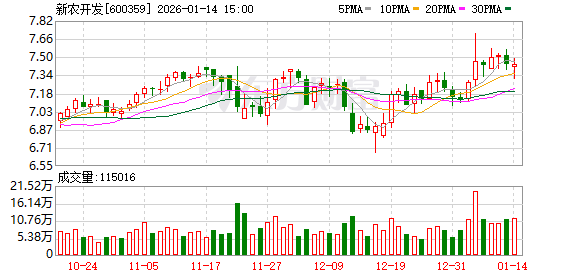
新农开发:公司目前未开展网红合作带货业务
Zheng Quan Ri Bao· 2026-01-14 12:38
Core Viewpoint - The company, Xinong Development, has not engaged in influencer marketing or live-streaming sales, focusing instead on its official live-streaming channels [2]. Group 1: Company Strategy - The company emphasizes its unique position as the only publicly listed entity that embodies the "359" spirit, which is rooted in the historical context of the 359th Brigade's efforts in frontier development and hardship [2]. - The company aims to deeply integrate the "359" spirit into its brand building, product packaging, market promotion, and corporate culture [2]. - The focus is on creating a core cultural IP identifier based on the "359" spirit to enhance brand recognition and market presence [2].


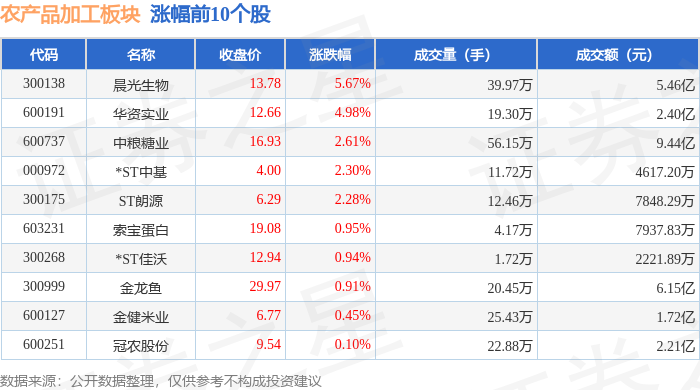
农产品加工板块1月14日涨0.82%,晨光生物领涨,主力资金净流入260.95万元
Zheng Xing Xing Ye Ri Bao· 2026-01-14 08:44
Group 1 - The agricultural processing sector increased by 0.82% on January 14, with Morning Light Biological leading the gains [1] - The Shanghai Composite Index closed at 4126.09, down 0.31%, while the Shenzhen Component Index closed at 14248.6, up 0.56% [1] - Key stocks in the agricultural processing sector showed varied performance, with Morning Light Biological rising by 5.67% to a closing price of 13.78 [1] Group 2 - The agricultural processing sector saw a net inflow of 260.95 million yuan from main funds, while retail investors experienced a net outflow of 8899.4 million yuan [2] - Major stocks like Jinlongyu and Zhongliang Sugar Industry had significant net inflows from main funds, amounting to 5739.86 million yuan and 5559.22 million yuan respectively [3] - Morning Light Biological had a notable retail net outflow of 8899.58 million yuan, despite a positive performance in main fund inflow [3]





新农开发(600359.SH):目前未开展网红合作带货业务
Ge Long Hui· 2026-01-14 07:58
Core Viewpoint - The company, Xin Nong Development (600359.SH), is currently not engaged in influencer marketing or sales but operates its official live streaming channel [1] Group 1: Company Strategy - The company emphasizes its unique position as the only publicly listed entity that carries forward the "359" spirit, which is rooted in the themes of perseverance and hard work [1] - The company is focused on deeply integrating the "359" spirit into its brand building, product packaging, market promotion, and corporate culture [1] - The aim is to create a strong cultural IP identity centered around the "359" core values [1]
铜冠金源期货商品日报-20260114
Tong Guan Jin Yuan Qi Huo· 2026-01-14 07:32
Report Industry Investment Rating There is no relevant content provided in the report. Core View of the Report - Overseas, the US inflation data in December continued to decline moderately, with the CPI同比 at 2.7% and the core CPI同比 at 2.6%. The market expects the Fed to cut interest rates twice this year, but the Fed may maintain a wait - and - see attitude. Trump's interference in the Fed has increased market uncertainty. Domestically, the A - share market adjusted after a continuous rise, showing a shift from a general rise to differentiation [2][3]. - Precious metals: The US inflation data strengthened the expectation of interest rate cuts, and silver prices reached a new high. The physical delivery of COMEX silver was active, and the inventory decreased rapidly. Although the exchange strengthened supervision, silver prices are expected to remain relatively strong [4][5]. - Copper: The moderate decline in US inflation led to speculation about a possible interest rate cut in April. Trump's interference in the Fed increased market risk aversion, and the strike at a copper mine in Chile affected production. Copper prices are expected to remain strongly volatile at a high level [6][7]. - Aluminum: US inflation pressure was stable, but core indicators were slightly weak. High aluminum prices suppressed downstream demand, and social inventory was expected to continue to accumulate. Aluminum prices are expected to fluctuate at a high level [8][9]. - Alumina: Supply was loose, and inventory was high, so alumina prices were under pressure and are expected to remain weak [10]. - Cast aluminum: Driven by cost, cast aluminum prices are expected to remain strong, although downstream acceptance of high prices is limited [11]. - Zinc: The US core CPI cooled unexpectedly, and zinc prices were expected to fluctuate strongly, but the spot market was weak [12][13]. - Lead: Some refineries resumed production, and lead prices were expected to fluctuate as supply improved and consumption was under pressure [14]. - Tin: Supply - side disturbances and demand expectations supported tin prices, but there was a risk of adjustment due to crowded capital [15]. - Steel products: The demand for construction steel was in the off - season, and the supply - demand balance was weak. Steel prices are expected to fluctuate [16]. - Iron ore: Supply was strong and demand was weak, and iron ore prices are expected to fluctuate [18]. - Coking coal and coke: Steel enterprises did not respond to the price increase request of coke enterprises. The off - season demand led to limited fundamental support, and prices are expected to fluctuate [19]. - Soybean and rapeseed meal: The report was negative, and Brazilian soybean production was certain to be high. The auction of imported soybeans was fully subscribed, and prices are expected to fluctuate [20][21]. - Palm oil: The export demand for Malaysian palm oil improved, but the implementation of Indonesia's biodiesel policy was uncertain. Palm oil prices are expected to fluctuate and strengthen [23][24]. Summary by Related Catalogs Macroeconomy - Overseas: In December, the US CPI同比 was 2.7%, and the core CPI同比 was 2.6%. The market expected the Fed to cut interest rates twice this year, but the Fed may maintain a wait - and - see attitude. Trump's interference in the Fed increased market uncertainty. Gold and silver reached new highs, the US dollar rose, and industrial metals' upward momentum slowed [2]. - Domestic: The A - share market adjusted after a 17 - day consecutive rise. The Shanghai Composite Index closed at 4138 points, and the trading volume reached 3.7 trillion yuan. More than 3700 stocks fell. The margin trading balance reached a new high, and the market shifted from a general rise to differentiation [3]. Precious Metals - Gold prices fluctuated, and silver prices reached a new high. The active physical delivery of COMEX silver and the rapid decline in inventory were important factors driving silver prices. The US inflation data strengthened the expectation of interest rate cuts, and precious metal prices were supported [4][5]. Copper - Macro: The moderate decline in US inflation led to a 40%+ probability of an interest rate cut in April, but the Fed may maintain a wait - and - see attitude. Trump's interference in the Fed increased market risk aversion, and copper prices' center of gravity moved up [6]. - Industry: The labor negotiation at a copper mine in Chile was stagnant, and the strike affected production. The supply - demand situation and market sentiment jointly affected copper prices, which are expected to remain strongly volatile at a high level [6][7]. Aluminum - Macro: The World Bank raised the global economic growth forecast for 2026 to 2.6%. The US inflation pressure was stable, and the market expected the Fed to keep interest rates unchanged in January [8][9]. - Fundamental: High aluminum prices suppressed downstream demand, and social inventory was expected to continue to accumulate. Aluminum prices are expected to fluctuate at a high level [9]. Alumina - Supply was loose as the environmental policy was relaxed in some areas, and the import window was open. Inventory was high at all levels, putting pressure on prices. Alumina prices are expected to remain weak [10]. Cast Aluminum - Driven by the rising cost of scrap aluminum, cast aluminum prices rose, but downstream acceptance of high prices was limited. Cast aluminum prices are expected to remain strong [11]. Zinc - The US core CPI cooled unexpectedly, and the market speculated about an interest rate cut in April. However, Fed officials' hawkish remarks and weak fundamentals led to a high - level shock in zinc prices. Zinc prices are expected to fluctuate strongly [12][13]. Lead - Some refineries resumed production, and supply improved. Consumption was under pressure, and social inventory was expected to increase. Lead prices are expected to fluctuate [14]. Tin - Supply - side factors such as the tense situation in Congo - Kinshasa, the slow resumption of mines in Myanmar, and Indonesia's export policy supported tin prices. However, due to the large short - term increase and crowded capital, there was a risk of adjustment [15]. Steel Products - The demand for construction steel was in the off - season, with a significant decline in apparent demand and a small increase in production. The supply - demand balance was weak, and steel prices are expected to fluctuate [16]. Iron Ore - Supply was strong due to high arrivals, and demand was stable. The overall supply - demand situation was supply - strong and demand - weak, and iron ore prices are expected to fluctuate [18]. Coking Coal and Coke - Steel enterprises did not respond to the price increase request of coke enterprises. Terminal demand was in the off - season, and the fundamental support was limited. Supply pressure increased, and prices are expected to fluctuate [19]. Soybean and Rapeseed Meal - The report was negative, and Brazilian soybean production was certain to be high. The auction of imported soybeans was fully subscribed, which alleviated the supply shortage expectation in the first quarter. Prices are expected to fluctuate [20][21]. Palm Oil - Macro: The US core CPI in December was at a four - year low, and oil prices rose. - Fundamental: The export demand for Malaysian palm oil improved in early January, and the inventory reduction expectation was strengthened. However, the implementation of Indonesia's biodiesel policy was uncertain. Palm oil prices are expected to fluctuate and strengthen [23][24].
中国消费名品!湘潭湘莲走俏市场
Sou Hu Cai Jing· 2026-01-14 05:16
Core Viewpoint - Xiangtan County's lotus industry, known for its historical significance and quality, has been recognized as a key consumer brand in China, reflecting the successful integration of policy, technology, and industry for high-quality development [3][12]. Group 1: Industry Development - Xiangtan County has a long history of lotus cultivation, dating back over 2,000 years, with the lotus being recognized as a national geographical indication product since 1995 [2]. - The Xiangtan lotus deep processing industry cluster has become the leading industry, with the Huashi Lotus Industrial Park developing into the largest lotus seed distribution center in China, handling over 100,000 tons annually and accounting for more than 70% of the national market [5]. - The county's lotus industry development plan (2019-2030) includes a special leadership group and funding to enhance resource allocation, with over 8 million yuan in loans for chain enterprises by 2025 [7]. Group 2: Economic Impact - The total output value of the lotus industry cluster is projected to reach 8.398 billion yuan by 2025, representing a year-on-year growth of 1.9%, with a national market share of 82.7% and exports exceeding 70% [7]. - The industry supports over 100,000 jobs and generates nearly 500 million yuan in annual wages, contributing to local economic benefits [5]. Group 3: Innovation and Technology - By 2025, the lotus deep processing industry cluster will have 95 enterprises, with 74.74% being large-scale industrial companies, and has nurtured 11 provincial specialized and innovative enterprises and 31 national high-tech enterprises [9]. - Significant investment in research and development, totaling 252 million yuan, has led to 53 invention patents and the establishment of various technical standards, reinforcing the industry's foundation [7][9]. Group 4: Product Diversification and Market Expansion - The industry has transitioned from selling raw materials to offering processed products, with innovations such as lotus seed soup and lotus seed wine, some of which have won awards and are exported to 21 countries [9]. - Digital transformation has improved production efficiency, with automated production lines achieving a daily output of over 50 tons and cost savings of 2 million yuan annually [9]. Group 5: Sustainable Development and Cultural Integration - The promotion of green development practices, such as the "lotus and crab co-cultivation" model, has led to a 40% reduction in pesticide and fertilizer use and a 30% increase in per-acre income [9]. - The integration of cultural tourism with the lotus industry has created attractions that draw visitors, enhancing local dining and agricultural experiences [10].
农产品:获准注册发行合计不超40亿元超短期融资券和中期票据
Xin Lang Cai Jing· 2026-01-14 03:47
Core Viewpoint - The company has received a registration acceptance notice from the China Interbank Market Dealers Association for its short-term financing bonds and medium-term notes, indicating a positive step towards raising funds in the market [1] Group 1: Financing Details - The company has registered a short-term financing bond amounting to 2 billion yuan [1] - The company has also registered a medium-term note for an amount of 2 billion yuan [1] - The registration quota is valid for two years from the date of the notice [1]
综合晨报-20260114
Guo Tou Qi Huo· 2026-01-14 03:07
Report Industry Investment Ratings No relevant information provided. Core Views - Geopolitical risks are driving up oil prices, but short - term upside is limited due to supply surplus and the lack of confirmed conflicts. Precious metals remain bullish, and various commodities and financial products show different trends affected by factors such as supply - demand, policies, and geopolitical situations. [2][3] Summary by Categories Energy - **Crude Oil**: US December CPI data boosts market expectations for a rate cut in April. API shows a significant weekly inventory build. Geopolitical tensions in Iran drive up oil prices, but short - term upside is limited due to supply surplus in Q1 2026. [2] - **Fuel Oil & Low - Sulfur Fuel Oil**: Fuel oil follows crude oil price movements. High - sulfur fuel oil may see increased demand as a substitute for asphalt if Venezuelan heavy - oil supply is disrupted. Low - sulfur fuel oil supply is expected to increase, with a weakening fundamental outlook. [22] - **Asphalt**: Iranian geopolitical tensions lead to a rebound in crude oil prices, but asphalt's price increase is limited. Attention should be paid to the arrival of Venezuelan crude oil. [23] Metals - **Precious Metals**: US December CPI data and Iranian tensions make precious metals bullish. [3] - **Base Metals** - **Copper**: LME copper shows signs that support domestic refined copper exports. Chile raises its copper production target. [4] - **Aluminum**:沪铝 tests historical highs, but the break - through is unconfirmed. High profits prompt aluminum plants to consider selling - hedging. [5] - **Zinc**: Zinc prices rise, but high prices may have a negative impact on downstream consumption. [8] - **Nickel & Stainless Steel**:沪镍 falls, while stainless - steel market activity is high. Inventory changes show different trends for pure nickel, nickel - iron, and stainless steel. [10] - **Tin**:沪锡 trading is driven by increased funds. Indonesian tin exports are significant, and option trading amplifies price fluctuations. [11] - **Carbonate Lithium**: The market is active. Upstream sales strategies change, and demand remains strong. Inventory changes vary among different sectors. [12] - **Industrial Silicon**: It has a weak supply - demand situation. Reduced production in the north is not enough to offset weak demand from downstream industries. [13] - **Polysilicon**: Prices continue to decline. The market trading logic has changed, and caution is advised. [14] Steel - **Iron Ore**: The supply is relatively abundant, and the demand is weak. It is expected to fluctuate in the short - term. [16] - **Coke & Coking Coal**: Both are expected to have a bullish - oscillating trend. Carbon element supply is abundant, and downstream iron - water production may bottom - out and rebound. [17][18] - **Silicon Manganese & Silicon Ferrosilicon**: Both suggest a strategy of buying on dips. They are affected by factors such as raw material prices, inventory, and demand from the iron - making industry. [19][20] - **Rebar & Hot - Rolled Coil**: Steel prices are in a range - bound pattern. Demand is weak, and supply is gradually recovering. [15] Chemicals - **Urea**: The market is in a stalemate. Production increases, and downstream demand shows mixed trends. Short - term prices may decline slightly, but the downward space is limited. [24] - **Methanol**: Geopolitical factors cause significant price fluctuations. Overseas supply is low, but domestic demand is weakening, and the driving force for price increases is weakening. [25] - **Pure Benzene**: Cost - driven short - term price increases, but the fundamental situation is weak, and long - term de - stocking is difficult. [26] - **Styrene**: Cost - support is strengthened, and the supply - demand is in a tight balance. [27] - **Polypropylene, Plastic, & Propylene**: Rising oil prices are beneficial to the market. Supply and demand show different trends for each product. [28] - **PVC & Caustic Soda**: PVC may strengthen in the long - term with potential de - capacity. Caustic soda is in a weak state, and the profit of chlor - alkali integration may be compressed. [29] - **PX & PTA**: Geopolitical risks drive up prices, but downstream demand is weakening. [30] - **Ethylene Glycol**: Supply is expected to increase domestically and decrease overseas. Short - term attention should be paid to oil price fluctuations, and the long - term outlook is still under pressure. [31] - **Short - Fiber & Bottle - Chip**: Demand for both is weakening in the short - term. Cost is the main driving factor, and long - term over - capacity is a pressure. [32] Agricultural Products - **Soybean & Soybean Meal**: The USDA report is bearish. South American weather and US soybean exports are important factors to watch. [36] - **Soybean Oil & Palm Oil**: The market is affected by bio - diesel expectations and supply - side factors. It is expected to be range - bound. [37] - **Rapeseed Meal & Rapeseed Oil**: The US Department of Agriculture report indicates a loose supply - demand situation. The market is affected by Sino - Canadian relations and inventory levels. [38] - **Soybean No. 1**: Domestic soybean prices are回调. Supply is tight at the grassroots level, but demand is cautious. [39] - **Corn**: The US corn harvest is large, and the domestic market is affected by supply and demand factors. It is expected to fluctuate widely. [40] - **Livestock & Poultry Products** - **Pig**: The futures market is oscillating. Short - term supply pressure is high, and long - term prices may form a double - bottom pattern. [41] - **Egg**: Egg prices are expected to strengthen in the first half of 2026 due to reduced supply and increased demand. [42] - **Cotton**: The US cotton report is bullish, but the domestic market is in the off - season. Demand is stable, and the planting area policy in Xinjiang is uncertain. [43] - **Sugar**: International sugar production shows different trends in different countries. Domestic sugar production in Guangxi is expected to increase, and the rebound of Zhengzhou sugar is limited. [44] - **Apple**: Apple futures prices rise. The market focus shifts to demand, and the high - quality fruit supply is tight. [45] - **Wood & Pulp** - **Wood**: Wood prices are at a low level. Supply is expected to decrease, and demand is in the off - season. Low inventory provides some support. [46] - **Pulp**: Pulp prices are stable. Downstream demand is weak, and inventory is increasing. [47] Financial Products - **Stock Index**: A - share markets are expected to be range - bound and strong. Geopolitical situations need to be closely monitored. [48] - **Treasury Bond**: Treasury bond futures show a bullish - flattening trend. The strategy of flattening the yield curve is recommended. [49] Shipping - **Container Shipping Index (European Route)**: Maersk's price cuts indicate a weakening market. The 04 - contract valuation lacks a clear anchor, and far - month contracts are under pressure due to the expected resumption of Red Sea shipping. [21]