
啤酒

Search documents
青岛啤酒股份获瑞众人寿保险增持20万股 每股作价约49.97港元
Xin Lang Cai Jing· 2026-01-28 00:10
Group 1 - The core point of the article is that Swiss Re Life Insurance has increased its stake in Qingdao Beer (00168) by purchasing 200,000 shares at a price of HKD 49.9658 per share, totaling HKD 9.9932 million [1] - After the purchase, Swiss Re Life Insurance's total holdings in Qingdao Beer amount to approximately 39.374 million shares, representing a 6.01% ownership stake [1]


燕京啤酒:公司2024年度实现啤酒销量(含托管企业)400.44万千升
Zheng Quan Ri Bao Wang· 2026-01-27 13:44
证券日报网讯1月27日,燕京啤酒(000729)在互动平台回答投资者提问时表示,公司2024年度实现啤 酒销量(含托管企业)400.44万千升。 ...

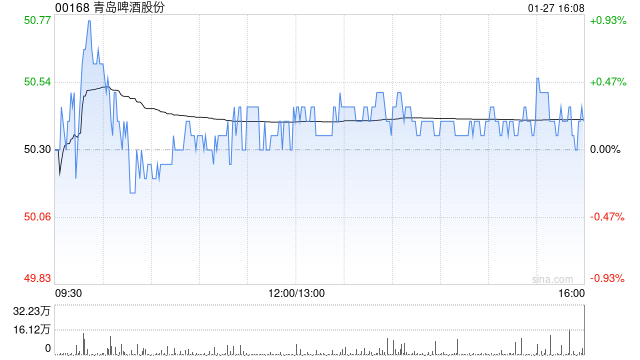
青岛啤酒股份获瑞众人寿保险增持20万股
Ge Long Hui· 2026-01-27 13:37
Group 1 - Qingdao Beer Co., Ltd. (00168.HK) received an increase in shareholding from Ruizhong Life Insurance Co., Ltd. on January 22, 2026, with the purchase of 200,000 shares at an average price of HKD 49.9658 per share, totaling approximately HKD 9.9932 million [1] - Following this transaction, Ruizhong Life Insurance's total shareholding rose to 39.374 million shares, increasing its ownership percentage from 5.98% to 6.01% [1]

惠泉啤酒:未建立财务共享中心
Zheng Quan Ri Bao Wang· 2026-01-27 11:46
Core Viewpoint - Huiquan Beer (600573) has not established a financial shared service center and emphasizes strict internal control management with established financial management systems and control processes [1] Group 1 - The company has responded to investor inquiries regarding its financial management practices [1] - Huiquan Beer maintains a focus on internal control management [1] - The company has implemented standardized financial management systems and control processes [1]

“经济媒体调研行”:莆田,一瓶啤酒的“十五五”叙事——20家财经媒体解码中国制造新质生产力、夜间经济与零碳未来
Bei Jing Wan Bao· 2026-01-27 11:38
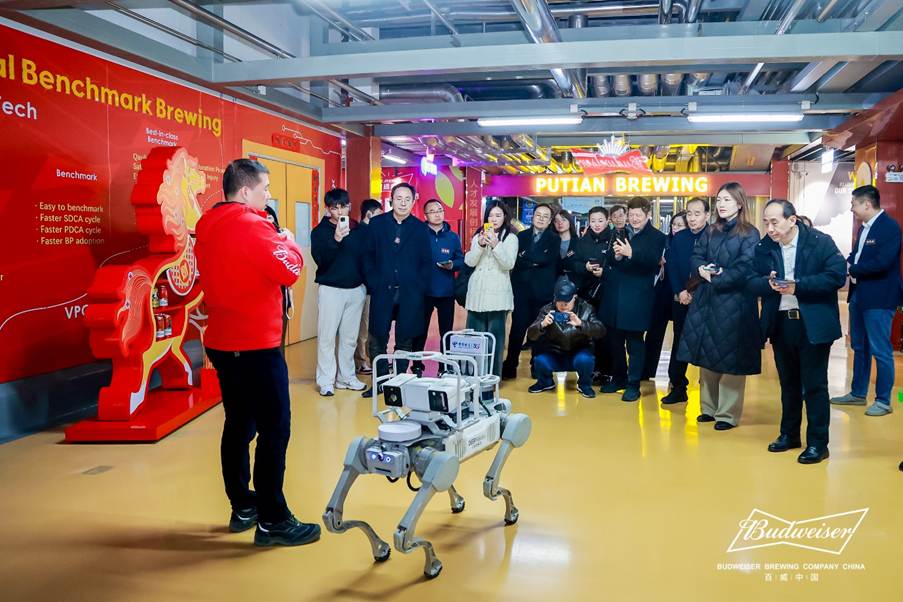
Core Insights - The article highlights the transformation of the Chinese beer industry from "scale expansion" to "value growth," aligning with national policies to enhance domestic consumption and quality development [1] - The Budweiser Snow Beer factory in Putian is showcased as a model of modern manufacturing, integrating advanced technology and sustainable practices to drive efficiency and environmental responsibility [4][7] Industry Overview - The Chinese beer industry is undergoing a shift towards high-quality development, responding to the government's call for expanding the supply of quality goods and services [1] - The Budweiser Snow Beer factory is positioned as a leading player in this transformation, with a focus on digitalization, green manufacturing, and regional economic development [10][12] Technological Advancements - The factory employs a comprehensive management system based on 5G technology, enabling real-time monitoring of production processes and achieving a daily output of 2,550 tons of beer [4][5] - Automation is enhanced through the use of a robotic dog for inspections, reducing inspection time from 2 hours to 40 minutes and improving detection accuracy [5] Sustainability Practices - The factory has implemented a green manufacturing system, achieving a water usage efficiency of 94% and reducing carbon emissions significantly through solar energy and waste recycling initiatives [7][8] - Budweiser's commitment to sustainability is evident in its zero-waste policy and the conversion of by-products into valuable resources, contributing to a circular economy [8] Economic Impact - The Budweiser factory is a key driver of regional economic growth, with plans to create a food processing hub generating over 30 billion yuan in annual output [10][11] - The establishment of a beer town and food industry park around the factory is expected to attract numerous suppliers and create thousands of jobs, enhancing local tax revenues [11] Consumer Engagement - The factory's initiatives include the development of a beer museum and tourism projects, which have become popular attractions, drawing over 80,000 visitors annually [12] - Budweiser is actively promoting a vibrant night economy in Putian through themed events and unique consumer experiences, further integrating beer culture into the city's identity [13]

惠泉啤酒(600573.SH):公司未建立财务共享中心
Ge Long Hui· 2026-01-27 07:56
Group 1 - The company, Huiquan Beer (600573.SH), has stated that it has not established a financial shared service center [1] - The company emphasizes strict internal control management and has established standardized financial management systems and control processes [1]
金星啤酒向港交所递交招股书,燕京啤酒发布2025年业绩预告
Jianghai Securities· 2026-01-27 06:09
Investment Rating - The industry investment rating is maintained as "Overweight" [7] Core Insights - The report highlights the rapid growth of Jin Xing Beer, with projected revenues of 356 million, 730 million, and 1.11 billion yuan for 2023, 2024, and 2025 respectively, indicating growth rates of 104.87% and 191.16% for 2024 and 2025 [7] - The report also notes that Yanjing Beer expects a net profit of 1.584 to 1.742 billion yuan for 2025, representing a year-on-year growth of 50% to 65% [7] - The overall beer production in China is projected to decline slightly, with a total production of 35.36 million kiloliters in 2025, down 1.1% year-on-year [7] Summary by Sections Recent Industry Performance - The industry has shown relative returns of -5.35% over the past month, -6.9% over three months, and -27.32% over the past year compared to the CSI 300 index [3] Company Performance - Jin Xing Beer has a significant revenue contribution from its Chinese craft beer segment, with 78.1% of revenue coming from this category [7] - Yanjing Beer has achieved a net profit growth exceeding 50% for four consecutive years, focusing on its core product strategy [7] Market Trends - The report indicates a stable beer production level in China around 35 million kiloliters, with slight declines expected in 2024 and 2025 [7] - The competitive landscape in the beer industry is solidifying, with a recommendation to monitor Jin Xing Beer's IPO progress as it could become the first Chinese craft beer stock in Hong Kong [7]
燕京啤酒跌2.04%,成交额1.52亿元,主力资金净流出1576.47万元
Xin Lang Cai Jing· 2026-01-27 05:17
Core Viewpoint - Yanjing Beer has experienced a decline in stock price recently, with a current trading price of 12.03 yuan per share and a market capitalization of 33.907 billion yuan, despite a year-to-date increase of 7.12% in stock price [1] Financial Performance - For the period from January to September 2025, Yanjing Beer reported a revenue of 13.433 billion yuan, reflecting a year-on-year growth of 4.57%, and a net profit attributable to shareholders of 1.770 billion yuan, which is a significant increase of 37.45% [2] Shareholder Information - As of January 20, 2025, the number of shareholders for Yanjing Beer is 44,100, showing a decrease of 3.61% from the previous period, while the average circulating shares per person increased by 3.75% to 56,890 shares [2] - The company has distributed a total of 4.791 billion yuan in dividends since its A-share listing, with 1.325 billion yuan distributed in the last three years [3] Institutional Holdings - As of September 30, 2025, the second-largest circulating shareholder is Hong Kong Central Clearing Limited, holding 74.5763 million shares, a decrease of 21.0157 million shares from the previous period [3] - The fourth-largest circulating shareholder is the Wine ETF (512690), which increased its holdings by 15.0099 million shares to 45.1167 million shares [3]
国信证券晨会纪要-20260127
Guoxin Securities· 2026-01-27 01:45
Group 1: Hotel Industry Insights - The hotel industry is entering a new phase characterized by non-linear growth among leading players, driven by expectations of cyclical turning points and capital consolidation, with a long-term focus on scale and efficiency [17][18] - The valuation of hotels follows a three-dimensional framework: macro supply-demand mismatches determine valuation turning points, structural upgrades amplify volatility, and individual company cycles provide alpha opportunities [17] - The current cycle's bottom is marked by increased differentiation within the industry, with leading hotels expected to see RevPAR (Revenue per Available Room) recover as supply stabilizes and demand rebounds, particularly in leisure travel [17][18] Group 2: Social Services Sector - The social services sector has seen a 1.52% increase during the reporting period, outperforming the broader market by 2.71 percentage points, with notable stocks including Tongdao Liepin and Keri International [19][20] - The sector is actively responding to the silver economy, with policies promoting the development of elderly care services and companies like New Oriental launching local interest courses for retirees [21] - The Spring Festival is expected to drive significant travel demand, with predictions of approximately 95 million air passengers during the holiday period, indicating a strong recovery in travel-related services [21] Group 3: Food and Beverage Sector - The food and beverage sector has experienced a decline of 1.37%, with A-share food and beverage indices falling by 1.57%, while H-share indices showed a slight increase [26] - The sector is characterized by differentiated performance, with alcoholic beverages, particularly baijiu, showing stable prices and a focus on demand recovery during the Spring Festival [27] - Recommendations include leading companies in various categories, such as Moutai for baijiu, Yili for dairy, and Nongfu Spring for beverages, highlighting their strong growth potential and market positioning [27][28] Group 4: Pharmaceutical Industry - The pharmaceutical industry is witnessing a robust outflow of innovative drugs and a recovery in the CXO sector, driven by favorable clinical data and supportive policies [33][34] - The domestic supply-demand landscape remains stable, with a focus on innovative drug forms and technologies such as AI in healthcare and brain-machine interfaces, which are expected to see significant growth [35] - Investment recommendations include companies with strong competitive advantages in innovation and cost control, such as Mindray Medical and WuXi AppTec [35][36]
燕京啤酒(000729):公司研究|点评报告|燕京啤酒(000729.SZ):燕京啤酒跟踪点评:重看改革路,书写新篇章
Changjiang Securities· 2026-01-26 23:57
Investment Rating - The investment rating for the company is "Buy" and is maintained [5]. Core Insights - After undergoing internal reforms, Yanjing Beer has experienced a rebirth, transitioning from a period of declining sales and low profitability to significant revenue and profit growth. The company’s net profit margin was only 1.9% in 2021, which was considerably lower than the industry average. Under the leadership of Chairman Geng, the company has implemented a U8 single product strategy and internal efficiency improvements, leading to a qualitative leap in profitability [2][10]. - The company forecasts a net profit attributable to shareholders of 1.584 to 1.742 billion yuan for 2025, representing a year-on-year increase of 50% to 65%. The net profit margin is expected to exceed 10% in 2025, up from 7.2% in 2024 [4][19]. Summary by Relevant Sections Company Overview - Yanjing Beer, a long-established brewery in Beijing, faced challenges due to the elimination of excess capacity and a slower transition to high-end products compared to competitors. The company has since embarked on a transformation journey, focusing on market-oriented operations and innovative systems [2][10]. Sales Performance - The U8 product line has been pivotal in reversing declining sales, with expected sales of approximately 400 million liters in 2024, a growth of around 470,000 liters compared to 2020. The company anticipates continued sales growth into 2025 [11][19]. Pricing Strategy - The U8 product has initiated a high-end strategy, with an average price increase of approximately 4% annually from 2020 to 2024. The company expects this upward trend in pricing to continue in 2025 [14][19]. Revenue Growth - Revenue has increased from approximately 10.9 billion yuan in 2020 to about 14.7 billion yuan in 2024, with a compound annual growth rate (CAGR) of around 8%. The company aims to achieve new revenue highs in 2025 [17][19]. Profitability Improvement - The internal reforms have led to significant efficiency gains, with the company’s net profit margin expected to rise to over 10% in 2025. The forecasted net profit for 2025 marks a historical high for the company [19][33]. Future Outlook - Yanjing Beer is also exploring new business avenues in health products and beverages, with initial successes in the natto product line and the launch of the Beiste soft drink. These initiatives are expected to contribute positively to revenue and profit growth in the coming years [24][26].