外卖

Search documents
外卖平台“新国标”发布 强化配送员权益保障
Sou Hu Cai Jing· 2025-12-04 13:18
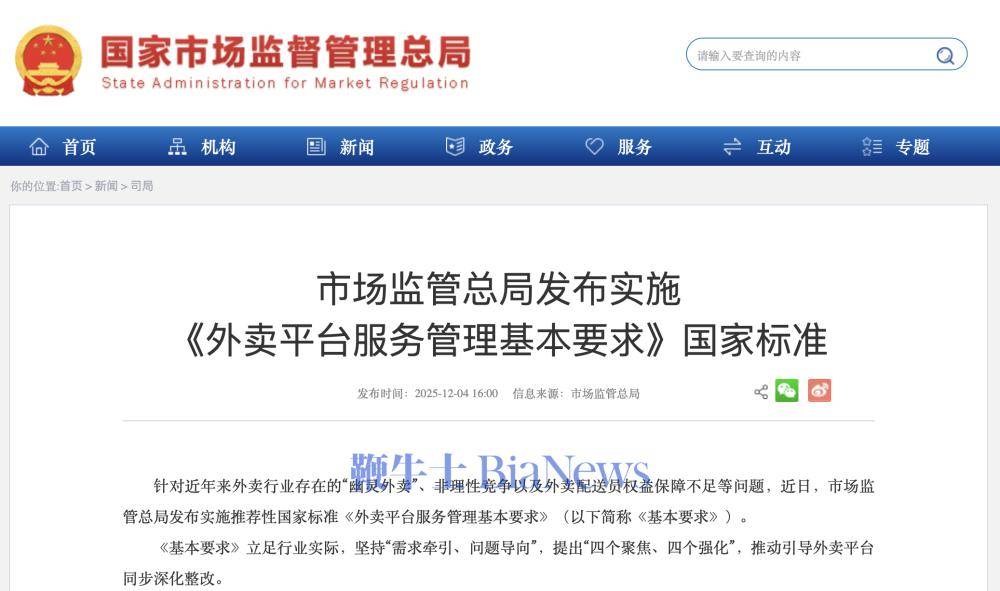
针对近年来外卖行业存在的"幽灵外卖"、非理性竞争以及外卖配送员权益保障不足等问题,近日,市场 监管总局发布实施推荐性国家标准《外卖平台服务管理基本要求》(以下简称《基本要求》)。 《基本要求》立足行业实际,坚持"需求牵引、问题导向",提出"四个聚焦、四个强化",推动引导外卖 平台同步深化整改。 聚焦平台内争议处理,强化协商机制建设。督促平台建立完善消费者权益保护体系,完善消费者、商 户、配送员等多元主体投诉、申诉及处置机制建设,确保平台管理程序透明,畅通投诉举报与异议反馈 渠道,主动接受社会监督。 《基本要求》遵循科学性、规范性、实用性、前瞻性原则,在充分调研外卖平台服务管理实践经验的基 础上,对现有法律法规和监管要求进行细化和补充,广泛采纳商户、配送员、消费者等多元主体意见建 议,切实帮助外卖平台优化管理方式、提升服务质量、实现多方共赢,进一步推动外卖行业在良性竞争 中创新发展。 转自央视新闻客户端(总台央视记者 王婧) 来源:中工网 聚焦平台内商户管理,强化主体责任落实。通过规范商户入驻审核、日常运营管理等环节,引导外卖平 台切实履行对商户的服务与管理责任。支持鼓励商户积极响应"互联网+明厨亮灶"有关要求 ...
拟鼓励投保、建体系,食安险或迎新机遇
Bei Jing Shang Bao· 2025-12-04 13:07
Core Viewpoint - The introduction of food safety liability insurance (referred to as "food safety insurance") is expected to be promoted significantly in response to consumer concerns about food safety issues, particularly in the context of the food production and service industry [1][3]. Group 1: Policy and Regulatory Framework - The State Administration for Market Regulation has initiated the revision of the "National Food Safety Incident Emergency Plan (Draft for Comments)," encouraging food producers and operators to participate in food safety insurance [3][4]. - The draft emphasizes the establishment and improvement of the food safety insurance system, aiming to ensure timely insurance claims for food safety incidents [3][4]. Group 2: Market Dynamics and Trends - Food safety insurance is becoming increasingly recognized as a risk management mechanism, particularly in the rapidly growing food delivery service sector, which has seen significant scale development due to the integration of the internet and digital economy [3][4]. - Currently, the variety and number of food safety insurance products in the market are relatively limited, with most offerings focused on food delivery services, primarily through collaborations between delivery platforms and insurance companies [3][4]. Group 3: Challenges and Opportunities - Despite the potential for growth, food safety insurance in China is still in its early stages compared to developed countries, having gone through policy exploration, mandatory promotion, and now encouragement phases [5][6]. - There are significant challenges in the claims process, including disputes over accident recognition and compensation amounts, as well as difficulties consumers face in proving claims [6]. - The insurance product's coverage is narrow, and there is a notable information asymmetry among delivery platforms, merchants, and consumers, complicating the claims process and limiting the development of the food delivery industry [6]. Group 4: Recommendations for Improvement - To stimulate demand for food safety insurance, it is suggested that insurance companies optimize product design and service processes, potentially developing a combination of basic and additional insurance products [6]. - Implementing a floating rate mechanism based on the food safety rating of enterprises could dynamically adjust premiums, enhancing the attractiveness of food safety insurance [6]. - The promotion of food safety insurance is viewed not only as a risk management tool but also as a modernization of food safety governance, aiming to create a robust safety net connecting government, enterprises, and consumers [6].


为了三套新工服,外卖平台烧光1000亿
远川研究所· 2025-12-04 13:04
Core Viewpoint - The intense competition among Meituan, JD, and Alibaba in the food delivery sector has led to significant financial losses, with nearly 100 billion yuan in profits wiped out over the past six months, marking one of the most costly battles in Chinese internet history [2][6]. Group 1: Financial Performance - Meituan reported its largest quarterly loss since its IPO, while Alibaba's e-commerce business saw operating profits decline by 85% year-on-year, and JD's overall operating profit dropped by 108% [2][6]. - In Q3, Alibaba's EBITDA decreased by approximately 24 billion yuan, while JD and Meituan's EBITDA fell by 17.5 billion yuan and 44.8 billion yuan, respectively [6]. - Marketing expenses surged dramatically, with Alibaba and JD increasing their spending by 106% and 110% year-on-year, while Meituan's marketing costs rose by 91% [6]. Group 2: Market Dynamics - The oligopolistic structure of the food delivery market is beginning to shift, with Meituan's market share expected to drop to around 65% in 2024, a decline of nearly 20% this year [6][8]. - The competition is not just about food delivery; it serves as a strategic entry point for e-commerce growth, with JD and Alibaba leveraging food delivery to drive traffic to their core retail businesses [8][9]. Group 3: User Engagement and Growth - JD's food delivery GMV experienced triple-digit growth, with new user conversion rates nearing 50%, leading to a 40% increase in active users and shopping frequency [9]. - Taobao's flash sales in August contributed to a 25% year-on-year increase in monthly active users, while Meituan also saw a more than 20% increase in daily active users [9]. Group 4: Strategic Adjustments - The three major platforms have begun to recognize the unsustainable nature of the price war, with joint statements issued to resist "disorderly competition" in July [22]. - JD has quietly adjusted its strategy, including plans to launch an independent app and improve unit economic costs, while Alibaba aims to significantly reduce its flash sales investments in the upcoming quarter [22]. Group 5: Long-term Outlook - Despite the fierce competition, the platforms are now more focused on survival rather than solely defeating competitors, indicating a potential shift towards more sustainable practices in the industry [22][23]. - The ongoing battle in the food delivery sector is expected to continue, with companies acknowledging that the price war has not created value for the industry and is not sustainable [20][26].


事关外卖!这一国家标准发布→
Sou Hu Cai Jing· 2025-12-04 13:00
针对近年来外卖行业存在的"幽灵外卖"、非理性竞争以及外卖配送员权益保障不足等问题,近日,市场 监管总局发布实施推荐性国家标准《外卖平台服务管理基本要求》(以下简称《基本要求》)。 《基本要求》立足行业实际,坚持"需求牵引、问题导向",提出"四个聚焦、四个强化",推动引导外卖 平台同步深化整改。 聚焦平台内商户管理,强化主体责任落实。通过规范商户入驻审核、日常运营管理等环节,引导外卖平 台切实履行对商户的服务与管理责任。支持鼓励商户积极响应"互联网+明厨亮灶"有关要求,严守食品 安全底线,守护消费者"舌尖上的安全"。 来源:人民日报客户端 聚焦平台用工管理,强化配送员权益保障。围绕劳动强度、职业关怀和社会保障等方面,提出合理确定 劳动时间、完善职业培训体系、探索多元保障方式等内容,助力健全配送员权益保障机制。 聚焦平台内争议处理,强化协商机制建设。督促平台建立完善消费者权益保护体系,完善消费者、商 户、配送员等多元主体投诉、申诉及处置机制建设,确保平台管理程序透明,畅通投诉举报与异议反馈 渠道,主动接受社会监督。 《基本要求》遵循科学性、规范性、实用性、前瞻性原则,在充分调研外卖平台服务管理实践经验的基 础上, ...
保障配送员劳动收入、平台不得强制商户促销,市场监管总局详解外卖平台国家标准
Xin Lang Cai Jing· 2025-12-04 12:11
Core Viewpoint - The newly approved national standard "Basic Requirements for Delivery Platform Service Management" aims to address key issues in the food delivery industry, including "ghost deliveries," irrational competition, and insufficient protection of delivery personnel's rights [1][8]. Group 1: Platform Responsibilities - The standard emphasizes the need to strengthen the platform's responsibility, particularly in managing merchant onboarding and ensuring compliance with food safety regulations [2][9]. - Platforms are required to establish dedicated teams to verify merchant information and operating conditions, ensuring that only qualified merchants are allowed to operate [2][9]. - Monthly audits of merchant operations must be conducted, with a minimum sampling rate of 5% to enhance ongoing oversight [2][9]. Group 2: Promotion and Pricing - The standard differentiates between "platform price promotions" and "merchant price promotions," stating that the costs of platform promotions should not be passed on to merchants or delivery personnel [3][10]. - Platforms must not interfere with merchants' pricing autonomy or compel them to participate in promotional activities [3][10]. - Promotional activities must be communicated to merchants at least seven days in advance to allow for adequate preparation [3][10]. Group 3: Competition Regulation - Platforms are prohibited from using exaggerated marketing tactics, such as "zero-cost purchases," and must avoid practices that disrupt market pricing and order [4][11]. - The standard encourages rational competition among platforms, ensuring that subsidies provided to consumers are not misrepresented as platform subsidies [4][11]. Group 4: Delivery Personnel Rights - The standard outlines measures to protect delivery personnel, including optimizing dispatch algorithms to consider various factors like traffic and weather [6][12]. - Delivery personnel must receive compensation for working during public holidays and adverse weather conditions, with platforms required to provide additional support [6][12]. - Platforms must ensure that delivery personnel have reasonable working hours and rest periods, implementing fatigue warning systems to prevent overwork [7][13].
外卖平台“新国标”发布
21世纪经济报道· 2025-12-04 09:42
针对近年来外卖行业存在的"幽灵外卖"、非理性竞争以及外卖配送员权益保障不足等问题,近 日,市场监管总局发布实施推荐性国家标准《外卖平台服务管理基本要求》(以下简称《基本 要求》)。 《基本要求》立足行业实际,坚持"需求牵引、问题导向",提出"四个聚焦、四个强化",推动 引导外卖平台同步深化整改。 聚焦平台内争议处理,强化协商机制建设。督促平台建立完善消费者权益保护体系,完善消费 者、商户、配送员等多元主体投诉、申诉及处置机制建设,确保平台管理程序透明,畅通投诉 举报与异议反馈渠道,主动接受社会监督。 聚焦平台内商户管理,强化主体责任落实。通过规范商户入驻审核、日常运营管理等环节,引 导外卖平台切实履行对商户的服务与管理责任。支持鼓励商户积极响应"互联网+明厨亮灶"有 关要求,严守食品安全底线,守护消费者"舌尖上的安全"。 《基本要求》遵循科学性、规范性、实用性、前瞻性原则,在充分调研外卖平台服务管理实践 经验的基础上,对现有法律法规和监管要求进行细化和补充,广泛采纳商户、配送员、消费者 等多元主体意见建议,切实帮助外卖平台优化管理方式、提升服务质量、实现多方共赢,进一 步推动外卖行业在良性竞争中创新发展。 聚 ...

外卖新国标出台:禁止平台强制商户促销、转嫁成本
Xin Jing Bao· 2025-12-04 08:32
在促销规则方面,新标准要求平台坚持公平、透明原则,不得对交易条件相同的商户实施歧视性待遇。 平台必须保障商户自主选择权,提供"不参与平台促销"的选项,且不得将商户购买流量推广、使用指定 工具或参与其他活动作为设置促销门槛的前提条件。 针对部分平台强制或诱导商户促销的问题,《基本要求》明确禁止平台通过流量倾斜、优先配送承诺、 默认勾选促销功能、第三方施压等手段,变相强迫商户开展价格促销。同时,平台不得利用技术手段或 管理权限限制商户自主撤销已发起的促销活动,不得干预商户对促销价格的设定与调整。 新京报讯(记者陈琳)针对近年来外卖行业存在的"幽灵外卖"、非理性竞争以及外卖配送员权益保障不足 等问题,近日,市场监管总局正式发布推荐性国家标准《外卖平台服务管理基本要求》,对外卖行业长 期存在的促销乱象、成本转嫁、商户自主权受限等问题作出明确规范,旨在推动行业公平竞争与健康有 序发展。 《基本要求》强调,外卖平台开展价格促销活动时,相关成本应由平台自身承担,不得以任何形式转嫁 给商户或配送员。平台不得通过分摊工具捆绑收费、临时上调服务费等方式变相转移促销成本,切实减 轻商户与骑手负担。 此外,新规还对促销宣传行为作出规 ...
市监局发布《外卖平台服务管理基本要求》:针对「幽灵外卖」、非理性竞争等问题
Sou Hu Cai Jing· 2025-12-04 08:25
12月4日,针对近年来外卖行业存在的"幽灵外卖"、非理性竞争以及外卖配送员权益保障不足等问题,近日,市场监管总局发布实施推荐性国 家标准《外卖平台服务管理基本要求》(以下简称《基本要求》)。 聚焦平台收费与促销行为,强化竞争秩序规范。明确平台收费规则及促销活动管理要求,督促引导外卖平台简化收费项目、规范促 销行为,推动各类收费信息透明化、促销规则合理化,营造公平有序的市场竞争环境。 聚焦平台用工管理,强化配送员权益保障。围绕劳动强度、职业关怀和社会保障等方面,提出合理确定劳动时间、完善职业培训体 系、探索多元保障方式等内容,助力健全配送员权益保障机制。 聚焦平台内争议处理,强化协商机制建设。督促平台建立完善消费者权益保护体系,完善消费者、商户、配送员等多元主体投诉、 申诉及处置机制建设,确保平台管理程序透明,畅通投诉举报与异议反馈渠道,主动接受社会监督。 《基本要求》遵循科学性、规范性、实用性、前瞻性原则,在充分调研外卖平台服务管理实践经验的基础上,对现有法律法规和监管要求进行 细化和补充,广泛采纳商户、配送员、消费者等多元主体意见建议,切实帮助外卖平台优化管理方式、提升服务质量、实现多方共赢,进一步 推动外 ...
外卖、AI 2025年的阿里打赢了命运之战
新财富· 2025-12-04 08:04
Core Viewpoint - Alibaba is refocusing its strategy around e-commerce and AI cloud services, with significant investments planned for infrastructure and product development, aiming to reclaim its market position and enhance user engagement [2][3][31]. Investment and Strategic Focus - CEO Wu Yongming announced an investment of over 380 billion yuan in cloud and AI hardware infrastructure over the next three years, exceeding the total investment of the past decade [3]. - The company is prioritizing long-term investment in core businesses while seeking to monetize non-profitable segments quickly [2]. E-commerce Developments - In April, Alibaba launched "Taobao Flash Purchase," integrating various categories into a "30-minute delivery" system, marking its entry into the competitive food delivery market [4]. - By Q3 2025, the average daily order volume for Alibaba's delivery services surged to 28-30 million, increasing its market share from 18% to 32% [9][11]. AI and Technology Advancements - Alibaba's Qwen series of AI models has achieved over 600 million downloads globally, establishing itself as a leading choice for developers [4][17]. - The "Qwen" API offers competitive pricing, significantly lower than alternatives like GPT-4, enhancing its attractiveness in the market [16]. Product Launches and User Engagement - The "Qianwen" app, launched in November 2025, became the fastest-growing AI application, surpassing 10 million downloads in just one week [4][14]. - The introduction of Quark AI glasses represents a significant step in integrating AI into everyday life, allowing users to access various services seamlessly [5][27]. Market Position and Future Outlook - Alibaba's strategic shift is reflected in the rebranding of Ele.me to "Taobao Flash Purchase," emphasizing its integration into the broader Taobao ecosystem [29][30]. - The company aims to leverage both e-commerce and AI as dual engines for growth, signaling a return to its core strategic focus [31][32].


外卖大战还会继续吗?至少不会是价格战了
Sou Hu Cai Jing· 2025-12-04 06:39
Core Viewpoint - The takeaway from the recent market results indicates that the price war in the food delivery industry has not created sustainable value and is unsustainable in the long run [2][4] Group 1: Market Competition - Meituan's CEO Wang Xing emphasized that while the price war is meaningless, competition itself is essential for the industry [2] - Meituan's response to the low-level price competition involved increasing restaurant subsidies, resulting in an operating loss of 14.1 billion RMB and an adjusted net loss of 16 billion RMB in Q3 [4][6] - Despite the losses, Meituan's performance was better than expected, indicating a relatively favorable "battle damage ratio" compared to industry peers [4] Group 2: Long-term Value Creation - Wang Xing stated that Meituan will focus on doing the right things to serve consumers, merchants, and delivery personnel, with confidence in creating genuine long-term value [7][8] - The long-term value strategy is not solely reliant on food delivery but aims to build a diversified growth ecosystem centered around instant retail [8][9] Group 3: Ecosystem Development - Meituan aims to serve consumers, merchants, and delivery personnel, which forms the core of its platform ecosystem [10][12] - The company has implemented a multi-layered welfare system for delivery personnel, including health insurance and housing support, to ensure their rights and benefits [10][12] - For small and medium-sized merchants, Meituan focuses on reducing costs and increasing efficiency through optimized subsidy rules and AI tools [14] Group 4: Operational Precision - The food delivery industry is characterized by thin margins, requiring precise operations to avoid losses [16][18] - Meituan's operational strategy includes user-segmented subsidies and efficiency improvements for merchants, which have helped maintain operational efficiency despite price competition [18][19] - The company believes that the current irrational competition is temporary and that platforms with deep industry knowledge and operational efficiency will lead the market [19]