
水泥制造

Search documents
A股持续走强!沪指、创业板指创年内新高
Sou Hu Cai Jing· 2025-07-21 10:46
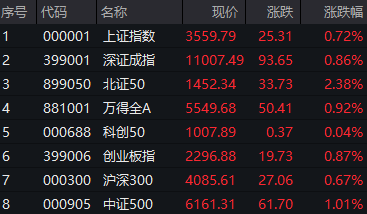
Market Performance - The three major indices showed strong fluctuations throughout the day, with both the Shanghai Composite Index and the ChiNext Index reaching new highs for the year [1] - As of the close, the Shanghai Composite Index was at 3559.79 points, up 0.72%; the Shenzhen Component Index was at 11007.49 points, up 0.86%; and the ChiNext Index was at 2296.88 points, up 0.87% [1][2] - The total trading volume in the Shanghai and Shenzhen markets was 1.7 trillion yuan, an increase of 128.9 billion yuan compared to the previous trading day, with over 4000 stocks rising and 130 stocks hitting the daily limit [2] Sector Performance - In terms of capital flow, major net inflows were observed in sectors such as electric power and grid, basic metals, industrial machinery, chemical raw materials, and building materials; while major net outflows were seen in banking, software, communication equipment, internet, and computer hardware sectors [3] - The infrastructure sector experienced a collective surge, with significant gains in cement manufacturing, water conservancy and hydropower construction, and excavator-related stocks [4] Notable Stocks - In the building materials sector, several stocks including Jinyu Group, Qingsong Jianhua, Wannianqing, and others hit the daily limit [5] - The top gainers in the building materials sector included Metal Group at 10.19%, Qingsong Jianhua at 10.08%, and Wannianqing at 10.07% [6] - Stocks related to the Yarlung Zangbo River hydropower project also saw significant increases, with companies like Zhuhua Design and Deep Water Planning Institute rising by 20.03% and 20.00% respectively [7] Project Announcement - On July 19, a major investment of 1.2 trillion yuan was announced for the Yarlung Zangbo River downstream hydropower project, which will construct five cascade power stations primarily using a diversion tunnel method, focusing on power delivery while also catering to local demand in Tibet [8]


沸腾了!一则大消息,彻底引爆
中国基金报· 2025-07-21 03:39
Core Viewpoint - The article highlights the significant surge in the super hydropower sector and the fluctuations in the Yushui robotics concept stocks, indicating a positive market sentiment towards these industries [1][3]. Super Hydropower Sector - The super hydropower sector experienced a strong rally, with notable increases in related stocks such as Wuxin Tunnel Equipment, which saw a 30% limit up, and Deep Water Planning Institute, which rose by 20% [8][10]. - The overall market performance showed that the hydropower construction index increased by 8.29%, leading the sector's growth [4]. Yushui Robotics Concept - The Yushui robotics industry chain opened high and continued to rise, with stocks like Changsheng Bearing and LIGONG Optics rising over 10%, and several stocks hitting the limit up [13]. - Yushui Technology has initiated its listing guidance with CITIC Securities as the advisory firm, indicating potential growth and investment interest in the robotics sector [13]. Market Overview - The A-share market opened positively, with the Shanghai Composite Index up by 0.39%, the Shenzhen Component Index up by 0.36%, and the ChiNext Index up by 0.32% [1]. - The Hong Kong stock market also saw gains, with major companies like Meituan, JD Group, and Alibaba showing significant increases in their stock prices [5][6].

行业周报:中央城市工作会强调城市更新,关注建材投资机会-20250720
KAIYUAN SECURITIES· 2025-07-20 11:43
Investment Rating - The investment rating for the construction materials industry is "Positive" (maintained) [1] Core Views - The central urban work conference emphasized urban renewal, which is expected to drive demand for construction materials such as pipes, waterproofing, and coatings. This will lead to significant improvements in the real estate chain's fundamentals [3] - The report recommends several companies in the consumer building materials sector, including Sankeshu (channel expansion), Dongfang Yuhong (waterproofing leader), Weixing New Materials (high retail business ratio), and Jianlang Hardware. Beneficiary companies include Beixin Building Materials (gypsum board leader) [3] - The National Development and Reform Commission's action plan for the cement industry aims to control cement clinker capacity at around 1.8 billion tons by the end of 2025, which is expected to accelerate energy-saving and carbon reduction efforts [3] Market Performance - The construction materials index fell by 0.23% in the week from July 14 to July 18, 2025, underperforming the CSI 300 index by 1.32 percentage points. Over the past three months, the CSI 300 index rose by 7.17%, while the construction materials index increased by 4.36%, underperforming by 2.82 percentage points. In the past year, the CSI 300 index rose by 14.68%, and the construction materials index increased by 16.62%, outperforming by 1.94 percentage points [4][13] Cement Sector - As of July 18, 2025, the average price of P.O42.5 bulk cement nationwide was 280.87 CNY/ton, down 0.71% month-on-month. The clinker inventory ratio was 67.24%, up 1.35 percentage points [6][27] - The report highlights regional price variations, with Northeast China stable, North China up by 0.74%, and East China down by 1.90% [26] Glass Sector - The spot price of float glass as of July 18, 2025, was 1214.63 CNY/ton, an increase of 0.71% from the previous week. The inventory of float glass nationwide decreased by 175 million weight boxes, a decline of 3.05% [82][84] - The average price of photovoltaic glass remained stable at 116.02 CNY/weight box [89] Fiberglass Sector - The market price for non-alkali 2400tex direct yarn ranged from 3300 to 4100 CNY/ton, with variations depending on the manufacturer [6] Consumer Building Materials - As of July 18, 2025, the price of asphalt was 4570 CNY/ton, stable week-on-week, and up 2.93% year-to-date. The price of titanium dioxide was 13050 CNY/ton, down 1.14% month-on-month [6]


山东淄博淄川区有序淘汰落后产能 培育壮大新兴产业 因地制宜 催生转型发展新动能(经济聚焦·关注资源型城市转型)
Ren Min Ri Bao· 2025-07-17 21:47
Core Viewpoint - The emphasis is on the transformation and development of resource-based cities, highlighting the importance of balancing development and safety while promoting green and low-carbon initiatives in resource-depleted areas [1][8]. Group 1: Resource-Based City Transformation - Kunlun Town in Zibo City has successfully transformed a former coal mining area into a green low-carbon development model by introducing innovative projects such as greenhouse flower cultivation [2][3]. - Zibo City, particularly the Zichuan District, has been recognized for its efforts in transitioning from a resource-dependent economy, achieving excellent performance in national assessments for resource-depleted cities [3][4]. Group 2: Industrial Upgrading and Carbon Reduction - The Shandong Energy Donghua Technology Company is leading efforts in carbon reduction by replacing coal with hydrogen in cement production, resulting in a significant decrease in coal consumption and carbon emissions [5][6]. - The district has closed over 3,000 outdated production facilities since the 13th Five-Year Plan, reducing coal consumption by 307,000 tons, which is a 60.58% decrease [6]. Group 3: New Industry Development - The Zibo Economic Development Zone has established a new energy vehicle production base, significantly increasing production capacity and contributing to a 108.6% year-on-year growth in the new energy vehicle and equipment sector [7]. - New and high-tech industries now account for over 35% of the district's added value, with high-tech industry contributions rising from 31.29% in 2008 to 50% currently [7].
华泰证券:“反内卷”有望对PPI和企业盈利形成提振,行情启动信号通常为价格或ROE拐点
Sou Hu Cai Jing· 2025-07-17 00:17
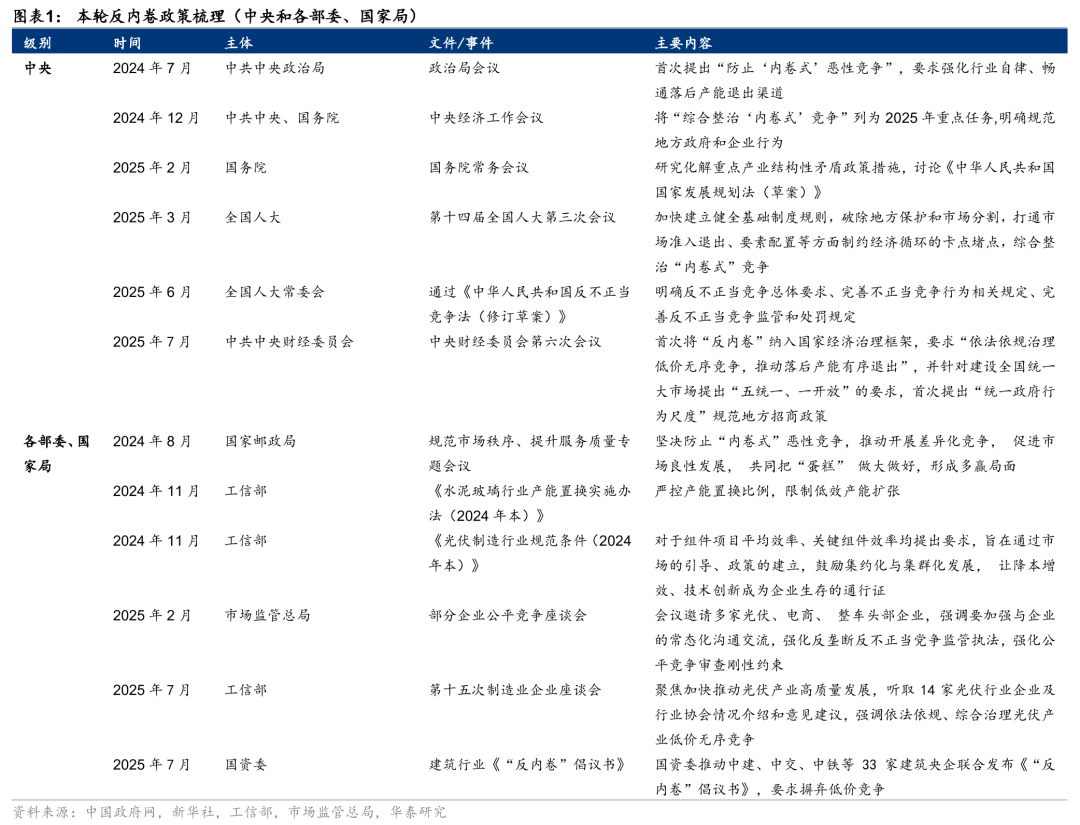
Core Insights - The recent emphasis on "anti-involution" by the Central Financial Committee indicates a significant policy shift aimed at addressing issues in various sectors, including photovoltaic, steel, and construction materials [2][3] - The current "anti-involution" policy is expected to differ from the 2016 "supply-side reform" in terms of industry characteristics, causes, and policy intensity [4][15] Group 1: Policy Background and Timing - The current macroeconomic environment mirrors that of 2016, with global economic slowdown, weak domestic demand, and declining capacity utilization leading to negative PPI growth [4][15] - The sequence of policy implementation for "anti-involution" is expected to follow a similar pattern to that of the "supply-side reform," starting with policy definition, followed by top-level design, and then specific industry policies [21][46] Group 2: Industry Characteristics and Opportunities - The "anti-involution" initiative focuses on advanced manufacturing sectors, which have shorter capacity formation times and higher private enterprise participation compared to traditional industries targeted in the 2016 reforms [4][25] - Industries such as wind power, steel, certain chemicals, photovoltaic, and coal are identified as having "involution" pressures, with potential for policy support and market recognition [3][6] Group 3: Market Impact and Investment Opportunities - The "anti-involution" policy is anticipated to boost PPI and corporate profitability, contingent on appropriate timing, policy strength, and demand-side coordination [3][4] - Historical data suggests that the initiation of supply-side reforms led to significant improvements in industrial profits, commodity prices, and capacity utilization rates, indicating potential for similar outcomes under the current policy [47][50] Group 4: Sector-Specific Insights - In the construction materials sector, self-balancing supply capabilities are strong, particularly in cement and fiberglass, with a focus on eliminating disorderly competition [7] - The steel industry is expected to enter a recovery phase by Q3 2024, aided by voluntary production cuts and favorable pricing dynamics [7] - The chemical industry is projected to benefit from supply-side adjustments driven by self-discipline and environmental regulations, with a recovery anticipated in the latter half of 2025 [8] - The automotive sector is shifting from price competition to value competition, with the "anti-involution" policy expected to stabilize pricing dynamics [8] - The agricultural sector, particularly in pig farming, is seeing policy measures aimed at reducing production capacity and optimizing structure, which may lead to price stabilization [9]

宁波富达: 宁波富达关于为控股子公司提供担保的进展公告
Zheng Quan Zhi Xing· 2025-07-16 10:20
Core Viewpoint - Ningbo Fuda Co., Ltd. has announced the provision of guarantees for its subsidiaries, Mengzi Yingzhou Cement Co., Ltd. and Xinpingshan Cement Co., Ltd., to support their operational needs and ensure financial stability [1][6]. Summary by Sections Guarantee Overview - The total guarantee amount provided by the company for Mengzi Company is 30 million RMB, while for Xinpingshan Company, it is 50 million RMB, with a cumulative guarantee balance of 120 million RMB for Xinpingshan before this announcement [1][2]. - The company has provided a total of 250 million RMB in guarantees to its subsidiaries, with no overdue guarantees reported [2][6]. Subsidiary Information - **Mengzi Yingzhou Cement Co., Ltd.**: - Established on December 10, 2001, with a registered capital of 100 million RMB [3]. - As of March 31, 2025, it reported total assets of 415.74 million RMB and total liabilities of 218.78 million RMB, resulting in a debt-to-asset ratio of 52.6% [4]. - **Xinpingshan Cement Co., Ltd.**: - Established on October 18, 2018, with a registered capital of 100 million RMB [3]. - As of March 31, 2025, it reported total assets of 215.70 million RMB and total liabilities of 99.01 million RMB, resulting in a debt-to-asset ratio of 45.9% [4]. Guarantee Details - The guarantees are part of a supply chain finance initiative, with a total reverse factoring financing limit of 80 million RMB, effective until June 24, 2026 [2][3]. - The company will assume joint repayment responsibility for the debts of its subsidiaries under this financing arrangement [3][4]. Necessity and Reasonableness of Guarantees - The guarantees are deemed necessary for the daily operational needs of the subsidiaries and are within the authorized limits set by the company's shareholders [6]. - The board of directors believes that these guarantees will not harm the interests of the company or its shareholders and will not adversely affect the company's operations [6].

宁波富达上市29周年:利润增长857.99%,市值较峰值蒸发69.31%
Jin Rong Jie· 2025-07-16 02:23
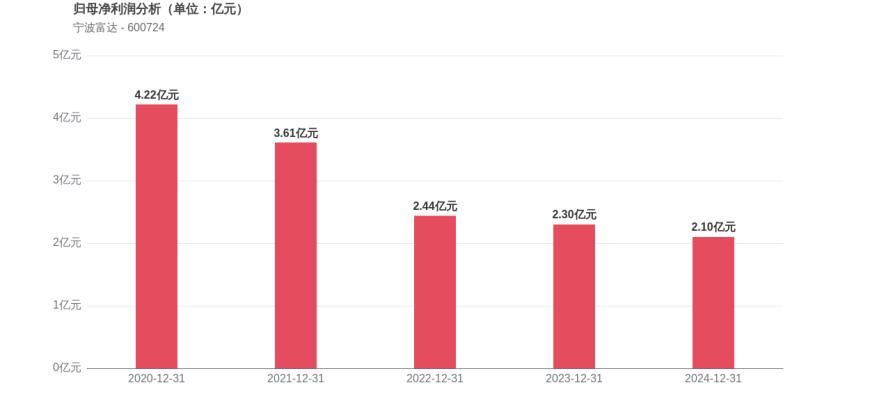
Core Viewpoint - Ningbo Fuda has experienced significant growth since its listing in 1996, with a market capitalization increase from 4.76 billion yuan to 67.64 billion yuan, but recent years have shown a decline in both revenue and profit [1][3]. Business Overview - The main business segments of Ningbo Fuda include commercial real estate, real estate development, and cement manufacturing, with cement sales contributing the highest revenue share at 52.03%, followed by leasing at 20.18% [3]. - Since its listing, Ningbo Fuda has achieved a cumulative profit growth of 857.99%, with a net profit of 2.10 billion yuan in the latest fiscal year compared to 0.22 billion yuan in 1996 [3]. Financial Performance - Revenue has declined from 23.40 billion yuan in 2020 to 17.01 billion yuan in 2024, representing a year-on-year decrease of 46.31% [3]. - Net profit has also decreased from 4.22 billion yuan in 2020 to 2.10 billion yuan in 2024, indicating a continuous decline in profitability over the past five years [3]. Market Capitalization - The market capitalization of Ningbo Fuda has increased 13.20 times since its listing, reaching a peak of 220.40 billion yuan in June 2015, but has since decreased by 152.76 billion yuan, or 69.31%, to 67.64 billion yuan as of July 15 [5].
东吴证券晨会纪要-20250716
Soochow Securities· 2025-07-15 23:30
Macro Strategy - The "urban renewal" initiative is expected to achieve a total investment of at least 4.48 trillion yuan during the 14th Five-Year Plan period, averaging nearly 900 billion yuan annually. The main sources of potential demand will come from the renovation of urban villages, old residential areas, and urban infrastructure upgrades [1][18] - The renovation of old residential areas and urban infrastructure is projected to contribute at least 2.35 trillion yuan in new investment during the 14th Five-Year Plan period, supported by over 470 billion yuan in central budget investments and special bonds [1][18] - The urban village renovation is estimated to contribute 2.13 trillion yuan in new investment during the 14th Five-Year Plan period, assuming a "half-demolition, half-renovation" approach for the remaining self-built houses [1][18] Economic Data - The actual GDP growth rate for Q2 was 5.2%, with a cumulative growth of 5.3% for the first half of the year, indicating a strong performance compared to the previous year. However, the nominal GDP growth rate was lower at 3.9% [2][20] - Consumer spending showed a year-on-year increase of 5.0% in the first half, driven by the "old-for-new" policy, while real estate sales showed resilience compared to the previous year [2][20] - Industrial production in June saw a year-on-year increase of 6.8%, supported by strong external demand, particularly in the equipment manufacturing sector [2][21] Company Analysis - Zhongkuang Resources (002738) has adjusted its profit forecast for 2025-2027 due to pressure from falling lithium prices and temporary losses in copper smelting, projecting net profits of 4.0/9.6/19.3 billion yuan [10] - Li Ning (02331.HK) anticipates challenges in sales due to deepening discounts and increased expenses, with revised net profit forecasts of 23.1/26.0/29.3 billion yuan for 2025-2027 [10] - 361 Degrees (01361.HK) is expanding its superstore network and maintaining industry-leading growth, with net profit forecasts of 13.0/14.6/16.2 billion yuan for 2025-2027 [11] - Zhongrong Electric (301031) expects continued high growth in its electric vehicle-related products, projecting net profits of 3.4/4.8/6.3 billion yuan for 2025-2027 [12] - Huanxin Cement (600801) reported a significant increase in Q2 profits, driven by improvements in domestic cement profitability and overseas operations, with revised net profit forecasts of 28.8/32.2/35.6 billion yuan for 2025-2027 [15]
天山股份: 董事会议事规则(2025年7月)
Zheng Quan Zhi Xing· 2025-07-14 16:26
Core Points - The document outlines the rules and procedures for the board of directors of Tianshan Materials Co., Ltd, aiming to enhance governance and decision-making efficiency [1][2][3] Chapter 1: General Principles - The board of directors must comply with national laws and the company's articles of association when making decisions [1] - Directors are required to prioritize the interests of the company and its shareholders over personal gains [1] Chapter 2: Composition and Powers of the Board - The board consists of 9 directors, including 1 chairman, 1 vice-chairman, 3 independent directors, and 1 employee director [1][2] - At least one-third of the board members must be independent directors, with at least one being a professional accountant [2] - The board has various powers, including convening shareholder meetings, executing resolutions, and deciding on major operational and investment plans [2][3] Chapter 3: Board Meetings - The board must hold at least two regular meetings annually, with provisions for special meetings as needed [6][7] - Meeting notifications must include date, location, agenda, and notification date [12] Chapter 4: Meeting Procedures - A quorum requires the presence of more than half of the directors [7] - Directors can delegate their voting rights to other directors under specific conditions [16] Chapter 5: Decision-Making and Voting - Directors must actively seek detailed information before making decisions and express clear opinions on matters [17][18] - Voting is conducted on a one-vote-per-person basis, with resolutions requiring majority approval [20] Chapter 6: Meeting Records - Meeting records must be accurate and include details such as date, attendees, agenda, and voting results [23][25] - Records are maintained for a period of 10 years [26] Chapter 7: Announcement and Execution of Resolutions - The company is responsible for announcing board resolutions in accordance with stock exchange regulations [27] - The chairman must ensure the implementation of board decisions and inform all directors of significant matters [28] Chapter 8: Miscellaneous - Any matters not covered by these rules will follow relevant national laws and the company's articles of association [29] - The rules take effect upon approval by the shareholders' meeting [32]
天山股份: 关联交易决策制度(2025年7月)
Zheng Quan Zhi Xing· 2025-07-14 16:26
Core Viewpoint - The document outlines the decision-making system for related party transactions of Tianshan Materials Co., Ltd, emphasizing the need for compliance with legal regulations and the protection of the company's and shareholders' interests. Group 1: General Principles - The company aims to standardize related party transactions to ensure they do not harm the company's or shareholders' legal rights and interests [1] - Related party transactions must adhere to principles of honesty, equality, voluntariness, fairness, openness, and impartiality [2] - Transactions should not be used to manipulate financial indicators or harm the company's interests [2] Group 2: Related Party Definition - Related parties include entities controlled by the company's major shareholders, actual controllers, directors, and senior management [6] - The definition of related parties extends to individuals holding more than 5% of the company's shares and their close family members [10] Group 3: Transaction Procedures - Related party transactions must be documented in written contracts that clearly define the rights and obligations of both parties [4] - Transactions exceeding certain thresholds require board approval, with specific amounts set for transactions with individuals (over 300,000 yuan) and organizations (over 3 million yuan) [22][23] Group 4: Decision-Making Process - The board must ensure that related directors abstain from voting on transactions where they have a conflict of interest [17] - Independent directors must discuss and approve related party transactions before they are submitted to the board for review [25] Group 5: Disclosure Requirements - The company is required to disclose related party transactions that exceed specified monetary thresholds, ensuring transparency in dealings [31][32] - Disclosure must include detailed documentation such as board resolutions and independent director opinions [33] Group 6: Special Provisions - The company may engage independent financial advisors to assess the fairness of significant related party transactions [27] - Transactions involving guarantees for related parties must receive heightened scrutiny and approval from non-related directors [28]