金融业

Search documents
热点思考 | 如果美国失业率升至4.6%?——关税“压力测试”系列之十三(申万宏观·赵伟团队)
赵伟宏观探索· 2025-06-29 13:43
Group 1 - The core viewpoint of the article highlights the rising risks of unemployment in the U.S. labor market, driven by weakening labor supply and demand, and the potential impact of tariffs on employment [2][3][4] - The U.S. labor market is crucial for the economy, with consumer spending significantly contributing to GDP growth, primarily driven by labor income [2][6] - The unemployment rate is expected to rise, with estimates suggesting it could reach 4.5-4.6% by the end of the year, influenced by the new tariffs [3][89] Group 2 - The article discusses the employment impact of tariffs, indicating that a 1% decline in GDP could lead to a 0.3-0.7% increase in unemployment, based on Okun's Law [3][89] - The current tariff situation is expected to have a more significant impact on the manufacturing sector compared to previous tariff implementations, with a broader economic slowdown anticipated [65][77] - The article notes that the current economic environment is characterized by declining wage growth and increased precautionary savings among consumers, which could further exacerbate employment challenges [77][81] Group 3 - The "Sahm Rule" is mentioned as a potential indicator of recession, suggesting that if the unemployment rate rises to 4.6%, it could trigger recession signals [4][99] - Historical data shows that the Sahm Rule has a high success rate in predicting recessions, with the article indicating that the current labor market conditions could lead to its activation in the coming months [99][100] - The article emphasizes that the labor market is currently in a "loosened" state, with demand-side weaknesses likely driving the unemployment rate upward [100]


16省份2024年平均工资公布
第一财经· 2025-06-28 10:44
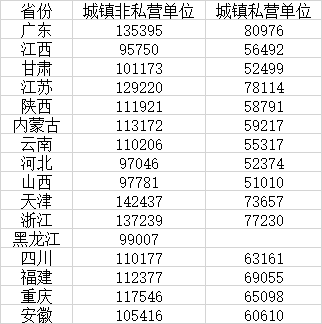
Core Insights - The average annual salary for urban non-private sector employees in China reached 124,110 yuan in 2024, marking a nominal increase of 2.8% and a comparable increase of 2.6% from the previous year [1] - The average annual salary for urban private sector employees was 69,476 yuan, with a nominal increase of 1.7% and a comparable increase of 4.0% [1] Provincial Salary Data - Sixteen provinces have reported their average annual salary data for urban employees, with non-private sector salaries exceeding 120,000 yuan in provinces like Tianjin, Zhejiang, Guangdong, and Jiangsu [2][3] - In Tianjin, the average salary for urban non-private sector employees was 142,437 yuan, an increase of 4,430 yuan or 3.2% year-on-year [3] - Zhejiang's average salary for non-private sector employees was 137,239 yuan, with a year-on-year increase of 4,194 yuan or 3.2% [4] Industry Salary Disparities - The highest average salaries in urban non-private sectors are found in the information transmission, software, and IT services, finance, and scientific research sectors [5] - In Zhejiang, the average salary in the information transmission and software sector exceeded 301,889 yuan, the highest across all industries [5] - Financial services also ranked high in several provinces, while mining, although not in the top three nationally, was prominent in resource-rich provinces [5]

16省份2024年平均工资公布,收入前三行业各省不相同
Di Yi Cai Jing· 2025-06-28 09:44
Core Insights - The average annual salary for urban non-private sector employees in China reached 124,110 yuan in 2024, reflecting a nominal increase of 2.8% from the previous year [1][4] - The average annual salary for urban private sector employees was 69,476 yuan in 2024, with a nominal increase of 1.7% [1][4] - There is a significant disparity in average salaries between non-private and private sectors, with non-private sector salaries substantially higher [3][5] Provincial Salary Data - Among the 16 provinces, 10 reported average salaries for urban non-private sector employees exceeding 110,000 yuan, with Tianjin leading at 142,437 yuan [4][5] - Zhejiang's urban non-private sector employees earned an average of 137,239 yuan, while Guangdong's average was 135,395 yuan [5][6] - The average salary in provincial capitals often exceeds that of smaller cities, with Hefei and Taiyuan being notable examples [5][6] Industry Salary Insights - The top three industries for average salaries in urban non-private sectors vary by province, with information transmission, software, and IT services leading in several regions [6] - In Zhejiang, the average salary for employees in the information transmission and software sector surpassed 301,889 yuan, the highest across all industries [6] - Financial and mining industries also show high average salaries, particularly in provinces rich in resources [6]
宋雪涛:谁导演了美股的情绪市?
雪涛宏观笔记· 2025-06-28 02:55
一个短视的市场往往也是脆弱的,一旦新的担忧出现,反转可能接踵而至。 文:国金宏观宋雪涛/联系人陈瀚学 当前的美股是散户乐观、机构悲观。 6月12日当周,美股散户看多比例达到33.2%,为1月底以来新 高;看空比例为33.6%,为1月底以来新低。散户乐观的另一个佐证,是小市值股票成交火热,因为小 市值股票往往是散户们激烈博弈的战场。截至6月18日,美股市场上股价小于1美元的公司成交量占比 升至36.6%,较4月9日上升近20个百分点。 而美股机构资金普遍偏悲观。从CFTC报告的E-mini标普500非商业期权期货净持仓数据来看,非商业 交易者通常并非套期保值者(即不利用期货市场来对冲现有业务敞口),而是以对冲基金为代表的投机 性机构资金。截至6月10日,美股非商业期权期货净持仓-12.4万张,位于近一年4%的极低分位数水 平。 Be fearful when others are greedy. —— Warren Buffett 4月9日前,美股在"科技例外论"消退和对等关税带来的经济担忧下,一度接近技术性熊市(详见 《美 股已进入"特朗普周期"》 )。但之后的两个多月里,美股迎着美元和美债的逆风独自反弹,当 ...

成都将打造三文鱼、榴莲、鱼子酱等特色单品全国集散基地
Xin Hua Cai Jing· 2025-06-27 14:11
Core Viewpoint - Sichuan Province is supporting Chengdu to enhance its core functions and accelerate high-quality development, particularly in the import of fresh aquatic products and the establishment of a national distribution center for specialty items like salmon, durian, and caviar [1]. Group 1: Economic Development Initiatives - Chengdu will pilot an import "white list" system for fresh aquatic products, aiming to create a national distribution hub for specialty items [1]. - In 2024, over 10,000 tons of salmon are expected to enter the Chinese market through Chengdu's air port, with the value of imported salmon ranking second nationwide [1]. - Chengdu is identified as the "main battlefield" for Sichuan's open economy and a "ballast stone" for stabilizing foreign trade, accounting for over 80% of the province's import and export volume [1]. Group 2: Infrastructure and Logistics - Sichuan will support Chengdu in leveraging its "dual international airports + international railway port" to enhance international cargo distribution capabilities [1]. - The province aims to accelerate the construction of a "Belt and Road" import and export commodity distribution center [1]. Group 3: Market Expansion and Support for Enterprises - Sichuan encourages Chengdu enterprises to form groups to explore new markets, with a focus on cross-border e-commerce, overseas warehouses, and local quality products [1]. - Small and medium-sized foreign trade enterprises will receive increased support to facilitate their international expansion [1]. Group 4: Industry Strengthening and Financial Support - Chengdu will focus on enhancing key industries such as electronic information, equipment manufacturing, and healthcare to improve international competitiveness [2]. - The province will promote the development of digital trade and establish a digital trade service platform to expand the scale of sectors like online gaming and software services [2]. - Sichuan will guide Chengdu in utilizing financial products and special credit quotas to support the internationalization of its industries [2].
朱民达沃斯发声:AI将重塑全球劳动力市场,哪些行业受冲击?
Sou Hu Cai Jing· 2025-06-25 16:46
Group 1 - The core viewpoint emphasizes that artificial intelligence (AI) will reshape the global labor market, affecting existing job structures and leading to a new technological revolution with unprecedented opportunities and challenges [2][4] - AI is transitioning from a "tool" to a "labor force," enhancing work efficiency and potentially replacing human jobs in various sectors, particularly in traditional industries [2][4] - The introduction of AI in manufacturing, finance, and healthcare is already demonstrating significant potential, with applications like automated production lines, algorithmic trading, and AI-assisted diagnostics [2][4] Group 2 - One of the major concerns regarding AI proliferation is the potential for "mass unemployment," particularly in sectors reliant on low-skill, repetitive jobs such as customer service and data entry [3][4] - The labor market will undergo a dramatic restructuring, where adaptability to new technologies will be crucial for both companies and individuals to benefit from the technological revolution [4][5] - Traditional industries such as manufacturing and transportation are expected to be the first to experience significant impacts from AI, with labor-intensive sectors facing substantial job reductions [4][5] Group 3 - In manufacturing, the rise of robotics and automated production lines will lead to the replacement of many manual and mechanical jobs, particularly in mid to low-end production roles [5] - The transportation sector will also be affected by AI, with the advent of autonomous driving technologies likely to reduce the demand for drivers significantly [5] - Despite the challenges faced by traditional industries, new job opportunities will emerge in fields such as data science, AI algorithm engineering, and smart hardware development [5][6] Group 4 - Governments and society must address how to protect workers' interests and promote skill upgrades in the face of accelerating AI adoption [6] - Policies encouraging retraining and career transitions for displaced workers are essential for helping them integrate into new industries [6] - A cautiously optimistic view suggests that AI's proliferation will not entirely destroy the job market but will instead create more innovation and opportunities, contingent on effective education and policy measures [6]

新疆证监局深入辖区公司一线宣讲监管政策动态 完善常态化走访机制促区域经济高质量发展
Zheng Quan Shi Bao Wang· 2025-06-25 13:23
Group 1 - The core viewpoint emphasizes the importance of regular visits by the Xinjiang Securities Regulatory Bureau to listed companies to promote high-quality development and enhance investment value [1][2] - As of 2024, the Xinjiang listed companies achieved a total operating revenue of 709.78 billion yuan, accounting for 34.57% of the region's GDP [2] - A total of 33 listed companies announced cash dividend plans for 2024, with a total dividend amount of 11.608 billion yuan, representing 82.5% of the profits of the profitable listed companies in the region [2] Group 2 - The Xinjiang Securities Regulatory Bureau has visited over 60% of the listed companies in the region since the beginning of 2024, with more than 20 companies visited this year across various industries including manufacturing, mining, finance, and information technology [1] - The region currently has 61 A-share listed companies with a combined market value of 766 billion yuan, including one company with a market value exceeding 100 billion yuan and 14 companies exceeding 10 billion yuan [2] - Future efforts will focus on enhancing the regular visit mechanism, integrating policy promotion, regulatory services, and industry communication to effectively address the practical difficulties faced by listed companies [2]
为什么GDP在涨,税收在降?
3 6 Ke· 2025-06-25 05:59
Core Insights - The divergence between GDP growth and tax revenue in China has become increasingly pronounced, with GDP maintaining around 5% growth while tax revenue continues to decline, leading to a significant gap of -8.4% in 2024 [2][11] - Structural issues in the tax system, particularly the heavy reliance on indirect taxes like VAT, have created vulnerabilities that are now impacting fiscal sustainability [4][11] - The decline in VAT revenue is primarily driven by high export tax rebates, a shrinking real estate market, and ongoing producer price deflation, which collectively undermine the tax base [7][9][12] Tax Revenue Structure - Tax revenue in China can be categorized into four main sources: tax revenue, government fund income, state-owned capital income, and social security contributions, with tax revenue being the most significant [2] - The major tax types include VAT, corporate income tax (CIT), personal income tax (IIT), and consumption tax, with VAT and CIT together accounting for over half of total tax revenue [2] Economic Structure and Taxation - China's economy is heavily industrialized, with industry accounting for 26% of GDP, leading to a tax system that is closely tied to production [3] - The high dependence on indirect taxes has resulted in a regressive tax burden, disproportionately affecting low-income households and reducing the tax system's redistributive capacity [3][4] VAT Revenue Trends - VAT revenue has shown significant fluctuations, with a notable decline from 2020 to 2024, reflecting broader economic challenges [6] - In 2024, VAT revenue is projected to decrease by 3.8% compared to 2023, following a trend of declining growth rates in previous years [6][11] Factors Contributing to VAT Decline - The large scale of export tax rebates has significantly reduced net VAT revenue, with 2023 export rebates reaching approximately 1.8 trillion yuan, accounting for about 22% of annual VAT net income [7] - The real estate sector's downturn has led to a 22.4% drop in land transfer fees, further diminishing VAT contributions from this critical industry [8] - Continuous producer price deflation has negatively impacted the VAT tax base, with a projected decline in VAT revenue of over 2.6 billion yuan due to PPI decreases [9] Corporate and Personal Income Tax Trends - Corporate income tax revenue has declined sharply, dropping to approximately 4.11 trillion yuan in 2023, a 17.8% decrease, reflecting the broader economic downturn and reduced industrial profits [12][13] - Personal income tax has also faced pressure, with revenues falling to about 1.48 trillion yuan in 2023, influenced by rising unemployment and a sluggish real estate market [14] Fiscal Sustainability Challenges - The ongoing decline in tax revenue poses significant challenges for fiscal sustainability, as local governments increasingly rely on tax income amid falling land transfer revenues [15][16] - Restoring tax revenue growth will require addressing several structural issues, including stabilizing the industrial sector, reviving the real estate market, and implementing necessary tax reforms [17]
策略专题:赋时间以价值:时间调查公报解析
Huachuang Securities· 2025-06-20 07:31
Group 1 - The report highlights a shift in the value of time from urbanization and industrial expansion to personal development quality enhancement, with significant growth in activities like entertainment, socializing, and personal care from 2018 to 2024 [2][16][24] - The average annual growth rates for various activities from 2008 to 2018 were notably high for transportation (17.2%), entertainment and socializing (17.1%), and learning and training (16.3%), driven by labor mobility during China's urbanization phase [16][24][27] - From 2018 to 2024, the growth rates for entertainment and socializing (11.1%), purchasing goods and services (9.8%), and labor employment (8.0%) reflect a transition towards personal development amid economic transformation [16][24][27] Group 2 - The report identifies key factors influencing changes in unit time value, including technological innovation, demographic shifts, consumption upgrades, and the impact of urbanization cycles [3][24][26] - Technological advancements, such as the rise of e-commerce and increased internet usage, have significantly reduced shopping time and enhanced efficiency in various activities [24][26][45] - The aging population is leading to a decline in the proportion of the working-age population, resulting in shorter average working hours and impacting labor employment activities [24][27][32] Group 3 - The analysis of unit time output across industries shows that finance has consistently maintained a high position, while the growth rates for mining and finance were prominent from 2004 to 2008, and manufacturing and public services gained traction from 2013 to 2018 [5][52] - The report suggests constructing investment portfolios based on unit time output, indicating that identifying high-efficiency industries can yield significant excess returns compared to broader market indices [5][52][36] - The financial sector is projected to continue its growth in unit time output from 2018 to 2024, reflecting its resilience and adaptability in the changing economic landscape [5][52]
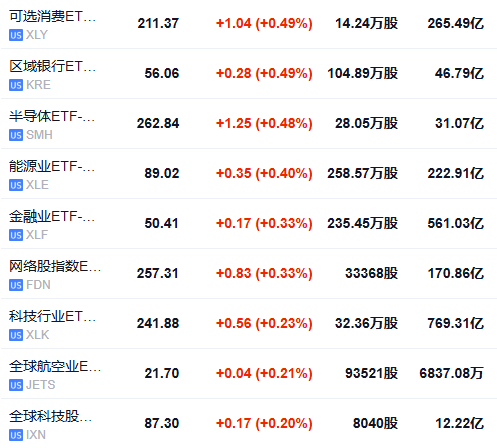
美股盘初,主要行业ETF涨跌不一,总体波动不大,区域银行ETF、能源业ETF涨幅居前。
news flash· 2025-06-18 13:53
Core Viewpoint - The U.S. stock market opened with mixed performance among major industry ETFs, showing overall modest fluctuations, with regional bank and energy sector ETFs leading the gains [1] Group 1: ETF Performance - Consumer discretionary ETF (US XLY) increased by 1.04 points, or 0.49%, with a trading volume of 142,400 shares [2] - Regional bank ETF (US KRE) rose by 0.28 points, or 0.49%, with a trading volume of 1,048,900 shares and a market value of $4.679 billion [2] - Semiconductor ETF (US SMH) gained 1.25 points, or 0.48%, with a trading volume of 280,500 shares and a market value of $3.107 billion [2] - Energy sector ETF (US XLE) saw an increase of 0.35 points, or 0.40%, with a trading volume of 2,585,700 shares and a market value of $22.291 billion [2] - Financial sector ETF (US XLF) rose by 0.17 points, or 0.33%, with a trading volume of 2,354,500 shares and a market value of $56.103 billion [2] - Internet index ETF (US FDN) increased by 0.83 points, or 0.33%, with a trading volume of 33,368 shares and a market value of $17.086 billion [2] - Technology sector ETF (US XLK) gained 0.56 points, or 0.23%, with a trading volume of 323,600 shares and a market value of $76.931 billion [2] - Global airline ETF (US JETS) rose by 0.04 points, or 0.21%, with a trading volume of 93,521 shares and a market value of $6.83708 million [2] - Global technology ETF (US IXN) increased by 0.17 points, or 0.20%, with a trading volume of 8,040 shares and a market value of $1.222 billion [2]