
创新药

Search documents
兴业证券:A股业绩预告即将进入披露高峰 关注哪些方向?
智通财经网· 2026-01-20 10:56
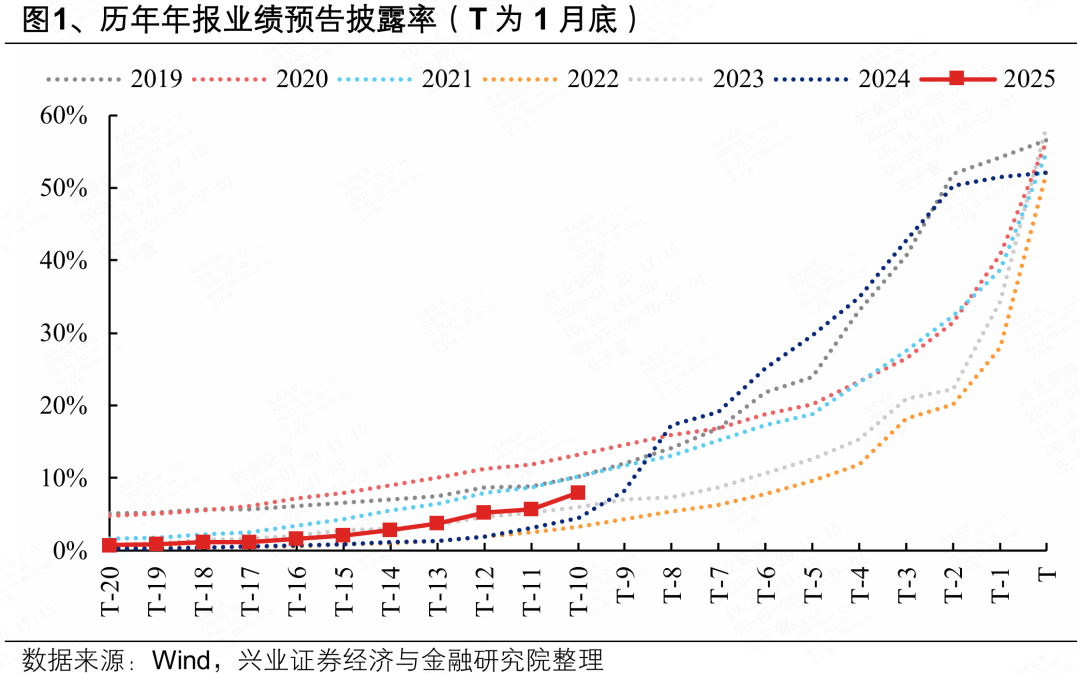
Core Viewpoint - As of January 19, the disclosure rate of annual performance forecasts for A-shares is 7.98%, with a peak expected in late January, where the final disclosure rate may reach around 55% [2][5]. Group 1: Performance Forecasts - The performance forecasts indicate that companies with significant net profit growth are primarily in sectors such as computing power, new energy, chemicals, pharmaceuticals, non-ferrous metals, and computers [6][10]. - By January 19, 447 A-share companies have released annual performance forecasts, with 144 companies expecting net profit growth exceeding 50%, mainly in computing power (semiconductors, communication equipment), new energy (batteries, photovoltaics), and chemicals [6][10]. Group 2: Market Reactions - As the performance forecasts enter their peak disclosure period, the correlation between stock prices and performance is expected to increase significantly in the latter half of January, with market sentiment returning to rationality [5]. - The market is likely to undergo a structural adjustment based on fundamentals, with previous hot sectors facing performance validation, while some low-performing but high-quality sectors may attract new capital inflows [5]. Group 3: Industry Insights - The sectors with upward revisions in profit forecasts since November include technology (especially in upstream computing hardware and downstream applications like consumer electronics and software), advanced manufacturing (new energy, military, automotive), and cyclical industries (building materials, non-ferrous metals, coal, steel) [12][13]. - The industries with lower performance growth since the last market rally include AI computing power, new energy, pharmaceuticals, and cyclical sectors like steel and glass fiber [14].


杨德龙:2026年我国经济整体发展态势持续向好
Xin Lang Cai Jing· 2026-01-20 09:20
Economic Growth - In 2025, China's GDP achieved a growth of 5%, meeting the initial target, but quarterly growth rates showed a declining trend: 5.4%, 5.2%, 4.8%, and 4.5% respectively, indicating a reasonable economic operation with some recovery growth [1][7] - The trade surplus reached a historic high of over $1.1 trillion, approaching $1.2 trillion, reflecting strong competitiveness of Chinese export products despite the tariff war [1][7] Domestic Demand - The main issue in domestic demand is insufficient demand, with an annual CPI growth rate of 0% and negative PPI growth, indicating that weak demand has prevented price increases and led to price wars in industrial products [1][7] - Measures such as the "old-for-new" consumption policy have been introduced to boost consumer spending, which is crucial for stabilizing economic growth as consumption has become a more significant driver than investment and exports [1][7] Industrial Performance - Industrial production in 2025 showed some growth, with the total industrial output value increasing by 5.9% year-on-year, driven by sectors like 3D printing, industrial robots, and new energy vehicles, which saw production increases of 52.5%, 28%, and 25.1% respectively [2][8] - The manufacturing PMI for December was 50.1, indicating a return to the expansion zone, while profits for large industrial enterprises totaled 66,269 billion yuan, reflecting a low growth rate of 0.1% year-on-year [2][8] Investment Trends - Fixed asset investment decreased by 3.8% year-on-year, with real estate development investment dropping by 17.2%, highlighting the pressure on investment stability due to real estate adjustments [3][9] - The National Development and Reform Commission emphasized the need to strengthen domestic demand and adapt to the upgrading of demand structures, planning to develop a strategy for expanding domestic demand from 2026 to 2030 [3][9] Future Opportunities - The focus for 2026 includes sectors like robotics, AI, innovative pharmaceuticals, and controlled nuclear fusion, which are expected to continue to attract attention as technology-driven opportunities grow [4][10] - The digital economy's added value is projected to reach 49 trillion yuan by 2025, accounting for about 35% of GDP, indicating significant future market potential [3][10] Market Outlook - The market is expected to continue a slow bull trend, with a focus on technology stocks, while caution is advised against speculative behaviors, especially in the context of recent high margin trading balances [5][11] - Brand consumer goods are seen as having stable profitability and growth potential, despite a slowdown in consumption growth, making them attractive for investment [5][11]
先声再明递表港交所:先声药业分拆肿瘤业务谋求估值重塑
21世纪经济报道· 2026-01-20 08:25
Core Viewpoint - The article discusses the IPO application of Xiansheng Zaiming Pharmaceutical Co., Ltd. and its strategic focus on the oncology innovation drug sector, highlighting the company's financial performance, market positioning, and future growth potential through the separation from its parent company [1][2][9]. Financial Performance - In 2023, 2024, and the first nine months of 2025, the company achieved revenues of 1.522 billion, 1.296 billion, and 1.238 billion respectively, but remained in a loss position due to high R&D and sales expenses [2][8]. - The net losses recorded were 336 million, 506 million, and 303 million for the same periods, indicating ongoing financial pressure from high investment needs [8][11]. Market Positioning - Xiansheng Zaiming has established itself as a new player in China's oncology innovation drug industry, with five commercialized innovative drugs contributing over 90% of total revenue [5][6]. - The company has formed multiple licensing collaborations with potential total transaction values exceeding 2.8 billion, positioning it as one of the most active biopharmaceutical companies in China for licensing transactions [6][9]. R&D and Commercialization Strategy - The company maintains a high R&D investment intensity, with R&D costs of 831 million, 708 million, and 512 million for 2023, 2024, and the first nine months of 2025, respectively, representing over 50% of revenue in the earlier years [8][11]. - A sales and marketing team of over 1,200 has been established, with sales and distribution expenses exceeding 40% of revenue during the reporting periods [8][11]. Strategic Separation - The decision to spin off the oncology business is part of a broader strategy for Xiansheng Pharmaceutical to transition towards an innovation-driven model, allowing for a more focused approach to R&D and commercialization in oncology [9][10]. - The spin-off is expected to create a dedicated financing platform for oncology innovation drugs, attracting long-term investment and providing organizational support for sustained R&D [9][10]. Future Growth Potential - The company has over 60 innovative drug pipelines, with six candidate drugs in NDA or key clinical stages, indicating a robust future growth trajectory [9][10]. - The successful launch of its innovative drug, Kewike®, in June 2025, is expected to contribute significantly to market revenue, showcasing the company's potential in the CNS field [10][11].

创新药迎JPM+BD+业绩预增多重催化!港股通创新药ETF(159570)跌近1%连续第四日回调,超1亿元资金逢跌布局!
Xin Lang Cai Jing· 2026-01-20 07:05
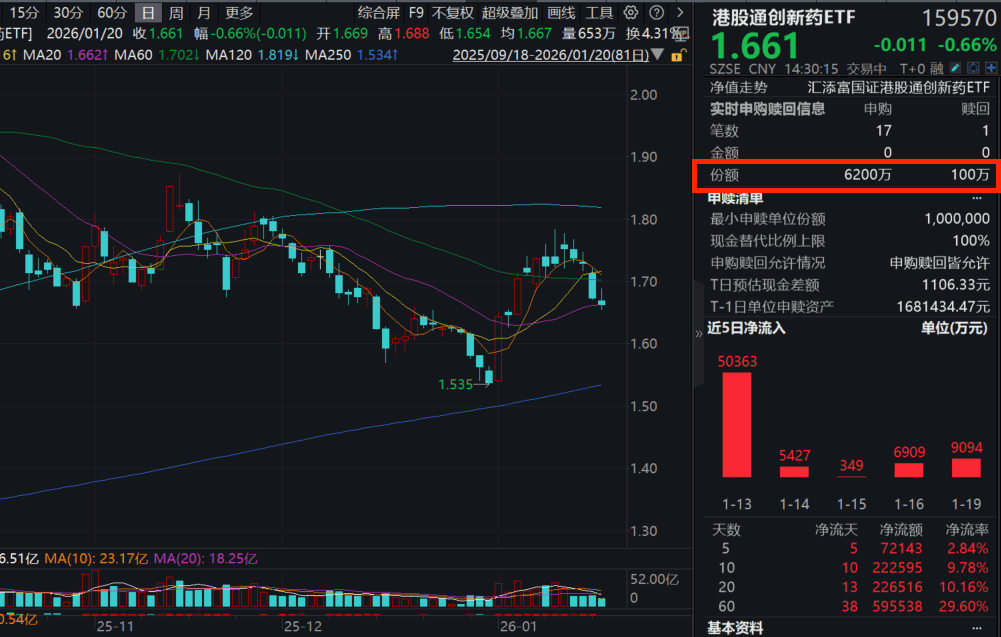
Group 1 - The Hong Kong Innovation Drug ETF (159570) has experienced a decline for four consecutive days, with a nearly 1% drop and a trading volume exceeding 1.15 billion HKD, indicating rapid capital inflow [1] - As of January 19, the latest scale of the Hong Kong Innovation Drug ETF (159570) has surpassed 25.4 billion HKD, leading its peers in the same category [1] - The weighted stocks of the ETF have mostly shown negative performance, with notable declines including Innovent Biologics down over 3% and Hengrui Medicine down over 2% [3][4] Group 2 - At the JPMorgan Conference, over 20 Chinese pharmaceutical companies showcased their innovations, with Hengrui expected to see a 25%+ growth in innovative drug revenue by 2026 [5] - The domestic biotech sector is experiencing a surge in business development (BD) activities, with significant deals such as the 5.6 billion USD global exclusive license agreement between Rongchang Biopharma and AbbVie [5][6] - A domestic innovative drug company has projected a revenue of approximately 45.46 billion RMB for 2025, reflecting a year-on-year growth of 15.84%, with a substantial increase in net profit [7]
20cm速递|科创创新药ETF国泰(589720)连续5日资金净流入超1.3亿元,医药行业迎来多项利好
Mei Ri Jing Ji Xin Wen· 2026-01-20 06:51
Group 1 - The core viewpoint of the article highlights the positive developments in the pharmaceutical industry, particularly in the innovative drug sector, driven by multiple favorable factors such as increased funding, industry conferences, and performance forecasts [1] - The Cathay Innovation Drug ETF (589720) has seen a net inflow of over 130 million yuan for five consecutive days, indicating strong investor interest in the sector [1] - The industry is benefiting from positive clinical data for small nucleic acid drugs and increased collaborations, which are expected to enhance the outlook for innovative drugs [1] Group 2 - Neuralink plans to start mass production in 2026, aiming for safer surgical operations in the brain-computer interface technology sector [1] - The AI and pharmaceutical fields are evolving, with OpenAI launching ChatGPTHealth and several domestic AI drug companies exploring new business models [1] - The domestic CRO (Contract Research Organization) sector is experiencing a significant increase in demand, with new orders accelerating on a month-over-month basis [1] Group 3 - The Cathay Innovation Drug ETF focuses on innovative drug companies listed on the Sci-Tech Innovation Board, tracking a representative index of 30 high-quality companies [1] - During the market rebound period from September 24, 2024, to October 31, 2025, the Sci-Tech Innovation Drug Index and the Hang Seng Hong Kong Stock Connect Innovation Drug Index are expected to rise by 143.70% and 135.34%, respectively [1] - The Sci-Tech Innovation Drug Index may provide better exposure to the resilience of the Sci-Tech Innovation Board when market risk appetite increases [1]
关注港股科技ETF(513020)投资机会,后市获结构性支撑
Mei Ri Jing Ji Xin Wen· 2026-01-20 03:43
Core Viewpoint - The Hong Kong technology ETF (513020) has experienced a decline of over 1.4%, but is expected to receive structural support in the future as leading tech companies accelerate the integration of AI into their business ecosystems [1] Group 1: Company Developments - Alibaba is advancing productization in core scenarios such as e-commerce and transportation using its Qianwen platform, with the Agent application expected to expand continuously [1] - Tencent is leveraging its WeChat ecosystem to lower development barriers through the Agent platform, promoting the continuous enrichment of AI mini-programs and intelligent agents, and achieving large-scale applications in vertical fields like education [1] - Alibaba Cloud is showing strong growth momentum in its overseas business [1] Group 2: Market Trends - The Hong Kong market is gathering leading H-share semiconductor companies, and the recent stable performance of domestic GPU, large model, and hard tech companies post-IPO is expected to continue attracting high-quality tech firms to list in Hong Kong [1] - The Hong Kong technology ETF (513020) tracks the Hong Kong Stock Connect Technology Index (931573), which selects listed companies in core tech sectors such as the internet, innovative pharmaceuticals, new energy vehicles, and semiconductors to reflect the overall performance of high R&D intensity and growth-oriented tech companies in the Hong Kong market [1] - Given the strict regulation and cooling sentiment in the A-share market, the weighted tech stocks in Hong Kong are likely to benefit from entering a concentrated window for AI product releases, with "northbound capital" expected to actively seek out advantageous assets in the Hong Kong market [1]
中国创新药2025年出海交易超1300亿美元,港股医药ETF(159718)备受关注
Xin Lang Cai Jing· 2026-01-20 02:24
Core Viewpoint - The Chinese innovative drug business development (BD) for overseas licensing reached a record high of $135.655 billion in total transaction value for 2025, with a significant increase in upfront payments and transaction numbers compared to previous years [1][2]. Group 1: Market Performance - The China Securities Hong Kong Stock Connect Pharmaceutical and Health Comprehensive Index (930965) showed mixed performance among its constituent stocks, with Times Angel leading at a 4.83% increase [1]. - The Hong Kong pharmaceutical ETF (159718) was quoted at 0.96 yuan [1]. Group 2: Industry Developments - The innovative drug BD overseas licensing transactions in China for 2025 totaled $135.655 billion, with upfront payments of $7 billion and 157 transactions, all marking historical highs [2]. - Notable collaborations include Rongchang Biopharma's PD-1/VEGF dual antibody RC148 receiving a $650 million upfront payment from AbbVie, and Yilian Biopharma's partnership with Roche on B7H3-targeted ADC [2]. - GSK's Bepirovirsen for chronic hepatitis B showed positive results in Phase III trials, and Arrowhead announced advancements in RNAi therapies for weight loss, validating the clinical value of small nucleic acid drugs [2]. Group 3: Investment Outlook - The 44th Annual J.P. Morgan Healthcare Conference revealed positive updates from leading global pharmaceutical companies, with significant BD transactions and improved forecasts from CXO companies like WuXi AppTec [2]. - The global pharmaceutical industry remains robust, with innovation in drugs and medical devices continuing to be the main investment theme [2].



港股开盘 | 恒指低开0.07% AI应用概念回暖 智谱等涨超3%
智通财经网· 2026-01-20 01:37
Group 1 - The Hang Seng Index opened down 0.07% and the Hang Seng Tech Index fell 0.22%, with AI application concepts showing a rebound while tech stocks like Baidu Group declined over 2% [1] Group 2 - Huatai Securities believes that the core factors driving the market rebound in the first quarter remain unchanged, including overall loose financial conditions, foreign capital inflow, upward revisions of profit expectations, and the attractiveness of Hong Kong stocks [2] - Tianfeng Securities indicates that the short-term rebound of Hong Kong stocks is supported by valuation recovery and improved sentiment, but the upward potential may be constrained by high overseas interest rates and limited rate cut expectations [2] - Guojin Securities expects that with the acceleration of domestic economic recovery and the shift towards loose monetary policy in major overseas economies, the valuation advantage of Hong Kong stocks will become more pronounced [2] Group 3 - Industrial Securities recommends prioritizing leading internet companies in the Chinese AI sector, anticipating a resonance of buying from both domestic and foreign investors [3] - The report suggests focusing on dividend assets in a low-interest-rate environment, highlighting opportunities in insurance, banking, energy, property management, and public utilities [3] - New consumption trends are emphasized, with three main lines of focus: traditional service-oriented consumption transformation, Z-generation consumption trends, and high-end consumption [3]
2025年年报业绩预告进入加速披露期:40余家上市公司净利翻番 AI成业绩增长强大驱动力
Zhong Guo Zheng Quan Bao· 2026-01-20 00:36
Core Viewpoint - The A-share listed companies are entering a rapid disclosure period for their 2025 annual performance forecasts, with a significant number of companies expecting substantial profit growth driven by AI and rising commodity prices [1][2]. Group 1: Performance Forecasts - A total of 451 A-share listed companies have disclosed their 2025 performance forecasts, with 156 companies expecting positive results [1]. - Among these, 42 companies anticipate a net profit growth of over 100% year-on-year [2]. - Notable companies include: - DingTong Technology expects a revenue of approximately 1.593 billion yuan, a 54.37% increase, and a net profit of about 242 million yuan, a 119.59% increase, driven by AI demand in the communications sector [2]. - Baiwei Storage forecasts a net profit between 850 million and 1 billion yuan, representing a growth of 427.19% to 520.22% [3]. Group 2: Mining Sector Performance - Mining companies are experiencing significant growth due to rising prices and demand for gold and copper [4]. - Luoyang Molybdenum expects a net profit of 20 billion to 20.8 billion yuan, a year-on-year increase of 47.8% to 53.71%, attributed to effective cost control and product price increases [4]. - Zijin Mining anticipates a net profit of approximately 51 billion to 52 billion yuan, a growth of 59% to 62%, with increased production across key minerals [5]. Group 3: Innovative Sectors - Companies in semiconductor, innovative pharmaceuticals, and commercial aerospace sectors are gaining market attention [6]. - Haopeng Technology projects a net profit of about 19.5 million to 22 million yuan, a growth of 113.69% to 141.09%, focusing on AI hardware applications [6]. - The pharmaceutical industry is entering a critical phase of innovation and global expansion, with investment opportunities shifting towards companies with global competitiveness [7].

2025年年报业绩预告进入加速披露期 40余家上市公司净利翻番 AI成业绩增长强大驱动力
Zhong Guo Zheng Quan Bao· 2026-01-19 21:12
Core Viewpoint - The A-share listed companies are entering a rapid disclosure period for their 2025 annual performance forecasts, with a significant number of companies expected to report strong growth driven by AI and rising commodity prices [1][2]. Group 1: Performance Forecasts - As of January 19, 2025, 451 A-share listed companies have disclosed their performance forecasts, with 156 companies expecting positive results [1]. - Among these, 42 companies anticipate a net profit growth of over 100% year-on-year for 2025 [2]. - Notable companies include: - DingTong Technology expects a revenue of approximately 1.593 billion yuan, a 54.37% increase, and a net profit of about 242 million yuan, a 119.59% increase, driven by AI demand in the communications sector [2]. - Baiwei Storage forecasts a net profit between 850 million to 1 billion yuan, representing a growth of 427.19% to 520.22%, with a revenue expectation of 10 billion to 12 billion yuan [3]. Group 2: Mining Sector Performance - Mining companies are showing significant performance improvements due to rising prices and production volumes of key commodities [4]. - Luoyang Molybdenum expects a net profit of 20 billion to 20.8 billion yuan, a year-on-year increase of 47.8% to 53.71%, attributed to effective cost control and a dual-core strategy focusing on copper and gold [4]. - Zijin Mining anticipates a net profit of approximately 51 billion to 52 billion yuan, a growth of 59% to 62%, with increased production in gold, copper, and silver [5]. Group 3: Innovative Sectors - Companies in semiconductor, innovative pharmaceuticals, and commercial aerospace sectors are gaining market attention [6]. - Haopeng Technology projects a net profit of about 19.5 million to 22 million yuan, a growth of 113.69% to 141.09%, driven by advancements in AI hardware applications [6]. - The pharmaceutical industry is entering a critical phase of innovation and global expansion, with investment opportunities focusing on companies with global competitiveness [7].