
医药生物

Search documents
A股市场大势研判:沪指十二连阳重返4000点迎开门红
Dongguan Securities· 2026-01-06 01:41
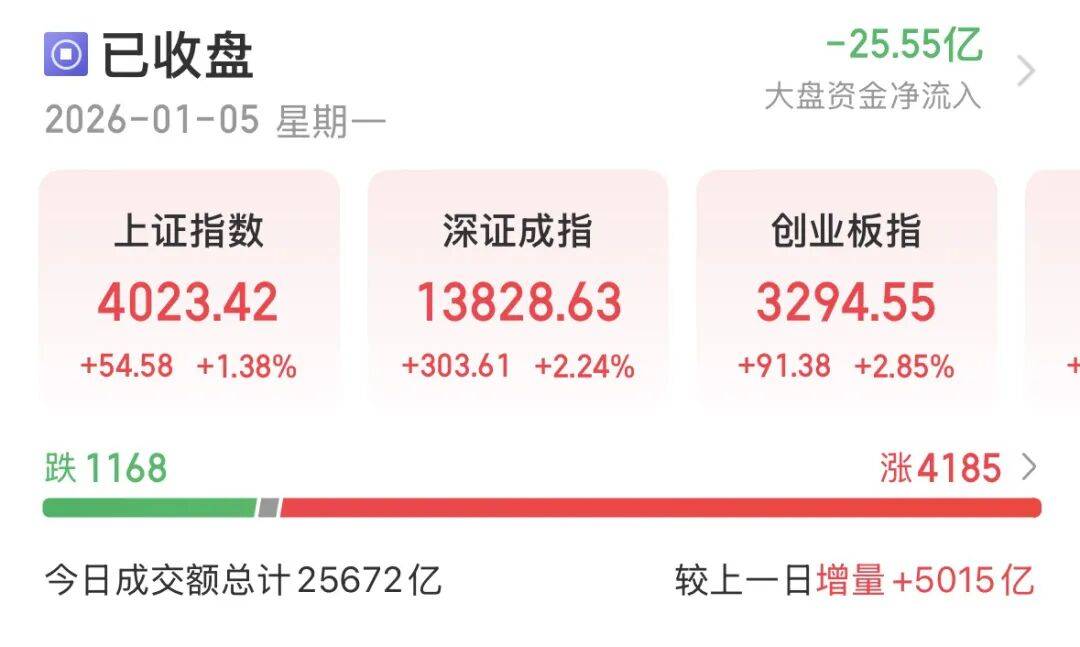
Market Overview - The Shanghai Composite Index has returned to above 4000 points, marking a twelve-day winning streak, with a closing increase of 1.38% [1][6] - The Shenzhen Component Index rose by 2.24%, while the ChiNext Index led the gains with a 2.85% increase [2][6] Sector Performance - The top-performing sectors included Media (4.12%), Pharmaceuticals (3.85%), Electronics (3.69%), Non-Bank Financials (3.14%), and Computers (2.71%) [3] - Conversely, the worst-performing sectors were Oil & Petrochemicals (-1.29%), Banks (-0.34%), Transportation (-0.30%), Retail (-0.17%), and Agriculture, Forestry, Animal Husbandry, and Fishery (0.00%) [3] Conceptual Sector Highlights - The leading conceptual sectors were Brain-Computer Interface (13.70%), Hyperbaric Oxygen Chamber (7.01%), Blood Oxygen Monitor (5.65%), and New Technology Stocks (5.19%) [3] - The lagging conceptual sectors included Hainan Free Trade Zone (-2.93%), Duty-Free Shops (-1.08%), Free Trade Ports (-0.94%), Pork (-0.28%), and Ride-Hailing (-0.05%) [3] Future Outlook - The market opened strong on the first trading day of 2026, with significant participation from over 4100 stocks rising, including 127 hitting the daily limit [6] - The manufacturing PMI showed a seasonal rebound, indicating improved supply and demand, while the construction PMI saw a significant month-on-month increase, suggesting a potential boost to the economy [6] - The report anticipates continued market liquidity and risk appetite improvement, supported by favorable domestic policies and a strengthening RMB, with a focus on sectors such as TMT, Finance, Machinery, Military, Power, and Nonferrous Metals for investment opportunities [6]
浙商证券浙商早知道-20260106
ZHESHANG SECURITIES· 2026-01-05 23:30
Market Overview - On January 5, the Shanghai Composite Index rose by 1.38%, the CSI 300 increased by 1.9%, the STAR 50 surged by 4.41%, the CSI 1000 climbed by 2.09%, the ChiNext Index went up by 2.85%, and the Hang Seng Index slightly increased by 0.03% [4][5] - The best-performing sectors on January 5 were Media (+4.12%), Pharmaceutical and Biological (+3.85%), Electronics (+3.69%), Non-Bank Financials (+3.14%), and Computers (+2.71%). The worst-performing sectors included Oil and Petrochemicals (-1.29%), Banks (-0.34%), Transportation (-0.3%), and Retail (-0.17%) [5] - The total trading volume for the A-share market on January 5 was 25,672 billion, with a net inflow of 18.723 billion HKD from southbound funds [5] Key Insights - The semiconductor equipment sector is expected to see a significant increase in capital expenditure and an acceleration in domestic production rates, leading to a positive outlook for orders in the semiconductor equipment segment [6][7] - Four major growth directions are highlighted: 1. AI-driven storage supercycle focusing on etching and thin-film equipment leaders 2. Dawn of domestic photolithography machine production, emphasizing core subsystems and components 3. Evolution of cutting-edge technologies, with ALD equipment entering a golden development period 4. Advanced packaging continuing the Moore's Law, with substantial room for equipment localization [7] - The driving factors include accelerated capital expenditure from domestic wafer fabs and higher-than-expected domestic production rates [7] Investment Opportunities - The year 2026 is anticipated to be a pivotal year for AI applications, marking the beginning of a significant growth phase in the sector [8] - The convergence of application, computing power, and capital is expected to trigger a "flywheel" effect in embodied intelligence [8]
【早报】猛涨超7%!COMEX白银期货单日暴力拉升;证监会发声,打击财务造假
财联社· 2026-01-05 23:21
Macro News - President Xi Jinping emphasized the importance of mutual trust and respect for each other's development paths during a meeting with South Korean President Lee Jae-myung, advocating for dialogue to resolve differences [2] - Premier Li Qiang highlighted the need for high-quality development and innovation during his inspection in Guangdong, aligning with the goals set in the Central Economic Work Conference [2] - The Chinese Foreign Ministry reaffirmed its commitment to deepening practical cooperation with Venezuela, regardless of the political situation in the country [2] Industry News - The State-owned Assets Supervision and Administration Commission (SASAC) stressed the importance of supporting agricultural development, focusing on key areas such as biotechnology, agricultural machinery, and food production [4] - Samsung and SK Hynix are seeking to increase server DRAM prices by 70% [8] - The Shanghai Pudong New Area signed 50 key projects with a total investment exceeding 70 billion yuan, aiming to boost various industrial clusters [8] - The China Passenger Car Association projected a 25% growth in the sales of new energy passenger vehicles in 2025, with December sales showing a year-on-year increase of 4% [8] Company News - The Shanghai Stock Exchange issued a regulatory warning to Tianpu Rubber Technology Co., Ltd. and related responsible parties [9] - Postal Savings Bank announced a cash dividend distribution of 14.772 billion yuan for the first half of 2025, with the record date set for January 9, 2026 [9] - ST Renfu received approval for clinical trials of HW221043 tablets for late-stage solid tumors, with no similar drugs approved in the domestic and international markets [10] - GAC Group signed a comprehensive cooperation framework agreement with Huawei to deepen collaboration on HarmonyOS cockpit and other projects [10] - The announcement from Sailyus indicated a 63.4% year-on-year increase in new energy vehicle sales in December [12]


Wind:2025年港股股权融资市场融资总额达6122亿港元 增长比率达250.91%
Zhi Tong Cai Jing· 2026-01-05 23:05
(原标题:Wind:2025年港股股权融资市场融资总额达6122亿港元 增长比率达250.91%) 智通财经APP获悉,1月6日,Wind发布2025年度港股承销排行榜。二级市场流动性的深度修复与风险偏好的显著回升,为一级股权融资市场提供 了理想的"发行窗口",港股股权融资呈现出爆发式增长态势。据统计,2025年全年,港股股权融资市场融资总额达6,122亿港元,较去年同期1,745 亿港元明显翻倍,增长比率达250.91%,实现了规模上的跃迁。这一激增得益于大型中概股回归及特专科技企业(18C)的常态化发行,不仅重塑了 香港作为全球新股募资中心的地位,更在南下资金定价权提升的背景下,完成了从"估值洼地"向"资产定价枢纽"的核心转型。 2025年,港股二级市场的强劲复苏为一级股权融资提供了绝佳的"发射窗口",恒生综合指数全年上涨30.98%。值得关注的是,市场风格呈现出明 显的"双轮驱动"特征:一方面,恒生金融类指数以39.26%的涨幅跨越式领跑,反映出宏观流动性改善下权重板块的压舱石作用;另一方面,恒生 科技指数与可持续发展企业指数分别上涨23.45%与31.36%,显示出资本对新质生产力与ESG长线价值的高 ...

12连阳创33年纪录!开启春季行情?最新解读
Zhong Guo Ji Jin Bao· 2026-01-05 22:53
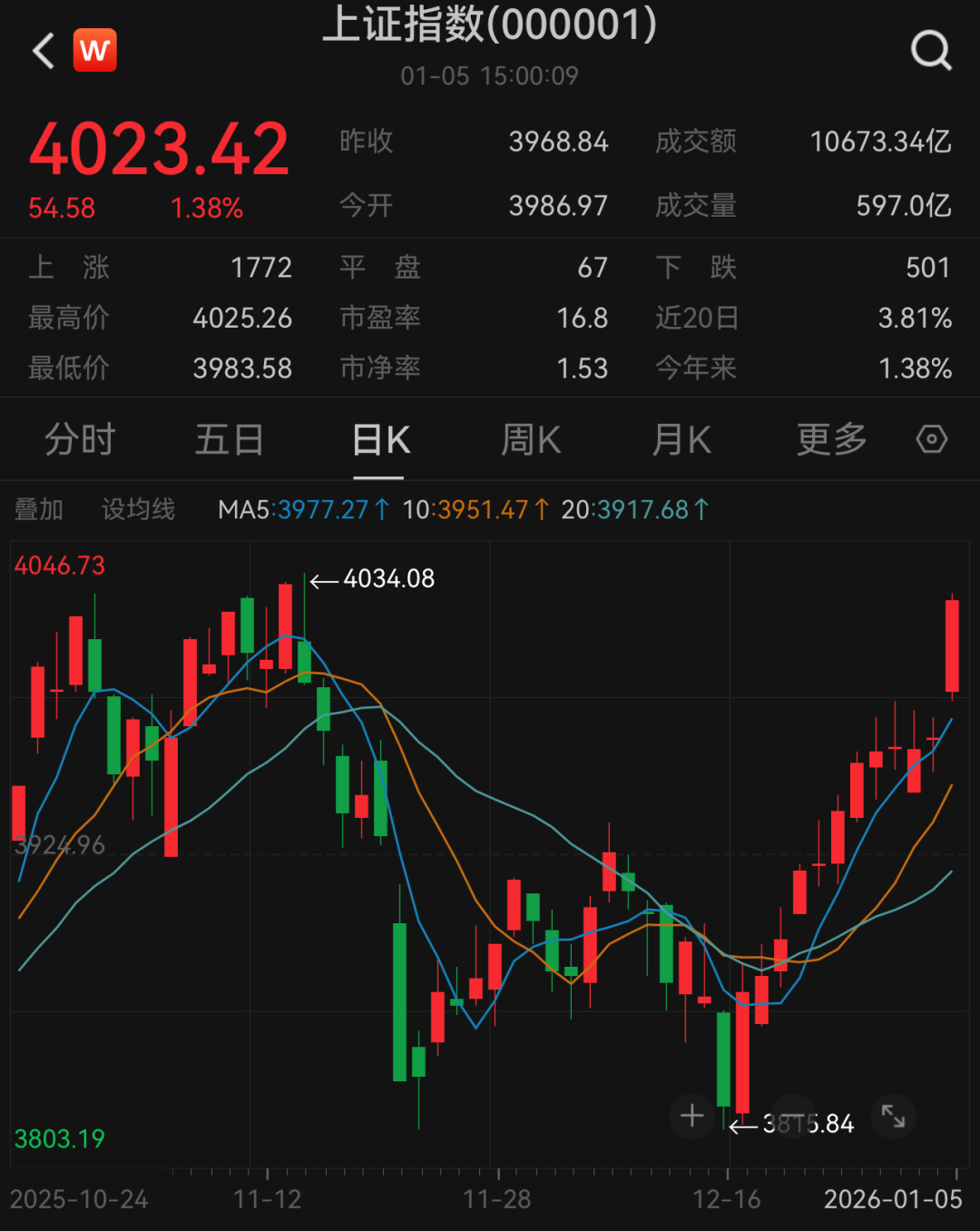
Group 1 - A-shares experienced a strong start in 2026, with the Shanghai Composite Index rising above 4000 points and achieving a record 12 consecutive daily gains, the longest since March 1992 [1] - The market's trading volume surged to 2.57 trillion yuan, marking a two-month high, with sectors like media, pharmaceuticals, and electronics leading the gains [3][4] - Factors contributing to this "opening red" include a strong performance in the Hong Kong market during the New Year holiday, a rebound in China's manufacturing PMI, and a favorable exchange rate for the yuan attracting foreign capital [4][5] Group 2 - The expectation of a spring market rally is supported by positive external market trends and pre-holiday investments in technology stocks, with significant IPOs anticipated to catalyze the tech sector [5][6] - The upcoming earnings forecasts for 60% of listed companies by the end of January may drive further market momentum, particularly in high-growth industries [6] - The market is expected to transition from a phase of low trading volume to a rebound, with a shift in investment focus from defensive sectors to technology and manufacturing [6][8] Group 3 - Key investment areas include consumer electronics, AI, and cyclical sectors, with expectations for performance improvements driven by the AI industry and domestic computing power projects [10][11] - The outlook for the A-share market remains optimistic, with potential for further upward movement supported by macroeconomic policies and a favorable liquidity environment [8][9] - The emphasis on self-reliant technological innovation is seen as crucial for long-term growth, particularly in sectors like domestic computing power and commercial aerospace [11]
2025年度港股承销排行榜
Wind万得· 2026-01-05 22:35
Market Overview - In 2025, the Hong Kong stock market experienced a strong recovery, with the Hang Seng Composite Index rising by 30.98% [2] - The market exhibited a "dual-driven" characteristic, with the Hang Seng Financial Index leading with a 39.26% increase, while the Hang Seng Technology Index and Sustainable Development Enterprises Index rose by 23.45% and 31.36% respectively [2] - The performance of the Hang Seng Hong Kong Stock Connect Small and Medium-sized Enterprises Index (+30.93%) activated financing channels for small and medium-sized enterprises, indicating a significant structural development in the market [2] Equity Financing Trends - The total amount of equity financing in the Hong Kong stock market reached HKD 612.2 billion in 2025, a 250.91% increase from HKD 174.5 billion in the previous year [5][8] - Initial Public Offerings (IPOs) raised HKD 285.8 billion, up 224.24% from HKD 88.1 billion the previous year [22] - Placement financing saw a remarkable increase, raising HKD 289.6 billion, a 438.66% rise compared to the previous year [5] - The amount raised through rights issues decreased to HKD 7.6 billion, down 43.33% from the previous year [5] Financing Method Distribution - In 2025, the distribution of financing methods showed that IPOs accounted for 46.69% of total fundraising, while placements made up 47.31% [12] - Other methods included consideration issuance at 4.40%, rights issues at 1.23%, and public offerings at 0.37% [12] Industry Distribution of Financing - The top three industries for fundraising were Automotive and Parts (HKD 95 billion), Hardware Equipment (HKD 80.9 billion), and Pharmaceuticals and Biotechnology (HKD 80.8 billion) [13] - In terms of the number of financing events, the Pharmaceuticals and Biotechnology sector led with 68 events, followed by Software Services with 66, and Non-bank Financials with 56 [15] IPO Market Insights - A total of 117 companies went public in 2025, a 67.14% increase from 70 in the previous year [18] - The highest fundraising industry for IPOs was Electrical Equipment, raising HKD 44.6 billion, followed by Non-ferrous Metals at HKD 42.8 billion [28] - The top three IPOs by fundraising amount were CATL (HKD 41.006 billion), Zijin Mining International (HKD 28.732 billion), and SANY Heavy Industry (HKD 15.349 billion) [35] Refinancing Market Insights - The total amount raised through refinancing in 2025 was HKD 326.4 billion, a 278.15% increase from HKD 86.3 billion the previous year [40] - The Automotive and Parts sector led refinancing with HKD 66.2 billion, primarily from BYD's placement of HKD 43.5 billion [44] - The number of refinancing projects increased to 574, up 43.50% from 400 the previous year [40] Underwriting and Advisory Rankings - CICC topped the IPO underwriting scale with HKD 51.652 billion, followed by CITIC Securities (HK) at HKD 46.029 billion [54] - Goldman Sachs led the refinancing underwriting scale with HKD 32.244 billion, followed by CICC at HKD 24.967 billion [70]






脑机接口板块领涨市场上证指数“十二连阳”
Zhong Guo Zheng Quan Bao· 2026-01-05 20:05
Core Viewpoint - The A-share market experienced a strong start in 2026, with all major indices rising and the total market capitalization surpassing 120 trillion yuan, marking a historical high [1][6]. Market Performance - On January 5, the Shanghai Composite Index, Shenzhen Component Index, ChiNext Index, and other indices saw increases of 1.38%, 2.24%, 2.85%, and 3.61% respectively, with the Shanghai Composite Index surpassing 4020 points [1][2]. - A total of 4185 stocks rose, with 127 hitting the daily limit, while 1168 stocks declined [2]. - The A-share market's trading volume reached 2.57 trillion yuan, an increase of 501.5 billion yuan from the previous trading day [2]. Sector Performance - The brain-computer interface sector saw significant gains, with companies like Sainuo Medical and Meihao Medical hitting the daily limit of 20% [2]. - Other strong-performing sectors included media, pharmaceuticals, and electronics, with respective increases of 4.12%, 3.85%, and 3.69% [2]. - The non-bank financial sector also rose over 3%, while sectors like oil and gas, banking, and transportation saw slight declines [2]. Funding and Investment Trends - The A-share market's financing balance increased by over 600 billion yuan in December 2025, with a notable rise in net inflows into over 2300 stocks on January 5 [1][3]. - As of December 31, 2025, the A-share margin trading balance reached 25.41 trillion yuan, marking a historical high [4]. - The electronic, defense, and machinery sectors saw significant net buying, while the computer and pharmaceutical sectors experienced net selling [4]. Optimism in Market Sentiment - Analysts noted a shift towards optimistic funding sentiment, with a continuous rise in the Shanghai Composite Index since mid-December 2025 [3][6]. - The market is expected to benefit from long-term capital inflows, particularly from insurance funds, and a favorable global liquidity environment [6][7]. - The upcoming spring market is anticipated to focus on consumption and growth as key themes [6][7].


沪指12连阳!后市怎么走?
Sou Hu Cai Jing· 2026-01-05 15:24
1月5日,A股以放量大涨拉开2026年序幕,日成交额增至2.57万亿元,赚钱效应良好,4185只个股收红,传媒、医药生物、电子、证券、大消费等均表现 亮眼。 受访人士表示,国际流动性宽松、美元贬值、人民币升值及国内政策利好共振,今日A股放量大涨,资金从低股息权重切换至高景气成长,市场风险偏好 显著提升。短期强势有望延续,可逢低关注脑机接口、半导体等新兴产业,同时警惕技术性回调、海外不确定性与行业分化风险。 沪指12连阳 A股新年开门红:沪指12连阳,收涨1.38%报4023.42点;创业板指涨2.85%报3294.55点,深证成指涨逾2%;科创50飙升4.4%,沪深300、上证50、北证50 齐涨约2%。 交易量较上一个交易日放大5016亿元,日成交额增至2.57万亿元。杠杆资金方面,截至去年12月31日,沪深京两融余额为2.54万亿元。 盘面上,半导体、存储芯片、电子设备制造等科技主线大涨,生物医药、医疗器械、人脑工程、AI制药爆发,短剧互动亦表现活跃;银行、石油天然 气、天然气、页岩气等板块回落。 31个申万一级行业中26个飘红,石油石化、银行等板块微跌,传媒板块大涨,蓝色光标、天下秀、引力传媒、三七互娱 ...


万亿资金,涌入!
Zhong Guo Zheng Quan Bao· 2026-01-05 14:56
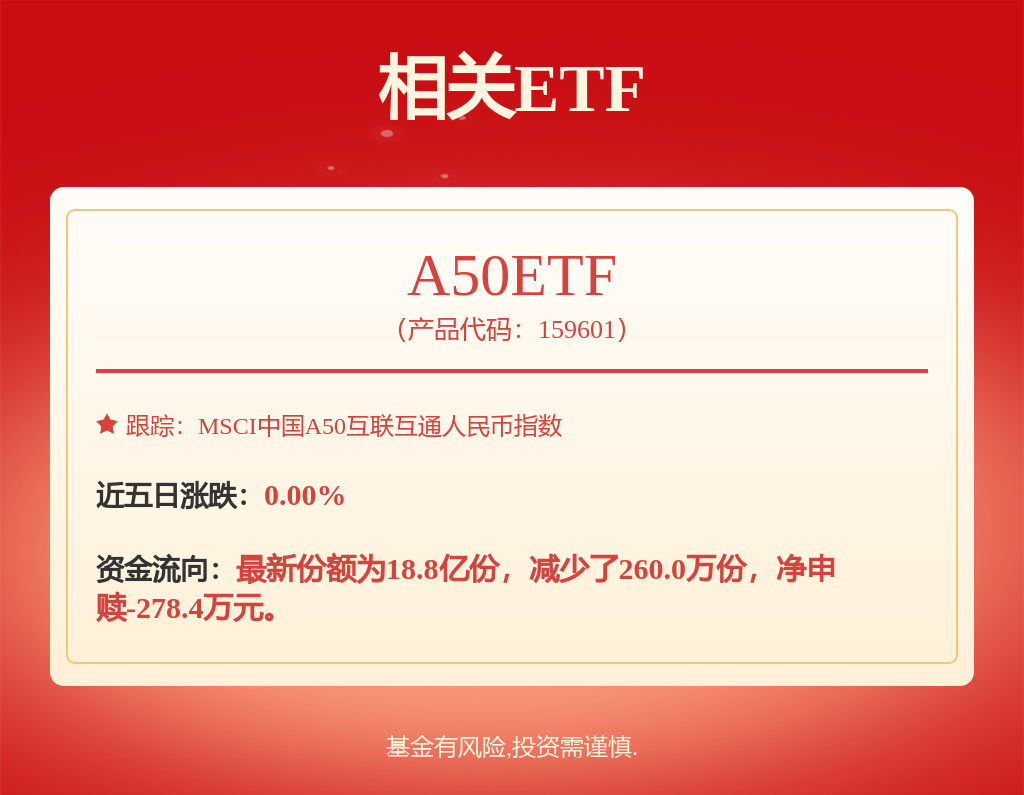
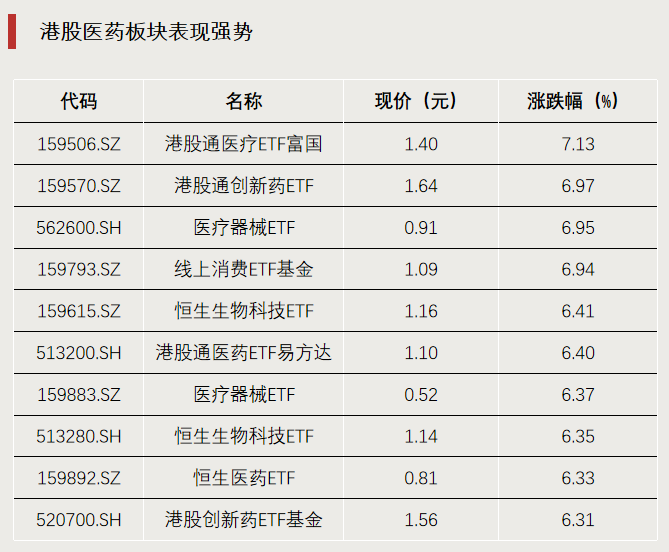
Group 1 - The A-share market showed strong growth in growth style, with notable performances in the pharmaceutical and semiconductor sectors, where multiple related ETFs rose over 5% in a single day [1] - In December 2025, the A500 and Sci-Tech bonds became significant directions for capital inflow, with several related ETFs seeing net inflows exceeding 10 billion yuan [2][8] - The Hong Kong pharmaceutical sector performed strongly, with multiple ETFs in innovative drugs and medical devices rising over 6%, indicating a robust market for innovative pharmaceuticals [4][5] Group 2 - The semiconductor sector experienced a hot market, with multiple ETFs related to semiconductor chips, big data, AI, and cloud computing showing significant gains, with some ETFs rising over 5% [6][7] - In December 2025, the net inflow for A500-related ETFs exceeded 20 billion yuan, with specific ETFs like the Southern CSI A500 ETF and Huatai-PB CSI A500 ETF seeing net inflows over 20 billion yuan each [9] - The outlook for the Hong Kong market in 2026 suggests a potential recovery in corporate earnings, particularly in sectors benefiting from overseas demand and competitive industry leaders, with AI, new consumption, pharmaceuticals, and dividends highlighted as key focus areas [12]
银河证券北交所日报-20260105
Yin He Zheng Quan· 2026-01-05 14:01
Core Insights - The North Exchange 50 index increased by 1.80% to close at 1,466.42 points on January 5, 2026, with a trading volume of 211.38 billion yuan and a turnover rate of 3.16% [1][2][5] - The overall valuation of the North Exchange is at 46.72 times earnings, which is higher than the valuations of the ChiNext and Sci-Tech Innovation Board [1][8][9] - The most significant sector gains were seen in the oil and petrochemical (+6.0%), pharmaceutical and biological (+4.5%), home appliances (+4.3%), and communications (+3.7%) sectors [1][2] Trading Performance - On January 5, 2026, the North Exchange had a total market capitalization of 884.47 billion yuan, with 396.77 billion shares listed, of which 253.27 billion were tradable [1] - The trading activity showed a recovery compared to the previous week, with an average daily trading volume of 194.04 billion yuan [1] Sector Analysis - The highest average price-to-earnings (P/E) ratios among sectors on the North Exchange were in non-ferrous metals (108.9), home appliances (82.5), and communications (80.1) [1][8] - The majority of industries on the North Exchange experienced gains, with notable declines in the automotive (-0.9%) and transportation (-0.3%) sectors [1][2] Stock Performance - Among the top gainers, Beiyikang (29.98%), Kaide Quartz (22.36%), and Jinhao Medical (20.03%) led the market [1][6] - Conversely, Tianming Technology (-15.03%), Jiaxian Co. (-10.33%), and Lifang Holdings (-8.46%) were the largest decliners [1][7] Valuation Trends - The North Exchange's overall valuation has shown an increase, with the P/E ratio at 46.72 times, indicating a higher valuation compared to the ChiNext (44.40 times) [1][9] - The valuation trends indicate a consistent premium of the North Exchange over the ChiNext, reflecting investor confidence in the listed companies [1][9]