煤炭开采和洗选业

Search documents
郑州、榆林、洛阳、太原,这四个百强市一季度经济增量为负
Sou Hu Cai Jing· 2025-05-15 01:14
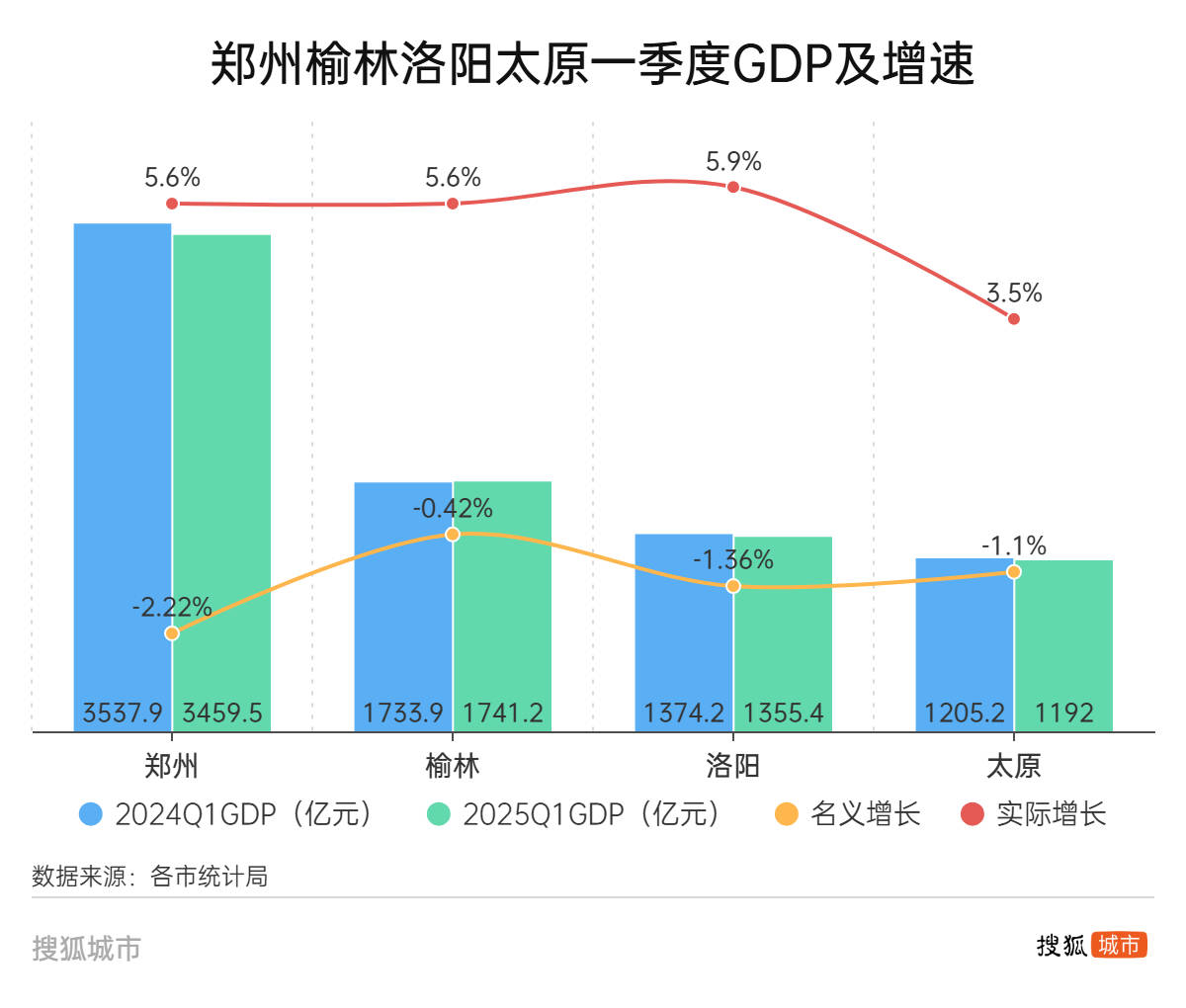
5月12日,太原统计局官网发布一季度全市经济运行情况,至此,全国GDP百强市一季度经济数据全部揭晓。 相比去年同期,郑州、榆林、洛阳、太原名义增速为负,排名分别下降1个、2个、7个、8个位次。这些城市遭遇了什么? -1- 太原全国排名下滑八个位次 2025年一季度城市GDP百强榜,入榜名单与去年同期相差无几。相比头部城市,中尾部城市位次变动幅度更大。 这其中下滑最多位次的城市是山西省会太原,一季度经济规模同比减量13.24亿元(名义增速-1.1%),在百强市排名下降了8名,来到第64位。 太原不是唯一经济增量为负的百强市。前3个月,河南省会郑州、陕西副中心城市榆林、河南副中心城市洛阳经济规模均遭遇负增长,名义增速分别 为-2.22%、-0.42%、-1.36%,郑州名义增速垫底百强市。 从经济排位看,作为全国前二十强中唯一"负增长"城市,郑州下滑1位排在第16名,被老对手长沙反超;"煤都"榆林下滑2位排在第41名;洛阳下滑7个位 次,来到第54位。 值得一提的是,郑州、榆林去年同期排位是上升趋势,今年小幅回落——可视为短期震荡;而洛阳、太原去年同期是下滑,今年趋势依旧——这意味着两地 尚未走出下行轨道。 -2 ...

盐湖股份拟成为高地资源最大股东;沃尔核材筹划发行H股股票| 新能源早参
Mei Ri Jing Ji Xin Wen· 2025-05-12 23:20
Group 1 - Company沃尔核材 plans to issue H-shares and apply for listing on the Hong Kong Stock Exchange to advance its international strategy and enhance its brand image and core competitiveness [1] - The issuance is subject to approval from the company's shareholders and relevant regulatory bodies, with significant uncertainty regarding the final implementation [1] Group 2 - Company通润装备's major shareholder,珠海悦宁管理咨询合伙企业, plans to reduce its stake by up to 2% within three months through centralized bidding and block trading [2] - This reduction may impact market sentiment and investors should monitor potential stock price fluctuations [2] Group 3 - Company盐湖股份 intends to become the largest shareholder of高地资源 by investing $300 million in common stock, thereby gaining control over the company [3] - This transaction, if completed, will alter the ownership structure of高地资源 and will provide盐湖股份 access to significant potassium resources [3]

4月中国PPI下降 部分工业行业价格向好
Huan Qiu Wang· 2025-05-10 09:26
Group 1 - In April, China's Producer Price Index (PPI) decreased by 0.4% month-on-month and 2.7% year-on-year, with the year-on-year decline widening by 0.2 percentage points compared to the previous month [1] - The decline in PPI is attributed to changes in the international trade environment and a rapid drop in prices of certain international bulk commodities, affecting domestic industry prices [1] - Specific sectors such as oil and gas extraction saw a price decrease of 3.1%, while refined petroleum products and chemical manufacturing prices fell by 2.5% and 0.6% respectively [1] Group 2 - Seasonal declines in energy prices were noted, with coal mining and processing prices dropping by 3.3% due to the end of heating season and traditional off-peak demand [1] - The electricity and heat production and supply sector experienced a price decrease of 0.3%, influenced by lower costs of new energy generation and increased wind power output [1] - Despite international factors exerting downward pressure, domestic macro policies aimed at boosting consumption and the growth of high-tech industries have led to increased demand in certain sectors, resulting in positive price changes in some areas [1] Group 3 - Policies promoting consumption and equipment upgrades are expected to lead to a recovery in prices for certain consumer goods and manufacturing products [2] - In April, the year-on-year price decline for household washing machines narrowed by 0.3 percentage points, while food manufacturing and new energy passenger vehicles also saw a reduction in their price decline by 0.2 percentage points [2] - The diversification of trade and market expansion has contributed to price increases or reduced declines in some export sectors, with integrated circuit packaging and testing prices rising by 2.7% and semiconductor device manufacturing prices increasing by 1.0% in April [2]
重磅数据发布!价格领域呈现积极变化
第一财经· 2025-05-10 09:14
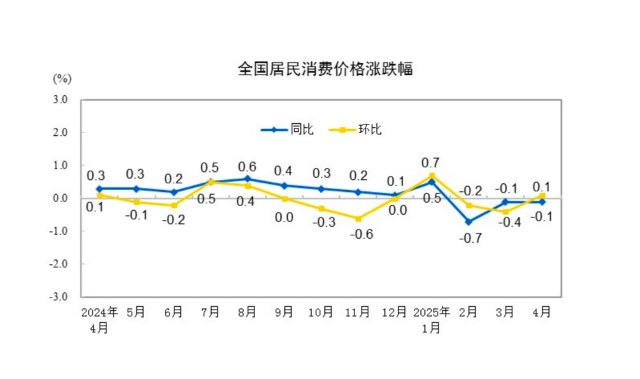
Core Viewpoint - The article discusses the recent trends in China's Consumer Price Index (CPI) and Producer Price Index (PPI), highlighting the impact of international oil prices and domestic economic policies on these indices [1][2]. CPI Analysis - In April, the CPI showed a month-on-month increase of 0.1% after a previous decline of 0.4%, but year-on-year it decreased by 0.1% [1]. - The core CPI, excluding food and energy, rose by 0.5%, indicating stable inflation in essential goods [2]. - The year-on-year decline in CPI is attributed mainly to a significant drop in energy prices, which fell by 4.8%, with gasoline prices decreasing by 10.4%, contributing approximately 0.38 percentage points to the CPI decline [6]. PPI Analysis - The PPI decreased by 0.4% month-on-month and 2.7% year-on-year, with the latter decline widening by 0.2 percentage points compared to the previous month [7]. - The drop in PPI is influenced by international commodity price declines, particularly in oil and gas extraction, which saw a price drop of 3.1%, and refined petroleum products, which fell by 2.5% [7]. - Seasonal factors also contributed, with coal prices declining as demand decreased post-heating season [7]. Positive Price Changes - Despite the overall decline in CPI and PPI, certain sectors are experiencing positive price changes due to improved supply-demand dynamics and government policies promoting consumption [9]. - Industries such as black metal smelting and non-metallic mineral products saw a narrowing of year-on-year price declines, indicating a recovery in demand [9]. - High-tech industries are also benefiting, with prices for wearable smart devices and aircraft manufacturing increasing by 3.0% and 1.3%, respectively [10]. Trade and Export Impact - The diversification of trade and market expansion has led to price increases in some export sectors, such as integrated circuit packaging, which rose by 2.7% [10]. - The government emphasizes the importance of maintaining prices within a reasonable range to support both consumer spending and corporate profitability [10].

4月CPI同比下降0.1%,价格领域呈现积极变化
Di Yi Cai Jing· 2025-05-10 04:58
Economic Overview - The National Bureau of Statistics indicates that despite international input factors exerting downward pressure on prices in certain industries, China's economic foundation remains stable and resilient, with macro policies working in synergy to promote high-quality development [1][2] - In April, the Consumer Price Index (CPI) showed a month-on-month increase of 0.1% after a previous decline of 0.4%, while year-on-year, it decreased by 0.1% [1][4] - The Producer Price Index (PPI) experienced a month-on-month decline of 0.4%, with a year-on-year decrease of 2.7%, which is an expansion of the decline by 0.2 percentage points compared to the previous month [1][5] CPI Analysis - The core CPI, excluding food and energy prices, rose by 0.5% in April, maintaining a stable growth rate [2] - The year-on-year CPI decline is primarily influenced by a significant drop in international oil prices, with energy prices decreasing by 4.8% year-on-year, and gasoline prices falling by 10.4%, contributing approximately 0.38 percentage points to the CPI decline [4] PPI Analysis - The PPI's decline is attributed to international input factors affecting domestic industry prices, with global commodity prices, including Brent crude oil and LME copper, experiencing declines of 6.6% and 5.5% respectively [5][6] - Domestic energy prices are also seasonally declining, particularly in coal mining and processing, which saw a month-on-month decrease of 3.3% [6] Price Trends in Specific Industries - Certain industries are witnessing positive price changes due to improved supply-demand relationships, with construction and manufacturing sectors showing signs of recovery [7] - Prices in the black metal smelting and rolling industry and non-metallic mineral products industry have seen a narrowing of year-on-year declines by 1.4 and 1.0 percentage points respectively [7] - The prices of consumer goods and equipment manufacturing products are also rebounding, with household washing machines and new energy vehicles showing reduced year-on-year price declines [7][8] Export and Trade Impact - The ongoing diversification of trade is leading to price increases or reduced declines in some export sectors, such as integrated circuit packaging and testing, which saw a price increase of 2.7% [8] - The government emphasizes the importance of maintaining reasonable price levels to balance consumer spending and corporate profitability, with policies aimed at promoting price recovery [8]
董莉娟:PPI环比降幅与上月相同
news flash· 2025-05-10 01:46
Core Viewpoint - The Producer Price Index (PPI) has decreased by 0.4% month-on-month, with the decline rate remaining consistent with the previous month [1] Group 1: PPI Decline Factors - The primary reason for the PPI decline is the impact of international input factors leading to a decrease in domestic industry prices [1] - Changes in the international trade environment and a rapid decline in certain international bulk commodity prices have affected domestic industry prices [1] - Seasonal declines in domestic energy prices also contributed, particularly with the end of heating season in northern regions, leading to a decrease in coal demand [1] Group 2: Specific Industry Impact - The coal mining and washing industry, as well as coal processing prices, have seen a month-on-month decline of 3.3% due to the seasonal drop in demand [1]
A股市场并购重组将持续活跃
Jin Rong Shi Bao· 2025-05-08 01:46
本次重组白音华煤电,或将对电投能源的煤电业务布局产生积极影响。 据了解,电投能源原名露天煤业,成立于2001年,2007年在深圳证券交易所A股上市,是国家电投唯一 的煤炭上市公司平台。电投能源主营生产销售煤炭、铝、火电及光伏风电新能源等业务。 白音华煤电成立于2003年,注册资本38.62亿元,国家电投集团通过内蒙古能源有限公司对其实现全资 持有。白音华煤电所属行业主要为煤炭开采和洗选业。此外,白音华煤旗下还有白音华煤电铝电分公司 以及多个风电业务公司。 从业务布局来看,白音华煤电与电投能源较为接近,在重组完成后,两公司业务或将出现较好的协同效 应。值得注意的是,不少企业都在加大优质资产的整合力度。 近日,国家电投集团旗下电投能源(002128)发布公告称将启动重组,并宣布了停牌安排。值得注意的 是,这是国家电投集团近期的又一次资产重组动作。 数据显示,截至5月7日,A股市场今年以来的重大资产重组案例已达476起。作为实现产业加速转型、 整合提高业务效率的重要手段,并购重组已经成为上市公司战略发展的重要手段。 5月5日,深交所上市公司电投能源发布了关于筹划发行股份及支付现金购买资产并募集配套资金暨关联 交易事 ...

江苏兆齐能源有限公司成立,注册资本1000万人民币
Sou Hu Cai Jing· 2025-04-29 16:20
Core Viewpoint - Jiangsu Zhaoqi Energy Co., Ltd. has been established with a registered capital of 10 million RMB, fully owned by Inner Mongolia Zhaoqi Coal Industry Co., Ltd. [1] Company Summary - Company Name: Jiangsu Zhaoqi Energy Co., Ltd. [1] - Legal Representative: Wang Jianfei [1] - Registered Capital: 10 million RMB [1] - Shareholder: Inner Mongolia Zhaoqi Coal Industry Co., Ltd. holds 100% [1] - Business Scope: Includes coal and products sales, coal washing, coal-based activated carbon production, coking, internet sales (excluding licensed goods), cement products sales, construction materials sales, metal structure sales, plastic products sales, rubber products sales, fire-fighting equipment sales, metal materials sales, environmental protection equipment sales, textile products sales, daily necessities sales, handling and transportation, road cargo transportation station operation, general cargo warehousing (excluding hazardous chemicals), business training (excluding licensed education and vocational training), domestic cargo transportation agency, advertising production, design and agency, urban greening management, conference and exhibition services, park management services, municipal facility management, urban and rural appearance management, forest park management, traffic facility maintenance, planning and design management, air pollution control, water pollution control, solid waste management, advanced power electronic device sales, mechanical and electrical equipment sales, mechanical and electrical equipment manufacturing, software development, information system operation and maintenance services, software sales, big data services, building stone processing, auto parts wholesale and retail, mechanical equipment leasing, chemical products sales (excluding licensed chemical products), petroleum products sales (excluding hazardous chemicals), information consulting services (excluding licensed information consulting services), and information technology consulting services (excluding projects requiring approval) [1] Industry Summary - Industry Classification: Mining Industry > Coal Mining and Washing Industry > Other Coal Mining [1] - Business Address: No. 5, Gangqian Avenue, Lianyungang Xuwei New District, Lianyungang City, Jiangsu Province, China [1] - Company Type: Limited Liability Company [1] - Business Duration: Until April 29, 2025, with no fixed term [1] - Registration Authority: National East, Central, and West Regional Cooperation Demonstration Zone (Lianyungang Xuwei New District) Market Supervision Administration [1]
山西一季度煤炭产量大增近两成,谁将是今年的“煤老大”
Di Yi Cai Jing· 2025-04-29 11:51
Core Viewpoint - Shanxi and Inner Mongolia are in a competitive landscape for coal production, with Shanxi experiencing significant growth in Q1 2024, leading to a tight race for the top producer position [1][2][3] Group 1: Coal Production Data - In Q1 2024, Inner Mongolia produced 33,074 million tons of coal, while Shanxi produced 32,540.7 million tons, marking growth rates of 1.9% and 19.1% respectively [1][2] - Historical data shows that Inner Mongolia surpassed Shanxi in coal production in 2009 and has alternated as the top producer since then, with Shanxi holding the title from 2020 to 2023 [2] - For 2024, Shanxi's coal production is projected at 126,873.8 million tons, a decrease of 8,784.4 million tons from 2023, while Inner Mongolia's production is expected to reach 129,686.9 million tons, an increase of 8,587.6 million tons [2] Group 2: Economic Impact and Growth Factors - The significant increase in Shanxi's coal production in Q1 2024 is attributed to a low base from the previous year, where production fell by 18.9% [3] - The provincial government of Shanxi emphasized the importance of stabilizing coal production to support economic growth, aiming to enhance production capacity and ensure safety [3][4] - Shanxi's industrial output value increased by 7.7% in Q1 2024, driven by the recovery in coal production [2][3] Group 3: Future Projections and Plans - Shanxi plans to build 130 intelligent coal mines by 2025, targeting an annual coal production of 1.3 billion tons [4] - Inner Mongolia aims to approve new coal mining projects with a total capacity of over 30 million tons and achieve an annual production of over 1.2 billion tons by 2025 [4] Group 4: Market Conditions - National coal production and import levels have reached historical highs, leading to a surplus in supply and downward pressure on coal prices [5] - The coal mining sector's revenue decreased by 11.6% year-on-year, with coal extraction and washing industries seeing a 19.0% drop in revenue [5] - Companies are focusing on balancing production volume and pricing strategies to maximize overall benefits [5]
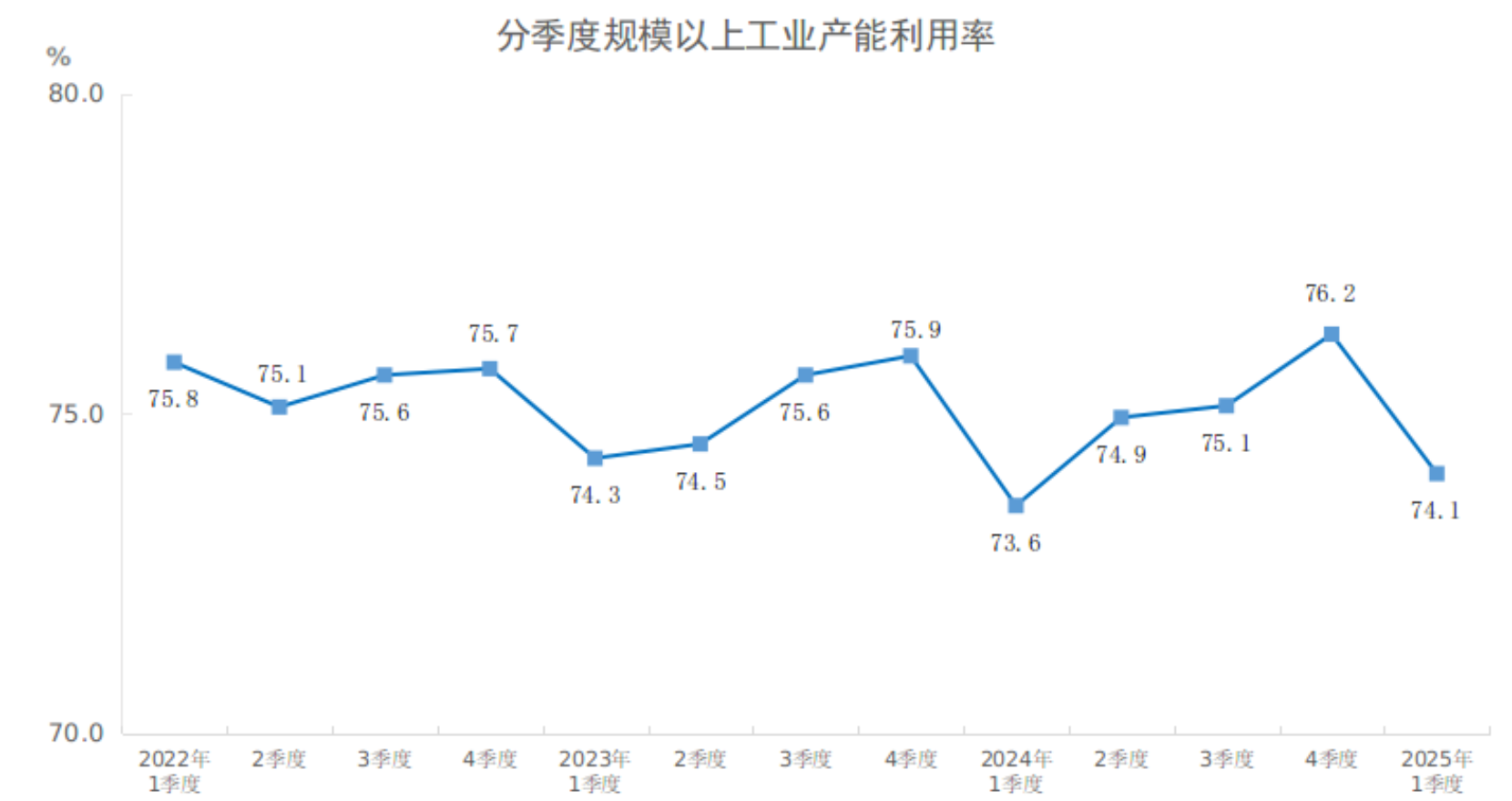
2025年一季度全国规模以上工业产能利用率为74.1%
Guo Jia Tong Ji Ju· 2025-04-16 02:01
2025年一季度,全国规模以上工业产能利用率为74.1%,比上年同期上升0.5个百分点。 分三大门类看,2025年一季度,采矿业产能利用率为74.6%,比上年同期下降0.4个百分点;制造业产能利用率为74.1%,上升0.3个百分点;电力、热力、燃 气及水生产和供应业产能利用率为73.6%,上升2.4个百分点。 分主要行业看,2025年一季度,煤炭开采和洗选业产能利用率为71.9%,食品制造业为69.3%,纺织业为77.8%,化学原料和化学制品制造业为73.5%,非金 属矿物制品业为60.9%,黑色金属冶炼和压延加工业为79.3%,有色金属冶炼和压延加工业为77.5%,通用设备制造业为78.1%,专用设备制造业为75.6%,汽 车制造业为71.9%,电气机械和器材制造业为71.7%,计算机、通信和其他电子设备制造业为74.7%。 | 2025年一季度规模以上工业产能利用率 | | --- | 产能利用率:是指实际产出与生产能力(均以价值量计量)的比率。 企业的实际产出是指企业报告期内的工业总产值;企业的生产能力是指报告期内,在劳动力、原材料、燃料、运输等保证供给的情况下,生产设备(机械) 保持正常运行,企业可实 ...