
软饮料

Search documents
香飘飘:Meco果茶推出两款新口味,其中“橙漫茉莉”口味线下铺货,销售反馈良好
Cai Jing Wang· 2025-08-29 12:27
Core Insights - The company has launched two new flavors of Meco fruit tea, "Orange Jasmine" and "Mulberry Jasmine," with the former showing promising sales feedback and potential to become a classic product, while the latter is still in the trial sales phase [1] Group 1: Sales Performance - The company's traditional brewing products faced sales pressure in the first half of 2025 due to changes in external consumer environment, habits, and demand [1] - The sales season was shortened as the Spring Festival occurred earlier compared to the previous year, leading to an early onset of the off-peak season for brewing products [1] - To maintain the interests of distributors and terminals, the company adopted a strategy of reducing channel inventory levels to ensure healthy inventory for the second half of the year [1] Group 2: Ready-to-Drink Business - The company is actively promoting the freezing of terminal points for its ready-to-drink business, particularly in schools and snack wholesale channels where Meco fruit tea has a significant sales share [1] - There is an increased focus on the quality of freezing, with higher requirements for the "layering rate" of ice paths to enhance the effectiveness of freezing [1]

蒙牛乳业上半年经营利润同比增长超13%;安踏集团官宣投资MUSINSA中国
Mei Ri Jing Ji Xin Wen· 2025-08-28 23:26
Group 1: Mengniu Dairy - Mengniu Dairy reported a revenue of 41.57 billion yuan and an operating profit of 3.54 billion yuan for the first half of 2025, with a year-on-year growth of 13.4% [1] - The company achieved a significant increase in operating cash flow, which grew by 46.2% year-on-year, and improved its operating profit margin by 1.5 percentage points to 8.5% [1] - In response to homogenized competition in the dairy industry, Mengniu Dairy is focusing on product innovation to navigate the ongoing supply-demand imbalance [1] Group 2: Anta Group - Anta Group announced a joint investment with South Korean fashion group MUSINSA to establish a new company, MUSINSA China, with Anta holding 40% and MUSINSA holding 60% [2] - The new company will focus on developing its own brand "MUSINSA STANDARD" and multi-brand stores in the Chinese market [2] - Anta's chairman emphasized that this investment aligns with the trend of young consumer preferences and aims to explore the integration of the fashion and sports industries [2] Group 3: Nongfu Spring - Nongfu Spring reported a revenue of 25.622 billion yuan and a net profit attributable to shareholders of 7.622 billion yuan for the first half of 2025, reflecting a year-on-year growth of 15.6% and 22.1% respectively [3] - The company's gross margin increased by 1.5 percentage points to 60.3%, with tea beverage products generating revenue of 10.089 billion yuan, up 19.7% year-on-year [3] - Nongfu Spring is expected to maintain its growth momentum due to new water source capacity, deeper overseas market expansion, and a diversified product matrix [3] Group 4: Wanda Film - Wanda Film reported a revenue of 6.689 billion yuan and a net profit attributable to shareholders of 536 million yuan for the first half of 2025, with a significant year-on-year increase of 372.55% in net profit [4] - The company's Australian subsidiary, HOYTS, achieved a box office revenue of 144 million AUD, growing by 9.9% year-on-year, with attendance increasing by 10.2% [4] - The industry is shifting from a focus on ticket sales to enhancing consumer experience and diversifying revenue streams, which is seen as a key to unlocking growth potential [4]

蒙牛乳业上半年经营利润同比增长超13%;安踏集团官宣投资MUSINSA中国|消费早参
Mei Ri Jing Ji Xin Wen· 2025-08-28 23:20
Group 1: Mengniu Dairy - Mengniu Dairy reported a revenue of 41.57 billion yuan and an operating profit of 3.54 billion yuan for the first half of 2025, with a year-on-year growth of 13.4% in operating profit [1] - The company achieved a significant increase in operating cash flow, which grew by 46.2% year-on-year, and improved its operating profit margin by 1.5 percentage points to 8.5% [1] - Mengniu Dairy is focusing on product innovation to address the homogenization competition in the dairy industry, which is currently experiencing a critical recovery phase [1] Group 2: Anta Group - Anta Group announced a joint venture with South Korean fashion group MUSINSA to establish "MUSINSA China," with Anta holding 40% and MUSINSA holding 60% [2] - The joint venture aims to develop MUSINSA's own brand "MUSINSA STANDARD" and multi-brand stores in the Chinese market, aligning with young consumer trends [2] - Anta's chairman emphasized that this investment is not a deviation from its main business but rather an exploration of the integration between the fashion and sports industries [2] Group 3: Nongfu Spring - Nongfu Spring reported a revenue of 25.622 billion yuan for the first half of 2025, reflecting a year-on-year growth of 15.6%, and a net profit attributable to shareholders of 7.622 billion yuan, up 22.1% [3] - The company's gross margin increased by 1.5 percentage points to 60.3%, with tea beverage products generating revenue of 10.089 billion yuan, a 19.7% increase year-on-year [3] - The company is expected to maintain growth momentum due to new water source capacity, deeper overseas market expansion, and a diversified product matrix [3] Group 4: Wanda Film - Wanda Film reported a revenue of 6.689 billion yuan for the first half of 2025, with a year-on-year increase of 7.57%, and a net profit attributable to shareholders of 536 million yuan, a substantial increase of 372.55% [4] - The company's net profit after excluding non-recurring items was 480 million yuan, reflecting a year-on-year growth of 455.35% [4] - The report highlighted a shift in the cinema industry from merely selling seats to offering experiences, which has opened up new growth opportunities [4]



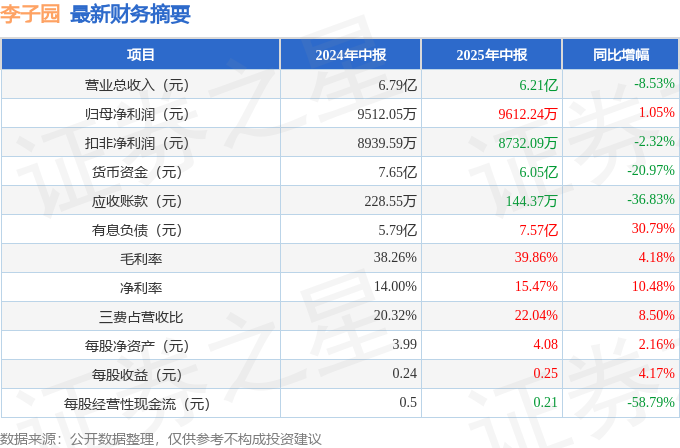
李子园(605337)2025年中报简析:净利润同比增长1.05%,盈利能力上升
Zheng Quan Zhi Xing· 2025-08-28 14:19
Core Viewpoint - Li Ziyuan (605337) reported a decline in total revenue for the first half of 2025, attributed to intensified market competition and adjustments in sales strategy, while net profit showed a slight increase [1][2]. Financial Performance Summary - Total revenue for the first half of 2025 was 621 million yuan, a decrease of 8.53% year-on-year [1]. - Net profit attributable to shareholders was 96.12 million yuan, an increase of 1.05% year-on-year [1]. - Gross margin improved to 39.86%, up 4.18% year-on-year, while net margin increased to 15.47%, up 10.48% year-on-year [1]. - Total expenses (selling, administrative, and financial) amounted to 137 million yuan, representing 22.04% of revenue, an increase of 8.5% year-on-year [1]. - Earnings per share rose to 0.25 yuan, a 4.17% increase year-on-year [1]. Cash Flow and Debt Analysis - Operating cash flow per share decreased significantly by 58.79% to 0.21 yuan, due to reduced cash received from sales and increased cash paid for purchases [1][4]. - The company’s interest-bearing debt increased by 30.79% to 757 million yuan, indicating a rising debt burden [1][3]. - The company's debt-to-asset ratio reached 24.66%, suggesting a need for attention to its debt situation [5]. Changes in Key Financial Items - Prepayments increased by 38.02%, reflecting higher advance payments for goods [3]. - Short-term borrowings surged by 426.77%, driven by increased pledged loans and bank acceptance bill discounts [3]. - The company reported a significant increase in investment income by 63.76%, attributed to higher interest income from large certificates of deposit [6]. Business Model and Market Position - The company relies heavily on marketing-driven performance, necessitating a thorough examination of the underlying factors driving this strategy [6]. - Historical data indicates a median Return on Invested Capital (ROIC) of 28.6% since its listing, although the ROIC for the previous year was only 9.12%, suggesting a decline in investment returns [6].


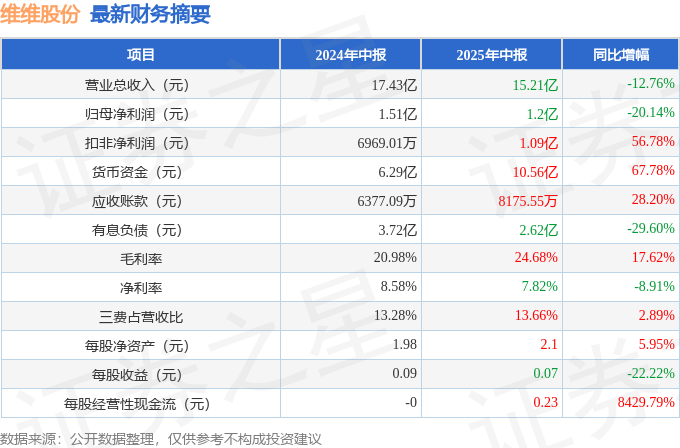
维维股份(600300)2025年中报简析:净利润同比下降20.14%
Zheng Quan Zhi Xing· 2025-08-28 14:14
Financial Performance - The company reported a net profit of 120 million yuan for the first half of 2025, a decrease of 20.14% year-on-year [1] - Total operating revenue was 1.521 billion yuan, down 12.76% compared to the same period last year [1] - In Q2 2025, operating revenue reached 668 million yuan, an increase of 5.32% year-on-year, while net profit for the same quarter was 49.47 million yuan, up 105.76% year-on-year [1] Key Financial Ratios - Gross margin improved to 24.68%, an increase of 17.62% year-on-year [1] - Net margin decreased to 7.82%, down 8.91% year-on-year [1] - The ratio of selling, administrative, and financial expenses to revenue was 13.66%, an increase of 2.89% year-on-year [1] Cash Flow and Assets - The company reported a significant increase in operating cash flow per share to 0.23 yuan, up 8429.79% year-on-year [1] - Cash and cash equivalents rose to 1.056 billion yuan, a 67.78% increase year-on-year [1] - Accounts receivable increased to 81.76 million yuan, up 28.20% year-on-year [1] Debt and Equity - Interest-bearing debt decreased to 262 million yuan, down 29.60% year-on-year [1] - Book value per share increased to 2.1 yuan, a rise of 5.95% year-on-year [1] - Earnings per share fell to 0.07 yuan, a decrease of 22.22% year-on-year [1] Investment Insights - The company has a return on invested capital (ROIC) of 11.23%, indicating average capital returns [4] - The historical median ROIC over the past decade is 3.64%, suggesting weak investment returns [4] - The company maintains a healthy cash position, indicating good debt repayment capability [4]

农夫山泉(09633.HK)25H1点评:包装水业务底部回暖盈利能力显著提升
Ge Long Hui· 2025-08-28 11:20
Core Viewpoint - The company reported a strong performance in H1 2025, with revenue and net profit growth, driven by a recovery in the packaged water business and effective cost management [1][2]. Financial Performance - In H1 2025, the company achieved revenue of 25.622 billion, a year-on-year increase of 15.56%, and a net profit of 7.622 billion, up 22.16% year-on-year [1]. - The gross profit margin for H1 2025 was 60.32%, an increase of 1.55 percentage points compared to the previous year [2]. - The net profit margin for H1 2025 was 29.75%, reflecting a year-on-year increase of 1.6 percentage points [2]. Business Segment Performance - Revenue from the packaged water segment was 9.443 billion, growing by 10.69% year-on-year [2]. - The tea beverage segment generated 10.089 billion in revenue, with a year-on-year increase of 19.68% [2]. - Functional beverages and juice drinks reported revenues of 2.898 billion and 2.564 billion, respectively, with year-on-year growth of 13.62% and 21.28% [2]. - The company added three new water sources in H1 2025, enhancing its competitive advantage in the packaged water business [2]. Investment Outlook - The company has raised its profit forecast for 2025-2027, expecting net profits of 14.7 billion, 16.9 billion, and 19 billion, representing year-on-year growth of 21%, 15%, and 13% respectively [1]. - The latest closing price corresponds to a PE ratio of 33x, 29x, and 25x for 2025-2027 [1]. - The dual business model of "water + tea" is expected to provide stable cash flow and potential for new growth opportunities [1].
中国必选消费品8月成本报告:现货成本小幅回升
Haitong Securities International· 2025-08-28 11:15
Investment Rating - The report assigns an "Outperform" rating to several companies including China Feihe, Huazhu, and others, while Budweiser APAC is rated as "Neutral" [1]. Core Insights - The report indicates a slight rebound in spot costs for essential consumer goods, with most indices showing an increase, while futures indices generally declined [35]. - The overall trend in the consumer goods sector reflects a mixed performance, with some categories experiencing cost increases while others face declines [8][35]. Summary by Category Beer - The spot cost index for beer increased by 0.39% month-on-month, while the futures index decreased by 6.06%. Year-to-date changes show a decline of 4.17% for spot and 6.16% for futures [36][13]. - Glass prices initially rose but later fell, with month-on-month changes of +0.3% for spot and -13.9% for futures [12]. Seasonings - The spot cost index for seasonings decreased by 0.16% month-on-month, while the futures index fell by 5.93%. Year-to-date changes are -1.76% for spot and -6.01% for futures [37]. - Domestic soybean prices have increased due to supply contraction, while imported soybeans remain weak [16]. Dairy - The spot cost index for dairy products increased by 0.7% month-on-month, while the futures index decreased by 1.44%. Year-to-date changes are -3.2% for spot and -2.11% for futures [38]. - Fresh milk prices have declined to 3.02 yuan/kg, with various factors contributing to price pressures [19]. Instant Noodles - The spot cost index for instant noodles increased by 1.3% month-on-month, while the futures index decreased by 2%. Year-to-date changes are -3.01% for spot and -4.21% for futures [39]. - Palm oil prices have risen, impacting overall costs [23]. Frozen Foods - The spot cost index for frozen foods increased by 1.15% month-on-month, while the futures index rose by 0.97%. Year-to-date changes are -1.83% for spot and -2.74% for futures [40]. - Vegetable prices have shown significant fluctuations due to seasonal demand [27]. Soft Drinks - The spot cost index for soft drinks increased by 0.78% month-on-month, while the futures index decreased by 5.63%. Year-to-date changes are -4.99% for spot and -8.6% for futures [41]. - PET prices are stable to weak, reflecting changes in demand and inventory levels [31].



恒生指数收跌1.27% 李宁、阿里健康、泡泡玛特跌超4%
Jin Tou Wang· 2025-08-28 08:59
Market Overview - The Hang Seng Index closed at 25,201.76 points, down 1.27% [1] - The Hang Seng Tech Index closed at 5,697.53 points, down 1.47% [1] - The China Enterprises Index closed at 9,020.26 points, down 1.40% [1] - The Red Chip Index closed at 4,273.29 points, down 1.62% [1] Top Gainers - Nongfu Spring rose over 7% to 50.250 HKD [1][2] - NIO-SW increased over 4% to 51.700 HKD [1][2] - Shanghai Fudan and WanGuo Data-SW both rose over 1% [1][2] Top Losers - Beike-W fell over 6% to 47.200 HKD [1][2] - Naixue's Tea and Stone Pharmaceutical Group both dropped over 5% [1][2] - Li Ning, Alibaba Health, and Pop Mart fell over 4% [1][2] - JD Logistics, Zhou Hei Ya, and Mengniu Dairy declined over 3% [1][2] - Other notable declines include Zhou Dafu, Dongfang Zhenxuan, and Haidilao, all down over 2% [1][2]


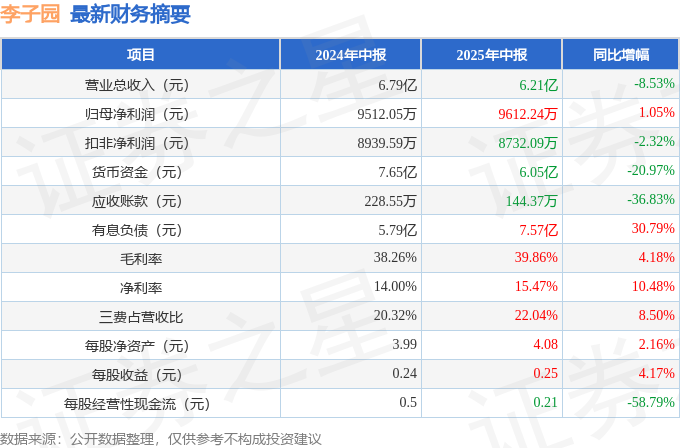
李子园2025年中报简析:净利润同比增长1.05%,盈利能力上升
Zheng Quan Zhi Xing· 2025-08-27 22:56
Core Insights - The company Li Ziyuan (605337) reported a total revenue of 621 million yuan for the first half of 2025, a year-on-year decrease of 8.53%, while the net profit attributable to shareholders increased by 1.05% to 96.12 million yuan [1] - The company's gross margin improved by 4.18% to 39.86%, and the net margin increased by 10.48% to 15.47% [1] - The financial report indicates a general performance with mixed results, highlighting a significant decrease in operating cash flow per share by 58.79% to 0.21 yuan [1] Financial Performance - Total revenue for 2025 was 621 million yuan, down from 679 million yuan in 2024, reflecting a decline of 8.53% [1] - Net profit attributable to shareholders rose to 96.12 million yuan from 95.12 million yuan, marking a slight increase of 1.05% [1] - The gross margin for the period was 39.86%, up from 38.26%, while the net margin improved to 15.47% from 14.00% [1] - Total expenses (selling, administrative, and financial) amounted to 137 million yuan, accounting for 22.04% of revenue, an increase of 8.5% year-on-year [1] Cash Flow and Debt - Operating cash flow per share decreased significantly by 58.79% to 0.21 yuan, indicating reduced cash inflow from operations [1] - The company’s interest-bearing liabilities increased by 30.79% to 757.1 million yuan, reflecting a rise in financial leverage [1] - Short-term borrowings surged by 426.77%, attributed to increased pledged loans and bank acceptance bill discounts [2] Asset and Liability Changes - The company saw a 20.97% decrease in cash and cash equivalents, totaling 605 million yuan [1] - Accounts receivable dropped by 36.83% to 1.44 million yuan, indicating improved collection efficiency [1] - The construction in progress increased by 336.81%, reflecting ongoing investments in new projects [2] Operational Insights - The decline in revenue was attributed to intensified market competition and adjustments in sales strategy [4] - Sales expenses decreased by 7.24%, while financial expenses rose significantly by 108.68% due to reduced bank interest income [4] - The company’s return on invested capital (ROIC) was reported at 9.12%, with a historical median of 28.6%, indicating a need for improved capital efficiency [5]
李子园20250827
2025-08-27 15:19
Summary of Li Ziyuan's Conference Call Company Overview - **Company**: Li Ziyuan - **Date**: August 27, 2025 Key Points Industry and Market Dynamics - Traditional channels are facing significant challenges due to market conditions and consumer recovery fatigue, leading to an approximate 8% decline in overall revenue for the first half of 2025 [3][4] - Fragmentation in distribution channels has notably impacted traditional circulation channels, while snack wholesale systems and e-commerce have shown growth [3][5] Financial Performance - In July, sales increased by a single-digit percentage year-on-year, with gross margin rising by 1.5 percentage points to 41.5%, and net profit growing by over 10% [12] - The company reported a slight increase in gross margin due to lower raw material costs, despite a decline in revenue leading to lower capacity utilization and increased depreciation costs [3][7] Product and Channel Adjustments - The company continues to focus on dairy beverages while expanding into vitamin water, which has seen over 70% growth, although its overall impact on revenue remains limited [4][6] - Vitamin water sales reached approximately 20 million yuan, primarily through convenience stores and e-commerce, with plans to expand sales channels next year [2][6] Cost Control and Management Strategy - The company has locked in prices for bulk powder, which constitutes about 35% of total costs, ensuring cost advantages will continue into the next year [7] - A new spray powder factory is expected to be operational by the end of this year or early next year, allowing for cost-effective raw material procurement [7] Management Changes - Following the second-generation succession, the management team has been rejuvenated, with a focus on optimizing management structure and improving operational efficiency [8][9] Sales Team and Product Strategy - The sales team has been restructured to include younger personnel, with a focus on adapting to market changes [9] - The product strategy emphasizes dairy beverages while exploring new product lines in health and nutrition [9][10] Future Outlook - The company anticipates a seasonal increase in sales in the second half of the year, particularly from September to November, which is expected to be the peak sales period [12][28] - Full-year sales for vitamin water are projected to be around 50 million yuan, with ongoing efforts to enhance brand presence and channel distribution [20] Dividend Policy - The company plans to maintain a high dividend payout ratio, with a dividend of 0.24 yuan per share for the first half of 2025, representing approximately 95% of earnings [29] Challenges and Strategic Responses - Traditional circulation channels are under pressure, prompting the company to strengthen its presence in alternative channels such as convenience stores and retail systems [27] - The company is preparing for new product launches in the upcoming year, focusing on various packaging and flavor options [22] Additional Insights - The company has experienced a decline in direct sales, particularly in the second quarter, due to strategic adjustments in online sales of dairy products [22] - E-commerce remains a critical channel for brand promotion, although it has not yet turned profitable, with losses of approximately 3 to 4 million yuan in the first half of the year [18][19] This summary encapsulates the key insights from Li Ziyuan's conference call, highlighting the company's current challenges, strategic adjustments, and future outlook in the beverage industry.