
啤酒

Search documents
祝贺!百威亚太CEO程衍俊入选“2025年度啤酒企业五大杰出总裁”
Xin Lang Cai Jing· 2026-01-21 09:17
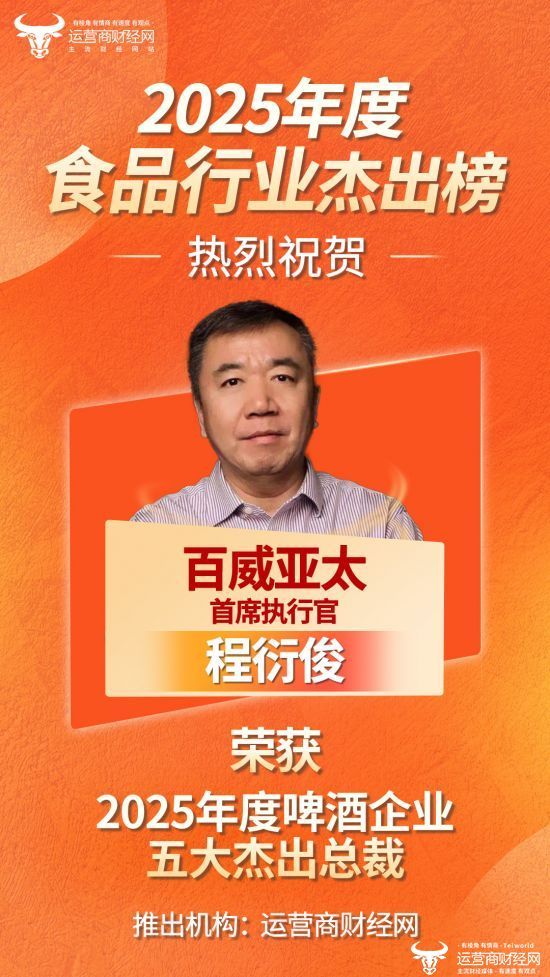
Group 1 - The "2025 Annual Outstanding Presidents of Beer Enterprises" list has been released, with Budweiser APAC CEO Cheng Yanjun being selected [1] - Budweiser is a globally recognized beer brand, established in the United States in 1876, and entered the Chinese market in 1984 [3] - Budweiser APAC was spun off from AB InBev and successfully listed on the Hong Kong Stock Exchange in 2019 [3] Group 2 - Cheng Yanjun became the CEO of Budweiser APAC in April 2025, marking him as the first Chinese CEO in the company's recent history [4] - Under his leadership, the company has undergone systematic reforms in strategy, channels, and organization [4] - In the first three quarters of 2025, Budweiser APAC achieved a revenue of $4.691 billion and a net profit of $594 million, indicating steady growth [4] - The company has focused on expanding non-drinking channels, particularly enhancing the Budweiser and Harbin Beer brands, optimizing product structure, and innovating products to meet diverse consumer needs [4]

非白酒板块1月21日跌0.99%,燕京啤酒领跌,主力资金净流出9345.66万元
Zheng Xing Xing Ye Ri Bao· 2026-01-21 08:53
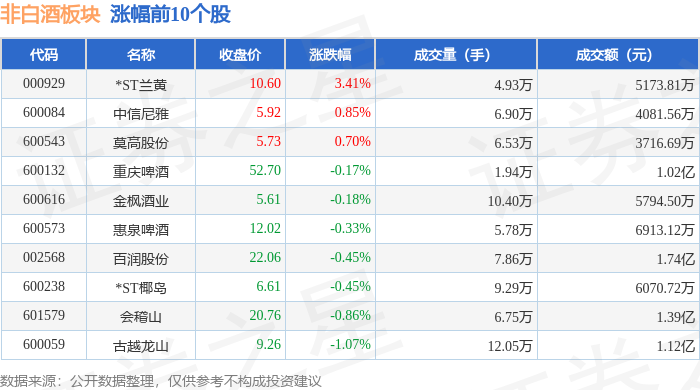
Core Viewpoint - The non-liquor sector experienced a decline of 0.99% on January 21, with Yanjing Beer leading the drop, while the Shanghai Composite Index rose by 0.08% and the Shenzhen Component Index increased by 0.7% [1] Group 1: Market Performance - The non-liquor sector's stocks showed mixed performance, with notable declines in several companies, including Chongqing Beer down by 0.17% and Jinfeng Wine down by 0.18% [1] - The closing prices and percentage changes of key stocks in the non-liquor sector were detailed, highlighting the overall downward trend [1] Group 2: Trading Volume and Value - The trading volume and value for various stocks in the non-liquor sector were reported, with ST Lanhua showing a significant increase of 3.41% in closing price and a trading volume of 49,300 hands, amounting to 51.73 million yuan [1] - The total trading volume and value for the non-liquor sector indicated active trading despite the overall decline [2] Group 3: Capital Flow - The non-liquor sector saw a net outflow of 93.45 million yuan from main funds, while retail investors contributed a net inflow of 28.66 million yuan [2] - The capital flow data revealed that retail investors were more active in the market compared to institutional investors, with specific stocks like Guyue Longshan experiencing significant retail inflows [3]




鲜啤福鹿家上新三款冬季产品,带动客流同比提升28%
Xin Lang Cai Jing· 2026-01-21 08:35
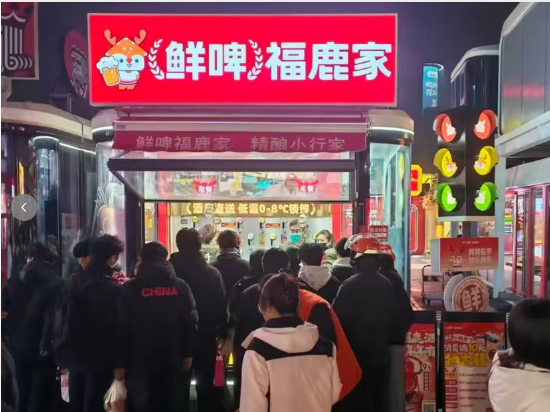
Core Insights - The core focus of the article is on the successful launch of three winter products by the fresh beer brand Xianpi Fulu Jia under the Mixue Ice Cream brand, which have significantly boosted sales and customer traffic during the winter season [2][7]. Product Performance - The "Osmanthus Sparkling Winter Brew Rice Wine" is priced at 9.9 yuan per jin and has achieved sales of over 350,000 jin within three days of launch, contributing to a winter performance increase for the market center [2][7]. - The product generated a GMV of over 7.77 million yuan on Douyin, with the new product alone accounting for 4.83 million yuan in GMV and over 300 million total exposures online [2][7]. - The "Red Date Small Milk Beer," a collaboration with "Good Idea," emphasizes health and sweetness, gaining popularity among consumers [2][7]. - The "Rock Candy Fulu Fresh Rice Wine," inspired by the national snack "rock candy hawthorn," saw over 60% of orders from young users within three days of launch [2][7]. Market Expansion - Xianpi Fulu Jia's nationwide store traffic increased by 28% year-on-year due to the winter product matrix [2][7]. - The brand plans to expand its store count to 1,800 by 2025, maintaining a pace of over 100 new signed stores each month despite traditional beliefs that beer sales decline in winter [2][7]. Revenue Growth - Following the launch of the "Osmanthus Sparkling Winter Brew Rice Wine" in October 2025, most stores reported a monthly revenue increase of over 30% compared to October, with weekday sales stabilizing above 1,000 yuan and weekend sales exceeding 3,000 yuan [2][7]. Strategic Positioning - The brand is expanding its presence in high-frequency winter scenarios such as community convenience stores and office buildings, with data indicating a significant rise in family and immediate consumption [8]. - Xianpi Fulu Jia leverages the five production bases of the Mixue Group and a global procurement network to convert supply chain advantages into product strength and price competitiveness, ensuring consumers can enjoy fresh beer even in winter [8].
燕京啤酒:预计去年净利增长50%-65%,燕京U8继续保持稳健增长态势
Cai Jing Wang· 2026-01-21 08:26
Core Viewpoint - Yanjing Beer forecasts a net profit attributable to shareholders of between 1.583 billion to 1.742 billion yuan for the year 2025, representing a year-on-year growth of 50% to 65% [1] Group 1: Strategic Initiatives - The company is firmly advancing its major product strategy, focusing on product strength, brand power, and channel capability while actively exploring innovative paths [1] - Yanjing Beer is implementing a strategy of brand rejuvenation, fashion orientation, and premiumization, alongside a gradient market development strategy [1] Group 2: Operational Improvements - The company is continuously tackling transformations in key business areas such as production, marketing, market, and supply chain, diligently promoting various strategic measures [1] - Yanjing Beer is enhancing its organizational mechanisms to ensure robust operational efficiency and growth potential through product upgrades, market upgrades, and management upgrades [1] Group 3: Performance Outlook - The company reports that its flagship product, Yanjing U8, continues to maintain a steady growth trend [1] - Overall, the operational efficiency and growth potential of the company are showing continuous improvement, leading to better business performance [1]
华润雪花推黄果树瀑布啤酒新品,主打640ML大容量
Cai Jing Wang· 2026-01-21 06:05
Group 1 - The core message of the article is the launch of a new beer product by China Resources Snow Beer, specifically the Huangguoshu Waterfall Beer, which emphasizes its large 640ML capacity and value pricing [1] - The new product features a malt extract concentration of 8.0P and an alcohol content of at least 2.5% vol, indicating a focus on quality and consumer preferences for higher alcohol content [1]
研报掘金丨国盛证券:维持燕京啤酒“买入”评级,25年业绩亮眼,26年持续突破
Ge Long Hui A P P· 2026-01-21 06:04
Core Viewpoint - Yanjing Beer has demonstrated impressive performance over the past 25 years, with expectations for continued breakthroughs in 2026, driven by strong growth in major products and steady profit margin improvements [1] Revenue Summary - The company's major product U8 series has a well-established matrix and is experiencing rapid growth [1] - The implementation of a "beer + beverage" marketing strategy is expected to generate new revenue sources, with products like Beisite soda and natto contributing to this growth [1] Profit Summary - The acceleration of premiumization, combined with advancements in production, market strategies, and supply chain reforms, is anticipated to further enhance profit elasticity [1] - The company forecasts net profit attributable to shareholders to grow by 60.6% in 2025, 18.3% in 2026, and 15.0% in 2027, reaching 1.7 billion, 2.01 billion, and 2.31 billion yuan respectively [1]
燕京啤酒(000729):业绩持续高增,期待“十五五”新发展
GF SECURITIES· 2026-01-21 04:47
Investment Rating - The report assigns a "Buy" rating for the company [7] Core Views - The company is expected to achieve a net profit attributable to shareholders of RMB 15.8-17.4 billion in 2025, representing a year-on-year increase of 50-65%, which aligns with previous expectations and exceeds market consensus [7] - The company has demonstrated strong growth due to ongoing reforms, with a projected net profit of RMB 16.6 billion for 2025, reflecting a year-on-year increase of 57.5% [7] - The company is focusing on product structure upgrades and expanding its beverage business, which is anticipated to drive future growth [7] Financial Summary - Revenue projections for the company are as follows: - 2023: RMB 14,213 million - 2024: RMB 14,667 million (growth rate: 3.2%) - 2025: RMB 15,319 million (growth rate: 4.4%) - 2026: RMB 16,264 million (growth rate: 6.2%) - 2027: RMB 17,020 million (growth rate: 4.6%) [3] - EBITDA is projected to grow significantly, reaching RMB 3,724 million by 2027 [3] - The net profit attributable to shareholders is expected to increase from RMB 645 million in 2023 to RMB 2,371 million in 2027, with a growth rate of 16.9% in 2027 [3] - The earnings per share (EPS) is projected to rise from RMB 0.23 in 2023 to RMB 0.84 in 2027 [3] - The company’s price-to-earnings (P/E) ratio is expected to decrease from 37.7 in 2023 to 14.9 in 2027, indicating improved valuation [3] Strategic Focus - The company is undergoing comprehensive reforms, with a focus on enhancing its product offerings and operational efficiency, which is expected to lead to improved profit margins [7] - The introduction of the "燕京 U8" product aims to capture the preferences of younger consumers and drive national expansion [7] - The company is also exploring the health food segment with its natto products, indicating a diversification strategy [7]
燕京啤酒(000729):业绩预告超预期 改革成效持续兑现
Xin Lang Cai Jing· 2026-01-21 04:38
Core Viewpoint - The company forecasts a net profit attributable to shareholders of 1.58-1.74 billion yuan for 2025, representing a year-on-year increase of 50-65% [1] - The company expects a non-recurring net profit of 1.46-1.56 billion yuan for 2025, indicating a year-on-year growth of 40-50% [1] Group 1: Financial Projections - For 2025, the average forecast for net profit attributable to shareholders is 1.66 billion yuan, reflecting a year-on-year increase of 58% [1] - The expected non-recurring net profit for 2025 is 1.51 billion yuan, showing a year-on-year growth of 45% [1] - Revenue projections for 2025-2027 are 15.34 billion, 15.97 billion, and 16.56 billion yuan, with year-on-year growth rates of 4.6%, 4.1%, and 3.7% respectively [2] Group 2: Profit Drivers - The increase in profits is attributed to land reserve acquisitions by subsidiaries and ongoing internal reforms that enhance profit margins [1] - The company is diversifying its business beyond beer, including ventures into natto and beverages, which is expected to further improve profit margins [1] Group 3: Quarterly Performance - In Q4 2025, the company anticipates a net profit attributable to shareholders of -110 million yuan, a reduction in losses by 120 million yuan year-on-year [1] - The expected non-recurring net profit for Q4 2025 is -180 million yuan, a decrease in losses by 44.58 million yuan year-on-year [1]
燕京啤酒:业绩高增,26年空间与动能仍足-20260121
HTSC· 2026-01-21 02:50
Investment Rating - The investment rating for the company is maintained as "Buy" with a target price of RMB 17.25 [1][9]. Core Insights - The company is expected to achieve significant profit growth, with a projected net profit for 2025 ranging from RMB 1.58 billion to RMB 1.74 billion, representing a year-on-year increase of 50% to 65% [6]. - The company anticipates a reduction in losses for Q4 2025 compared to Q4 2024, driven by land reserve contributions and operational improvements [6]. - The U8 product line is expected to continue its rapid growth, supported by strategic market expansions and new product launches at a price point of RMB 10 [7][9]. Financial Performance and Forecast - Revenue projections for the company are as follows: RMB 14.67 billion in 2024, RMB 15.14 billion in 2025, RMB 15.48 billion in 2026, and RMB 15.84 billion in 2027, with growth rates of 3.20%, 3.24%, 2.25%, and 2.32% respectively [5]. - The net profit attributable to the parent company is forecasted to be RMB 1.06 billion in 2024, RMB 1.68 billion in 2025, RMB 1.95 billion in 2026, and RMB 2.25 billion in 2027, with growth rates of 63.74%, 59.29%, 16.09%, and 15.12% respectively [5]. - The company’s EPS is projected to increase from RMB 0.37 in 2024 to RMB 0.80 in 2027 [5]. Valuation Metrics - The company’s PE ratio is expected to decrease from 33.40 in 2024 to 15.69 in 2027, indicating an improving valuation as earnings grow [5]. - The target price of RMB 17.25 corresponds to a PE of 25x for 2026, reflecting a higher growth rate compared to peers [9][10]. Market Position and Strategy - The company is focusing on optimizing its product structure and reducing costs, which is expected to enhance profit margins [8]. - The beverage business is anticipated to contribute significantly to revenue growth, particularly in core markets [7]. - The company is also benefiting from trends towards health-conscious products, particularly in its natto business [7].
未知机构:广发食品燕京啤酒2025年业绩预告点评2025年公司预计实现-20260121
未知机构· 2026-01-21 02:10
1、如何看待Q4减亏? 25Q4土地收储贡献5700万利润,中值计算25Q4经营性利润/扣非归母减亏了6717万/4458万元,考虑到24Q4公司营 业外支出高达4342万元、23Q4/22Q4仅为390/64万元,我们认为燕京依然具备较大的利润释放空间,或因25Q4收 入端并未享受春节备货红利,#26Q1开门红值得期待,再次强调燕京啤酒作为国企是兼具开门红意愿与能力的企 业; 2025年公司预计实现归母净利润15.8-17.4亿元,同比+50-65%,实现扣非归母净利润14.6-15.6亿元,同比+40- 50%; 2025年实现归母净利润16.6亿元、同比+57.5%,实现扣非归母净利润15.1亿元,同比+45%; 25Q4单季度归母净利润-1.1亿元,同比减亏1.2亿,实现扣非归母净利润-1.8亿元,同比减亏4458万元。 【广发食品】燕京啤酒2025年业绩预告点评 2025年公司预计实现归母净利润15.8-17.4亿元,同比+50-65%,实现扣非归母净利润14.6-15.6亿元,同比+40- 50%; 2025年实现归母净利润16.6亿元、同比+57.5%,实现扣非归母净利润15.1亿元,同比+45 ...