信息传输

Search documents
浙江年用电量首超7000亿度,同比增长7.18%
Xin Lang Cai Jing· 2026-01-22 11:00
Group 1: Zhejiang Electricity Consumption - In 2025, Zhejiang's total electricity consumption is projected to exceed 700 billion kWh for the first time, reaching 726.65 billion kWh, with a year-on-year growth of 7.18%, ranking among the top in major economic provinces in China [2] - The peak electricity load in Zhejiang is expected to reach a historical high of 131 million kW, with urban and rural residential electricity consumption at 112.54 billion kWh, an increase of 9.65% [2] - The electricity consumption in the primary industry was 4.11 billion kWh, in the secondary industry was 476.81 billion kWh (up 5.60%), and in the tertiary industry was 133.2 billion kWh (up 10.84%) [2] - The information transmission, software, and IT services related to the digital economy consumed 12.38 billion kWh, growing by 14% [2] - Hangzhou, as a digital economy hub, saw its AI-driven internet data service industry consume 1.48 billion kWh, with a remarkable growth of 159% [2] - Zhejiang Fubao Intelligent Technology Co., a leader in AI focusing on healthcare and elderly services, reported a 25.2% increase in electricity consumption, totaling 2.861 million kWh [2] Group 2: Zhoushan Maritime Trade - Zhoushan has launched a new maritime route to South America, marking the first direct container shipping line to BRICS countries in South America, enhancing trade connections [3] - The new route reduces operational costs for export enterprises in the surrounding areas, facilitating efficient access to the South American market for products like textiles and automotive parts [3] - The route operates weekly, connecting major domestic ports such as Qingdao, Shanghai, Taicang, Zhoushan, and Guangzhou, directly reaching key trade hubs in South America [3] Group 3: Nanjing Marriage Registration - In 2025, Nanjing registered 63,400 marriages, an increase of 18.27% from the previous year [4] - The implementation of the "national universal registration" policy led to a significant rise in cross-province and cross-city registrations, with 20,000 couples not registered in Nanjing, a surge of 184.11% [4]


【海报】一组数据勾勒中国经济“向新向优”曲线
Zhong Guo Jing Ji Wang· 2026-01-22 06:55
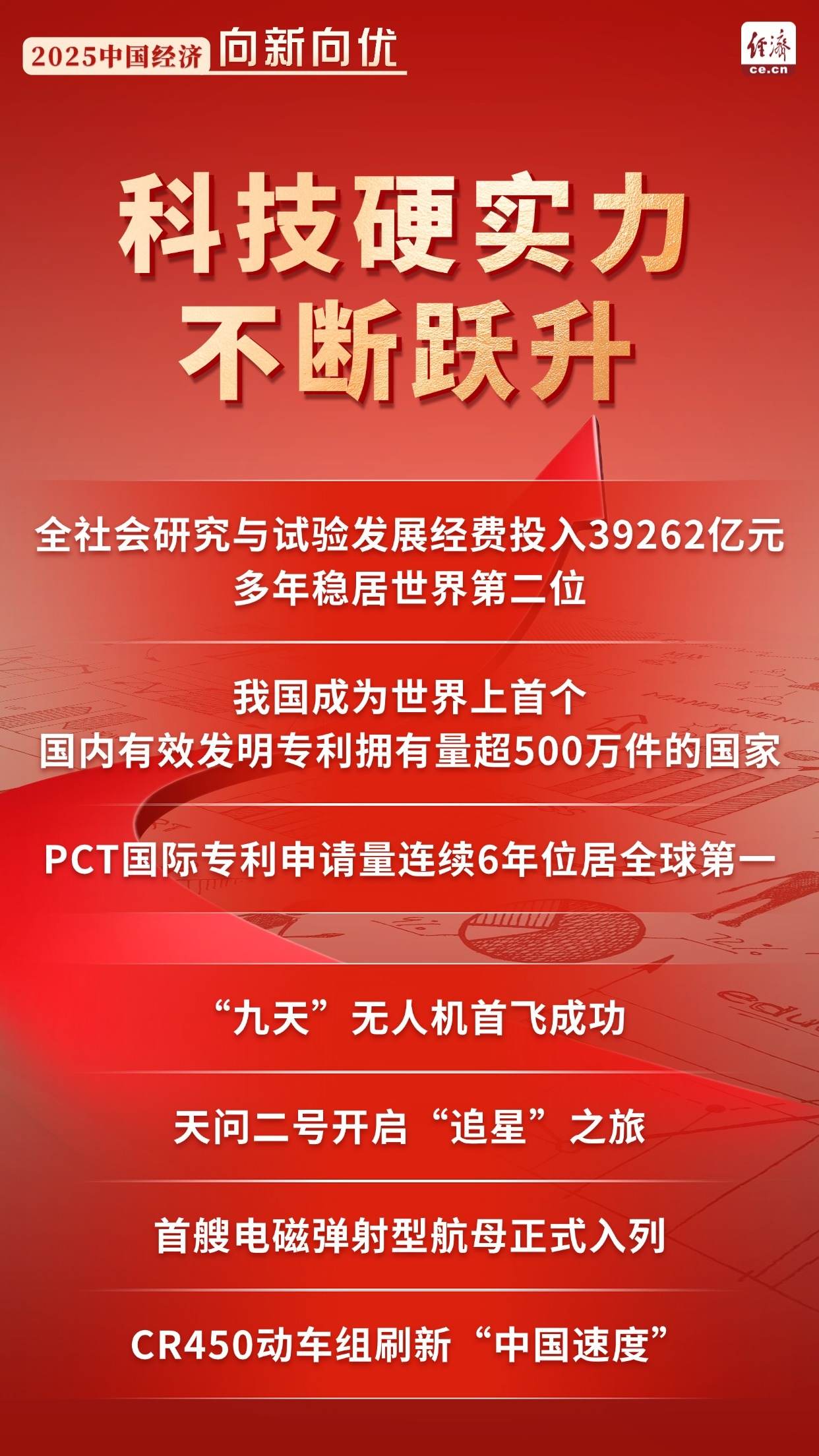
2025年,我国在创新驱动、产业提质、数字赋能、绿色转型等方面都取得了新进展,新质生产力从理念共识转化成了发展实效,不仅让经济增长更具质 量、更有后劲,更印证了中国经济在复杂环境中主动求变、向新突破的坚定决心与有力行动。 715 5 5 5 5 3 1 天问二号开启"追星"之旅 首艘电磁弹射型航母正式入列 CR450动车组刷新"中国速度" 2025中国经济 回新向优 基础设施 同入 千行百业的生产经营和千家万户的日常生 规模以上数字产品制造业增加值 比上年增长9.3% 信息传输、软件和信息技术服务业增加 增长11.1% L = · 1 / 人 / 人 新兴领域持续长会 | | 高端装备 绿色能源 智能制造 规模以上装备制造业、高技术制造业 增加值占规模以上工业增加值比重 分别达到36.8%和17.1% 民用无人机、工业机器人产量 分别比上年增长37.3%、28% 工业互联网融合应用 全面覆盖41个工业大类行业 2025中国经济 回 时 门 消费新模式、新场景加快拓展 带动网上零售额增长8.6% ST = 8 3 1 F Late 数字 数字消费 数字产业 5G、千兆光网、物联网等 新型基础设施建设有序推进 2 ...
2025年贵州省规模以上工业增加值比上年增长7.0%
Zhong Guo Xin Wen Wang· 2026-01-22 03:24
Group 1 - The core viewpoint of the article highlights the economic performance of Guizhou Province in 2025, showcasing significant growth in various industrial sectors and overall GDP [1][3][4] Group 2 - In 2025, Guizhou's industrial added value for large-scale enterprises increased by 7.0%, surpassing the national average by 1.1 percentage points [1] - The province's industrial electricity consumption grew by 7.9%, an increase of 2.0 percentage points compared to the previous year [1] - The added value of the equipment manufacturing industry surged by 26.6% [1] - Guizhou's GDP reached 23,562.17 billion yuan, reflecting a year-on-year growth of 4.9% [3] - The automotive manufacturing industry saw an impressive growth of 42.3%, while electrical machinery and equipment manufacturing and computer communication and other electronic device manufacturing increased by 41.1% and 35.9%, respectively [3] - Production figures included 253,300 new energy vehicles, 8.963 billion electronic components, and 22.1665 million kilowatt-hours of lithium-ion batteries, which stimulated upstream raw material industries such as phosphate rock and alumina, with production increases of 17.3% and 15.9% [3] - The "Six Major Industrial Bases" in Guizhou experienced an 8.2% increase in industrial added value, accounting for 83.3% of the total industrial output [4] - The non-ferrous metal smelting and rolling processing industry saw a 26.1% increase in added value, while the chemical raw materials and chemical products manufacturing industry grew by 17.0% [4] - Investment in the information transmission, software, and information technology service industry rose by 10.8%, with an average annual growth of 21.8% over the past five years [4]
又一座5万亿城市诞生
Zhong Guo Jing Ying Bao· 2026-01-22 03:18
中经记者 颜世龙 北京报道 继上海之后,北京成为又一座"5万亿"城市。 从2007年地区生产总值首次突破万亿元大关,到"十四五"开局之年跨越4万亿元台阶,再到"十四五"收 官之年(2025年)突破5万亿元,达到52073.4亿元的新跨越,北京成为继上海后第二座跨入"5万亿俱乐 部"城市。 这意味着,5年的时间,北京经济增量约1.4万亿元,相当于多造了一个海淀区。同时,北京当前的经济 体量也已经超过比利时2024年的GDP,跻身全球前25大经济体。 《中国经营报》记者注意到,北京此次站上"5万亿"台阶,主要贡献来自第三产业服务业,尤其是高端 服务业。其中,信息传输、软件和信息技术服务业实现增加值12192.4亿元,增长11.0%,金融业实现增 加值8668.2亿元,增长8.7%,两个行业对全市经济增长的贡献率超过七成。而这也为北京在"十五五"期 间,高质量发展迈上新台阶奠定坚实基础。 高端服务业是"压舱石" 北京市统计局于1月21日发布的最新数据显示,2025年北京市实现地区生产总值达52073.4亿元,同比增 长5.4%,增速较2024年提高0.3个百分点,高于全国平均增速0.4个百分点。 具体到产业结构中, ...
2025年杭州经济成绩单“出炉”
Mei Ri Shang Bao· 2026-01-21 22:31
Economic Overview - In 2025, Hangzhou's GDP reached 23,011 billion yuan, growing by 5.2% year-on-year, surpassing the national average by 0.2% [1] Agriculture - The total output value of agriculture, forestry, animal husbandry, and fishery in Hangzhou was 569 billion yuan, with growth rates of 3.8% for planting, 5.3% for forestry, 0.2% for animal husbandry, and 4.2% for fishery [2] - Major agricultural products included a total grain output of 599,000 tons (up 3.9%), vegetable output of 3,860,000 tons (up 3.6%), and fruit output of 900,000 tons (up 3.9%) [2] Industrial Growth - The added value of industrial enterprises above designated size was 4,624 billion yuan, with significant growth in the computer, communication, and other electronic equipment manufacturing (up 13.4%) and automotive manufacturing (up 36.7%) [3] - New quality productivity showed remarkable results, with high-tech industries, strategic emerging industries, and high-end equipment manufacturing growing by 7.5%, 10.0%, and 9.5% respectively [3] - Production of new energy vehicles, industrial robots, and 3D printing equipment saw explosive growth rates of 383.0%, 38.6%, and 15.1% respectively [3] Service Sector - The added value of the service industry was 16,997 billion yuan, with the profit-making service sector growing by 7.0% and financial services by 6.4% [4] - From January to November, the revenue of the service industry above designated size reached 21,168 billion yuan, growing by 8.1%, with the information transmission, software, and IT services sector growing by 13.4% [4] Consumer Market - The total retail sales of consumer goods in Hangzhou reached 9,499 billion yuan, indicating a stable and upgrading consumption pattern [5] - The "8+4" economic policy led to significant growth in retail sales of household appliances (up 42.8%) and communication equipment (up 31.4%) [5] - Upgrading consumption demands were strong, with sports and entertainment goods growing by 45.3% and cosmetics by 12.3% [5] Foreign Trade - The total import and export value was 9,072 billion yuan, with exports at 6,469 billion yuan and imports at 2,603 billion yuan [6] - The export of electromechanical products reached 3,107 billion yuan (up 10.9%), and high-tech products reached 1,001 billion yuan (up 9.9%) [6] - The private economy accounted for 77.0% of total exports, with exports to Belt and Road countries growing by 14.1% [6] Living Standards - The per capita disposable income of residents was 80,017 yuan, with balanced growth across four income sources [7] - Urban residents had a per capita disposable income of 86,640 yuan (up 3.9%), while rural residents had 53,565 yuan (up 5.4%), narrowing the income gap to 1.62 [7] Price Stability - In 2025, the consumer price index remained stable compared to the previous year, with six categories of goods experiencing price increases and two categories seeing declines [8] - Hangzhou aims to achieve a GDP of 30 trillion yuan and a per capita GDP of over 30,000 USD by 2030, focusing on policy coordination and market demand stimulation [8]
成色更足步伐更稳韧性更强
Xin Lang Cai Jing· 2026-01-21 21:34
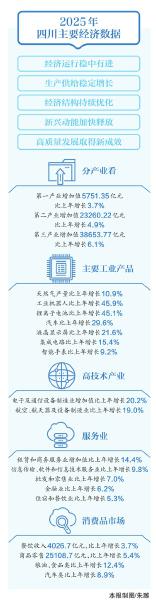
Economic Performance - In 2025, Sichuan's GDP reached 67,665.34 billion yuan, reflecting a 5.5% growth compared to the previous year at constant prices [2] - Sichuan's economic growth rates for the first quarter, first half, first three quarters, and the entire year were 5.5%, 5.6%, 5.5%, and 5.5% respectively, indicating a stable economic trajectory [3] Comparative Analysis - Sichuan's economic growth of 5.5% surpassed the national average by 0.5 percentage points, with industrial added value growth at 6.5% and service sector growth at 6.1%, both exceeding national rates [3] - Retail sales of consumer goods in Sichuan grew by 5.1%, outpacing the national growth rate by 1.4 percentage points [3] Industrial Structure - Over 80% of the 41 major industrial categories in Sichuan saw an increase in added value, with six key advantageous industries consistently outperforming the overall industrial growth [4] - The service sector contributed significantly to the economy, accounting for 57.1% of GDP and over 60% of economic growth, particularly in modern service industries like leasing and business services [4] Innovation and Technology - High-tech manufacturing led growth, with a 12.3% increase in added value, particularly in electronics and communication equipment, which grew by 20.2% [5] - The green and low-carbon transition is evident, with significant growth in industries such as power batteries and lithium-ion batteries, which saw increases of 28.4% and 45.1% respectively [5] Investment Trends - Investment in clean energy and industrial upgrades showed significant growth, with electricity and natural gas investments increasing by 10.7% and 32.4% respectively [6] - High-tech manufacturing investment rose by 5.3%, with notable growth in electronics and communication equipment investment at 10.5% [6] Policy Impact - The provincial government implemented targeted policies to stimulate economic recovery, including measures that led to a 50.8% increase in retail sales of communication equipment and an 8.9% increase in automobile sales [7] - Private investment in Sichuan rebounded, growing by 2.1% in 2025, reversing a two-year decline [7] Future Outlook - The construction of the He Tian Chuang headquarters and optical display manufacturing base in Chengdu is expected to be completed by November 2026, reflecting a positive investment climate [8] - Despite ongoing challenges, Sichuan's economic resilience and potential remain strong, supported by strategic initiatives like the Chengdu-Chongqing economic circle [8]
2025年北京GDP首破5万亿元大关
Xin Lang Cai Jing· 2026-01-21 21:34
其中,信息传输、软件和信息技术服务业增加值比上年增长11.0%,人工智能加速演进,算力、算法需 求迭代升级,应用软件开发、信息处理和存储等领域成长壮大;金融业增加值增长8.7%,有力支持实 体经济发展,11月末金融机构企(事)业单位贷款增长6.3%;规模以上工业增加值增长6.5%,新能源 汽车、集成电路等领域加快布局,计算机、通信和其他电子设备制造业,汽车制造业增加值分别增长 20.2%和17.7%。 投资增量提质,全年固定资产投资(不含农户)比上年增长5.5%,重点产业布局稳步推进,有效投资 占比不断提高,反映实物工作量的建筑安装工程投资和反映企业生产能力扩大的设备购置投资占全市投 资的比重为66.8%,同比提高8.5个百分点。 消费结构优化,居民服务性消费支出占居民消费支出的比重接近六成,限额以上批发和零售业、住宿和 餐饮业网上零售额占社会消费品零售总额的比重超过四成,新消费模式加快发展,限额以上便利店、超 市、仓储会员店等业态中通过公共网络实现的零售额增长17.1%。 居民收入保持增长 (来源:千龙网) 昨日(21日),北京市统计局相关负责人在解读2025年北京经济运行情况时表示,2025年,全市认真贯 ...
筑牢经济底盘 北京迈入“五万亿之城”行列
Bei Jing Shang Bao· 2026-01-21 15:10
VANIA NA NA NA NA NA NA 1 . e n "十四五"圆满收官,北京也正式迈入"5万亿"城市行列。1月21日,据北京市统计局数据,2025年北京市地区生产总值(GDP)超5.2万亿元,同比增长 5.4%。值得注意的是,2025年,北京工业生产提质增效,新兴领域加速布局,成为经济增长的新引擎。北京市统计局党组成员、副局长、新闻发言人朱燕 南表示,2026年,北京经济还将保持向新向优发展态势。 "实"的底盘 数据显示,根据地区生产总值统一核算结果,北京市2025年全年实现地区生产总值达5.21万亿元。分产业看,第一产业增加值109.2亿元,同比下降0.7%; 第二产业增加值7187.4亿元,同比增长3.5%;第三产业增加值4.48万亿元,同比增长5.8%。 优势行业稳固支撑、投资增量提质,成为筑牢经济的基础。具体来看,信息传输、软件和信息技术服务业,金融业,工业增加值合计占全市地区生产总值的 51.8%,对经济增长的贡献率合计超八成。其中,信息传输、软件和信息技术服务业增加值同比增长11%;金融业增加值同比增长8.7%,有力支持实体经济 发展,11月末金融机构企(事)业单位贷款同比增长6.3% ...
中国第二个5万亿之城诞生
21世纪经济报道· 2026-01-21 12:35
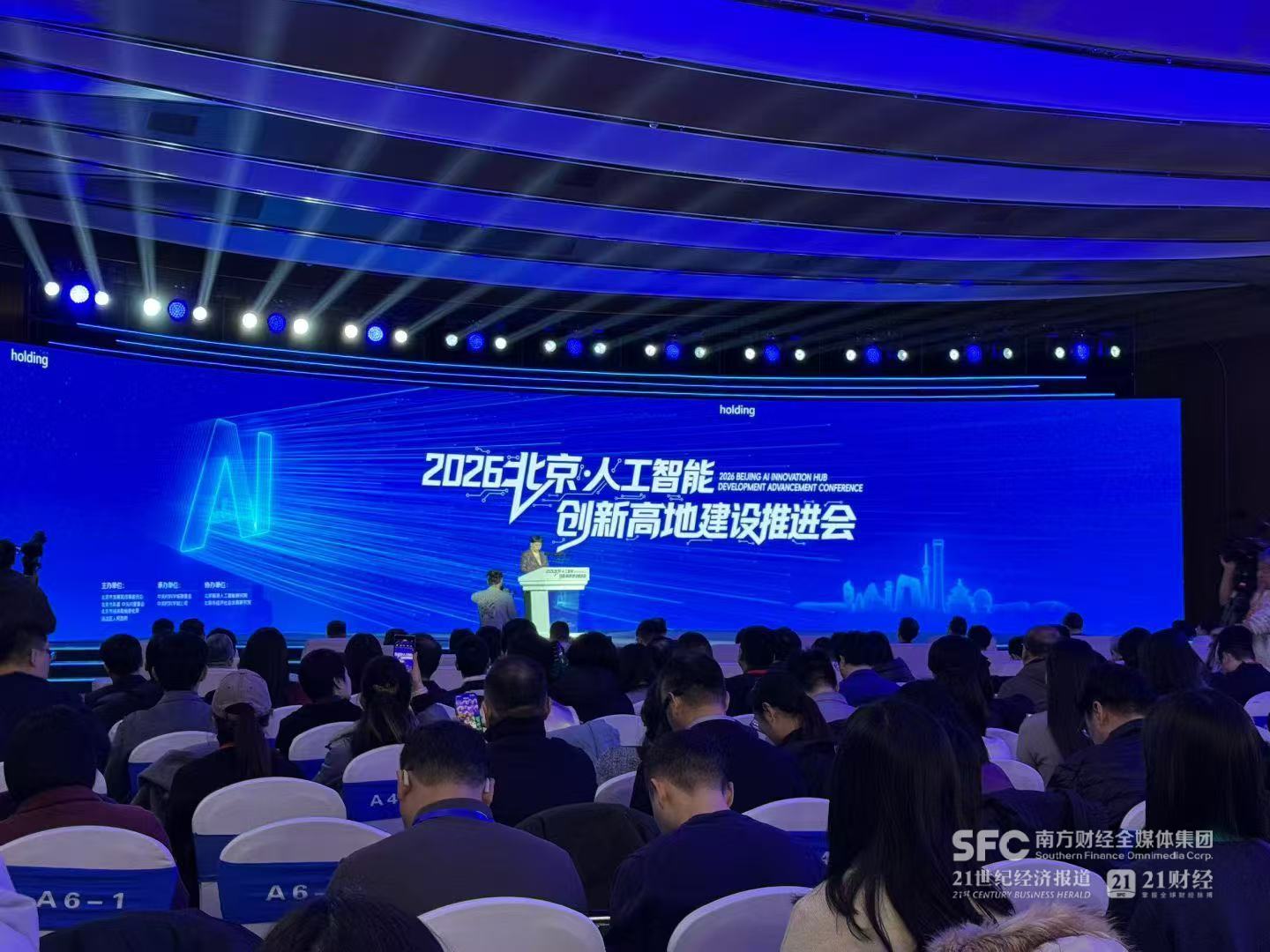
记者丨周慧 编辑丨陈洁 1月21日,据北京统计局消息,2025年,北京实现地区生产总值52073.4亿元,按不变价格计 算,比上年增长5.4%。 北京交出了一份不错的经济成绩单: 整体GDP增速高出全国0.4个百分点,也成为继上海之 后,中国又一个新的5万亿之城 。 具体来看,2025年,北京信息传输、软件和信息技术服务业实现增加值12192.4亿元,增长 11.0%;金融业实现增加值8668.2亿元,增长8.7%。两个行业对北京市经济增长的贡献率超过 7成。 值得注意的是,作为北京科技创新与高技术产业重要集聚区的海淀,在其中发挥了关键作 用。海淀区相关负责人透露,海淀软件和信息服务业的产值在全市占比约三分之二,该产业 的高速增长,也带动了海淀区2025年的整体经济增速。 在2026年1月份发布的海淀政府工作报告也提到,海淀区地区生产总值预计增长7%左右,预 计软件和信息服务业增长17%。 此外,1月19日,胡润研究院发布《2025胡润中国人工智能企业50强》,上榜企业中,北京以 19家企业的数量领先,其中18家集中在海淀。 图:北京人工智能新年第一会 拍摄:周慧 北京作为全国创新资源最集中的区域之一,在资本 ...
继上海之后,中国第二个5万亿之城诞生
2 1 Shi Ji Jing Ji Bao Dao· 2026-01-21 11:35
21世纪经济报道记者周慧 北京报道 1月21日,据北京统计局消息,2025年,北京实现地区生产总值52073.4亿元,按不变价格计算,比上年增长5.4%。 北京交出了一份不错的经济成绩单:整体GDP增速高出全国0.4个百分点,也成为继上海之后,中国又一个新的5万亿之城。 北京经济增长的动能主要来自哪里?21世纪经济报道记者梳理发现,以信息传输、软件和信息技术服务业和金融业为代表的第三产业,是拉动北京经济增长 的核心动力,2025年北京第三产业占GDP的比重约为86%,比上年增长了约0.7个百分点。相对来说,2025年北京社会消费品零售总额13677.0亿元,下降 2.9%,2026年北京消费市场还待进一步提振。 这一发展态势在具体经济数据中得到了清晰印证。2025年,北京数字经济增加值比上年增长8.7%(按现价计算),其中核心产业增长10.4%。产业高端化智 能化势头向好,规模以上工业战略性新兴产业、高技术制造业增加值分别增长15.5%和7.5%(二者有交叉),新能源汽车、锂离子电池、服务机器人、风力 发电机组产品产量分别增长1.4倍、1.2倍、47.6%和21.6%。 首都经济贸易大学城市经济与公共管理学院 ...