太空光伏

Search documents
刚刚!白银,暴力拉升!
Xin Lang Cai Jing· 2026-02-04 08:13
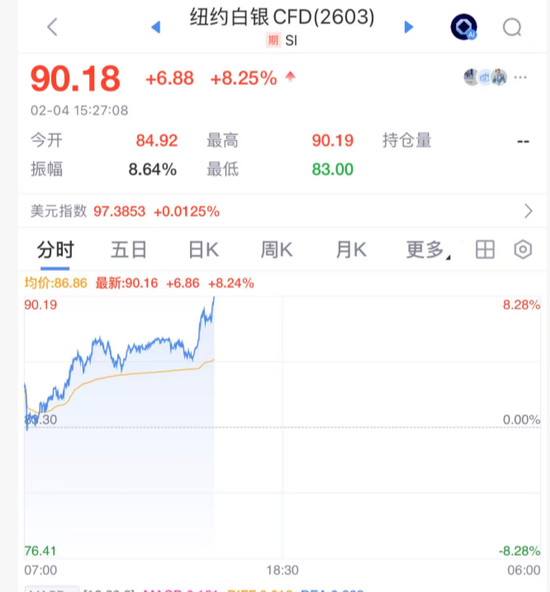
Market Overview - The overall market performance was positive, with the three major indices rising in the afternoon, and the Shanghai Composite Index returning above 4100 points [1][4][17] - The Shanghai Composite Index closed up by 0.85%, while the Shenzhen Component Index rose by 0.21%, and the ChiNext Index fell by 0.4% [4][17] Silver Price Surge - Silver prices experienced a significant increase, with the Shanghai silver futures main contract rising over 11% and spot silver increasing by more than 6%, reaching $90 per ounce [2][14] - In New York, silver futures also rose by over 8%, with the price at $90 per ounce [2][14] Stock Performance - A total of 3254 stocks rose, with 77 stocks hitting the daily limit up, while 2130 stocks declined [5][18] - The total trading volume reached approximately 25032.63 billion, with a total of 149819.37 shares traded [19] Sector Highlights - The coal sector saw a collective surge, with multiple stocks such as China Coal Energy and Lu'an Environmental Energy hitting the daily limit up [19][20] - The space photovoltaic concept stocks continued to rise, with companies like JinkoSolar and TCL Zhonghuan also hitting the daily limit up [20][21] - The civil aviation sector experienced a significant increase, with stocks like Huaxia Airlines and China Eastern Airlines reaching the daily limit up [22][23] - Real estate stocks continued to rebound, with companies such as Jingtou Development and Rong'an Real Estate hitting the daily limit up [23] Declines in AI Sector - The AI application sector faced declines, with stocks like Yizhi Mai and Tiandi Online hitting the daily limit down [11][24] - Notable declines included a drop of 11.55% for Zhidema and a 10% drop for Tiandi Online and Yizhi Media [12][25]

A股午评:三大指数震荡走低,创业板指半日跌1.74%,AI板块遇冷,煤炭、太空光伏概念集体爆发
Jin Rong Jie· 2026-02-04 03:42
Market Overview - The A-share market experienced a decline with major indices falling, including the Shanghai Composite Index and the ChiNext Index, which dropped over 2% at one point [1] - The trading volume in the Shanghai and Shenzhen markets reached 1.62 trillion yuan, an increase of 11.6 billion yuan compared to the previous trading day [1] - Over 2900 stocks in the market saw declines, indicating a broad-based sell-off [1] Sector Performance - The space photovoltaic sector saw significant gains, with Zhonglai Co. hitting the daily limit up, and Guosheng Technology achieving two consecutive limit-ups [1] - The coal sector rebounded collectively, with Yanzhou Coal Mining, China Coal Energy, and Shaanxi Black Cat all reaching the daily limit up [1] - The airport and shipping sector also performed well, with China Eastern Airlines and Huaxia Airlines hitting the daily limit up [1] - The real estate sector was active, with Rong'an Real Estate and Caixin Development reaching the daily limit up [1] - The hydrogen energy concept surged, with Beijing Capital Co. and Zhiyuan New Energy hitting the daily limit up [1] - Conversely, the precious metals sector saw significant declines, with Zhaojin Mining and Sichuan Gold experiencing sharp drops [1] - The AI application sector faced a collective downturn, with Ingrity Media hitting the daily limit down [1][2] AI Sector Analysis - The AI sector faced a downturn, particularly in semiconductor and AI computing hardware stocks, with companies like Xinyisheng and Zhongji Xuchuang dropping over 5% [2] - The decline was influenced by negative news from AI company Anthropic, which caused panic among software companies potentially at risk of being replaced by AI [2] - The overall sentiment in the tech sector was negative, with major tech stocks in the US, including Nvidia, experiencing declines [2] Other Active Sectors - The oil and gas sector showed strong performance, with Qianeng Hengxin rising over 11% following an increase in international crude oil prices [3] - The liquor sector also saw gains, with Kweichow Moutai rising nearly 2%, marking a return to 1500 yuan per share [3] - The space photovoltaic sector remained active, with Zhonglai Co. and Shichuang Energy both rising over 10% [3] Institutional Perspectives - Analysts from Zheshang Securities emphasized the need for proactive fiscal policy in 2026, suggesting that consumer spending will be a key variable for the stock market [4] - Huatai Securities noted that while trading sentiment has declined, there remains resilience in the funding environment, with a narrowing outflow from ETFs [4] - Ray Dalio, founder of Bridgewater Associates, highlighted the current geopolitical tensions and market volatility, suggesting that gold remains a preferred asset for capital preservation [4] Global Commercial Aerospace Insights - CITIC Securities pointed out that the global commercial aerospace sector is entering a new phase focused on large-scale deployment and ecosystem construction, driven by policy and capital [5] - The competition in this sector is intensifying, with both state-owned and private enterprises racing to secure resources and establish standards [5]

券商晨会精华:A股资金面韧性仍存
Xin Lang Cai Jing· 2026-02-04 00:04
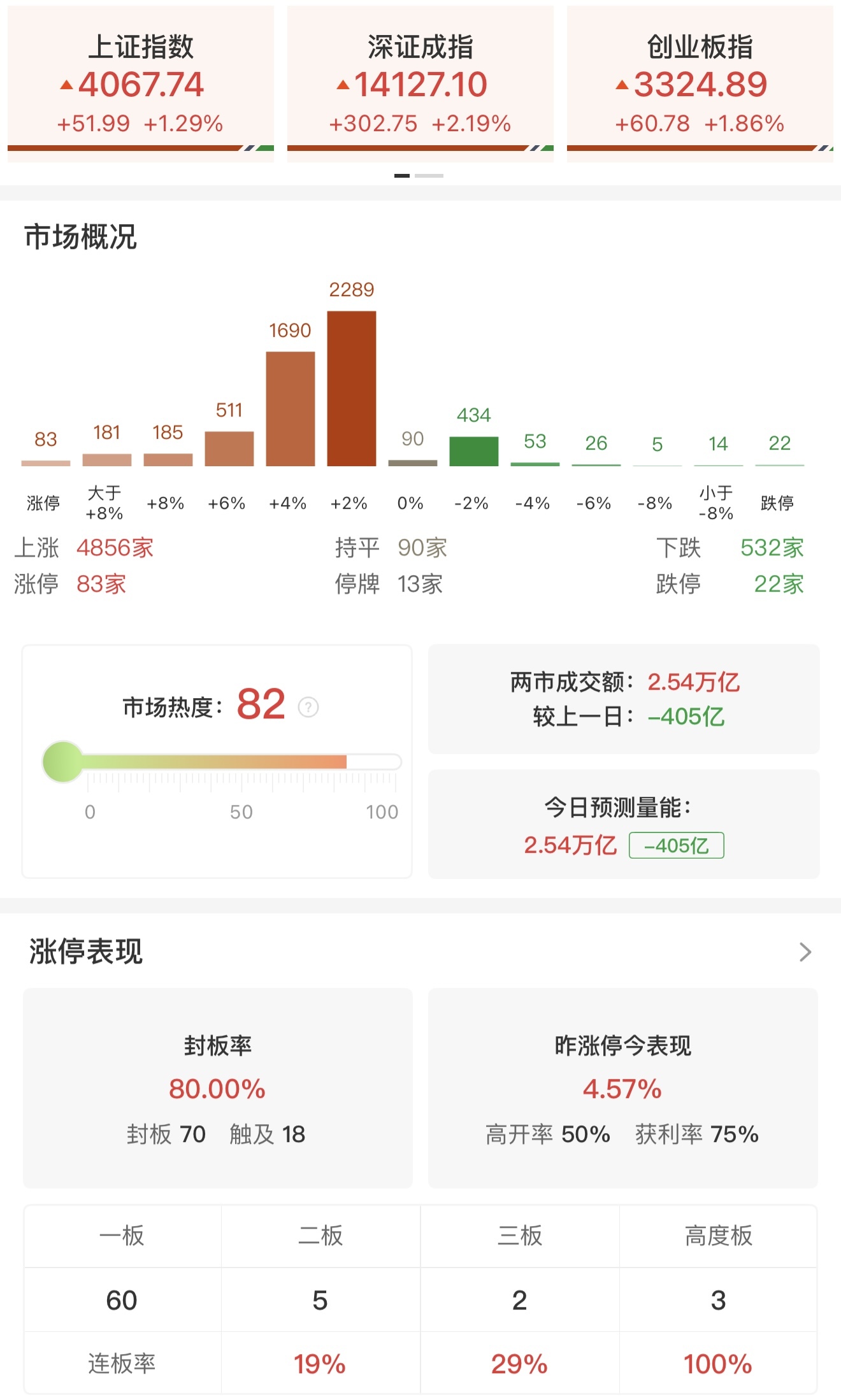
Market Overview - The market rebounded with the Shanghai Composite Index and ChiNext Index both rising over 1%, and the Shenzhen Component Index increasing over 2% [1] - The total trading volume in the Shanghai and Shenzhen markets was 2.54 trillion yuan, a decrease of 40.5 billion yuan compared to the previous trading day [1] - Over 4,800 stocks in the market saw gains, with notable performances in the commercial aerospace and space photovoltaic sectors [1] Sector Highlights - The commercial aerospace sector experienced significant growth, with stocks like Jili Rigging, Tongyu Communication, and Shenjian Co. hitting the daily limit [1] - The space photovoltaic concept continued to strengthen, with companies such as Guosheng Technology and Jinjing Technology also reaching the daily limit [1] - The chemical sector was active, with Hongbaoli achieving two limits in three days and Wanfeng Co. hitting four consecutive limits [1] - Precious metals showed a rebound, with Hunan Gold achieving six limits in seven days [1] - The AI application sector remained active, with Zhejiang Wenhu Interconnection achieving five limits in eleven days [1] Financial Insights - Huatai Securities noted that the resilience of the capital market remains, despite a decrease in trading activity and net outflows from ETFs [2] - CITIC Securities highlighted that the capacity price mechanism could significantly boost domestic energy storage installations, projecting a 84% year-on-year increase in new energy storage installations to 183 GWh by 2025 [2] - CITIC Jiantou stated that the global commercial aerospace sector is entering a new phase focused on large-scale deployment and ecosystem construction, with China leveraging policy support and capital to drive structural upgrades [2]
A股,强势反弹!超4800股上涨
证券时报· 2026-02-03 10:06
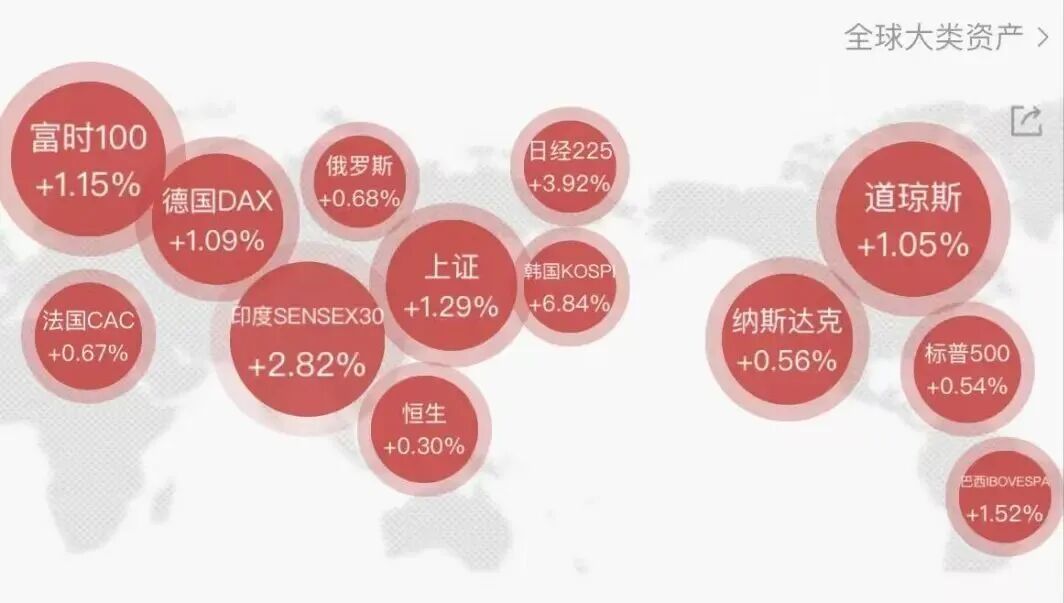
Core Viewpoint - The article highlights a strong rebound in the stock markets, particularly in the Asia-Pacific region, with significant gains in various sectors, especially commercial aerospace and space photovoltaic concepts, driven by technological advancements and market demand [1][2][3]. Group 1: Market Performance - Major Asia-Pacific stock indices saw significant increases, with Japan's Nikkei 225 rising by 3.92% to close at 54,720.66 points, and South Korea's composite index surging by 6.84% to 5,288.08 points [1]. - The A-share market also experienced a robust rebound, with the Shanghai Composite Index up 1.29% to 4,067.74 points, and the Shenzhen Component Index rising by 2.19% [2]. - The total trading volume in the Shanghai and Shenzhen markets was approximately 2.57 trillion yuan, a decrease of over 40 billion yuan from the previous day [2]. Group 2: Commercial Aerospace Sector - The commercial aerospace concept saw a significant surge, with stocks like Robotech and Dike shares hitting the 20% limit up, while other companies like XW Communication and Light Library Technology rose over 10% [4][6]. - SpaceX's recent acquisition of xAI aims to integrate resources across AI, rockets, and space internet, indicating a strategic move to enhance its capabilities in the commercial aerospace sector [5][6]. Group 3: Space Photovoltaic Concept - The space photovoltaic sector was notably active, with stocks such as Aotewi and Haiyou New Materials reaching the 20% limit up, and Jieput's stock price increasing by approximately 19% to a historical high [8][10]. - The demand for space photovoltaic technology is expected to grow significantly, driven by the industrialization of satellite manufacturing and the need for efficient power systems in low Earth orbit satellites [10]. Group 4: CPO Concept - The CPO (Chip-on-Board) concept experienced a substantial rise, with stocks like Juguang Technology increasing over 18% and Tianfu Communication rising by over 13%, both reaching new highs [12][14]. - Analysts predict that the domestic demand during the "14th Five-Year Plan" period, combined with high overseas demand and technological upgrades, will positively impact the performance of leading optical module companies [14].






【金信基金2.3市场点评】孔学兵:市场情绪快速修复 科技成长分化开启
Xin Lang Cai Jing· 2026-02-03 09:45
Market Overview - After the recent market disturbances caused by Kevin Walsh's "tapering" policy, the A-share market rebounded quickly, with the Shanghai Composite Index and ChiNext Index both rising over 1%, and the Shenzhen Component Index increasing by over 2% [1][3] - The total trading volume in the Shanghai and Shenzhen markets reached 2.54 trillion, a decrease of 40.5 billion compared to the previous trading day [1][3] - Over 4,800 stocks in the market experienced gains, with notable performances in sectors such as commercial aerospace, space photovoltaic concepts, semiconductor equipment, and chemicals [1][3] Market Sentiment and Factors - Recent volatility in the A-share market included a panic sell-off driven by multiple factors: 1. Investor concerns regarding the implications of Walsh's proposed "rate cuts + tapering" policy, leading to fears of financial market tightening [1][3] 2. Significant price fluctuations in precious metals like gold and silver, alongside systematic reductions in A-share weighted ETFs, compounded by increased market caution as the Spring Festival approaches [1][3] Future Outlook - The market is expected to stabilize after the rapid emotional downturn caused by indiscriminate panic selling, with short-term speculative trading likely to clear up quickly [4] - The new technology sector remains a primary focus for trading, supported by a shift in domestic policy towards demand-driven growth, which is anticipated to enhance the economic outlook and asset returns in China [4] - The "14th Five-Year Plan" emphasizes the construction of new productive forces, suggesting that market funds will continue to concentrate on technological innovation, with tech assets still in a significant upward cycle [2][4] Investment Strategy - Despite the consensus on technology growth, there are underlying divisions and challenges, as the development of emerging technologies requires substantial social investment and iterative application [2][4] - The current "asset shortage" and short-term market funding structure may lead to challenges in performance realization for some technology themes, with potential volatility and increased difficulty in trading expected post-2025 [2][4] - Investors are advised to adjust their expectations, focusing on long-term industrial logic and high-quality hard tech assets that are well-positioned in core segments, have strong technological barriers, and are capable of consistently delivering profits and cash flow [5]
每日收评三大指数探底回升均涨超1%,全市场超4800股飘红,商业航天概念卷土重来
Sou Hu Cai Jing· 2026-02-03 09:09
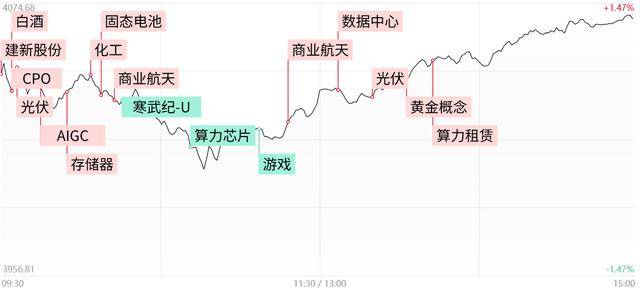
智通财经2月3日讯,市场探底回升,沪指、创业板指均涨超1%,深成指涨超2%。沪深两市成交额2.54 万亿,较上一个交易日缩量405亿。盘面上,市场热点快速轮动,全市场超4800只个股上涨。从板块来 看,商业航天概念爆发,巨力索具、通宇通讯、神剑股份、中超控股等多股涨停。太空光伏概念持续走 强,国晟科技、金晶科技、泽润新能、海优新材封涨停。化工板块表现活跃,红宝丽3天2板,万丰股份 4连板。贵金属概念探底回升,湖南黄金7天6板。AI应用概念反复活跃,浙文互联11天5板。下跌方 面,银行板块走势较弱,中国银行震荡下跌。截至收盘,沪指涨1.29%,深成指涨2.19%,创业板指涨 1.86%。 板块方面 商业航天概念卷土重来,巨力索具、通宇通讯、神剑股份、中超控股、天通股份、航天发展、润贝航科 等10余股涨停。 消息面上,太空探索技术公司(SpaceX)在官网发布由马斯克署名的声明,确认与人工智能企业xAI公 司合并。据报道,合并后公司预计每股定价约527美元,估值将达到1.25万亿美元。此外,近日,证监 会官网显示,星河动力、星际荣耀、天兵科技三家企业更新了IPO辅导进展。长江证券发布研报称,头 部商业航天企业有望 ...
亚太股市集体反弹,芯片股大爆发,三星电子飙涨11%,A股超4800股飘红
2 1 Shi Ji Jing Ji Bao Dao· 2026-02-03 07:50
Group 1: Market Performance - The Asia-Pacific stock markets experienced a significant rebound, with the Nikkei 225 index closing at 54,720.66 points, marking a historical high [1] - The South Korean Composite Index rose by 6.84% to 5,288.08 points, driven by major semiconductor manufacturers Samsung Electronics and SK Hynix, with Samsung's stock surging 11%, the largest single-day increase since March 2020 [1] - In the A-share market, major indices also strengthened, with the Shanghai Composite Index up 1.29%, the Shenzhen Component Index up 2.19%, and the ChiNext Index up 1.86%, with over 4,800 stocks rising and more than 80 stocks hitting the daily limit [1] Group 2: Sector Highlights - The space photovoltaic concept stocks saw a strong rally, with companies like Guosheng Technology and Jinjing Technology hitting the daily limit, while several others also experienced significant gains [3] - The precious metals sector rebounded strongly, with Xiaocheng Technology rising over 18% and Hunan Gold hitting the daily limit, following a surge in gold prices that broke through $4,890 [3] - CPO and other computing hardware stocks performed well, with companies like Robotec hitting the daily limit and Tianfu Communication rising over 10%, both reaching historical highs [3] Group 3: Individual Stock Movements - The stock of Cambrian Technologies experienced a significant drop, initially falling over 13% before closing down 9.18%, following the company's announcement addressing recent misinformation about its operations [3] - Domestic AI chip companies reported improved performance in their main operations, but their stock prices did not reflect this, with Moer Thread closing at 554.92 yuan per share, down 2.65%, and Muxi shares falling over 3% to 513.78 yuan per share [3] - In the Hong Kong market, the Hang Seng Index turned positive in the afternoon, while the Hang Seng Tech Index narrowed its decline to 0.9%, having previously dropped over 20% from its October 2024 high, entering a technical bear market [4]
A股收评:沪指涨1.29%、创业板指涨1.86%,商业航天及太空光伏概念股爆发,贵金属板块回升,全市场超4800只个股走高
Sou Hu Cai Jing· 2026-02-03 07:17
Market Overview - A-shares experienced a strong rebound after an initial drop, with the Shanghai Composite Index rising by 1.29% to 4067.74 points, the Shenzhen Component Index increasing by 2.19% to 14127.11 points, and the ChiNext Index up by 1.86% to 3324.89 points, with a total market turnover of 2.54 trillion yuan and over 4800 stocks rising [1] Hot Sectors - The space photovoltaic sector led the market, with stocks like Aotewi and Shuangliang Energy hitting the daily limit. According to Guosheng Securities, the demand for space energy is expected to explode, driven by the restructuring of the Sino-US supply chain, positioning Chinese photovoltaic companies for significant growth [2] - The computing hardware sector saw a collective rise, with stocks such as Tiantong and Woge Optoelectronics reaching the daily limit. Guosheng Securities noted that the high prosperity cycle of the computing industry chain is driving head manufacturers in the optical module sector to accelerate expansion, with a significant capacity release expected in Q1 2026 [3] - AI application stocks remained active, with Zhejiang Wenhu gaining for the 11th consecutive day. Recent updates from domestic model manufacturers have kept Chinese models trending on social media platforms [4] Institutional Insights - Guotai Junan believes that after recent declines, the market is likely to stabilize and regain upward momentum before the Spring Festival, driven by a shift in focus towards domestic demand and supportive government policies [5] - Huatai Securities indicated that the recent market adjustment is primarily technical and emotional, with a positive medium-term outlook for Chinese assets as liquidity and fundamentals remain favorable [6] - Guotai Junan also highlighted the impact of the new Federal Reserve chair on precious metal prices, suggesting that rising central bank gold purchases and ETF holdings will support gold prices in the long term [8] - CITIC Securities pointed out that the current adjustment phase in the liquor industry is nearing a turning point, presenting a bottoming opportunity for the sector as the Spring Festival approaches [8]
超4800股上涨
财联社· 2026-02-03 07:14
Market Overview - The A-share market rebounded today, with the Shanghai Composite Index and the ChiNext Index both rising over 1%, and the Shenzhen Component Index increasing by over 2% [1][3] - The total trading volume in the Shanghai and Shenzhen markets reached 2.54 trillion yuan, a decrease of 40.5 billion yuan compared to the previous trading day [1][7] Sector Performance - The commercial aerospace sector saw significant gains, with stocks like Giant Power, Tongyu Communication, Shenjian Co., and Zhongchao Holdings hitting the daily limit [1] - The space photovoltaic concept continued to strengthen, with stocks such as Guosheng Technology, Jinjing Technology, Zerun New Energy, and Haiyou New Materials also reaching the daily limit [1] - The chemical sector was active, with Hongbaoli achieving two consecutive daily limits in three days, and Wanfeng Co. hitting four consecutive daily limits [1] - The precious metals sector rebounded, with Hunan Gold achieving six daily limits in seven days [1] - The AI application concept remained active, with Zhejiang Wenhu Internet hitting five daily limits in eleven days [1] Decline in Banking Sector - The banking sector showed weakness, with China Bank experiencing fluctuations and a downward trend [2]

收评:深成指探底回升涨超2%,全市场超4800只个股上涨
Feng Huang Wang Cai Jing· 2026-02-03 07:13
下跌方面,银行板块走势较弱,中国银行震荡下跌。 盘面上,市场热点快速轮动,全市场超4800只个股上涨。截至收盘,沪指涨1.29%,深成指涨2.19%,创业板指涨1.86%。 从板块来看,商业航天概念爆发,巨力索具、通宇通讯、神剑股份、中超控股等多股涨停。太空光伏概念持续走强,国晟科技、金晶科技、泽润新能、海优 新材封涨停。化工板块表现活跃,红宝丽3天2板,万丰股份4连板。贵金属概念探底回升,湖南黄金7天6板。AI应用概念反复活跃,浙文互联11天5板。 凤凰网财经讯 2月3日,市场探底回升,沪指、创业板指均涨超1%,深成指涨超2%。 沪深两市成交额2.54万亿,较上一个交易日缩量405亿。 涨停表现 | 封板率 | | 昨涨停今表现 | | | --- | --- | --- | --- | | 80.00% | | 4.57% | | | 封板 70 触及 18 | | 高开率 50% 获利率 | | | 一板 | 二板 | 三板 | 를 | | 60 | 5 | 2 | | | 连板率 | 19% | 29% | TI | ...