
机械制造

Search documents
德国总理默茨就任后首次访华,中德经贸合作情况如何?
2 1 Shi Ji Jing Ji Bao Dao· 2026-02-26 14:45
Group 1 - German Chancellor Merz's official visit to China on February 25-26 marks his first visit since taking office, accompanied by around 30 executives from leading German companies in sectors such as automotive, chemicals, biopharmaceuticals, machinery manufacturing, and circular economy [1] - In 2025, German investment in China is expected to reach its highest level in four years, with a recent business confidence survey indicating that 93% of German companies in China plan to maintain or expand their cooperation [1] - Several German companies are looking to enhance collaboration with Chinese tech firms during this visit, with specific cooperation plans or intentions already in place, which will directly benefit related industries in China [1]
江苏,何以成为德企投资中国“首选地”
Xin Hua Ri Bao· 2026-02-26 11:45
Core Insights - The visit of German Chancellor Merz and a high-profile business delegation to China signals a strategic focus on long-term market opportunities for German companies in the current complex international trade environment [1] - Jiangsu province is emerging as a key location for German enterprises, providing a favorable business environment and policy continuity that aligns with the cautious investment style of German firms [1] Group 1: German Companies in Taicang - Taicang has become a "second hometown" for over 560 German companies, with total German investment exceeding 6 billion USD and annual industrial output surpassing 65 billion CNY [2] - The city has developed a competitive industrial cluster, attracting six of the top ten German machine tool companies, facilitating a network of suppliers within a 4-kilometer radius [2] - Over 90% of early German enterprises in Taicang have expanded their operations, demonstrating the effectiveness of the local business ecosystem [2] Group 2: Cultural Integration and Talent Development - Taicang has created a cultural integration initiative, including the Rothenburg-style street and German-style bakeries, to help over 1,000 German residents settle in [3] - The introduction of the German dual education system has trained over 10,000 skilled professionals, addressing talent shortages for German companies [3] - Suzhou has become one of the most concentrated cities for German investment in China, with 731 German enterprises by July 2025, including major players like Bosch and Siemens [3] Group 3: Changzhou's Long-Term Strategy - Changzhou has attracted 77 German-speaking enterprises with over 2.3 billion EUR in total investment, focusing on "invisible champion" companies in niche markets [4] - The city emphasizes a long-term approach to project development, exemplified by a decade-long collaboration with the electronics giant Eisele [4] - Changzhou aims to reach 100 German-speaking enterprises by the end of 2026, positioning itself as a preferred location for German companies in China [5] Group 4: Broader Development in Jiangsu - Jiangsu province is witnessing a multi-faceted development of German enterprises, with significant projects in cities like Nanjing, Wuxi, and Nantong [6] - Nanjing has attracted 309 projects with over 2.2 billion USD in German investment, becoming a hub for manufacturing upgrades and digital transformation [6] - Nantong has seen major investments from Merck and other high-end manufacturing giants, contributing to the region's economic growth [6] Group 5: Strategic Partnerships and Growth Opportunities - The collaboration between Jiangsu and German companies is characterized by precise industry alignment and exceptional service, creating a robust industrial chain [7] - German firms are increasingly viewing Jiangsu as a strategic base for deepening their market presence in China, enhancing growth prospects [7]
德国总理默茨率商业天团访华,两国经贸合作有望提速换挡
2 1 Shi Ji Jing Ji Bao Dao· 2026-02-26 11:24
Group 1 - The visit of German Chancellor Merz to China is seen as a critical point for the pragmatic and stable development of Sino-German relations amidst a complex international landscape [1][2] - The visit is marked by the presence of a high-profile delegation of about 30 German business executives from major companies, indicating strong interest in the Chinese market [7][10] - The bilateral economic cooperation between China and Germany is expected to expand, with Germany being China's largest trading partner in Europe and significant investment opportunities emerging [9][10] Group 2 - The joint statement from both countries emphasizes mutual respect, win-win cooperation, and the importance of open dialogue to address common challenges [2][4] - German companies are increasingly viewing China as a stable market, with a notable increase in direct investments projected to exceed 7 billion euros by 2025, marking a 50% increase compared to 2024 [10][11] - The evolving nature of Sino-German cooperation is shifting from mere technology export to collaborative development, particularly in high-tech sectors, reflecting a deeper integration of industries [11][12]
德国总理默茨访华,会见了哪些中方企业?中德经贸合作一览
2 1 Shi Ji Jing Ji Bao Dao· 2026-02-26 11:07
Group 1 - German Chancellor Merz's visit to China on February 25-26 marks his first official trip since taking office, accompanied by around 30 executives from leading German companies in sectors such as automotive, chemicals, biopharmaceuticals, machinery, and circular economy [1][5][8] - During the visit, significant cooperation documents were signed in areas including green transformation, customs, sports, and media, with over 60 entrepreneurs from both countries participating in discussions [1][5] - More than ten commercial agreements were reached between Chinese and German companies, covering industries such as automotive, machinery, energy, logistics, and finance [1][5] Group 2 - The trade volume between China and Germany has consistently exceeded $200 billion, with bilateral investments amounting to over $65 billion, representing nearly a quarter of the total trade volume between China and the EU [12][13] - A report indicates that German investments in China are expected to grow by over 55% in 2025, reaching approximately €7 billion, the highest level since 2021, with 93% of German companies in China planning to deepen their market presence [22][23] - Major German companies are increasing their strategic investments in China, with BASF committing €8.7 billion to build an integrated base in Zhanjiang, marking its largest single investment project to date [28]


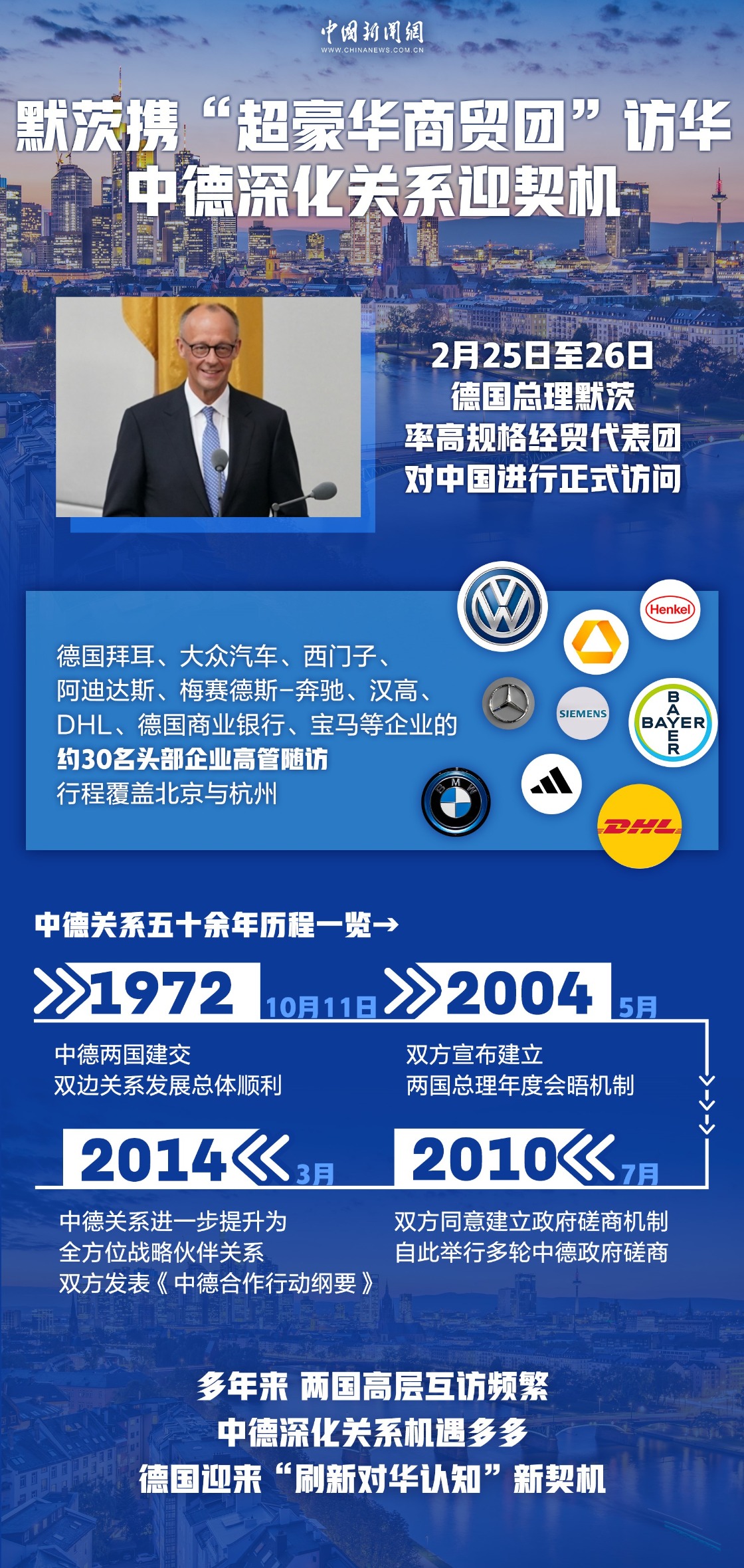
默茨率超豪华商务团到访中国:大生意,大机遇,大图景 | 图览天下
Zhong Guo Xin Wen Wang· 2026-02-26 10:49
Core Points - German Chancellor Merz's visit to China marks his first official trip since taking office, aiming to strengthen economic ties between Germany and China, two of the world's largest economies [1] - A high-level business delegation of around 30 German company executives from key industries such as automotive, chemicals, biopharmaceuticals, and machinery accompanies the Chancellor, reflecting deepening economic cooperation over more than 50 years of diplomatic relations [1] - The bilateral trade volume between China and Germany remains significant, with exports from China reaching $97.22 billion and imports from Germany at $173.69 billion, showing year-on-year growth of 3.5% and 9.7% respectively [10] Economic Cooperation - The establishment of a comprehensive strategic partnership between China and Germany has led to the signing of the "China-Germany Cooperation Action Outline" and the agreement to set up a government consultation mechanism [7] - The trade relationship supports approximately 1 million jobs in Germany, with over 5,000 German companies investing in China [10] - Emerging fields such as clean energy, embodied intelligence, biotechnology, and industrial digitalization present vast opportunities for future collaboration [12] Cultural Exchange - Cultural exchanges have deepened, with significant events such as the "Chinese Flavor" food festival and the "Happy Spring Festival" celebration planned for 2026, showcasing the cultural ties between the two nations [13] - As of the end of 2024, there are approximately 49,500 Chinese students studying in Germany, and 19 Confucius Institutes have been established in Germany to promote cultural understanding [13]
山东高密:复工复产动力足 冲刺首季“开门红”
Zhong Guo Jing Ji Wang· 2026-02-26 06:21
Group 1 - The production environment in Gaomi City, Shandong, is bustling with activity as companies strive to meet high order volumes, with some orders extending into June [1] - Haiyu Co., Ltd. has automated production lines operating at high speed, with a focus on ensuring timely delivery of orders [1] - Zep Medical Technology Co., Ltd. is managing its production efficiently, with all employees present and a well-structured production plan to meet urgent export orders [1] Group 2 - The local government is actively supporting businesses by organizing job fairs, providing thousands of quality job positions across various industries, including mechanical manufacturing and digital commerce [2] - The "Spring Breeze Action" recruitment fairs are aimed at addressing labor shortages for companies, ensuring they can maintain production levels [2] - During the Spring Festival holiday, the Xiazhuang Town in Gaomi City continued to provide services to enterprises, conducting equipment checks and assessing labor needs to facilitate smooth operations post-holiday [2]
ETF午评 | 沪指微跌0.08%,电力板块领涨,电网ETF、电网设备ETF均涨3%
Xin Lang Cai Jing· 2026-02-26 04:14
Market Overview - The Shanghai Composite Index fell by 0.08% and the ChiNext Index decreased by 0.39% [1] - Sectors such as AI applications, lithium batteries, fintech, photovoltaic, gold, and innovative pharmaceuticals showed weakness, while real estate and insurance industries experienced significant declines [1] Sector Performance - The storage chip sector continued to rise, with the South Korea-China semiconductor ETF increasing by 4.82% [1] - The AI hardware sector strengthened, with the 5G ETF from Bosera rising by 3.28%, and the communication ETFs from Huaxia and others increasing by 2.79% and 2.49% respectively [1] - The electric grid sector performed well, with both the electric grid ETF and electric grid equipment ETF rising by 3% [1] - The machinery sector also saw gains, with the Jiashan technology machinery ETF and industrial mother machine ETF increasing by 2.94% and 2.48% respectively [1] Declining Sectors - Oil and gas stocks declined, with the S&P oil and gas ETF from Jiashan dropping by 2.8% [1] - The real estate sector faced a pullback, with the real estate ETF and the real estate ETF from Yinhua falling by 2.74% and 2.71% respectively [1] - Automotive stocks were also down, with the Hong Kong automotive ETF and the Hong Kong Stock Connect automotive ETF from Fuguo decreasing by 2.38% and 2.09% respectively [1]
外媒热议默茨访华:中国不再是“学生”,德国应乐见
Guan Cha Zhe Wang· 2026-02-26 03:51
Group 1 - German Chancellor Merz's visit to China is seen as a significant step in recalibrating Germany's policy towards China amid a backdrop of strained transatlantic relations and a sluggish German economy [1][5] - Merz's delegation includes high-ranking executives from major German companies such as Bayer, Volkswagen, Siemens, Adidas, Mercedes-Benz, and Airbus, marking the largest business delegation accompanying a German leader to China since Merkel's tenure [1][9] - The bilateral trade between Germany and China reached €251.8 billion in 2025, with China surpassing the US to become Germany's largest trading partner [9] Group 2 - Despite a historically tough stance on China, Merz's recent statements indicate a shift towards a more pragmatic approach, emphasizing the importance of maintaining economic ties and avoiding a decoupling from China [5][6] - The visit is driven by two main factors: the need to counterbalance pressure from the US and the ongoing challenges posed by the Russia-Ukraine conflict, as well as the necessity for Germany to strengthen its economic connections with China for recovery [6][8] - There is a growing sentiment in Germany regarding the so-called "China shock," with some attributing the struggles of German manufacturing to competition from China, despite ongoing investments by German companies in the Chinese market [10][11]
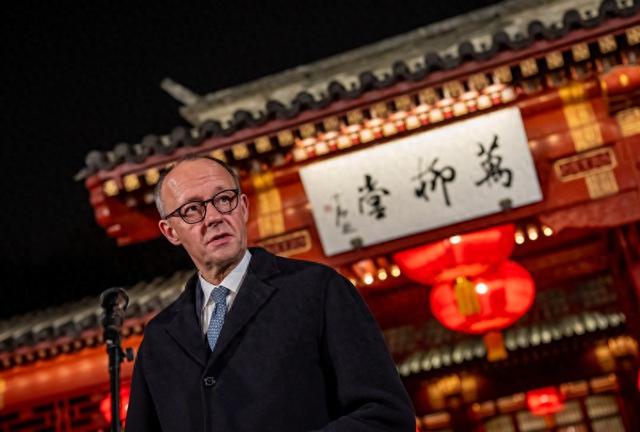
德国总理默茨访华,中国德国商会:望此访成为中德关系新起点
2 1 Shi Ji Jing Ji Bao Dao· 2026-02-26 03:01
Group 1 - German Chancellor Merz's visit to China marks his first official trip since taking office and is significant as he is the first foreign leader to be received by China in the Year of the Horse [1] - The high-profile German economic delegation accompanying Merz includes representatives from major industries such as automotive, machinery manufacturing, and engineering, highlighting Germany's overall business layout in China [1] - The delegation consists of around 30 companies, which is larger than those accompanying previous chancellors, and includes a notable number of German medium-sized enterprises, referred to as "hidden champions" [1] Group 2 - The focus of the visit should not solely be on the number of agreements or contracts signed, but rather on deepening bilateral commercial relations and elevating them to a higher level [2] - The visit is seen as a potential "reset button" for Sino-German relations, aiming to initiate a new and exciting phase of cooperation [2]
德国总理默茨今起访华,中国德国商会:望此访成为中德关系新起点
2 1 Shi Ji Jing Ji Bao Dao· 2026-02-26 02:53
Group 1 - The delegation accompanying German Chancellor Merz on his visit to China is larger and includes higher-level executives compared to previous visits by past chancellors [1] - The business delegation reflects Germany's overall commercial layout in China, covering key industries such as automotive, machinery manufacturing, and mechanical engineering [1] - The delegation includes a significant number of German medium-sized enterprises, referred to as "hidden champions," highlighting the importance of these companies in the German economy [1] Group 2 - The focus of the visit should not solely be on the number of agreements or contracts signed, but rather on deepening bilateral commercial relations [2] - The visit is seen as a potential "reset button" for Sino-German relations, aiming to initiate a new and exciting phase of cooperation [2]