金融保险

Search documents
农业驱动津巴布韦2025年第一季度GDP增长
Shang Wu Bu Wang Zhan· 2025-08-02 15:53
Core Insights - Zimbabwe's GDP reached 335 billion Zimbabwean dollars in Q1 2025, up from 299 billion in Q4 2024, driven by growth in agriculture, electricity, information communication, and financial insurance sectors [1] Sector Performance - Agriculture grew by 18.8%, electricity by 6.1%, and both information communication and financial insurance sectors increased by 4.3% [1] - Conversely, mining, accommodation and food services, and water supply sectors saw declines of 21.6%, 24.1%, and 12.3% respectively [1] Contribution to GDP - Manufacturing was the largest contributor to GDP in this quarter, accounting for 15%, followed by mining at 12.4%, agriculture at 11.7%, wholesale and retail at 11.6%, and financial insurance at 11.2% [1]
A股行业中观景气跟踪月报(2025年7月):反内卷推动光伏锂电和部分顺周期品价格修复至2024年同期水位-20250802
Shenwan Hongyuan Securities· 2025-08-02 07:25
Core Insights - The report highlights a recovery in prices for photovoltaic and lithium battery products, driven by anti-involution policies, bringing them back to levels seen in the same period of 2024 [1][5] - Manufacturing PMI for July 2025 shows a decline to 49.3%, indicating a slight contraction in the manufacturing sector, while non-manufacturing PMI remains above the threshold but shows marginal slowdown [2][9] Industry Analysis - **Manufacturing Sector**: The manufacturing sector is experiencing a mixed performance, with production still expanding despite a decline in PMI. The overall manufacturing PMI is at 49.3%, down from 49.7% in June [2][9] - **High-frequency Indicators**: Various industrial sectors show differing trends; sectors like non-ferrous metals and machinery are performing well, while pharmaceuticals and textiles are under pressure [3][4] - **Consumer Confidence**: There is a recovery in consumer confidence, but retail sales are expected to slow down due to the end of promotional seasons and transitional phases in government subsidies [4][5] - **Advanced Manufacturing**: The photovoltaic and lithium battery sectors are seeing price recovery due to regulatory measures against chaotic competition, although demand-side constraints remain [5] - **Technology Sector**: The export of optical communication modules has decreased by 11.2% year-on-year, while storage prices are rising due to supply constraints [5] - **Financial Sector**: Insurance premium income has increased by 5.3% year-on-year in the first half of 2025, indicating a recovery in the financial market [5] - **Real Estate Sector**: Real estate investment and sales are slowing down, with a notable decline in new housing starts and construction activities [5] - **Energy Sector**: Coal and steel prices have seen a spike due to high demand and regulatory measures, while oil prices are stabilizing amid improved economic expectations [5] - **Chemical Industry**: The PPI for industrial products has decreased, with significant declines in the chemical sector, indicating ongoing challenges [5][8]
海合会非油经济持续发力 GDP突破5878亿美元
Shang Wu Bu Wang Zhan· 2025-08-01 15:42
Core Insights - The GDP of Gulf Cooperation Council (GCC) countries is projected to reach $587.8 billion in 2024, reflecting a year-on-year growth of 1.5% [1] - Non-oil economic activities account for 77.9% of the GDP, indicating significant progress in economic diversification within the region [1] Sector Contributions - The manufacturing sector is the largest contributor to the non-oil economy, accounting for 12.5% [1] - Wholesale and retail trade follows with a contribution of 9.9%, while the construction sector contributes 8.3% [1] - Other significant sectors include public administration and defense (7.5%), financial and insurance services (7%), and real estate (5.7%) [1]
外资青睐中国科技股,海外中国股票ETF规模激增
Zhong Guo Zheng Quan Bao· 2025-07-30 05:02
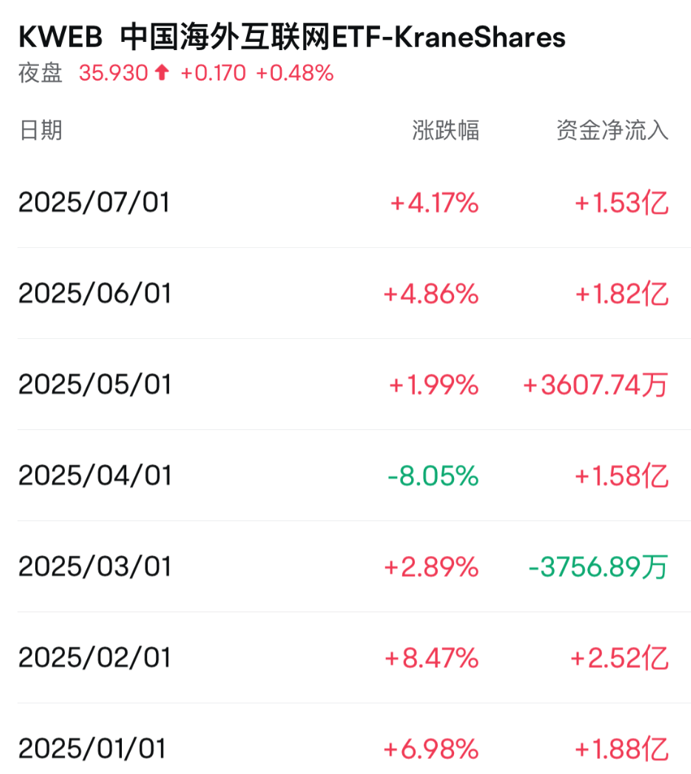
Core Insights - There has been a significant increase in overseas investment in Chinese stock ETFs since July, particularly in technology-related products, with some reaching new highs in 2023 [1][6] - Korean investors have shown heightened interest in A-share assets, contributing to the overall inflow of funds into Chinese ETFs [1][8] Fund Performance - As of July 28, five major overseas Chinese stock ETFs had a combined asset size of $24.7 billion, attracting over $2.6 billion in net inflows this year [2] - The KraneShares China Internet ETF (KWEB) saw its asset size grow to $7.7 billion, up from $6.374 billion at the end of June, marking a growth of over 20% [2] - The iShares MSCI China ETF (MCHI) reached an asset size of $7.171 billion, increasing by over 12% from $6.395 billion at the end of June, with July net inflows of $1.89 million [4] - The iShares China Large-Cap ETF (FXI) had an asset size of $6.507 billion, a growth of approximately 5% from $6 billion at the end of June, with net inflows of $3.31 billion in July [4] Technology ETF Highlights - The Invesco China Technology ETF (CQQQ) achieved a new high in asset size at $1.254 billion, a 13.84% increase from $1.101 billion at the end of June [6][7] - The top holdings of CQQQ include major Hong Kong-listed companies, with a total net inflow of $7.84 million this year [6] A-Share Investment Trends - The Deutsche Bank-Jia Shi CSI 300 A-Share ETF (ASHR) saw its asset size grow to $2.109 billion, up over 10% from $1.907 billion at the end of June, with net inflows of $154 million this year [7] - The Morgan Stanley China A-Share Index Fund (CAF) also experienced steady growth, reaching an asset size of $289 million by July 28 [7] Global Investment Shifts - Global investors are increasingly looking beyond the U.S. for resilient growth opportunities, which may have a profound impact on the Chinese market [8] - Data from the Korea Securities Depository indicates that China has become the second-largest overseas investment destination for Korean investors this year, following the U.S. [8]

美国6月职位空缺降幅小超预期,劳动力市场“降温但未冰冻”
Jin Shi Shu Ju· 2025-07-29 14:53
AI播客:换个方式听新闻 下载mp3 音频由扣子空间生成 美国6月份的职位空缺在前两个月连续跃升后有所下降,但仍徘徊在一个表明劳动力需求总体稳定的水 平。 根据美国劳工统计局周二公布的数据,职位空缺从5月份修正后的771万个减少到744万个,低于市场预 期的750万个。 每个失业工人对应的职位空缺数——美联储官员作为劳动力供需平衡的一个代表指标而密切关注的比率 ——保持在1.1。在2022年的峰值时期,该比率为2比1。 一些经济学家对JOLTS数据的有效性提出了质疑,部分原因是该调查的回复率低且修正幅度大。招聘网 站Indeed一个每日报告的类似指数显示,6月份的职位空缺有所下降,延续了今年以来稳步下降的趋 势。 周二的另一份独立数据显示,随着对更广泛经济和劳动力市场前景的担忧有所缓解,美国7月份的消费 者信心有所增强。 劳动力市场的状况将是本周美联储政策会议的一个主要议题。美联储主席鲍威尔曾将劳动力市场描述 为"稳固",并以关税对通胀影响的不确定性作为维持利率稳定的理由。 外界普遍预计官员们本周会再次这样做,但一些希望提振正在放缓的劳动力市场的决策者可能会提出异 议。这一点在将于周五公布的7月份非农就业报告 ...
原蚂蚁集团副总裁,去向定了
2 1 Shi Ji Jing Ji Bao Dao· 2025-07-29 12:23
Group 1 - Wang Xiaohang, former Vice President and CTO of Ant Group, has joined Ping An Group as Chief Technology Officer (CTO) and General Manager of Ping An Technology [1] - Ping An Group aims to enhance its AI technology research and application capabilities through Wang's expertise, focusing on the integration of self-developed large models and open-source big data platforms [1] - The strategic goal is to accelerate the digital transformation across five systems: digital operation, management, marketing, services, and business [1] Group 2 - Wang Xiaohang's departure from Ant Group was unexpected, occurring shortly after a significant organizational restructuring within the company [2] - His previous roles included leading digital finance and AI innovation at Ant Group, where he managed teams across various financial technology sectors [2] - Wang's educational background includes a master's degree in computer science from the National University of Singapore, and he has held senior technical positions at notable companies like Google and Bloomberg [2] Group 3 - During his tenure at Ant Group, Wang presented a report on the transformative impact of large model technology on the financial industry, highlighting its potential to enhance user experience and productivity [3]
从蚂蚁到平安,王晓航去向已定
2 1 Shi Ji Jing Ji Bao Dao· 2025-07-29 07:03
Core Insights - Wang Xiaohang, former Vice President and CTO of Ant Group, has joined Ping An Group as Chief Technology Officer (CTO) and General Manager of Ping An Technology, aiming to enhance AI technology development and application within the company [2][3] - His experience in digital finance and AI innovation at Ant Group aligns well with Ping An's digital transformation strategy, which focuses on integrating comprehensive financial services with healthcare and elderly care [2][4] Group 1: Leadership Transition - Wang Xiaohang's departure from Ant Group was unexpected, and he was appointed by Ping An Group on July 29, 2024 [2] - His role at Ant Group involved leading technology and research teams across various sectors, including wealth management and insurance, and he was instrumental in launching advanced AI products [2][3] Group 2: Strategic Goals - Ping An Group aims to integrate AI technology with its operations, focusing on building a digital ecosystem that includes digital management, marketing, and services [2][4] - The company has a significant workforce dedicated to technology, with over 21,000 technology developers and more than 3,000 scientists as of the end of 2024 [4][5] Group 3: Industry Context - Wang Xiaohang's insights on AI's impact on the financial industry highlight the ongoing transformation and the need for companies to adapt to new technological advancements [4] - The shift from Ant Group to Ping An represents a broader trend of integrating technology into traditional financial and insurance sectors, emphasizing the importance of digital transformation in enhancing user experience and operational efficiency [3][4]

日本平均月薪创47年来新高,达33万日元,物价压力仍凸显
Sou Hu Cai Jing· 2025-07-06 13:04
Overall Salary Level - The average monthly salary in Japan is projected to reach 330,000 yen (approximately 16,000 RMB) by 2025, marking the highest level since 1976 [1] - Nominal wage growth is expected to increase by 2.1% year-on-year in 2023, with large companies experiencing wage increases exceeding 5% for two consecutive years by 2025 [1] Entry-Level Salaries - The average starting salary for fresh graduates in 2025 is expected to be 254,000 yen (approximately 13,000 RMB), a record high [4] - Top companies in the IT sector, such as Accenture, offer annual salaries for fresh graduates that can reach 4.3 million yen (approximately 214,000 RMB), significantly above the average [4] Income Disparity - The median annual salary in the Tokyo region is 4 million yen (approximately 200,000 RMB) [4] - Only 0.6% of the population earns an annual salary of 20 million yen (approximately 1 million RMB) or more [4] - There is a widening gender pay gap, with average annual salaries of 5.63 million yen (approximately 275,000 RMB) for men and 3.14 million yen (approximately 153,000 RMB) for women [4] Industry and Occupational Differences - The highest-paying industries include finance, insurance, and information communication (IT) [5] - The fastest wage growth is observed in the chemical industry (28.99% increase) and shipbuilding (11.01% increase) [6] - Physical laborers earn approximately 180,000 RMB per month, which is lower than the hourly wage of university graduates [6] Regional Differences and Cost of Living - The average monthly salary in Tokyo is 380,000 yen (approximately 19,000 RMB), with disposable income after rent being higher than in New York and London [8] - Salaries in Osaka and other regional cities are lower than in Tokyo, but housing prices in suburban areas are more affordable [9] - The cost of living is high, with food prices being 2-3 times higher than in domestic markets [10] Policy and Social Issues - Single individuals face a heavier tax burden compared to married individuals with children who benefit from tax exemptions [12] - Childcare subsidies range from 5,000 to 15,000 yen per month for children under 15, with equal benefits for long-term visa holders [13] - A significant portion of low-income women earn less than 2 million yen (approximately 98,000 RMB) annually, and single mothers often work multiple jobs to make ends meet [14] International Comparison - The monthly salary in Tokyo is 2,592 USD, which is only half of that in New York (5,128 USD), ranking Tokyo 38th among global cities [15] - Japan's minimum wage is 1,055 yen (approximately 49 RMB) per hour, lower than in Seoul and Singapore [16] Summary - While Japan's overall salary has seen growth in recent years, high living costs, low savings rates, and significant industry and regional disparities have increased economic pressure on individuals [17] - Fresh graduates and those in the IT sector have experienced notable income increases, but low-income groups, particularly women and single individuals, face substantial economic challenges [17]

上海市企业走出去专业服务联盟成立,首批50家机构加盟
news flash· 2025-07-03 13:40
Core Viewpoint - The Shanghai Enterprise Going Global Professional Service Alliance was established on July 3 to support companies in expanding into diverse international markets and ensuring sustainable development [1] Group 1: Alliance Formation - The Shanghai Municipal Commission of Commerce announced the formation of the alliance and the establishment of a secretariat to draft the alliance's charter and solicit applications from professional service institutions [1] - A total of 50 institutions were selected as the first batch of members based on a principle of selecting the best among the best, after consulting relevant industry authorities [1] Group 2: Characteristics of Member Institutions - The first batch of member institutions exhibits three main characteristics: 1. Outstanding professional capabilities, gathering top-tier service providers across various fields with international service standards [1] 2. Diverse service products, covering eleven areas including finance and insurance, legal arbitration, accounting and taxation, and intellectual property [1] 3. Global resource distribution, with overseas institutions providing localized support for companies venturing abroad [1] Group 3: Future Plans - The alliance plans to further recruit more high-quality professional service institutions based on demand in the future [1]
加拿大制造业大滑坡!4月GDP意外下跌
Xin Hua Cai Jing· 2025-06-27 13:59
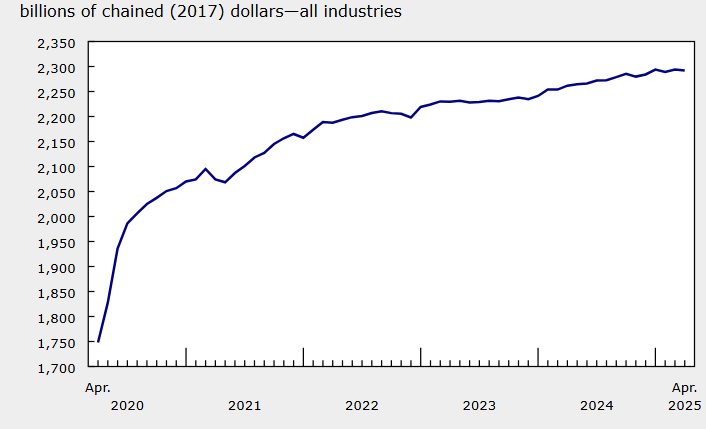
Economic Overview - In April 2025, Canada's real GDP decreased by 0.1%, ending the growth trend observed in March [1] - The goods-producing sector experienced an overall decline of 0.6%, with manufacturing being a significant drag, falling by 1.9% [1] - Durable and non-durable goods manufacturing dropped by 2.2% and 1.6% respectively, indicating negative impacts from tariff uncertainties on transportation equipment manufacturing and the food and oil industries [1] Service Sector Performance - The service-producing sector saw a slight increase of 0.1%, with public administration, finance and insurance, and arts and entertainment contributing to this growth [2] - The finance and insurance sector grew by 0.7%, marking the largest increase since August 2024, driven by high-frequency trading activities due to U.S. tariff announcements [2] - The arts, entertainment, and recreation sector achieved a growth of 2.8%, primarily due to increased attendance at NHL playoff games in Canada [2] Trade and Resource Sector Insights - The wholesale trade sector declined by 1.9%, significantly impacted by reduced imports and exports in motor vehicles and parts [7] - In the resource sector, while the oil and gas extraction sub-sector was affected by decreased natural gas and crude oil production, oil and gas support activities saw an increase due to rising drilling activities [7] Government Financials - In Q1 2025, the total deficit for all levels of government in Canada was CAD 12.4 billion, a reduction of CAD 19.6 billion compared to the same period last year [7] - The federal government significantly reduced its deficit to CAD 8.7 billion, while provincial and territorial governments faced pressures from increased spending and reduced revenues [7] Future Economic Outlook - The real GDP is expected to continue declining by 0.1% in May 2025, indicating challenges for short-term economic growth [7] - Growth in real estate rental activities may partially offset declines in other sectors [7] - The economic situation reflects the impact of global trade tensions on Canada's manufacturing and export-oriented industries, while also highlighting the supportive role of the service sector and other areas in economic growth [7]