云计算

Search documents
当“云端算力”遇见“交易本体”,企业数智化进化出“最佳解法”
Cai Jing Wang· 2026-02-04 04:03
Core Insights - The core viewpoint of the article emphasizes the shift in enterprise focus from AI computing power to the accuracy of AI-driven decision-making, highlighting the collaboration between Alibaba Cloud and Baiwang in developing advanced AI solutions for business applications [1][2]. Group 1: AI and Data Integration - Enterprises' primary concern has transitioned from "Is there enough computing power?" to "Are the results accurate?" [2] - Alibaba Cloud has established a long-term partnership with Baiwang, focusing on the integration of AI and data intelligence through the creation of a "Data Intelligence Joint Laboratory" [2]. - The "Transaction Ontology" proposed in Baiwang's white paper offers an innovative interpretation of enterprise data assets, contributing to Alibaba Cloud's "Trusted AI Infrastructure" by ensuring data certainty [2][3]. Group 2: Data Quality and Decision-Making - The article discusses the need for "high-purity fuel" in computing, emphasizing that not all data is equal and that unverified data is merely "digital noise" [3]. - Baiwang's "Transaction Ontology" purifies data at the cloud entry point through institutional confirmation, transforming invoices and contracts into legally binding "economic facts" [3]. - The combination of Alibaba Cloud's high-performance computing clusters with these high-purity "transaction ontologies" enables a shift from probabilistic correlations to evidence-based causal reasoning in enterprise AI applications [3]. Group 3: RaaS Model and Infrastructure Challenges - The white paper outlines a transition from SaaS (Software as a Service) to RaaS (Results as a Service), presenting unprecedented challenges for cloud infrastructure services [4]. - In the RaaS model, service providers directly commit to helping clients save costs or obtain bank credit, making system reliability crucial [4][5]. - Alibaba Cloud's elastic computing and high-availability architecture provide the necessary stability and computing power for RaaS, enabling real-time data processing for accurate market pricing [5]. Group 4: Privacy Computing and Data Sharing - The article highlights a future evolution in data circulation, moving from raw data transactions to "model parameter exchanges" based on privacy computing, forming a "federated ecosystem" [6]. - Alibaba Cloud's privacy computing technology can integrate with Baiwang's algorithms to create a "usable but invisible" cloud sandbox, ensuring data sovereignty while allowing for secure model execution [6]. - This architecture resolves "data silos" and facilitates the development of a cross-industry "business decision operating system," aligning with national data security regulations [6]. Group 5: Future Vision and Strategic Goals - In the AI 2.0 era, enterprises require intelligent services that directly lead to business outcomes (RaaS), rather than just faster computing and larger storage [7]. - Alibaba Cloud aims to provide the foundational infrastructure for the digital economy, collaborating with Baiwang and industry partners to establish a trustworthy and auditable "business decision operating system" [7]. - The vision includes leveraging the "Transaction Ontology" as a trust anchor to enable enterprises to benefit from data assetization and intelligence-driven growth [7].
AI开支延续高增态势,资金抢筹布局光模块,“含光量”高的通信ETF(515880)连续3日资金净流入超21亿元
Mei Ri Jing Ji Xin Wen· 2026-02-04 03:42
(文章来源:每日经济新闻) 2025年ETF"涨幅王"通信ETF(515880)全年上涨125.81%居全市场第一,不仅涨幅可观,通信ETF (515880)的规模也是同类第一,截至2025年12月31日,通信ETF光模块含量占比超过46%,服务器含 量近20%,代表了海外算力的基本面底气,目前仍是景气优选,建议持续关注。 AI开支延续高增态势,资金抢筹布局光模块。资金面看,"含光量"高的通信ETF(515880)连续3日资 金净流入超21亿元 兴业证券指出,Meta、微软资本开支延续高增态势,AI商业闭环落地节奏加快。微软Azure及其他云服 务收入同比增长约39%,云业务积压合同订单同比翻倍;Meta宣布2026年资本开支将大幅提升至约1150 亿~1350亿美元,同比增长59%~87%,显著高于此前预期。光模块龙头业绩如期兑现,行业2026年高景 气确定性较强。同时,液冷板块渗透加速,继Meta、Google后,亚马逊液冷需求即将释放,带动ASIC 液冷市场空间进一步上修。 ...
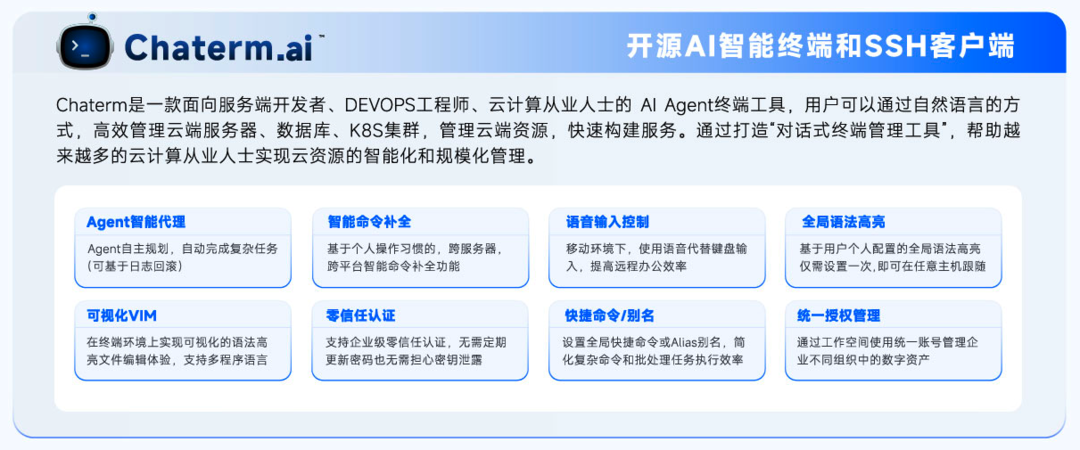
“声控”运维、技能复用……Chaterm上线移动端应用
Yang Zi Wan Bao Wang· 2026-02-04 02:44
Core Insights - The rapid deployment of AI infrastructure presents new challenges for enterprise operations management, particularly in cross-terminal and full-link management [1] - Chaterm, a product under Hehe Information, has launched a mobile application and introduced the "Agent Skills" feature on PC to address operational limitations in mobile scenarios for cloud computing professionals [1] Group 1: Remote Operations Challenges - Ensuring the continuous operation of core business systems has become vital for enterprise development, especially during non-fixed office scenarios like holidays and travel [2] - Chaterm has implemented voice command recognition in mobile management tools to allow operational commands to be executed verbally, enhancing efficiency in complex network environments [2] - The mobile application can accurately interpret operational terminology and user intent, converting vague verbal descriptions into precise, executable commands, thus reducing the risk of operational errors [2] Group 2: Knowledge Management and Automation - Traditional operational stability heavily relies on the personal experience of senior experts, making it difficult to scale knowledge transfer and increasing operational risks due to personnel changes [3] - The "Agent Skills" feature allows operations engineers to encapsulate their experience and business logic into reusable "skill packages," enabling AI to autonomously execute tasks like an experienced expert [3] - This innovation aims to enhance operational efficiency and support the establishment of a more robust automated operations system within enterprises [3] Group 3: Product Features and Recognition - Chaterm's capabilities are recognized as key to improving enterprise efficiency as AI technology penetrates vertical business scenarios [4] - The product was included in the 2025 China Generative AI Best Practice Case report by a global growth consulting firm and a research institute, highlighting its innovative application in cross-platform cloud resource management [4]

第二届“新质生产力产业实践洞见活动”: AI成驱动产业升级新引擎
Zhong Guo Hua Gong Bao· 2026-02-04 02:43
会上,环球时报、中国科协企业创新服务中心和赛迪新质生产力发展促进中心还发布了"新质生产力产 业实践示范案例"。 "发展新质生产力是我国实现高质量发展的根本动力,而AI正是驱动这一新质生产力发展的核心引 擎。"国务院国有重点大型企业监事会原主席季晓南说。针对如何应用AI发展新质生产力,他提出3点建 议:第一,要深刻把握新质生产力的内核,坚持以AI为引擎,推动发展新变革;第二,要立足中国实 践,充分发挥我国产业的综合优势,走出一条AI赋能产业发展的中国式道路;第三,要着力构建支撑 生态,汇聚各方合力,推动AI在具体场景中创造多层次实实在在的价值。 中化新网讯 1月29日,第二届"新质生产力产业实践洞见活动"在京举办。会上,多位嘉宾围绕人工智能 (AI)与产业融合、发展产业新质生产力等话题展开案例分享,并指出AI正逐步深入核心生产系统, 成为驱动产业升级的新质生产力引擎。 在圆桌对话环节,嘉宾们结合各自产业实践,深入分析了AI规模化落地面临的多重挑战与破解路径。 大家一致认为,AI规模化应用的成功标准关键在于能否创造实际价值,而不仅仅是技术本身的先进 性。未来,AI将在制造业、能源、交通、医疗、金融等行业迎来更深入 ...
东海证券晨会纪要-20260204
Donghai Securities· 2026-02-04 02:41
Group 1: Food and Beverage Industry - The food and beverage sector is expected to see positive seasonal demand, particularly with the upcoming Spring Festival, which is anticipated to boost inventory levels [5][6] - In Q4 2025, sales of frozen food categories improved, with sales growth rates of approximately 6.5% year-on-year. Specific categories like hot pot meatballs, frozen sausages, and shrimp slides saw sales growth of about 15%, 45%, and 55% respectively [5][6] - The overall food and beverage sector's performance is improving, with major companies like Anjuke gaining market share in the consumer segment, indicating a potential recovery in profitability [5][6] Group 2: Dairy and Meat Industry - Raw milk prices have stabilized and are showing signs of recovery, with the average price at 3.04 yuan per kilogram as of January 23, 2026, reflecting a slight increase from previous weeks [6] - The dairy and meat sectors are expected to benefit from favorable domestic demand due to new import policies and a potential upward trend in prices, suggesting a positive outlook for upstream agricultural companies and leading dairy firms [6][9] Group 3: Electronic Industry - Major overseas CSP manufacturers like Meta and Microsoft reported significant increases in capital expenditures, driven by AI as a key performance driver. Meta's Q4 2025 revenue was $59.893 billion, a 24% year-on-year increase [12][13] - Alibaba's PingTouGe launched a self-developed AI training and inference chip, indicating advancements in AI capabilities within the electronic sector. This chip supports high bandwidth and is expected to enhance AI applications across various industries [12][14] - The electronic industry is experiencing a recovery in demand, with rising prices for storage chips and an increased focus on domestic production capabilities [12][16] Group 4: Market Performance - The food and beverage sector outperformed the broader market, with a 1.56% increase, surpassing the Shanghai and Shenzhen 300 Index by 1.48 percentage points [7] - The overall retail sector in China saw a 5% year-on-year increase in value added, with significant growth in convenience stores and supermarkets, indicating a robust retail environment [8] - The electronic sector underperformed the market, with the electronic index declining by 2.51%, highlighting the need for strategic investments in this area [15][16]
云计算概念股走低,相关ETF跌超3%
Mei Ri Jing Ji Xin Wen· 2026-02-04 02:39
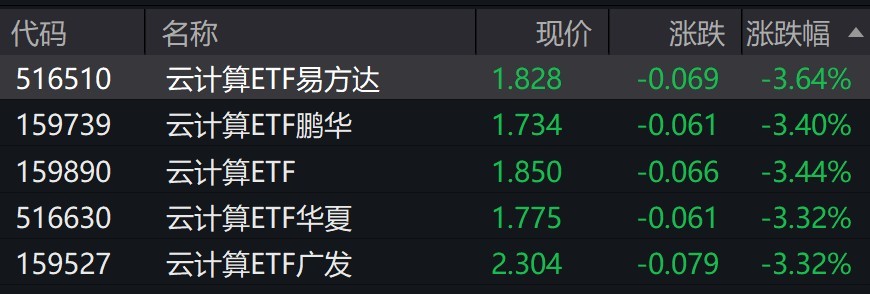
Group 1 - The core viewpoint of the news indicates that cloud computing concept stocks have declined, with companies such as Zhongji Xuchuang, Xinyi Sheng, and Runze Technology dropping over 6% [1] - Cloud computing-related ETFs have also been affected, experiencing a decline of over 3% due to the drop in heavy-weight stocks [1] Group 2 - Specific cloud computing ETFs reported the following price changes: - E Fund Cloud Computing ETF (code: 516510) at 1.828, down by 0.069 or -3.64% - Penghua Cloud Computing ETF (code: 159739) at 1.734, down by 0.061 or -3.40% - Other ETFs also showed similar declines, with the average drop around -3.32% to -3.44% [2] - Analysts believe that cloud computing, as the infrastructure of the AI era, is expected to benefit from the acceleration of AI applications and the commercialization of AI agents. The increasing usage of AI applications is anticipated to enhance cloud resource consumption and the scale effects of cloud vendors, leading to a symbiotic growth pattern between "AI models and cloud computing" [2] - Internet cloud vendors are expected to maintain competitive advantages in three key areas: computing power, models, and applications, with the internet cloud market share likely stabilizing and recovering [2]


美股AI软件股抛售潮传递到A股市场,低费率创业板人工智能ETF华夏(159381)、云计算ETF华夏(516630)开盘走低
Mei Ri Jing Ji Xin Wen· 2026-02-04 02:29
Group 1 - The core viewpoint of the news highlights a significant sell-off in AI software stocks in the US market, which has impacted the A-share market, particularly affecting AI-related ETFs and stocks [1] - The A-share market is experiencing increased volatility with a notable divergence among sectors, but the long-term upward trend remains intact, supported by ongoing policies for the domestic AI industry [2] - The recent sell-off in US tech stocks, especially software companies, has raised concerns about the potential threat of AI technology replacing core business functions [1] Group 2 - The AI sector is currently in a rapid development phase, with expectations for increased capital expenditure in the global computing power sector as domestic support policies continue to be implemented [2] - The Spring market rally is expected to be followed by a consolidation phase, where the focus will be on clarifying industry trends and digesting valuations [2] - The long-term outlook remains positive for sectors such as overseas computing power chains, AI applications, energy storage, robotics, and commercial aerospace [2] Group 3 - The Huaxia AI ETF (159381) tracks an index with nearly 50% weight in CPO, covering domestic software and AI application companies, and has a low fee rate of 0.20% [3] - The Huaxia Communication ETF (515050) has a scale exceeding 8 billion yuan, covering key areas such as optical modules and computing power infrastructure, with a combined weight of over 76% in CPO and CPB concept stocks [3] - The Huaxia Cloud Computing ETF (516630) focuses on domestic AI software and hardware computing power, with a combined weight of 83.7% in computer software, cloud services, and computer equipment, also featuring a low fee rate of 0.20% [3]

国产头部云厂的进展与变化
2026-02-04 02:27
Summary of Conference Call on Alibaba Cloud Company and Industry - **Company**: Alibaba Cloud - **Industry**: Cloud Computing Key Points and Arguments Price Increase Strategy - Alibaba Cloud plans to increase prices due to significant hardware cost increases across all related components, with a potential adjustment of **10% or more** for training and memory types of cloud servers [2][21] - The price increase will vary based on customer tiers, with lower-tier customers facing higher adjustments [2] - The price adjustments are seen as a response to rising demand and costs, with a focus on core components [2][5] Comparison with Competitors - Competitors like AWS and Google are also raising prices, driven by similar cost pressures and demand dynamics [3][4] - AWS's price increase is linked to its machine learning training modules, while Google has raised prices for CDN and network services, indicating a broader trend in the industry [3][4] Customer Feedback and Market Dynamics - Customers are generally resistant to price increases, but large clients accustomed to self-built or hybrid cloud solutions may adapt more easily [8][9] - The price increase is viewed as an opportunity to adjust customer structures and promote more PaaS products within comprehensive solutions [7][9] Revenue and Growth Projections - The revenue target for Alibaba Cloud is projected at **190 billion** for the year, with expectations of maintaining a growth rate of over **30%** in Q4 [63] - Demand appears healthy, with large clients increasing their procurement budgets by approximately **10-15%** compared to the previous year [65][66] Profit Margin Expectations - Profit margins are expected to improve slightly, potentially by **2-3%**, due to price increases and increased customer adoption of comprehensive solutions [30][68] - The impact of rising costs and investments in infrastructure will be a factor in determining overall profitability [30][68] Cost Structure and Adjustments - Storage costs are estimated to account for **20-25%** of overall cloud computing costs, with ongoing adjustments based on market conditions [27] - Price adjustments will likely be communicated to customers about a month in advance, with new contracts reflecting the updated pricing [10][12] Product Development and Agent Strategy - Alibaba Cloud is focusing on enhancing its Agent infrastructure and developing low-cost platforms for Agent applications, with significant investments in PaaS capabilities [40][41] - The introduction of products like the "Qianwen APP" and "Quarter Work" aims to penetrate both consumer and enterprise markets, leveraging AI capabilities [41][42] Competitive Landscape - The competitive landscape for productivity tools and Agents is expected to be driven by model capabilities and operational costs, with a focus on maintaining a competitive edge through technological advancements [53][54] Internal Procurement and Token Consumption - Internal clients, such as Taobao and Qianwen, have a different procurement structure, often receiving better pricing than external clients [72] - Token consumption is projected to be between **230,000 to 250,000**, with a significant portion coming from external clients [69] Conclusion - Alibaba Cloud is navigating a complex landscape of rising costs and competitive pressures while aiming to enhance its product offerings and maintain growth. The strategic price increases and focus on comprehensive solutions are seen as key to sustaining profitability and market position in the cloud computing industry.
火箭加AI,马斯克1.25万亿美元“太空圈地”
阿尔法工场研究院· 2026-02-04 00:08
Core Viewpoint - SpaceX is shifting its strategy from merely connecting Earth to providing computational capabilities through a proposed deployment of 1 million satellites, aiming to create a "Space AI Empire" valued at approximately $1.25 trillion, integrating AI with satellite technology [4][13][50]. Group 1: SpaceX's Strategic Shift - SpaceX has applied to deploy up to 1 million satellites, marking a fundamental shift in its strategy towards creating a computational layer around Earth [4][11]. - The acquisition of xAI is a critical component of this strategy, with SpaceX's valuation at around $1 trillion and xAI at approximately $250 billion [4][13]. - The goal is to establish a massive computational system in low Earth orbit, utilizing solar energy and enabling efficient data processing and AI model training [11][12]. Group 2: Competitive Landscape - The competition for low Earth orbit resources is intensifying, with China also applying for approximately 203,000 satellites, indicating a race for satellite frequency and orbital slots [7][8]. - The International Telecommunication Union mandates that applicants must launch their first satellite within seven years and complete deployment within 14 years, adding pressure to competitors [8][20]. - SpaceX's aggressive strategy is prompting other players, including national and private entities, to respond with their own satellite deployment plans [18][38]. Group 3: Business Model Transformation - SpaceX is transitioning from a telecommunications company charging subscription fees for satellite internet to a cloud computing service provider renting computational power, expanding its market potential from billions to trillions [23][24]. - The new model will allow SpaceX to compete directly with established cloud service providers like Amazon AWS and Microsoft Azure [25][36]. - The anticipated cost efficiency of space-based computational power could disrupt the AI industry, with projections suggesting that space will become the most cost-effective location for generating AI computational power [24][25]. Group 4: Technological and Regulatory Challenges - Significant technical challenges remain, including the development of radiation-resistant chips and high-speed inter-satellite communication systems necessary for effective space-based computing [28][29]. - Regulatory hurdles are also a concern, as SpaceX's previous applications for satellite deployments have faced scrutiny, and the new proposal for 1 million satellites will likely encounter rigorous review [29][30]. - Despite these challenges, advancements in satellite technology and launch capabilities are being pursued to facilitate the ambitious deployment plans [30][34]. Group 5: Implications for Global Technology Landscape - SpaceX's transformation could reshape the global technology landscape, particularly impacting traditional cloud computing giants that rely on terrestrial data centers [36][51]. - The emergence of a space-based computational network could redefine geopolitical dynamics in technology, as it would allow for a more distributed and less geographically constrained AI development environment [36][52]. - The competition for orbital resources is not just a commercial battle but also a strategic one, with implications for national security and technological sovereignty [9][52].

特朗普又搞定了一个大块头?
Xin Lang Cai Jing· 2026-02-03 23:55
Core Viewpoint - The recent trade agreement between the United States and India marks a significant step towards reducing tariffs and enhancing bilateral trade relations, with both countries making concessions to achieve mutual benefits [1][4][23]. Group 1: Trade Agreement Details - The agreement establishes a framework for "reciprocal tariff reduction," where India commits to gradually lowering tariffs on U.S. goods, particularly in agriculture, technology, and energy sectors, within a specified timeline [4][6]. - India will reduce tariffs on U.S. agricultural, technology, and energy products by 30%-50% within six months, while non-tariff barriers will be phased out over one year [4][6]. - The U.S. will eliminate a 25% punitive tariff on Indian goods and reduce "reciprocal tariffs" from 25% to 18%, maintaining tariff exemptions for Indian pharmaceuticals and electronics [4][6]. Group 2: Economic Commitments - India has pledged to purchase over $500 billion worth of U.S. goods over the next five years, focusing on energy, technology, agriculture, and coal [6][7]. - In the energy sector, India will cease importing Russian oil and instead increase purchases of U.S. and Venezuelan oil, with an expected total import of 120 million tons of crude oil and 50 million tons of LNG valued at approximately $250 billion [6][7]. - In technology, India will procure cloud services and related technologies from major U.S. companies, totaling around $150 billion, while gradually lifting market access restrictions for U.S. tech firms [7][8]. Group 3: Strategic Implications - The agreement reflects a shift from punitive measures to conditional reciprocity, addressing U.S. demands for market access while allowing India to retain competitiveness in key industries [6][8]. - The trade deal is seen as a strategic move by the U.S. to counterbalance the recent India-EU trade agreement, which could impact U.S. influence in the Indo-Pacific region [12][15]. - The agreement also serves domestic political interests for the U.S., particularly in agricultural and energy-producing states, as it aims to alleviate economic pressures on voters affected by previous tariffs [16][21].