家电

Search documents
支持服务业企业向生产、制造环节延伸,南京发力“服务型制造”——
Nan Jing Ri Bao· 2026-02-10 02:33
Core Viewpoint - The city of Nanjing is promoting "service-oriented manufacturing" as a key strategy for industrial transformation and high-quality development, emphasizing the integration of manufacturing and modern services [1][7]. Group 1: Policy and Industry Trends - The newly released policy document highlights the need to deepen the integration of manufacturing and services, supporting service enterprises to extend into production and manufacturing [1]. - The "China Manufacturing Beauty" award ceremony showcased innovative industrial design works, reflecting a trend where Nanjing manufacturing is shifting from merely selling products to offering "products + services" [1]. Group 2: Product Innovations - Nanjing Conny's portable charging and discharging integrated gun exemplifies service-oriented manufacturing, designed to be compact and user-friendly, addressing consumer needs for portability [2][3]. - The award-winning shockwave therapy device from Jiangsu Eagle Vision Medical Technology focuses on ergonomic design to reduce operator fatigue, enhancing user experience in medical settings [3]. Group 3: Service Integration - Nanjing Tianjia's TICA Airnext system combines hardware and AI algorithms to provide a comprehensive air purification solution, significantly reducing electricity costs while ensuring comfort [5]. - Bosch's AI home appliance assistant, "Xixi," offers 24/7 support for users, enhancing customer service across the entire purchasing and usage process [6]. Group 4: Strategic Importance - The shift towards service-oriented manufacturing is seen as essential for competitive advantage and a necessary path for urban industrial upgrading [7]. - National policies emphasize service-oriented manufacturing as a critical direction for the transformation and upgrading of the manufacturing sector, aligning with Nanjing's strategy for industrial strength [8]. Group 5: Future Outlook - The integration of manufacturing and services is expected to create significant synergies, enhancing product value and future competitiveness for Nanjing's industries [9].
政策加力,以旧换新激发市场潜能
Sou Hu Cai Jing· 2026-02-10 02:23
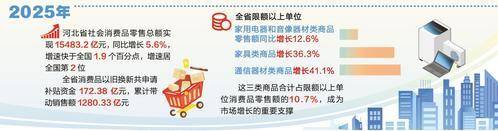
Core Viewpoint - The retail sales of consumer goods in Hebei Province reached 1,548.32 billion yuan in 2025, with a year-on-year growth of 5.6%, outpacing the national average by 1.9 percentage points, ranking second in the country [1] Group 1: Policy Impact - The "old-for-new" policy has significantly boosted consumer spending, with 172.38 billion yuan in subsidies leading to a sales increase of 1280.33 billion yuan [1] - The Hebei Province has expanded its "old-for-new" policy framework, enhancing its coverage and ensuring effective implementation through a combination of short-term and long-term strategies [2] - The introduction of subsidies for digital products such as smartphones, tablets, and smartwatches marks a significant expansion of the policy's scope, supporting consumers in adopting smart technologies [2] Group 2: Consumer Experience - The "Huanxin Life" app in Langfang has facilitated the purchase of electronic products, offering substantial subsidies and creating a new consumer service environment [4] - In Baoding, a streamlined online platform for electric bicycle exchanges has been established, allowing consumers to complete the entire process quickly and efficiently [4] - The "old-for-new" initiative not only stimulates consumption but also drives quality supply, creating a positive cycle of policy stimulation, industrial upgrading, and consumption expansion [4] Group 3: Sales Growth Data - In 2025, retail sales of household appliances and audio-visual equipment increased by 12.6%, furniture by 36.3%, and communication equipment by 41.1%, collectively accounting for 10.7% of retail sales in the province [5]

从“产品出海”到“文化出海”:双轮驱动“广货”全球启新程
2 1 Shi Ji Jing Ji Bao Dao· 2026-02-10 00:25
Core Viewpoint - The "Guangdong Goods Going Global" initiative represents a significant step in Guangdong's strategy to enhance its global trade presence, focusing on high-quality development and industrial upgrades, while leveraging local cultural elements to strengthen brand identity and market reach [2][3][9]. Group 1: Industrial Foundation - Guangdong has maintained its position as China's largest foreign trade province for over 30 years, accounting for about one-quarter of the national total, establishing itself as a core hub for international market engagement [3]. - The province has developed a comprehensive industrial ecosystem, particularly in consumer electronics, new energy vehicles, and home appliances, with thousands of specialized enterprises and leading companies [3][4]. - Shenzhen is highlighted as a global innovation center for consumer electronics, with major companies like Huawei and OPPO driving rapid responses to global demand through efficient industrial clusters [4][5]. Group 2: Challenges and Opportunities - Despite impressive export volumes, Guangdong's "Guangdong Goods" face challenges such as a lack of core technologies and global brand recognition, with many small enterprises relying on OEM models [4][5]. - The need for deeper cultural communication and adaptation to international standards is emphasized, as well as the importance of overcoming barriers related to green trade and geopolitical tensions [4][9]. Group 3: Policy and Platform Support - The Guangdong government has implemented supportive policies, including export tax rebates and R&D subsidies, to alleviate financial and logistical pressures on enterprises [5][10]. - The Canton Fair serves as a national-level platform facilitating global connections, attracting numerous international buyers and enhancing trade opportunities [5][10]. Group 4: Cultural Empowerment - Cultural elements are integrated into the branding and marketing strategies of "Guangdong Goods," enhancing their appeal in international markets [7][8]. - The initiative promotes a dual approach of "product + culture," allowing for a richer narrative that resonates with global consumers, as seen in the marketing of local agricultural products and traditional crafts [7][8]. Group 5: Strategic Collaboration - The dual-wheel drive strategy, combining industrial strength and cultural communication, is essential for overcoming the "big but not strong" dilemma faced by Guangdong's exports [9][10]. - Successful examples from companies like Xiaopeng and DJI illustrate the effectiveness of this collaborative approach in enhancing brand recognition and market penetration [9][10]. Group 6: Future Outlook - The "Guangdong Goods Going Global" initiative marks a new starting point for transforming Guangdong into a global brand leader, emphasizing the importance of maintaining quality and innovation while fostering cultural confidence [11].
十论广货④丨科技遇见人文,造就“新广货”竞争力
2 1 Shi Ji Jing Ji Bao Dao· 2026-02-09 23:12
Core Insights - The "Guangdong Goods Going Global" initiative represents a significant transformation in China's manufacturing industry, showcasing Guangdong's strength as the leading manufacturing province in China [1][4] - Guangdong produces a substantial portion of the world's electronics, with statistics indicating that for every two televisions and three air conditioners produced in China, one is made in Guangdong [1] - The shift from factor-driven to innovation-driven growth in Guangdong's manufacturing sector highlights the evolution of local companies from OEMs to world-class brands [2][4] Group 1: Manufacturing Strength - Guangdong accounts for 70% of consumer drones, 18% of integrated circuits, and 40% of industrial robots in China, emphasizing its manufacturing dominance [1] - The province has developed a comprehensive industrial ecosystem, enabling rapid production response and innovation efficiency through close collaboration among various sectors [1][4] - The "Shunde-Zhongshan home appliance cluster" exemplifies successful industrial collaboration, contributing nearly 30% of the province's home appliance revenue and fostering global brands like Midea and Galanz [1] Group 2: Innovation and Technology - The transition to innovation-driven growth has led to increased R&D investments, resulting in breakthroughs in core technologies and brand development [2] - Guangdong's new generation of products is characterized by a combination of "hardcore technology and cultural aesthetics," redefining its position in the global value chain [2][3] - Companies like DJI have overcome technical barriers, establishing new standards in aerial imaging and enhancing Guangdong's influence in high-value segments [2] Group 3: Cultural Integration and Market Adaptation - Cultural elements from Guangdong, such as traditional arts and games, are being integrated into modern products, shifting the competitive landscape from price to cultural recognition [3] - Digital technologies are transforming production and sales ecosystems, significantly reducing production cycles and enhancing responsiveness to market demands [3] - The "Guangdong Goods Going Global" initiative is leveraging multi-channel marketing strategies, achieving impressive sales figures in both online and offline platforms [3] Group 4: Future Outlook - The initiative is expected to drive a shift from "manufacturing products" to "manufacturing aesthetics," pushing companies to enhance product quality and brand value [4] - The integration of smart manufacturing and cultural elements in regions like Beijiao Town serves as a model for harmonizing industrial and cultural development [4] - Guangdong's evolution from imitation to leadership in manufacturing reflects a broader systemic transformation, offering a replicable model for global manufacturing [4]
科技遇见人文,造就“新广货”竞争力
2 1 Shi Ji Jing Ji Bao Dao· 2026-02-09 21:56
Core Insights - The "Guangdong Goods Going Global" initiative represents a significant transformation in China's manufacturing industry, showcasing Guangdong's strength as the leading manufacturing province in China [1][6] - Guangdong produces a substantial share of various consumer goods, including 50% of the world's mobile phones and 40% of industrial robots in China, highlighting its critical role in global supply chains [1][6] Group 1: Manufacturing Strength - Guangdong accounts for 50% of the world's mobile phones, 70% of consumer drones, and 18% of integrated circuits, emphasizing its manufacturing dominance [1] - The province has developed a comprehensive industrial ecosystem, enabling rapid production response and innovation efficiency through "one-hour supply" and "one-hour industrial circles" [1][6] Group 2: Evolution of the Industry - The "Shunde-Zhongshan Home Appliance Cluster" in Foshan exemplifies the evolution from independent competition to collaborative synergy, contributing nearly 30% of the province's home appliance revenue [3] - Guangdong's manufacturing has shifted from factor-driven to innovation-driven, with increased R&D investments post-2008 financial crisis leading to breakthroughs in core technologies and brand development [3][4] Group 3: Technological and Cultural Integration - The new generation of Guangdong goods is driven by "hardcore technology + cultural aesthetics," redefining global value chains and transitioning from merely meeting demand to creating demand [4][6] - Digital technologies are reshaping production and sales ecosystems, significantly reducing production adjustment cycles and enhancing market responsiveness [5] Group 4: Future Outlook - The "Guangdong Goods Going Global" initiative is expected to focus on transitioning from "manufacturing products" to "manufacturing aesthetics," pushing companies to enhance product quality and brand value [5][6] - The integration of smart manufacturing and cultural elements in places like Beijiao Town serves as a model for harmonizing industrial development with humanistic values [5][6]

北京家电数码以旧换新补贴升级
Bei Jing Shang Bao· 2026-02-09 17:07
Core Viewpoint - The implementation of the "Beijing 2026 Home Appliance Trade-in and Digital Product Purchase Subsidy Implementation Details" aims to enhance the precision and efficiency of subsidy fund allocation for consumers in Beijing, reflecting a shift from "heavy investment" to "performance-oriented" governance in fiscal fund usage [2][6]. Group 1: Subsidy Details - The subsidy applies to six categories of home appliances and four categories of digital and smart products, with a subsidy standard of 15% of the final sales price after discounts, capped at 1,500 yuan for home appliances and 500 yuan for digital products [3][4]. - Consumers must complete real-name authentication via the "Jingtong" mobile app to claim subsidies, with restrictions on the number of qualifications that can be claimed for each category [3][4]. Group 2: Qualification and Usage Rules - The qualification for subsidies has a validity period, with online qualifications expiring at 24:00 on the same day and offline qualifications expiring at 24:00 on the following Sunday, with a limit of four unutilized qualifications leading to ineligibility for future claims in that category [3][4]. - The implementation emphasizes consistency among the applicant, payer, and recipient, requiring verification of product activation and alignment with sales orders [4][5]. Group 3: Policy Implementation and Evolution - The "Two New" policy has entered a quality enhancement phase, transitioning from initial implementation to a focus on precision and efficiency in subsidy distribution [6]. - The central and local governments are collaborating to ensure unified policy direction while adapting to local market conditions, enhancing the convenience of participation through digital platforms [5][6].
以旧换新“新国补”首月成绩单:1613万人次参与,撬动近千亿消费
Sou Hu Cai Jing· 2026-02-09 15:51
Core Insights - The new consumption policy for replacing old products is showing strong effects, with 16.13 million people benefiting and sales reaching 92.56 billion yuan in January 2023 [1] Group 1: Policy Changes - The 2026 policy marks a significant shift in top-level design, granting local governments greater autonomy to implement the policy within a national framework [2] - Local subsidies can now include a wider range of products, such as smart home devices, alongside traditional categories like home appliances and automobiles [2] Group 2: Financial Support - A total of 62.5 billion yuan from the first batch of special long-term bonds has been allocated to support the old-for-new consumption policy, with an additional 93.6 billion yuan for large-scale equipment updates [3] - This funding is expected to drive total investments exceeding 460 billion yuan across approximately 4,500 projects in various sectors [3] Group 3: Market Impact - In January, the policy led to significant sales in key sectors, with 6.813 million home appliances sold, generating 29.71 billion yuan in revenue [4] - The automotive sector saw 335,000 applications for subsidies, resulting in new car sales of 53.77 billion yuan, indicating a clear trend towards consumption upgrades [4] Group 4: Growth in Smart Products - Digital and smart products emerged as key growth areas, with sales of 9.115 million units and revenue of 29.21 billion yuan in January [5] - Smart glasses, newly included in the subsidy program, achieved sales of 7.197 million yuan, highlighting their market potential [6] Group 5: Benefits to Physical Retail - The new policy has significantly boosted offline retail, with nearly 80% of sales occurring through physical channels, leading to a year-on-year sales increase of about 20% [7] - Increased foot traffic in stores has positively impacted surrounding businesses, creating a beneficial commercial cycle [7] Group 6: Environmental Impact - The policy has contributed to a robust recycling system, with 659,000 scrapped vehicles collected in January, a 50.2% increase year-on-year [8] - This initiative supports resource recovery and promotes a green transformation in the industry [8] Group 7: Future Directions - Despite initial successes, challenges remain in ensuring uniform market rules and preventing local protectionism [9] - Streamlining subsidy processes and improving fund disbursement efficiency are crucial for enhancing policy effectiveness [10] Group 8: Long-term Growth Engine - The expansion of the policy to include smart glasses and drones signals a shift towards "tech consumption" and "quality living" [11] - The ongoing implementation of the policy is expected to stimulate market dynamics and transform the large-scale market advantage into high-quality development momentum [11]
海外品牌发布财报,产能外迁是主方向
Orient Securities· 2026-02-09 13:11
Investment Rating - The report maintains a "Positive" outlook for the home appliance industry, indicating an expectation of returns exceeding the market benchmark by over 5% [4]. Core Insights - The report highlights that while the domestic subsidy effect is slowing, the "Two New" policy is expected to stimulate greater consumer potential in the home appliance sector. Leading white goods companies with higher energy efficiency product ratios and mature trade-in management processes are likely to benefit more significantly [3]. - The long-term strategy of expanding overseas production capacity remains a key focus, with companies that diversify their production locations expected to outperform. The report anticipates a valuation shift in 2026, particularly for companies like Roborock Technology and Lek Electric [3]. - The report emphasizes the importance of stable performance in core businesses and the potential for developing secondary growth avenues, with companies like Anfu Technology being highlighted for their strong cash flow and manufacturing capabilities [3]. Summary by Sections Domestic Market Insights - The report notes that the domestic market is experiencing a marginal slowdown in subsidy effects, but ongoing policy optimizations are expected to unlock more consumer potential [3]. Overseas Expansion - Companies are increasingly focusing on overseas production as a long-term strategy, with expectations of accelerated price increases starting in Q1 2026 due to tariff impacts and rising raw material costs [3]. Investment Recommendations - Key investment themes include: - Leading companies with higher operational efficiency and stable dividend yields are recommended for conservative allocation, with Haier Smart Home and Hisense Visual Technology as notable mentions [3]. - Companies with a focus on international expansion are expected to see valuation shifts, with Roborock Technology and Lek Electric recommended for buying [3]. - Companies with stable core business performance and potential for secondary growth avenues, such as Anfu Technology, are also highlighted [3].




流动性&交易拥挤度&投资者温度计周报:公募基金仍为当前市场主要增量资金-20260209
Huachuang Securities· 2026-02-09 11:46
Group 1: Liquidity - The issuance of equity public funds has decreased to 8.42 billion units, down from 32.79 billion units, but remains at a historically high level[8] - The net outflow of margin financing has increased to 52.1 billion CNY, marking a 2% percentile over the past three years[13] - The net inflow of southbound funds has surged to 49.83 billion CNY, reaching a historical high and representing a 96% percentile[40] Group 2: Trading Congestion - The trading heat for the non-ferrous metals sector has increased by 17 percentage points to 49%[46] - The trading heat for the liquor sector has risen by 10 percentage points to 15%[53] - The trading heat for the communication sector has also increased by 10 percentage points to 47%[66] - The trading heat for the home appliance sector has decreased by 12 percentage points to 47%[53] Group 3: Investor Sentiment - The net inflow of retail investor funds in the A-share market was 162.44 billion CNY, a decrease of 54.4 billion CNY from the previous value, placing it at the 87.4% percentile over the past five years[2] - The Shanghai Composite Index fell by 2.5% on February 2, leading to an increase in self-media search interest in A-shares[73]
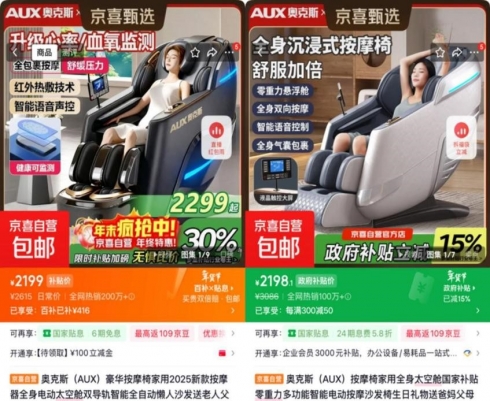
养生医美产品成刚需“新年货” 京东京喜自营按摩美容仪器卖出20万单
Zhong Jin Zai Xian· 2026-02-09 10:17
Group 1: Consumer Trends and Market Dynamics - The upcoming Spring Festival holiday in China will provide a 9-day break, leading to increased consumer focus on self-care and personal spending rather than social obligations [1] - The market for health and wellness products, particularly among the 30-55 age group, is seeing significant growth, with a notable increase in demand for massage and beauty devices [1] - The sales of massage health products have surged, with order volumes exceeding 100,000, a 200% year-on-year increase, and transaction values growing 1,100% [1] Group 2: Industry Growth and Projections - The massage chair industry in China is expected to grow to approximately 8.745 billion yuan by 2025, driven by rising health awareness and accelerated consumption upgrades [2] - The global market for massage equipment is projected to reach 39.068 billion yuan by 2032, with a compound annual growth rate of 4.77% [2] Group 3: Company Strategies and Innovations - Senyuan Trading, a company established in 2022, has leveraged the 京喜自营 platform to streamline operations, focusing on production while outsourcing marketing and logistics [2][3] - The company anticipates a significant increase in transaction volume, projecting over 5 million yuan in 2025 and 30 million yuan in 2026 [3] - The introduction of high-quality, competitively priced massage chairs has transformed them from luxury items to household necessities, with products priced just above 2,000 yuan [5] Group 4: Product Offerings and Consumer Engagement - The collaboration between 京喜 and various manufacturers has led to the development of innovative personal care products, including facial steamers and slimming devices, targeting women over 40 [8][10] - The successful launch of products like the "nano facial steamer" and "lazy face slimming device" has resulted in significant sales, with some items reaching transaction values of 500,000 yuan [12] - The focus on high-quality, affordable personal care products is reshaping consumer perceptions, making them more accessible to a broader audience [8][10]