
银行理财

Search documents
A股火爆“烧”银行理财,多只产品止盈
Hua Xia Shi Bao· 2025-08-13 13:49
Core Viewpoint - Multiple banks have recently announced early profit-taking on their "target profit" products due to achieving target yield rates, indicating a trend of declining yields in these financial products [2][3][4]. Group 1: Product Performance and Trends - Since July, several banks, including Bank of China Wealth Management and China Merchants Bank Wealth Management, have reported early profit-taking on multiple "target profit" products, with at least 31 products successfully achieving profit-taking this year [2][3]. - The average annualized yield for these products that have achieved profit-taking is around 3%, which is a decline compared to previous years where yields often reached 4% to 5% [2][6][7]. - The majority of the "target profit" products that have achieved profit-taking this year are linked to indices, gold, and U.S. Treasury bonds [2][4]. Group 2: Product Characteristics and Market Dynamics - "Target profit" products are designed to terminate and pay out once a pre-set yield target is reached, which can help investors avoid losses from market volatility [4][6]. - The issuance of "target profit" products has surged since their introduction, with the number of products increasing from 2 in 2022 to an expected 294 in 2024, and the total fundraising amount rising significantly [4][5]. - Currently, 214 "target profit" products are active, with a majority having a duration of 1-3 years [5]. Group 3: Market Conditions and Yield Expectations - The decline in yield rates for "target profit" products is attributed to lower risk-free interest rates and a general decrease in asset yields, leading to a downward trend in performance benchmarks [2][6][7]. - Recent profit-taking targets for these products have also been adjusted downward, reflecting the overall market conditions, with some products seeing target yields drop from 3.25% to 2.40% [7].


固收理财近一周收益回暖,两家理财公司试水线下打新
2 1 Shi Ji Jing Ji Bao Dao· 2025-08-13 10:30
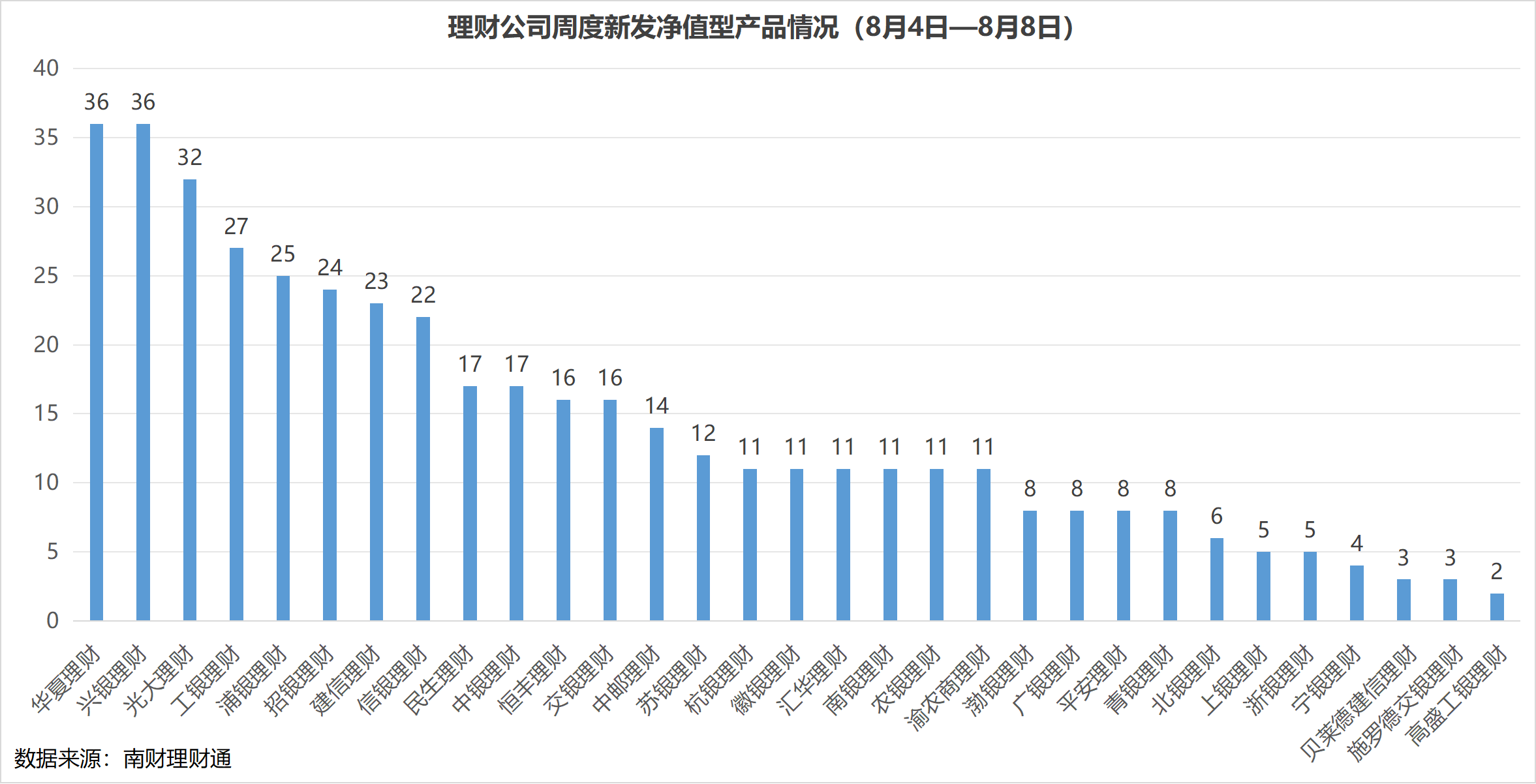
Market Overview - The bond market continued to experience fluctuations, with an overall balanced and loose liquidity environment. The weighted average of DR007 on August 8 was 1.425%, and the yield on 10-year government bonds closed at 1.69% [2] - In the stock market, major A-share indices saw gains, with the CSI 1000, Shanghai Composite Index, and CSI 500 increasing by 2.51%, 2.11%, and 1.78% respectively. The defense, non-ferrous metals, and machinery equipment sectors led the weekly gains [2] Product Performance - The number of underperforming products remains low, with 25,003 public wealth management products in existence as of August 10, 2025, of which 179 had a cumulative net value below 1, resulting in a comprehensive underperformance rate of 0.72% for bank wealth management [3] - The underperformance rates for equity and mixed wealth management products were 38.1% and 5.46%, respectively, while fixed income public wealth management products had an underperformance rate of 0.4% [3] - Fixed income products with 1-2 year and over 3-year terms had slightly higher underperformance rates of 0.9% and 1.12%, respectively [3] New Product Issuance - A total of 443 wealth management products were issued by 31 wealth management companies from August 4 to August 8, with joint-stock banks leading in issuance. Xinyin Wealth Management and Huaxia Wealth Management each issued 36 products, while Everbright Wealth Management issued 32 [4] - The newly issued products were primarily R2 (medium-low risk), closed-end net value type, and fixed income public products, with only 8 mixed products issued, accounting for 1.8%, and no new equity products [6] Pricing Trends - Pricing for different term products varied, with 1-2 year and 2-3 year products seeing an increase, particularly the 2-3 year products which rose by 24 basis points to 2.86%. In contrast, products with terms of 1-3 months, 3-6 months, 6-12 months, and over 3 years saw declines, with the latter dropping by 36 basis points to 2.15% [6] Yield Performance - Fixed income wealth management products showed signs of recovery, with an average net value growth rate of 0.0718% over the past week. Mixed and equity products had average net value growth rates of 0.091% and 0.8529%, respectively. The highest average net value growth rate among fixed income products was for those with over 3-year terms at 0.1075% [8] - Cash public wealth management products in RMB, USD, and AUD had annualized yields of 1.364%, 3.91%, and 2.83%, respectively [12] - The proportion of negative yield products decreased, with 5.19% of RMB public wealth management products yielding negative returns over the past week. The negative yield proportions for fixed income, mixed, and equity products were 4.02%, 23.3%, and 33.33%, respectively [12] Industry Trends - Since the opening of offline IPO participation for wealth management subsidiaries in March, only two companies, Everbright Wealth Management and Ningyin Wealth Management, have attempted this, with Ningyin participating more frequently [14] - In the first half of 2025, 36 out of 69 city commercial banks without wealth management subsidiaries saw their asset management business scale decrease by over 10%, indicating ongoing pressure for rectification [15] - Conversely, some city commercial bank wealth management subsidiaries experienced significant growth, with Ningyin Wealth Management's scale exceeding 600 billion RMB, reflecting a growth of over 25% compared to the beginning of the year [16]
周报 | 固收理财近一周收益回暖,两家理财公司试水线下打新
2 1 Shi Ji Jing Ji Bao Dao· 2025-08-13 10:29
Market Overview - The bond market continued to experience fluctuations, with an overall balanced and loose funding environment. The weighted average of DR007 on August 8 was 1.425%, and the yield on 10-year government bonds closed at 1.69% [2] - In the stock market, major A-share indices saw gains, with the CSI 1000 index, Shanghai Composite Index, and CSI 500 index increasing by 2.51%, 2.11%, and 1.78% respectively. The defense, non-ferrous metals, and machinery equipment sectors led the weekly gains [2] Product Performance - The number of underperforming products remains low, with 25,003 public wealth management products in existence as of August 10, 2025, of which 179 had a cumulative net value below 1, resulting in a comprehensive break-even rate of 0.72%. The break-even rates for equity and mixed wealth management products were 38.1% and 5.46%, respectively, while fixed income products had a break-even rate of 0.4% [3] - Fixed income products with 1-2 year and over 3-year terms had slightly higher break-even rates of 0.9% and 1.12%, respectively [3] New Product Issuance - A total of 443 wealth management products were issued by 31 companies from August 4 to August 8, 2025. The leading issuers were Xinyin Wealth Management and Huaxia Wealth Management, each issuing 36 products, followed by Everbright Wealth Management with 32 products [4] - The newly issued products were primarily R2 (medium-low risk), closed-end net value type, and fixed income public products, with only 8 mixed products (1.8% of total) and no new equity products [4] - Pricing varied across different term products, with 2-3 year products seeing a rise of 24 basis points to 2.86%. In contrast, longer-term products (over 3 years) saw a decline of 36 basis points to 2.15% [4] Yield Performance - Fixed income wealth management products showed signs of recovery, with an average net value growth rate of 0.0718% over the past week. Mixed and equity products had average growth rates of 0.091% and 0.8529%, respectively. The highest growth rate among fixed income products was for those with over 3-year terms at 0.1075% [5] - The average annualized yield for cash public wealth management products in RMB, USD, and AUD was 1.364%, 3.91%, and 2.83%, respectively [5] - The proportion of negative yield products decreased, with 5.19% of RMB public wealth management products reporting negative returns over the past week. The negative yield rates for fixed income, mixed, and equity products were 4.02%, 23.3%, and 33.33%, respectively [5] Industry Trends - Since the opening of offline IPO participation for wealth management subsidiaries in March, only two companies, Everbright Wealth Management and Ningyin Wealth Management, have attempted this, with Ningyin being more active [6][7] - In the first half of 2025, 36 out of 69 city commercial banks without wealth management subsidiaries saw their asset management business scale decrease by over 10%, reflecting ongoing regulatory pressure [8] - Conversely, some city commercial bank wealth management subsidiaries experienced significant growth, with Ningyin Wealth Management's scale exceeding 600 billion RMB, marking a growth of over 25% compared to the beginning of the year [9]
7月报:理财产品发行量环比增超25%,破净率升至1.23%
2 1 Shi Ji Jing Ji Bao Dao· 2025-08-13 09:18
Core Insights - The report highlights the performance and trends in the bank wealth management industry for July 2025, focusing on product performance, issuance, and maturity rates. Group 1: Performance Analysis - The net value decline rate for wealth management products in July was 1.23%, an increase of 0.69 percentage points from June. The fixed income product decline rate rose to 0.97%, while the mixed product decline rate decreased to 4.69%. The equity product decline rate increased from 15.65% at the end of June to 17.81% [3][7][5]. - Equity wealth management products showed the best performance in the first seven months of the year, with an average net value growth rate of 7.35%. Mixed products had a growth rate of 2.29%, while fixed income products only achieved a growth rate of 1.45%. However, fixed income products maintained a lower average maximum drawdown of 0.2%, compared to 9.41% for equity products [4][36]. Group 2: Issuance Trends - In July 2025, wealth management companies accelerated the issuance of new products, with a total of 2,272 products launched, representing a more than 25% increase from June's 1,795 products. The average fundraising scale reached 3.12 billion yuan, up over 20% from June's 2.55 billion yuan [9][13]. - The top three companies by issuance volume were Huaxia Wealth Management, Xinyin Wealth Management, and Xingyin Wealth Management, with 188, 160, and 158 products issued, respectively [9][11]. Group 3: Maturity and Compliance Rates - A total of 956 closed-end RMB wealth management products matured in July, a decrease of 12.21% from the previous month. The overall performance benchmark compliance rate for matured products was 84.76%, with fixed income products achieving a compliance rate of 55.15%, up 6.9 percentage points from June [19][22]. - Among the matured products, 423 fixed income products met the performance benchmark, representing 55.15% compliance, while mixed products had a compliance rate of 30.77% [22][26]. Group 4: Product Structure and Risk Levels - In July, public offerings accounted for 93.7% of the total new products issued, with fixed income products dominating at over 95% of the total issuance. The risk level distribution showed that 77% of new products were rated as medium-low risk [11][32]. - The average annualized yield for closed-end fixed income products that matured in July was 2.9%, while mixed products yielded an average of 2.31% [24][28].

ESG投资周报:ESG指数有所回暖,绿色债券稳步发行-20250813
GUOTAI HAITONG SECURITIES· 2025-08-13 05:27
Market Performance - The A-share market showed overall recovery from August 4 to August 8, 2025, with the CSI 300 index rising by 1.23%, the ESG 300 index increasing by 1.06%, and the STAR Market ESG index up by 1.31%[5] - The average daily trading volume across the A-share market was approximately 1.70 trillion RMB, indicating a contraction in liquidity compared to previous periods[5] ESG Fund Issuance - No new ESG fund products were issued in August 2025; however, a total of 241 ESG public funds were launched in the past year, with a total issuance of 171.41 billion units[7] - As of August 10, 2025, there are 910 existing ESG fund products, with the largest share being ESG strategy funds at 50.33% of the total net asset value of 1,022.06 billion RMB[9] Fund Performance - The top-performing fund for the week of August 4 to August 10, 2025, was the Zhonghai Charm Yangtze River fund, achieving a weekly return of 6.14% and a year-to-date return of 29.00%[10] - Other notable funds included the Robeco Resource Selection and Yongying New Energy Selection, which also performed well during the same period[10] Green Bond Issuance - A total of 23 new green bonds were issued in the interbank and exchange markets from August 4 to August 8, 2025, with a planned issuance scale of approximately 18.64 billion RMB[13] - In August 2025, 33 ESG bonds were issued, amounting to 15.3 billion RMB, with a total of 1,034 ESG bonds issued in the past year, totaling 1,227.7 billion RMB[13] Green Bond Trading - The total trading volume of ESG green bonds for the week was 562.58 billion RMB, with the interbank market accounting for 77.45% of the total trading volume[17] - Repo transactions dominated the trading methods, comprising 94.96% of the total trading volume, while cash transactions accounted for only 0.07%[20] Bank Wealth Management Products - In August 2025, 30 ESG bank wealth management products were issued, with a total of 1,049 existing products in the market as of August 10, 2025[18] - The largest share of existing products is pure ESG-themed products, which account for 54.53% of the total[18] Risk Factors - Potential risks include insufficient policy support for ESG initiatives, lack of standardized data reporting, and lower-than-expected product issuance scales[19]
15家银行理财子公司年内调研上市公司374次 招银理财最积极
Xin Hua Wang· 2025-08-12 06:29
Core Viewpoint - The frequency of bank wealth management subsidiaries conducting research on listed companies has significantly increased in 2023, indicating a growing interest in equity investments and the development of their investment research capabilities [1][2]. Group 1: Research Activity - As of March 22, 2023, 15 bank wealth management subsidiaries conducted research on listed companies 374 times, compared to over 350 times in the first half of the previous year [1]. - Notable participants in the research include Zhuhai Wealth Management with 100 research instances covering 86 companies, followed by Xingyin Wealth Management with 93 instances [1]. - Other subsidiaries such as Huizhou Wealth Management, Hangzhou Wealth Management, and Ningbo Wealth Management also showed significant research activity, each exceeding 10 instances [1]. Group 2: Investment Preferences - The sectors attracting attention from bank wealth management subsidiaries include electronics, biotechnology, industrial machinery, healthcare, food, and regional banks, reflecting a broader interest in various industries [1][2]. - The preference for these sectors is attributed to their status as market hotspots or sectors with improved fundamentals, thus presenting high allocation value [2]. Group 3: Regulatory Environment - The China Banking and Insurance Regulatory Commission (CBIRC) has emphasized increasing the issuance of equity asset management products, supporting wealth management companies in enhancing their equity product ratios [2][3]. - Over the past two years, regulatory encouragement has led to a gradual maturation of bank wealth management subsidiaries in equity investments, although the number of equity products remains limited [2]. Group 4: Market Dynamics - In a declining interest rate environment, high-quality debt assets are becoming scarce, prompting bank wealth management subsidiaries to increase their allocation to equity assets to enhance product yield [3]. - The need for these subsidiaries to strengthen their compliance and risk management systems is highlighted, as they navigate the shift towards more equity-focused products while considering their clients' lower risk appetites [3].
四家首批试点机构养老理财已在十城开售 部分产品提前结募
Xin Hua Wang· 2025-08-12 06:29
Core Viewpoint - The expansion of the pilot program for pension financial products has led to the launch of new products by multiple banks, indicating strong consumer interest and demand in the market [1][2][4]. Group 1: Product Launch and Demand - The pilot program for pension financial products has expanded from "four regions and four institutions" to "ten regions and ten institutions," with new products being launched [1]. - ICBC Wealth Management launched its pension financial product on March 24, while CCB Wealth Management released its product on March 23, both in ten pilot cities [1][2]. - The new pension financial products have gained popularity among consumers due to their low risk and high performance benchmarks, leading to rapid sales and early closure of fundraising periods [1][2]. Group 2: Product Characteristics - The newly issued pension financial products do not differ significantly from the initial batch in terms of investment amount, product duration, performance benchmarks, investment targets, investment strategies, risk ratings, and fee structures [3]. - The products are designed to be stable and secure, with a focus on long-term investment and risk management [5]. Group 3: Market Impact and Future Outlook - Experts suggest that short-term market fluctuations will have minimal impact on pension financial products, as many have a five-year lock-up period [4][5]. - The demand for pension financial products is expected to grow due to the changing demographic structure and the relatively underdeveloped third pillar of pension in China [5]. - Future pension financial products are likely to maintain long durations, high performance benchmarks, and low-risk strategies, while also incorporating mechanisms for liquidity [5].
净利润大幅增长 多家银行理财公司“成绩单”抢眼
Xin Hua Wang· 2025-08-12 06:28
Core Insights - Several bank wealth management companies reported significant profit growth in 2021, with net profit increases exceeding 30% for seven companies [1] - Some companies, such as Xinyin Wealth Management and Everbright Wealth Management, saw their net profits more than double, with increases of 108.62% and 181.21% respectively [2] - The total assets and management scale of these wealth management companies have surged, largely due to the transfer of products from their parent banks [3] Financial Performance - As of the end of 2021, Zhaoyin Wealth Management reported total assets of 12.097 billion yuan and net profit of 3.203 billion yuan, with a 13.47% increase in managed wealth products [2] - Jiao Yin Wealth Management achieved a net profit of 1.155 billion yuan, a 73.61% year-on-year increase, with total assets reaching 10.206 billion yuan [2] - Xinyin Wealth Management's net profit reached 2.806 billion yuan, ranking second among disclosed bank wealth management companies [2] Product Management Scale - Jiao Yin Wealth Management's product balance reached 1.224 trillion yuan, a 129.43% increase from the previous year [3] - The total scale of non-insurance wealth management products for Xinyin Wealth Management and its parent bank was 1.403 trillion yuan, with 90% of products meeting new asset management regulations [3] Market Trends - A significant number of wealth management products have experienced net value fluctuations, with 16% of products showing negative total returns this year [4] - Several banks have begun purchasing their own wealth management products to reassure clients and boost confidence [4] - The proportion of equity products remains low, with fixed income products continuing to dominate the market [5][6] Product Composition - As of the end of 2021, fixed income products accounted for 92.34% of the total wealth management product balance, while equity products made up only 0.28% [6]
自购频频 银行理财提升市场信心
Xin Hua Wang· 2025-08-12 06:28
中国证券报记者4月1日独家获悉,又有股份制银行理财公司准备自购旗下产品,金额有望创业内新 高。此外,有股份制银行理财公司已于日前自购旗下产品,金额超过4亿元。 除自购外,银行理财公司近期还通过调整产品结构、降低产品费率、加大投资者教育等途径来安抚投资 者。 3月21日,招商银行常务副行长兼董秘王良在业绩发布会上表示,招银理财正在研究措施,结合银行客 户低风险的配置,加大债券等固收类产品投入;对权益类产品的配置,加大投研能力,延长理财产品封 闭期;加强资产配置,减少回撤。 2月23日,信银理财发布公告称,决定对信银理财全盈象固收稳健年开8号理财产品固定管理费、销售服 务费、托管费给予阶段性优惠,2022年3月3日至2023年3月31日期间,固定管理费和销售服务费均由 0.30%/年下调至0.05%/年,托管费由0.05%/年下调至0.03%/年。 不久前,工银理财、建信理财、交银理财等多家银行理财公司纷纷以"致投资者的一封信"等形式,向投 资者详细说明近期理财产品净值波动的原因。多家银行理财公司还通过漫画、小视频、情景剧等通俗易 懂的形式,向投资者讲解理财产品的运作机制、产品类型、收益来源、估值方法等,丰富投资 ...
监管层明确壮大公募基金管理人队伍 银行理财子公司有期待有纠结
Xin Hua Wang· 2025-08-12 06:26
Core Viewpoint - The regulatory authorities are actively promoting the entry of bank wealth management subsidiaries into the public fund management sector, indicating a strong expectation for the high-quality development of these subsidiaries [1][2][3]. Regulatory Changes - The China Securities Regulatory Commission (CSRC) has released new rules allowing bank wealth management subsidiaries to apply for public fund licenses, which is a continuation of previous policies aimed at enhancing the quality of the public fund industry [2][3]. - The new regulations are seen as a way to gradually push bank wealth management towards public offerings, benefiting more ordinary investors and providing competitive opportunities against other asset management institutions [3][5]. Market Impact - The acquisition of public fund licenses is expected to significantly enhance the equity investment capabilities of bank wealth management subsidiaries, allowing them to offer a wider range of investment products [2][3]. - With the trend of declining interest rates, these subsidiaries are looking to improve their equity investment capabilities to better serve their clients and expand their market presence [3][5]. Collaboration and Competition - There is a potential for collaboration between bank wealth management subsidiaries and existing fund companies, with the expectation that cooperative effects will outweigh competitive tensions [6][7]. - The risk-return characteristics of products from bank wealth management subsidiaries and public funds differ significantly, which may lead to a complementary relationship rather than direct competition [6][7]. Future Outlook - If bank wealth management subsidiaries obtain public fund licenses, they are likely to focus initially on cash management and fixed-income products, which could complement traditional public funds that emphasize equity investments [7]. - The long-term success of these subsidiaries will depend on their ability to leverage their existing banking relationships and sales channels to meet diverse client financing needs while navigating the competitive landscape [7].