云计算

Search documents
人工智能成焦点,科技公司走钢丝,美国因素下韩股遭遇“过山车”
Huan Qiu Shi Bao· 2026-02-03 22:57
Core Insights - The South Korean stock market experienced significant volatility, with a sharp decline followed by a strong rebound, highlighting the precarious nature of AI-related investments in a high-valuation environment [1][2] Market Performance - On February 2, the KOSPI index fell by 5.3%, marking the largest drop since April of the previous year, with major chip stocks like Samsung Electronics and SK Hynix dropping over 6% [2] - The KOSPI index rebounded over 3% the following day, returning to above 5000 points, driven by a swift return of bargain hunters after the previous day's sell-off [2] - The volatility was influenced by external factors, including a downturn in the U.S. market and concerns over the Federal Reserve's interest rate policies [2] AI Investment Sentiment - The sustainability of AI investments has been identified as a key factor affecting the South Korean market, which has seen a surge in total market capitalization to over $3.3 trillion, partly due to strong demand for storage chips [4] - Recent discussions around AI spending plans have raised concerns about potential bubbles, particularly following disappointing earnings from Microsoft, which reignited debates about the viability of AI investments [4][5] Corporate Dynamics - OpenAI's dissatisfaction with NVIDIA's latest AI chips has complicated the relationship between the two companies, posing a significant challenge to NVIDIA's dominance in the AI sector [5] - Microsoft reported a robust earnings report but faced a 10% drop in stock price due to stagnation in its Azure cloud business and projected capital expenditures exceeding $100 billion [5] - Major tech companies, including Microsoft, Meta, Alphabet, and Amazon, are expected to collectively spend over $500 billion this year, primarily on AI infrastructure, necessitating precise execution to meet market expectations [6]


欧盟委员称:欧洲必须掌控关键技术
Xin Lang Cai Jing· 2026-02-03 16:57
Core Viewpoint - The European Union (EU) emphasizes the need to control key technologies that support its economic development, reflecting a growing call within the EU to reduce dependence on American tech giants [1][3]. Group 1: Digital Sovereignty - Europe is increasingly focusing on digital sovereignty, which posits that reliance on American companies, particularly those adopting isolationist policies, poses threats to its economy and security [1][3]. - EU Financial Services Commissioner Maria-Louise Albrecht stated that Europe must take control of the technologies that drive its economic growth [1][3]. Group 2: Risks and Dependencies - A senior official from the Dutch central bank highlighted the growing risks of cyberattacks faced by European financial institutions due to their dependence on a few cloud service providers [1][3]. - Steven Maijoor, Chair of the Dutch Central Bank's supervisory board, noted that the vulnerabilities in the European financial system have become more pronounced in recent years, citing cybersecurity risks and the deterioration of some long-term global partnerships [1][3]. Group 3: Regulatory Landscape - The European Central Bank previously identified geopolitical tensions and technological disruptions as core risks facing the European banking sector [2][4]. - EU regulatory authorities have classified 19 tech companies, including Amazon Web Services, Google Cloud, and Microsoft, as critical third-party cloud computing service providers for the EU financial industry [2][4].
算力租赁概念午后再度拉升
Di Yi Cai Jing· 2026-02-03 13:09
Group 1 - Tianwei Video Technology saw a sharp increase, hitting the daily limit up [1] - Shunwang Technology rose over 15% [1] - Wangsu Science and Technology increased by more than 13% [1] - Other companies such as Nanling Technology, Qingyun Technology, Yuke Technology, Litong Electronics, and Guanghuan Xunwang also experienced significant gains [1]






3760 万、大兴区(政务云及云监管)大单
Xin Lang Cai Jing· 2026-02-03 12:46
2026 年 2 月 2 日,北京市大兴区政务服务和数据管理局(本级)发布《2026 年 1 至 12 月政府采购意向》。 单位名称:北京市大兴区政务服务和数据管理局(本级) 项目名称:大兴区政务云及云监管服务 采购目标:采购 2026 年大兴区政务云服务 预算金额:3760 万元 预计采购时间:2026 - 04 云头条声明:如以上内容有误或侵犯到你公司、机构、单位或个人权益,请联系我们说明理由,我们会配合,无条件删除处理。 2026 年 2 月 2 日,北京市大兴区政务服务和数据管理局(本级)发布《2026 年 1 至 12 月政府采购意向》。 单位名称:北京市大兴区政务服务和数据管理局(本级) 项目名称:大兴区政务云及云监管服务 采购目标:采购 2026 年大兴区政务云服务 预算金额:3760 万元 预计采购时间:2026 - 04 云头条声明:如以上内容有误或侵犯到你公司、机构、单位或个人权益,请联系我们说明理由,我们会配合,无条件删除处理。 ...


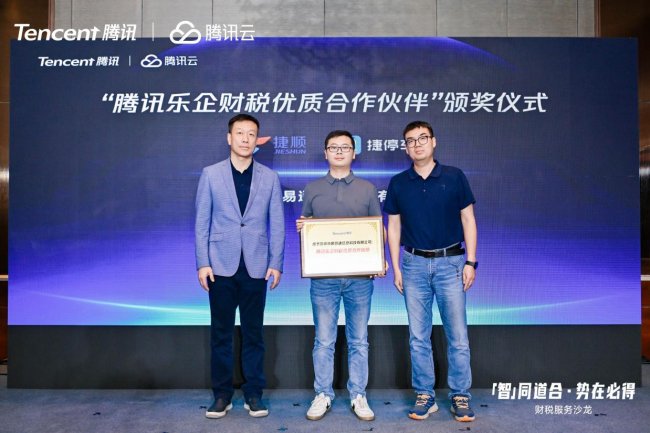
从生态共建到标杆认可:捷停车荣膺腾讯乐企财税优质合作伙伴
Sou Hu Wang· 2026-02-03 10:33
Core Insights - The article highlights the recognition of Shenzhen Shunyi Tong Information Technology Co., Ltd. (referred to as "Jie Parking") as a "Quality Partner" by Tencent for its excellence in digital financial and tax services in the parking sector [1] Group 1: Partnership and Recognition - Jie Parking was awarded the title of "Quality Partner" at the 2026 Tencent Cloud Partner Conference, indicating significant progress in connecting ecosystem partners and empowering the parking industry [5] - The collaboration with Tencent has allowed Jie Parking to integrate advanced technology and ecological resources, enhancing value for both B-end parking lots and C-end car owners [5] Group 2: Technological Advancements - Jie Parking, in partnership with Tencent Cloud and WeChat Pay, is actively promoting the digital transformation of tax services in response to the State Administration of Taxation's announcement [3] - The "payment upon invoicing" feature has been successfully implemented, allowing car owners to receive electronic invoices automatically after payment without additional steps, providing a seamless experience [3] Group 3: Future Outlook - Jie Parking aims to deepen strategic collaboration with top ecosystem partners like Tencent, exploring the value of electronic invoice data in refined operations and business intelligence analysis [5] - The company is committed to expanding its successful solutions to broader regions and scenarios, contributing to the prosperity of the smart travel ecosystem and the mission of making parking more convenient [5]

印度拟为数据中心落地“开绿灯”,外企有望享20年税收减免
Xin Lang Cai Jing· 2026-02-03 10:29
在全球加速建设人工智能(AI)基础设施的竞赛中,印度抛出重磅政策:若外国云服务商将面向海外 市场销售的云服务工作负载部署在印度数据中心运行,其相关收入可享受零税率优惠直至2047年。 这一举措旨在吸引全球AI算力投资,不过电力短缺和水资源压力正对印度的数据中心扩张构成现实威 胁。 AI基础设施总投资约900亿 2月伊始,印度财政部长尼尔玛拉·西塔拉曼就在年度联邦预算中宣布了这一提案。 根据安排,凡是在印度数据中心运行,但向印度境外销售的云服务,其收入将享受"税收假期"——实际 上等同于免税。她在议会表示,面向印度国内客户的云服务销售,必须通过在印度注册成立的本地经销 商进行,并在印度境内依法纳税。预算同时提出,对为关联海外实体提供服务的印度数据中心运营商, 适用15%的"成本加成安全港"税收规则。 与美国和中国相比,印度缺乏强大的本土基础模型、芯片制造能力和大型数据中心容量,因此,印度在 全球人工智能竞赛中的作用迄今为止还很有限。拟议的税收优惠极其可能带来投资:这一政策出台,正 值包括亚马逊、谷歌和微软在内的美国云计算巨头在全球范围内加速扩建数据中心,以应对人工智能工 作负载激增之际。 印度正逐步成为新的投资 ...
马斯克大动作!8.7万亿,史上最大独角兽诞生,中国如何突围?
创业邦· 2026-02-03 09:09
Core Viewpoint - SpaceX is shifting its strategy from merely connecting the Earth to providing computational resources through a proposed deployment of up to 1 million satellites, aiming to create a "space AI empire" valued at approximately $1.25 trillion [2][10]. Group 1: SpaceX's Strategic Shift - SpaceX has applied to deploy up to 1 million satellites, marking a fundamental shift in its strategy towards providing computational capabilities rather than just connectivity [2][5]. - The acquisition of xAI for stock is a critical component of this strategy, with SpaceX's valuation at around $1 trillion and xAI at approximately $250 billion [2][10]. - The goal is to establish a massive computational system in low Earth orbit, utilizing solar energy and enabling AI model inference and machine learning [8][10]. Group 2: Competitive Landscape - The near-Earth orbit is expected to become crowded, with China also applying for approximately 203,000 satellite frequency resources [4][5]. - The competition is driven by a "first come, first served" rule, with significant implications for information sovereignty and resource allocation in space [5][6]. - Other players, including China's satellite network initiatives, are responding to SpaceX's aggressive strategy by submitting their own satellite constellation plans [13][32]. Group 3: Business Model Transformation - SpaceX is transitioning from a telecommunications company charging for internet access to a cloud computing company renting out computational power, expanding its market potential from billions to trillions [18][19]. - The new model will allow SpaceX to compete directly with established cloud service providers like Amazon AWS and Microsoft Azure [20][29]. - The anticipated cost advantages of space-based computation could disrupt the AI industry by providing a more efficient means of generating AI computational power [20][21]. Group 4: Technological and Regulatory Challenges - The deployment of 1 million satellites poses significant technical challenges, including the need for advanced radiation-resistant chips and high-speed inter-satellite communication [23][24]. - Regulatory approval for such a large-scale deployment is uncertain, as previous applications for smaller satellite constellations have faced delays [24]. - The successful execution of this plan will require overcoming substantial logistical and operational hurdles, including the need for a high frequency of launches [24][25]. Group 5: Implications for Global Technology Landscape - SpaceX's strategy could redefine the competitive landscape for cloud computing and AI, creating a globally distributed computational network that is not bound by geographical or political constraints [29][30]. - This shift may lead to a new type of technology giant that controls orbital computational resources, fundamentally altering the infrastructure of the digital economy [46]. - The race for orbital resources is not just a commercial competition but also a strategic maneuver in the context of global power dynamics [6][29].
2亿美元结盟,Snowflake×OpenAI深度合作:AI没有独霸者,只有生态赢家
3 6 Ke· 2026-02-03 08:09
Core Insights - A strategic partnership worth $200 million has been established between Snowflake and OpenAI, marking a significant shift in the enterprise AI landscape from "model competition" to "ecosystem collaboration" [1][3]. Group 1: Partnership Details - The collaboration allows Snowflake's 12,600 customers to access OpenAI models across major cloud platforms, breaking down platform barriers and significantly lowering the technical threshold for AI implementation [4]. - The partnership focuses on developing AI agents that automate complex data processes, enabling enterprises to create custom AI solutions that enhance operational efficiency [5]. - Both companies will leverage each other's strengths, with OpenAI using Snowflake as a core data platform for model experimentation, while Snowflake integrates OpenAI's capabilities to enhance its offerings in generative AI [6]. Group 2: Market Dynamics - Snowflake's recent $200 million deals with both Anthropic and OpenAI reflect a strategic "model neutrality," allowing clients to choose from multiple AI models based on their specific needs [9][10]. - The enterprise AI market is shifting towards a "multi-model" approach, with companies increasingly opting for a diverse range of models to suit different business scenarios, rather than relying on a single provider [15][16]. - Research indicates that 81% of enterprises are now using three or more AI models simultaneously, highlighting a trend towards pragmatic selection of tools tailored to specific tasks [16]. Group 3: OpenAI's Strategy - OpenAI's collaboration with Snowflake is part of a broader strategy to secure entry points into enterprise markets by partnering with infrastructure leaders, thus facilitating the large-scale deployment of its models [12][14]. - The partnership provides OpenAI with access to a vast customer base and addresses compliance challenges, which are critical for AI adoption in regulated industries [13]. - OpenAI's approach emphasizes the importance of integrating its models into existing workflows, rather than merely providing standalone tools, enhancing its competitive position in the enterprise AI market [14]. Group 4: Future Outlook - The evolving landscape suggests that no single company will dominate the enterprise AI market, with a multi-faceted ecosystem emerging where collaboration and complementary strengths are key [15][18]. - The partnership between Snowflake and OpenAI exemplifies the shift towards a more rational market, where the focus is on integrating technology with real-world applications to drive efficiency and digital transformation [18].


决定AI交易的大问题:OpenAI本轮能融多少钱?
Hua Er Jie Jian Wen· 2026-02-03 07:22
Core Viewpoint - The ability of OpenAI to secure a new round of substantial financing is not only critical for its survival but also a key variable influencing the trading logic of the entire AI sector [1]. Group 1: Financing Uncertainty - OpenAI's upcoming financing round is expected to be between $150 billion and $170 billion, which could significantly impact the AI complex's growth trajectory [2]. - The actual progress of the financing is uncertain, as Nvidia's internal doubts have stalled a previously disclosed intention to invest up to $100 billion in OpenAI [3]. - OpenAI is seeking additional support from other major investors, including SoftBank, which is negotiating a further investment of up to $30 billion after previously investing $22.5 billion [3]. Group 2: Oracle's Exposure - Oracle's relationship with OpenAI is seen as a reflection of the cyclical nature of AI investments, with Oracle facing significant risk exposure due to a $300 billion contract with OpenAI [4]. - Oracle's remaining performance obligations (RPO) amount to $523 billion, which is approximately nine times its revenue over the past four quarters, including the $300 billion contract with OpenAI [4]. - The accounting treatment of this contract is under scrutiny, as it can only be included in RPO if management deems collection "probable" [4]. Group 3: Oracle's Financial Strategy - Oracle is planning to issue up to $20 billion in common stock as part of a broader strategy to raise $45 billion to $50 billion for expanding its cloud infrastructure [6]. - This move, while potentially dilutive to shareholders, is viewed as a prudent measure given the uncertainties surrounding AI transactions [6]. - Oracle's credit rating is currently under negative watch by S&P and Moody's, with some of its debt trading near junk bond levels, indicating rising market concerns [6].

华为云CEO周跃峰:聚产业之力,让医疗AI创新更简单
Sou Hu Cai Jing· 2026-02-03 06:56
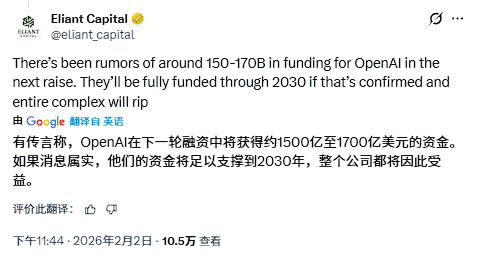
Core Insights - The core focus of the event was the launch of Huawei's "Industry AI Dream Factory" with a dedicated section for smart healthcare, aimed at addressing the imbalance of medical resources through technological innovation [1][5]. Group 1: Key Initiatives - Huawei announced three major initiatives during the conference. The first is to establish a digital foundation for smart healthcare, leveraging its secure products and solutions, along with experience from over 1,800 tertiary hospitals, to build a sustainable data infrastructure [5]. - The second initiative is the official launch of the smart healthcare section within the "Industry AI Dream Factory," which integrates advanced clinical experiences from leading medical institutions like Ruijin Hospital with Huawei's expertise in ICT, cloud, and AI [5]. - The third initiative focuses on ecosystem development, emphasizing that the widespread adoption of medical AI requires collaboration among various stakeholders, including medical institutions, tech companies, and developers [6]. Group 2: Vision and Future Outlook - Huawei's comprehensive approach, from solidifying the digital foundation to creating the smart healthcare section and building an ecosystem, outlines a complete logic for empowering medical AI [6]. - The vision for the future includes a gradual realization of the blueprint for widespread medical AI, contributing to the overarching goal of "Healthy China" [6].