工业

Search documents
三季度经济增速为何放缓?四季度经济前景如何?
Hua Xia Shi Bao· 2025-10-23 14:18
Economic Growth Analysis - The overall economic growth in China has shown a slowdown in Q3, with GDP growth at 4.8%, down from 5.2% in the first three quarters [2][3] - Nominal GDP growth for Q3 was 3.7%, with a cumulative nominal GDP growth of 4.1% for the first three quarters [2] Factors Contributing to Slowdown - The slowdown is attributed to three main factors: reduced policy effectiveness, diminishing internal growth momentum, and weak consumer sentiment [3][4] - Macro policies were strong in the first half of the year but weakened in the second half, impacting economic support [3] - The effectiveness of certain policies, such as the consumption upgrade program, has diminished, leading to a decline in retail sales growth [3][4] Positive Economic Indicators - Despite the slowdown, there are positive signs such as improved industrial capacity utilization and a rebound in PPI [6][7] - Exports have remained resilient, with a year-on-year growth of 8.3% in September, supported by diversified markets and competitive products [7] - High-tech industries have shown robust growth, with a 9.6% increase in value-added output in the first three quarters [8] September Economic Performance - In September, exports and industrial production saw a rebound, while consumer spending and investment continued to decline [9][10] - Retail sales and catering revenue showed a decrease, indicating ongoing consumer weakness [10] - Real estate sales saw a slight improvement due to new policies in major cities, but overall investment remains low [11] Future Economic Outlook - The economic performance in Q4 will depend on the introduction of new policies, with potential GDP growth forecasted between 4.6% and 4.8% [13] - The need for new incremental policies is emphasized to support economic recovery [14][19] Recommendations for Policy Adjustments - Suggestions include increasing fiscal support, optimizing debt management, and enhancing monetary policy to stimulate economic activity [15][16] - A comprehensive approach to real estate policy is recommended to stabilize the market and support local governments [17][18] - Consumer-oriented policies should be developed to boost spending and improve income distribution [19][20]


希腊第三季度经济稳健增长
Shang Wu Bu Wang Zhan· 2025-10-23 13:30
Core Insights - The Bank of Greece forecasts a 2.2% year-on-year GDP growth and a 0.7% quarter-on-quarter growth for Q3 2025 [1] - Economic sentiment index rose to 109.6 points from July to August, indicating high confidence in the industrial and construction sectors [1] - The unemployment rate dropped to 8% in July, marking the lowest level in 17 years [1] Economic Contributions - The tourism sector continues to significantly contribute to economic growth, with international passenger traffic at Athens airport increasing by 7% year-on-year in July and August [1] - Loans to the private sector increased by 10.5% year-on-year in July, with consumer loans growing by 6.2% [1] - VAT revenue rose by 9.8% year-on-year, while public investment and recovery fund expenditures maintained a double-digit growth of 15% [1]
前三季度云南省GDP超2.35万亿元 同比增长4.3%
Zhong Guo Xin Wen Wang· 2025-10-23 09:03
Core Insights - Yunnan Province's GDP for the first three quarters exceeded 2.35 trillion yuan, with a year-on-year growth of 4.3% [1] Economic Performance - The primary industry achieved a value-added of 250.37 billion yuan, growing by 2.8% [1] - The secondary industry recorded a value-added of 739.54 billion yuan, with a growth of 3.2% [1] - The tertiary industry saw a value-added of 1.36 trillion yuan, increasing by 5.2% [1] Agricultural Sector - The total output value of agriculture, forestry, animal husbandry, and fishery reached 427.62 billion yuan, with a year-on-year growth of 2.9% [1] - Summer grain and early rice production totaled 2.79 million tons, an increase of 0.63% compared to the previous year [1] Industrial Sector - The value-added of large-scale industries grew by 4.3%, accelerating by 0.3 percentage points compared to January-August [1] - Mining industry value-added increased by 9.7%, manufacturing by 4.6%, and electricity, heat, gas, and water production and supply by 1.9% [1] Consumer and Investment Trends - The total retail sales of consumer goods reached 953.77 billion yuan, with a year-on-year growth of 3.8% [2] - Fixed asset investment grew by 0.2%, with the primary industry investment increasing by 4.6%, while the secondary and tertiary industries saw declines of 0.1% and 0.3%, respectively [2] - The operating income of large-scale service industries was 251.23 billion yuan, growing by 6.4% [2] Income and Price Trends - The per capita disposable income of residents was 22,543 yuan, with a nominal growth of 5.0% and a real growth of 5.1% after adjusting for price factors [2] - The Consumer Price Index (CPI) saw a year-on-year decline of 0.1% [2] Policy and Future Outlook - The Yunnan Provincial Statistics Bureau indicated that economic indicators are stable and improving, supported by policies aimed at stabilizing the economy and employment [2] - Challenges such as insufficient effective demand and difficulties in transitioning between old and new growth drivers remain [2] - Future efforts will focus on enhancing the business environment, promoting economic growth, and developing a modern industrial system unique to Yunnan [2]
2024年北京科研经费投入3278.4亿元,同比增长11.2%
Bei Jing Shang Bao· 2025-10-23 05:48
Group 1 - In 2024, Beijing's R&D expenditure reached 327.84 billion yuan, an increase of 33.13 billion yuan, representing an 11.2% growth compared to the previous year [1] - The R&D expenditure intensity in Beijing is 6.58%, which is an increase of 0.36 percentage points from the previous year [1] - Basic research funding amounted to 50.32 billion yuan, growing by 6.5%, while applied research funding was 86.71 billion yuan, increasing by 15.2% [1] Group 2 - Enterprises contributed 155.86 billion yuan to R&D, marking a 13.5% increase year-on-year, while government research institutions contributed 121.91 billion yuan, up by 9.1% [1] - Higher education institutions allocated 41.07 billion yuan for R&D, reflecting a 12.2% growth, whereas other entities saw a slight decline of 0.9% to 9.00 billion yuan [1] - The proportions of R&D funding from enterprises, government research institutions, and higher education institutions were 47.5%, 37.2%, and 12.5%, respectively [1] Group 3 - The information transmission, software, and IT services sector invested 73.50 billion yuan in R&D, a 6.3% increase, with software and IT services alone accounting for 56.68 billion yuan, growing by 30.2% [2] - R&D expenditure from large-scale industrial enterprises reached 46.77 billion yuan, up by 6.1%, with high-tech manufacturing contributing 29.73 billion yuan [2] - Eight major industry categories within large-scale industrial enterprises maintained R&D expenditures exceeding 1 billion yuan, accounting for 90.4% of the total R&D expenditure in this sector [2]
大盘震荡,红利护航,红利国企ETF(510720)涨0.8%,关注上市以来连续分红18个月,可月月评估分红的红利国企ETF
Sou Hu Cai Jing· 2025-10-23 02:56
Group 1 - The current preference for dividend stocks is driven by risk aversion due to external shocks and the diminishing catalysts following a high technology slope [1] - A phase of "rebalancing" is expected in October, where dividend and cyclical stocks may temporarily outperform, but the core drivers of the bull market remain intact [1] - The market is characterized by a "conflicted period," with risk-averse logic dominating under low trading volumes, while stable dividend stocks, gold, and optimized high-dividend varieties provide defensive value as core holdings [1] Group 2 - The Dividend State-Owned Enterprise ETF (510720) tracks the State-Owned Dividend Index (000151), which selects stocks with high dividend characteristics, stable dividends, and good liquidity, primarily covering traditional sectors like finance, energy, and industry [1] - The Dividend State-Owned Enterprise ETF (510720) has achieved monthly dividends since its listing, marking 18 consecutive months of dividends, making it one of the few ETFs to consistently distribute dividends since inception [1] - Investors are encouraged to consider buying on dips, as the ETF's dividend distribution is noteworthy [1]
“三券齐发”:广东为工业AI落地破题
Nan Fang Du Shi Bao· 2025-10-22 13:10
Core Viewpoint - The Guangdong Provincial Government has launched the "Action Plan for High-Quality Development of Manufacturing Empowered by Artificial Intelligence (2025-2027)", which includes 16 measures aimed at enhancing industrial AI applications and support systems, with a focus on financial incentives such as "model vouchers", "computing power vouchers", and "training vouchers" to facilitate the adoption of AI in manufacturing [1][2][3] Group 1: Key Measures - The plan emphasizes four main areas: strengthening key supply of industrial AI, promoting large-scale application of industrial AI, building a supporting system for industrial AI, and optimizing the guarantee of industrial AI elements [1] - The "model vouchers" aim to lower the application threshold for small and medium-sized enterprises (SMEs) by subsidizing the purchase of industrial model services, thus reducing upfront investment risks [2][3] - The "computing power vouchers" are designed to alleviate resource bottlenecks by providing subsidies that enable SMEs to access high-end computing resources, which are typically monopolized by large corporations [2][3] - The "training vouchers" focus on supporting customized training for enterprises, helping them adapt general models to their specific production processes, thereby enhancing the effectiveness of AI applications [3] Group 2: Challenges and Solutions - The large-scale application of industrial AI faces significant challenges, particularly for SMEs, including high computing costs, scarcity of quality models, and high technical barriers due to a lack of specialized talent [2] - The "three vouchers" initiative is a problem-oriented approach that leverages fiscal tools to address these challenges and facilitate the intelligent transformation of enterprises [2][3] - The initiative represents a mechanism innovation that not only provides short-term subsidies but also encourages social capital investment in the industrial AI sector, promoting a diversified investment landscape [3] Group 3: Broader Implications - The integration of AI into manufacturing is seen as a necessary step for Guangdong to transition from a manufacturing province to a manufacturing powerhouse, with expectations that more enterprises will adopt AI technologies [3] - The "three vouchers" model offers a potential replicable experience for intelligent transformation in manufacturing across the country, moving away from traditional blanket subsidy approaches to more precise resource allocation [3]

华民股份:第三季度净利润亏损2183.02万元,同比增长57.13%
Xin Lang Cai Jing· 2025-10-22 12:14
Core Insights - The company reported a third-quarter revenue of 260 million, a year-on-year decrease of 10.02% [1] - The net profit for the third quarter was a loss of 21.83 million, an increase in loss of 57.13% year-on-year [1] - For the first three quarters, the revenue totaled 716 million, reflecting a year-on-year decline of 5.71% [1] - The net profit for the first three quarters was a loss of 103 million, which is a 45.22% increase in loss year-on-year [1]

*ST华微:10月22日召开董事会会议
Mei Ri Jing Ji Xin Wen· 2025-10-22 09:26
Group 1 - The core point of the article is the announcement by *ST Huamei regarding its board meeting and the composition of its revenue for the year 2024 [1] - The board meeting was held on October 22, 2025, to discuss the appointment of a vice president and financial officer [1] - The revenue composition for *ST Huamei in 2024 is as follows: industrial sector 96.92%, commercial sector 1.74%, service sector 0.82%, and other businesses 0.52% [1] Group 2 - As of the report, *ST Huamei has a market capitalization of 8.2 billion yuan [1]

多氟多:10月22日召开董事会会议
Mei Ri Jing Ji Xin Wen· 2025-10-22 08:47
Company Overview - Duofuduo (SZ 002407) announced on October 22 that its 33rd meeting of the 7th board of directors was held, where the "2025 Q3 Report" and other documents were reviewed [1] - As of the report date, Duofuduo's market capitalization is 23.4 billion yuan [1] Financial Performance - For the first half of 2025, Duofuduo's revenue composition was as follows: industrial sector accounted for 79.42%, while other sectors contributed 20.58% [1]

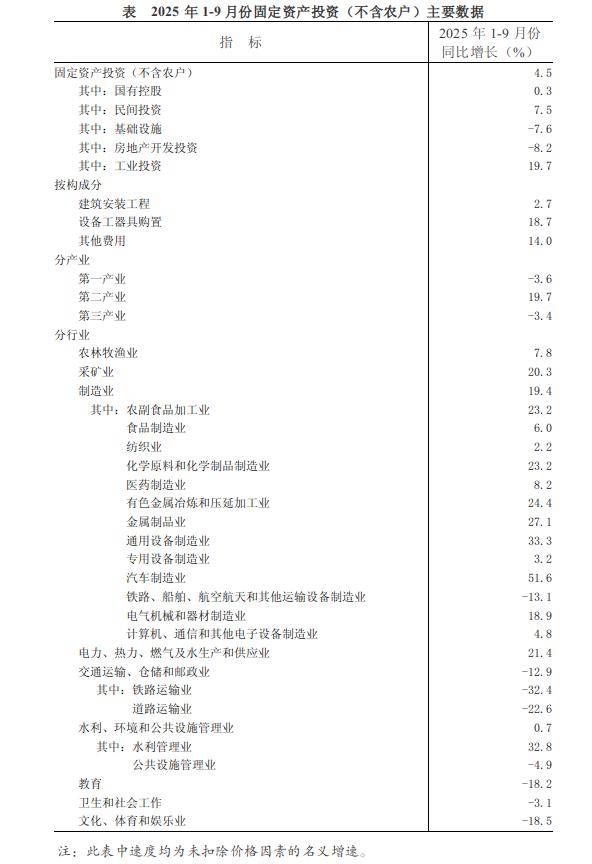
2025年1-9月份河南固定资产投资增长4.5%
Sou Hu Cai Jing· 2025-10-22 07:50
Core Insights - In the first nine months of 2025, fixed asset investment in Henan (excluding rural households) increased by 4.5% year-on-year, with private investment growing by 7.5% [1] Investment by Industry - Investment in the primary industry decreased by 3.6%, while the secondary industry saw a significant increase of 19.7%. The tertiary industry experienced a decline of 3.4% [2] - Industrial investment rose by 19.7%, infrastructure investment (excluding electricity, heat, gas, and water production and supply) fell by 7.6%, and real estate development investment decreased by 8.2% [2] - Within industrial investment, mining investment grew by 20.3%, manufacturing investment increased by 19.4%, and investment in electricity, heat, gas, and water production and supply rose by 21.4% [2] - In infrastructure investment, water, environment, and public facility management (excluding land management) saw a slight increase of 0.4%, while transportation and postal services investment dropped by 19.5%, and information transmission investment fell by 2.6% [2] Investment by Ownership - Central project investment increased by 2.4% year-on-year, while local project investment grew by 4.6% [3]