
进出口贸易

Search documents
前10个月东莞市外贸进出口总值达1.3万亿元
Zhong Guo Xin Wen Wang· 2025-11-25 07:15
Core Insights - Dongguan's foreign trade import and export value reached 1.3 trillion yuan in the first ten months of the year, maintaining the fifth position in China and second in Guangdong province, with a year-on-year growth of 14.7% [1] Trade Performance - Exports totaled 792.62 billion yuan, reflecting a year-on-year increase of 8.7%, while imports amounted to 505.62 billion yuan, showing a significant growth of 25.4% [1] - In October alone, the total trade value was 133.22 billion yuan, marking a year-on-year growth of 17.3%, and this growth has been sustained for 19 consecutive months [1] Business Activity - The number of foreign trade enterprises in Dongguan reached 26,000, an increase of 12.2% year-on-year [1] - Among these, 21,000 were private enterprises, contributing 813.79 billion yuan to the import and export value, which is a year-on-year increase of 21.6% and accounts for 62.7% of Dongguan's total trade [1] Regional Trade Growth - Trade with ASEAN, Hong Kong, Taiwan, and the EU saw year-on-year increases of 38.2%, 13.1%, 23.6%, and 10% respectively, collectively accounting for 53.4% of total trade [1] - Trade with countries involved in the Belt and Road Initiative grew by 23.9% year-on-year [1] Product Competitiveness - Dongguan's exports of electromechanical products reached 556.19 billion yuan, with a year-on-year growth of 12.4%, contributing 8.4 percentage points to the overall export growth [1] - Specific product categories such as electronic components, electrical equipment, computers and their parts, and mobile phones experienced year-on-year growth rates of 12.8%, 21.2%, 20.1%, and 10.3% respectively [1]
泰国进口激增 录得2023年以来最大贸易逆差
Sou Hu Cai Jing· 2025-11-25 04:59
Core Insights - Despite early procurement by U.S. buyers to avoid higher tariffs, Thailand's trade dynamics are showing weakness, leading to the largest trade deficit since early 2023 [1] Trade Data Summary - In October, Thailand's imports surged by 16.3% year-on-year, exceeding the most optimistic expectations from surveys [1] - During the same period, exports only grew by 5.7%, falling short of expectations [1] - The trade balance shifted from a surplus of $1.3 billion in September to a deficit of $3.4 billion in October [1] Economic Implications - The widening trade deficit highlights internal imbalances in Thailand's trade-driven economy [1] - A persistent trade deficit may hinder overall economic growth and exert pressure on the Thai baht exchange rate [1] - The current situation complicates monetary policy formulation as the Bank of Thailand and Prime Minister Anutin Charnvirakul strive to support the fragile economic recovery [1]
中方刚赢关税战,第二个打败美国的国家出现,特朗普准备好B计划
Sou Hu Cai Jing· 2025-11-25 04:12
Core Viewpoint - The article discusses the ongoing trade conflicts initiated by the U.S. under Trump, highlighting how countries like China and Brazil have successfully resisted U.S. tariffs and maintained their interests, with Brazil emerging as a significant player in this context [1][3][10]. Group 1: U.S. Tariff Wars - The U.S. appears strong but is likened to a "paper tiger," as countries that confront U.S. tariffs, like China and Brazil, can protect their interests and gain respect [1][3]. - Brazil, facing a 50% tariff from the U.S., has shown resilience similar to China, with President Lula willing to negotiate and stand firm against Trump's threats [3][5]. - Trump's attempts to interfere in Brazil's internal politics during tariff negotiations highlight his arrogance and ultimately lead to his failure in the trade conflict with Brazil [5][8]. Group 2: Economic Implications - Brazil's trade dynamics reveal that it has a trade deficit with the U.S., with only 13% of its total foreign trade reliant on U.S. exports, indicating that the U.S. is not Brazil's most critical market [5][7]. - The rising prices of goods in the U.S., such as beef and coffee, due to tariffs have forced Trump to make concessions to Brazil, reflecting the domestic economic pressures he faces [7][10]. - Trump's tariff exemptions for certain Brazilian products are seen as a sign of defeat in the trade war, as he aims to alleviate domestic price increases [7][10]. Group 3: Legal Challenges and Future Plans - Trump's trade policies have faced multiple legal challenges domestically, with the Supreme Court questioning his authority to impose tariffs, which could lead to significant setbacks for his administration [11][13]. - The potential loss in court could prompt Trump to implement a backup plan to continue imposing tariffs, indicating his determination to maintain a trade war strategy despite legal obstacles [10][13]. - The article suggests that Trump's reliance on tariffs is driven by the financial benefits they provide to the U.S. government, despite the negative impact on American consumers and businesses [11][13].


上海海关“高效办成一件事”应用项目升级
Zhong Guo Xin Wen Wang· 2025-11-24 09:45
Core Insights - Shanghai Customs has launched upgraded application projects to enhance efficiency in customs processes, focusing on online services and reducing bureaucratic steps [1][2] Group 1: New Application Projects - The new projects include proactive online application disclosure, convenient customs clearance for imported cosmetic samples, and the "first release economy" for consumer goods [1][2][3] - The proactive online application aims to standardize processes, making it easier for companies to submit necessary documentation and receive real-time feedback from customs officials [2] - The imported cosmetic samples project provides integrated services by reducing inspection burdens and establishing a risk grading mechanism based on company credit and sample risk [2] Group 2: Impact and Efficiency - Since the initial launch of the "efficient completion of one matter" projects, over 20,000 companies have adopted blockchain digital identity (DID) certification, resulting in a more than 100% increase in efficiency for online customs declaration cancellations [1] - The departure tax refund measures have been successfully replicated in other cities, with Shanghai accounting for over 50% of the national total in departure tax verification [1] - The one-stop mail handling platform has saved nearly 250,000 yuan in customs costs for approximately 9,000 recipients [1] Group 3: Policy Support - The new policies, including the announcement from the General Administration of Customs, further relax penalties and optimize conditions for voluntary disclosure, enhancing the benefits of the proactive disclosure policy [2] - The "first release economy" model, which combines a whitelist and differentiated qualification assessment, aims to promote Shanghai as a premier destination for product launches [3]
粤苏沪浙进出口总量占全国近六成 油气进口大增助推云南登外贸增速榜首
Mei Ri Jing Ji Xin Wen· 2025-11-24 04:09
Core Insights - China's GDP growth rate for the first half of the year reached 6.8%, with significant developments in foreign trade [1] - The total import and export volume reached 14.12 trillion yuan, with Guangdong, Jiangsu, Shanghai, and Zhejiang accounting for 58.3% of the total [1] - Despite leading in total trade volume, Guangdong experienced negative export growth, while Yunnan topped the national trade growth rankings [1][4] Trade Volume and Growth - The eastern coastal provinces dominate in trade volume, with Guangdong, Jiangsu, Shanghai, and Zhejiang being consistent members of the "trillion club" [2][3] - In the first half of 2018, Guangdong's total import and export value was 32,396.5 billion yuan, a year-on-year increase of 2.7%, maintaining its position as the largest [3] - Jiangsu led in growth rate among these provinces with a 9.4% increase, while Guangdong's export growth was negative at -3.3% [3] Western Provinces' Performance - Western provinces showed remarkable trade growth, with Yunnan, Shaanxi, and Gansu leading the national rankings [4][6] - Yunnan's import and export total reached 935.92 billion yuan, with a staggering year-on-year growth of 56% [6] - The disparity in growth rates among western provinces is notable, with Yunnan's growth significantly outpacing that of other regions like Qinghai, which saw a decline [4][6] Factors Influencing Trade Dynamics - The shift of production capacity from Guangdong to provinces like Sichuan and Chongqing is contributing to Guangdong's declining export growth [3][5] - The influx of outward-oriented enterprises into the central and western regions has led to explosive growth in trade, particularly in provinces like Sichuan [5] - Yunnan's impressive growth is attributed to increased imports of oil and gas through the China-Myanmar pipeline and the export of highland specialty agricultural products [6][7] Trade with Belt and Road Countries - Trade with ASEAN and other Belt and Road countries has shown significant growth, indicating the increasing importance of these regions in China's foreign trade [7][8] - The recent adjustments in foreign investment regulations may further influence trade dynamics, particularly in energy sectors [8]

芷江晟霜商贸有限公司成立 注册资本1万人民币
Sou Hu Cai Jing· 2025-11-22 07:15
Core Points - A new company named Zhijiang Shengshuang Trading Co., Ltd. has been established with a registered capital of 10,000 RMB [1] - The legal representative of the company is Xiong Chongchun [1] - The business scope includes general projects such as import and export of goods, technology import and export, import and export agency, internet sales (excluding goods requiring permits), wholesale of electronic components, sales of electronic products, wholesale of hardware products, research and development of household appliances, sales of daily necessities, and sales of paper products (excluding projects that require legal approval) [1] Company Overview - The company is involved in various sectors including import and export, technology, and e-commerce [1] - It has a diverse range of business activities, indicating a broad market approach [1] - The establishment of this company may reflect growing opportunities in the trading and e-commerce sectors in the region [1]
多边贸易体系面临更大重塑压力
Sou Hu Cai Jing· 2025-11-21 23:27
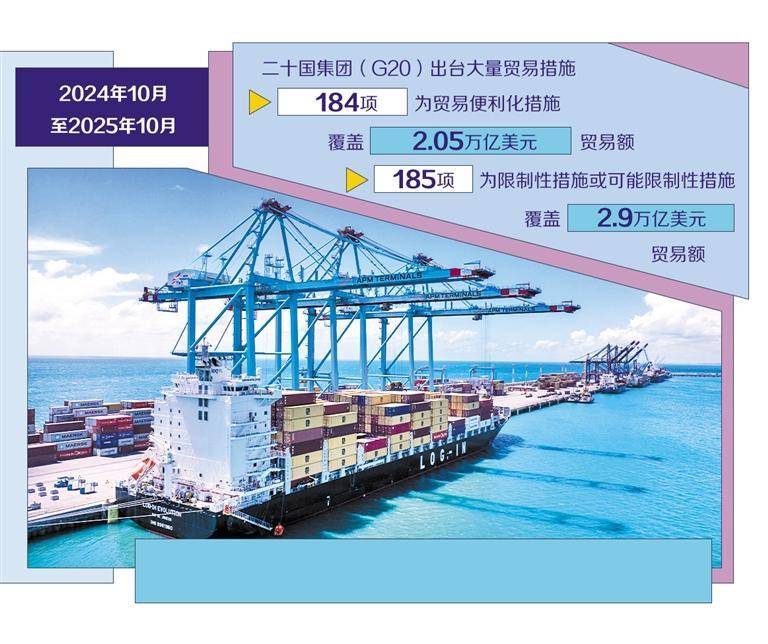
Core Insights - The World Trade Organization's report indicates a significant shift in G20 trade policies, with restrictive measures now covering more trade volume than facilitative measures for the first time since the monitoring mechanism was established in 2009, highlighting a rise in global protectionism [2][6] Group 1: Trade Facilitation Measures - The G20 implemented 184 trade facilitation measures, the second highest in the last decade, covering a trade volume of $2.05 trillion, nearly doubling from the previous period's $1.07 trillion [3] - Of these measures, 129 were related to import facilitation, accounting for 70% and covering $1.90 trillion, which is 10.5% of the G20's total imports [3] - These measures included lowering or eliminating import and export tariffs, simplifying customs procedures, and easing export quantity restrictions, which helped alleviate supply chain pressures and reduce production costs [3] Group 2: Trade Restrictive Measures - The report recorded 185 trade restrictive or potentially restrictive measures, the highest since monitoring began in 2009, covering a trade volume of $2.90 trillion, significantly up from $829 billion in the previous period [4] - Import-restricted trade volume reached $2.60 trillion, more than four times the previous period's $598 billion, with $2.35 trillion directly related to U.S. trade policies since early 2025 [4][5] - Types of restrictive measures included increased import tariffs, complex customs procedures, and setting limits on import and export quantities, with the U.S. being a key driver of these measures [5] Group 3: Long-term Structural Adjustments in Global Trade Policy - The increase in restrictive measures over facilitative ones reflects a systemic spillover effect rather than isolated actions by individual countries, indicating a gradual rise in protectionist policies [6] - The surge in restrictive trade policies and the spread of protectionism are contributing to greater uncertainty in global trade, with potential risks including supply chain reconfiguration and increased regionalism [6] - The growing number of restrictive measures is prompting countries to strengthen regional trade arrangements and bilateral agreements, which may further undermine the relative position of multilateralism in global trade [6]
辽宁成大:股东广西鑫益及其一致行动人累计质押公司股份约1.32亿股
Mei Ri Jing Ji Xin Wen· 2025-11-21 11:14
Group 1 - The core point of the article is that Liaoning Chengda has received a notice from its shareholder Guangxi Xinyi regarding the extension of the pledge buyback of some shares, with significant implications for the company's shareholding structure and financial health [1] - As of November 21, 2025, Guangxi Xinyi and its concerted parties hold approximately 158 million shares of Liaoning Chengda, accounting for 10.32% of the total share capital, with a total of 132 million shares pledged, representing 83.46% of their holdings and 8.61% of the total share capital [1] - For the first half of 2025, Liaoning Chengda's revenue composition is as follows: import and export trade accounts for 86.64%, biopharmaceuticals for 13.22%, and other sectors for 0.14% [1] Group 2 - The current market capitalization of Liaoning Chengda is 18.1 billion yuan [1]

深圳前十月进出口总值3.74万亿
Nan Fang Ri Bao Wang Luo Ban· 2025-11-21 08:11
Core Insights - Shenzhen maintained its position as the leading city in mainland China for import and export activities, achieving a total trade volume of 3.74 trillion yuan in the first ten months of the year [1] - The export value reached 2.27 trillion yuan, while imports totaled 1.47 trillion yuan, reflecting a year-on-year growth of 6.8% [1] Trade Composition - General trade accounted for 53.5% of Shenzhen's total import and export value, with a volume of 2 trillion yuan [1] - Bonded logistics contributed 26.8% with 1 trillion yuan, growing by 7.2%, while processing trade made up 19.2% with 717.9 billion yuan, increasing by 2.4% [1] Enterprise Participation - Private enterprises dominated the trade landscape, accounting for 68.5% of the total import and export value, amounting to 2.56 trillion yuan [1] - Foreign-invested enterprises showed a robust growth of 13.2%, reaching 1.05 trillion yuan, which constituted 28% of the total [1] - State-owned enterprises had a trade volume of 125.88 billion yuan [1] Trade Partners - The top ten trading partners represented nearly 80% of Shenzhen's total trade, with a combined import and export value of 2.93 trillion yuan, growing by 1.9% [1] - Key trading partners included Hong Kong, Taiwan, the EU, South Korea, Japan, and Mexico, with respective trade values of 638.33 billion yuan, 411.46 billion yuan, 384.13 billion yuan, 201.87 billion yuan, 179.18 billion yuan, and 52.1 billion yuan [1] Export Performance - The export of mechanical and electrical products reached 1.72 trillion yuan, growing by 4% and accounting for 75.7% of total exports [2] - Traditional electronic information products, such as computers and audio-video equipment, saw exports of 263.96 billion yuan and 75.59 billion yuan, with growth rates of 9.6% and 6.5% respectively [2] - Emerging industries also experienced significant growth, with lithium batteries, 3D printers, and medical devices exporting 70.06 billion yuan, 6.75 billion yuan, and 25.12 billion yuan, reflecting growth rates of 35.6%, 19.8%, and 5.5% respectively [2]
第六届中俄中小企业实业论坛将于11月23日至25日在西安举行
Shan Xi Ri Bao· 2025-11-21 00:52
Core Points - The 6th China-Russia SME Forum will be held from November 23 to 25 in Xi'an, focusing on "Green Economy Era: New Opportunities for China-Russia Industrial Cooperation" [1] - The forum will include an opening ceremony, plenary sessions, thematic parallel meetings, and field visits, emphasizing bilateral trade and investment cooperation [1] - The event aims to showcase the advantages of Shaanxi Province in agriculture and logistics, facilitating one-on-one discussions based on business cooperation needs [1] Industry Insights - The forum is a mechanism for economic and trade activities between China and Russia, previously held in major cities like Beijing, Guangzhou, and Sochi, indicating a strong commitment to bilateral relations [1] - The China-Russia Friendship, Peace and Development Committee, established in April 1997, serves as a main channel for promoting cooperation and public opinion foundation between the two countries [1]