军工

Search documents
龙虎榜 | 超7亿资金出逃金风科技,消闲派、城管希爆买雪人集团!
Ge Long Hui A P P· 2026-01-07 10:01
Market Overview - On January 7, the trading volume of the Shanghai and Shenzhen stock markets reached 2.85 trillion yuan, an increase of 476 billion yuan compared to the previous trading day [1] - Sectors such as storage chips, commercial aerospace, semiconductor equipment, and photoresist concepts saw significant gains, while brain-computer interfaces, titanium dioxide, and digital currency sectors experienced declines [1] Top Gainers - Shengtong Energy (001331) rose by 9.99% to 56.03 yuan, driven by a change in control and developments in robotics [2] - Fenglong Co. (002931) increased by 10.01% to 42.20 yuan, with news of a potential acquisition by UBTECH [2] - ST Dongyi (002713) gained 5.05% to 10.40 yuan, supported by restructuring expectations [2] - Lushin Investment (600783) surged by 10.00% to 26.94 yuan, linked to Blue Arrow Aerospace's IPO and AI fund developments [2] - Reco Defense (002413) rose by 10.01% to 16.71 yuan, benefiting from trends in storage chips and commercial aerospace [2] Notable Stocks - The top three net purchases on the Dragon and Tiger list were Tongyu Communication, Nanda Optoelectronics, and China First Heavy Industries, with net purchases of 404 million yuan, 342 million yuan, and 192 million yuan respectively [5] - The top three net sales were Goldwind Technology, Reco Defense, and Zhongchao Holdings, with net sales of 722 million yuan, 503 million yuan, and 197 million yuan respectively [6] Sector Highlights - Brain-computer interface stocks, such as Sanbo Brain Science, are gaining attention due to advancements in technology and clinical trials [9] - Commercial aerospace stocks, including Shunhao Co., are also in focus due to their involvement in space data center businesses and ongoing buyback plans [13] Trading Dynamics - The trading dynamics showed significant activity with stocks like Sanbo Brain Science experiencing a 10.45% increase, while Goldwind Technology faced a net sell-off despite a 10.00% rise [23][10] - The overall market sentiment appears to be influenced by sector-specific news and institutional trading behaviors, with notable net buying and selling patterns observed across various stocks [27][10]



北方导航(600435.SH):公司在商业航天领域无相关业务 也未取得相关订单
智通财经网· 2026-01-07 09:56
Core Viewpoint - The company, Beifang Navigation (600435.SH), clarifies that it has not engaged in any business related to the commercial aerospace sector, despite being included in this category by some websites and forums [1] Group 1: Company Operations - The company focuses on dual-use military and civilian products, primarily in "navigation control and ammunition information technology" [1] - It aims to develop three industrial ecosystems: navigation and control, military communication, and intelligent integrated connectivity [1] Group 2: Technical Expertise - The company is dedicated to eight specialized technical systems, including guidance and control, AI target autonomous recognition, optoelectronic detection and guidance, advanced material applications, intelligent manufacturing, comprehensive thermal management, cluster networking communication, and intelligent integrated connectivity [1]

两连板北方导航:在商业航天领域无相关业务和订单
Mei Ri Jing Ji Xin Wen· 2026-01-07 09:21
每经AI快讯,1月7日,北方导航(600435)(600435.SH)发布股票交易异常波动公告,近期,部分网 站、股吧将公司股票纳入商业航天板块。公司从未发布过相关公告,且公司在商业航天领域无相关业 务,也未取得相关订单。 ...
策略深度报告:“十五五”开局,破浪前行
Xinda Securities· 2026-01-07 08:55
Group 1 - The positive factors for stabilizing profits are increasing, including weak endogenous economic recovery, policy support, and potential improvements in PPI and real estate [4][11][18] - The PPI is expected to show marginal improvement due to seasonal demand and supply-demand balance driven by "anti-involution" policies [4][18][22] - The real estate market is experiencing a downtrend, but there are signs of potential stabilization, with some data showing slight improvements [4][28][29] Group 2 - The core factors influencing the height of the liquidity bull market are policies and stock market funds, with smaller bull markets focusing on profits while larger bull markets are driven by macro liquidity [4][11][18] - The capital market's institutional dividends can easily drive large-scale bull markets, and the "asset shortage" logic is expected to enhance the willingness to allocate funds to the stock market [4][18][22] - The regulatory policy adjustment rhythm will be crucial in the mid-term of the bull market, with significant changes in investor behavior expected as the market progresses [4][11][18] Group 3 - The style judgment indicates that small-cap growth stocks remain a trend, but there will be volatility in the mid-term of the bull market [4][29][31] - Long-term trends favor small-cap stocks, but there may be significant quarterly fluctuations influenced by new resident funds and growth-value style disturbances [4][31][32] - Growth style is likely to maintain a performance advantage over value style [4][31][32] Group 4 - Industry allocation suggests a foundation in finance, with technology as the main line and themes rotating actively [4][33][39] - Non-bank financials are gaining elasticity and have certain allocation value, while technology is expected to see a second wave of growth in the later stages of the bull market [4][33][39] - Key sectors to watch include power equipment, certain cyclical industries, and new consumption, focusing on improvements in ROE [4][39][42][44]
联合研究:组合推荐:金融制造行业 1月投资观点及金股推荐-20260107
Changjiang Securities· 2026-01-07 08:54
Investment Rating - The report provides a "Buy" rating for several key stocks in the financial and manufacturing sectors, including China Resources Land and Nanjing Bank, among others [12][19][53]. Core Insights - The report highlights the financial and manufacturing industries' investment outlook for January 2026, emphasizing the need to focus on companies with strong fundamentals and growth potential amid economic pressures [6][8][10]. - It identifies specific sectors such as real estate, non-bank financials, banking, new energy, machinery, military industry, light industry, and environmental protection as areas of interest for investment [8][10][21][32][36][43]. Summary by Sector Real Estate - The real estate sector faces increasing downward pressure, necessitating policy easing. Key companies like China Resources Land are highlighted for their strong operational capabilities and cash flow stability [11][12][53]. Non-Bank Financials - The non-bank financial sector is expected to benefit from policy support and high market trading volumes, with companies like New China Life Insurance showing strong growth potential [16][17][53]. Banking - The banking sector is viewed positively, with a focus on large banks and city commercial banks, particularly Jiangsu Bank, which is noted for its attractive valuation and growth prospects [18][19][53]. New Energy - The new energy sector is at a turning point, with companies like Sungrow Power Supply and Slin Smart Drive recommended for their growth potential in solar and energy storage technologies [21][23][53]. Machinery - The machinery sector is encouraged to focus on AI and robotics, with companies like Hengli Hydraulic and Ding Tai High-Tech identified for their growth opportunities in traditional and emerging markets [25][30][31][53]. Military Industry - The military sector is expected to see growth from military-to-civilian transitions and military trade, with AVIC Xi'an Aircraft Industry Company highlighted for its potential in the domestic and international markets [32][34][53]. Light Industry - The light industry is advised to focus on overseas manufacturing and new consumer opportunities, with companies like Yingke Medical and Meiyin Sen noted for their growth in international markets [36][40][53]. Environmental Protection - The environmental sector is poised for growth through overseas expansion and rising metal prices, with companies like Weiming Environmental and Ice Wheel Environment recommended for their strong market positions [43][48][51][53].





收评:沪指震荡微涨,煤炭板块走高,存储芯片概念等活跃
Sou Hu Cai Jing· 2026-01-07 07:41
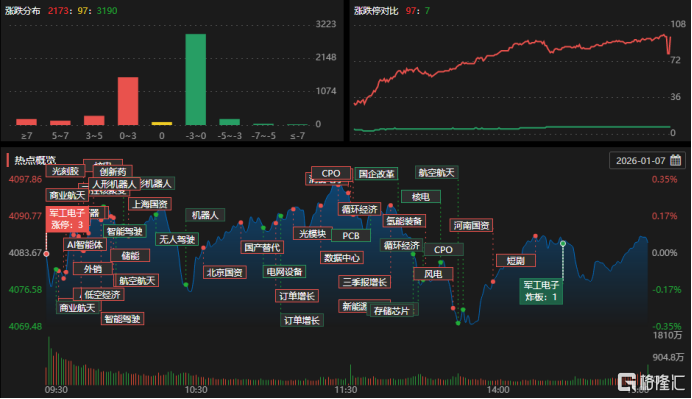
Market Overview - The Shanghai Composite Index briefly approached 4100 points before closing slightly up by 0.05% at 4085.77 points, while the Shenzhen Component rose by 0.06% and the ChiNext Index increased by 0.31% [1] - The STAR 50 Index showed strong performance, with total trading volume across the A-share market reaching approximately 2.88 trillion yuan [1] Sector Performance - Sectors such as brokerage, military, oil, and banking experienced declines, while the coal sector saw significant gains [1] - The semiconductor, tourism and catering, and insurance sectors showed upward momentum, with active concepts including lithography machines, storage chips, and CPO [1] Institutional Insights - Dongguan Securities noted that the return of the Shanghai Composite Index above 4000 points has boosted market sentiment, supported by the recovery of the RMB exchange rate and strong performance in Hong Kong stocks [1] - Institutions such as insurance funds and public offerings are accelerating asset allocation at the beginning of the year, with expectations for policy measures like interest rate cuts and reserve requirement ratio reductions to stimulate the market [1] - Potential catalysts for continued market momentum include improved fundamental data and the focus on sectors such as large financials, non-ferrous metals, robotics, AI applications, and storage chips [1]
元旦消费迎来开门红,头部晶圆厂密集资本运作
Tebon Securities· 2026-01-07 04:53
Consumer Insights - During the New Year holiday, 142 million domestic trips were made, representing a year-on-year increase of 5.19% compared to 2024, with total spending reaching 84.789 billion yuan, up 6.35%[16] - Hainan's duty-free shopping saw a significant boost, with the number of shoppers increasing by 27.09% and total spending rising by 49.89% compared to the same period in 2024[18] - In major cities, Shanghai's daily average consumption during the holiday was 12.2 billion yuan, a 2.5% increase year-on-year, while Beijing's monitored sales reached 4.04 billion yuan, up 16.3%[17] High-end Manufacturing - The "Justice Mission-2025" military exercise highlights the strategic importance of the military-industrial sector amid geopolitical tensions, emphasizing its role in national sovereignty and external risk management[20][26] - The military exercise's focus on Taiwan reflects a more precise and targeted approach compared to previous drills, enhancing control over critical maritime routes and deterring external interference[22] Hard Technology - Major domestic wafer manufacturers are actively engaging in capital operations, with SMIC's registered capital increasing from $6.5 billion to $10.0773 billion, and a planned acquisition of 49% of SMIC North for 40.601 billion yuan[27][33] - Longxin Technology's IPO aims to raise 29.5 billion yuan, potentially becoming the second-largest fundraising in the Sci-Tech Innovation Board's history, supporting its expansion in memory chip production[27][31] Health Sector - Domestic small nucleic acid drug companies, such as Rebio and Bowang Pharmaceutical, are demonstrating strong R&D capabilities, with multiple products entering clinical phases and significant business development collaborations underway[35][36]

财达证券每日市场观-20260107
Caida Securities· 2026-01-07 02:10
Market Performance - On January 6, the Shanghai Composite Index rose by 1.5%, the Shenzhen Component Index increased by 1.4%, and the ChiNext Index gained 0.75%[4] - The Shanghai Composite Index reached a new high not seen since July 2015, while the Shenzhen Component Index hit its highest point since February 2022[1] - The trading volume in both markets exceeded 2.8 trillion yuan, indicating a significant increase in market activity[1] Sector Highlights - Major sectors that saw gains included non-ferrous metals, military industry, securities, oil, chemicals, and computers, with nearly 80% of stocks in the two markets rising[1] - The top three sectors for net capital inflow were securities, software development, and optical electronics, while the sectors with the highest outflows were communication equipment, automation equipment, and batteries[4] Investment Strategy - The report suggests focusing on technology growth and undervalued financial and cyclical stocks as the main investment themes in the current strong market environment[1] - New capital inflows were noted in sectors such as brokerage, small metals, and state-owned enterprise reforms, indicating potential investment opportunities[1] ETF Market - As of the end of 2025, the total net asset value of ETFs in China surpassed 6 trillion yuan, making it the second-largest ETF market globally[12] - The trading volume of ETFs reached 497.28 billion yuan, with stock ETFs accounting for 199 billion yuan and bond ETFs for 148.41 billion yuan[13]

6日欧洲三大股指继续走高
Sou Hu Cai Jing· 2026-01-07 00:34
Core Viewpoint - European stock markets continued their strong start to the year, driven by the performance of large companies in sectors such as mining and defense [1] Group 1: Market Performance - The UK FTSE 100 index rose by 1.18%, closing at 10,122.73 points, remaining above the 10,000 mark [1] - The French CAC 40 index increased by 0.32% [1] - The German DAX index saw a slight rise of 0.09% [1] Group 2: Sector Highlights - The defense sector maintained its upward trend, with Swedish fighter jet manufacturer Saab's stock price increasing by 6.6% [1] - Danish company Novo Nordisk's stock price rose nearly 5% following the launch of an oral weight-loss drug in the US, priced significantly lower than similar injectable medications [1]
特朗普闯祸,美联储紧急救市,将继续降息?美元创25年新低
Sou Hu Cai Jing· 2026-01-06 23:12
Group 1 - The core event involves the U.S. military's capture of Venezuelan President Maduro, which has significantly impacted global financial markets, causing volatility in U.S. stock futures, a surge in gold and silver prices, and a decline in the U.S. dollar index [1][3][5] - Trump's declaration of intent to "take over Venezuela's key energy assets" indicates a strategic move to leverage geopolitical actions for economic benefits, highlighting the intertwining of military and economic strategies [3][5] - The immediate market reaction saw energy and defense stocks benefiting, with Lockheed Martin and General Dynamics shares rising approximately 3%, while the Dow Jones index increased by 1.23%, reaching a historical high [5][10] Group 2 - The U.S. dollar index had already declined nearly 9.5% in 2025, marking its worst annual performance since 2017, reflecting a loss of market trust in the dollar [7][13] - The Federal Reserve's response to market instability includes a neutral stance on interest rate cuts, with an 18.3% probability of a 25 basis point cut in January, while 81.7% of the market expects rates to remain unchanged [8][10] - Despite the Fed's liquidity management operations, which have become a norm, there is a growing concern about the sustainability of the dollar's value amid rising national debt exceeding $38 trillion [10][13] Group 3 - The dollar's dominance is being challenged as countries increasingly pursue local currency settlements, particularly in the energy sector, undermining the dollar's long-standing monopoly in pricing commodities [15][19] - The International Monetary Fund reported that the dollar's share of global allocated foreign exchange reserves fell to 56.92% in Q3 2025, signaling a potential shift in the global monetary landscape [15][19] - The trend of central banks favoring gold as a reserve asset, with gold prices soaring nearly 68% in 2025, indicates a move towards tangible assets as a hedge against fiat currency risks [15][19] Group 4 - The structural issues facing the dollar are becoming apparent, as political influences on monetary policy raise concerns about the future of the dollar as a global reserve currency [19][20] - The evolving international monetary system is seeing the emergence of multiple anchor currencies, including gold, the yuan, and the euro, suggesting a decline in the dollar's singular dominance [19][20] - The future may not necessitate a single "world currency," but rather a variety of "regional currencies," each operating independently [20]