
农业

Search documents
国家统计局:2025年我国国内生产总值突破140万亿元 增长5.0%
Jing Ji Guan Cha Bao· 2026-01-19 02:25
Economic Overview - In 2025, China's GDP reached 1401879 billion yuan, growing by 5.0% year-on-year, with the first, second, and third industries growing by 3.9%, 4.5%, and 5.4% respectively [1] - Quarterly GDP growth rates were 5.4% in Q1, 5.2% in Q2, 4.8% in Q3, and 4.5% in Q4, with a 1.2% increase in Q4 on a quarter-on-quarter basis [1] Agriculture - National grain production totaled 71488 million tons, an increase of 838 million tons or 1.2% from the previous year [2] - Livestock production reached 10072 million tons, a 4.2% increase, with pork production at 5938 million tons, growing by 4.1% [2] Industrial Production - Industrial value-added for large enterprises grew by 5.9%, with manufacturing increasing by 6.4% and high-tech manufacturing by 9.4% [3] - The production of 3D printing equipment, industrial robots, and new energy vehicles saw significant increases of 52.5%, 28.0%, and 25.1% respectively [3] Services Sector - The service sector's value-added grew by 5.4%, with information transmission and software services increasing by 11.1% [4] - The service industry business activity index was at 49.7 in December, indicating stable growth [4] Retail and Consumption - Total retail sales of consumer goods reached 501202 billion yuan, growing by 3.7%, with online retail sales increasing by 8.6% [5] - The retail sales of essential and upgraded goods showed strong growth, with communication equipment sales up by 20.9% [5] Investment Trends - Fixed asset investment decreased by 3.8% to 485186 billion yuan, with manufacturing investment growing by 0.6% [6] - High-tech industries, particularly information services and aerospace manufacturing, saw investment growth of 28.4% and 16.9% respectively [6] Trade Performance - Total goods import and export value reached 454687 billion yuan, a 3.8% increase, with exports growing by 6.1% [7] - Private enterprises accounted for 57.3% of total trade, reflecting a 1.8 percentage point increase from the previous year [7] Price Stability - The Consumer Price Index (CPI) remained stable year-on-year, with food prices decreasing by 0.7% [8] - Core CPI, excluding food and energy, rose by 0.7%, indicating mild inflationary pressure [8] Employment and Income - The urban unemployment rate averaged 5.2% for the year, with a slight decrease to 5.1% in December [9] - Per capita disposable income reached 43377 yuan, with rural income growth outpacing urban income growth [11] Demographic Changes - The total population decreased by 3.39 million to 140489 million, with an urbanization rate of 67.89%, up by 0.89 percentage points [12] Economic Outlook - The economy is expected to face challenges from external changes and domestic supply-demand imbalances, necessitating proactive macroeconomic policies [13]

突发特讯!马克龙回应美关税威胁:不排除启动欧盟最强硬贸易反制工具,少见措辞引发国际舆论
Sou Hu Cai Jing· 2026-01-19 01:50
当美国商务部对欧洲挥舞关税大棒时,法国总统马克龙在爱丽舍宫按下了一个红色按钮——欧盟2023年秘密打造的"反胁迫工具"首次进入实战状态。这个被 称作"欧洲贸易防御体系终极武器"的机制,正在布鲁塞尔紧急启动程序,一场跨大西洋的贸易暗战骤然升级。 欧盟委员会贸易总司的匿名官员透露,这套系统最致命的不是报复措施本身,而是其预设的"自动升级机制"——若美国继续施压,欧盟将按比例提高反击力 度,且决策过程完全脱离成员国一票否决制。这种"欧洲版相互保证毁灭"策略,正是马克龙敢于公开叫板的底气所在。 但布鲁塞尔走廊里的外交官们清楚,真正的战场在柏林总理府。德国经济部18日下午的声明仅表示"关注事态发展",这种暧昧态度暴露出欧盟内部裂痕。法 国需要说服德国等贸易大国相信:今天不对美国亮剑,明天遭胁迫的可能是北溪管道或汽车关税。马克龙的高调发声,实为测试欧洲团结度的压力实验。 1月18日这个看似平常的周四,注定要载入欧盟贸易史册。面对美国针对支持格陵兰岛的欧洲国家加征关税的威胁,马克龙在社交媒体以"不可接受"定性 后,随即祭出法律武器:"法国将请求启动反胁迫工具"。这短短12个字的官方声明,意味着欧盟成员国首次动用这项沉睡一年 ...

这个“10万亿” 意味着什么
Ren Min Ri Bao· 2026-01-19 01:37
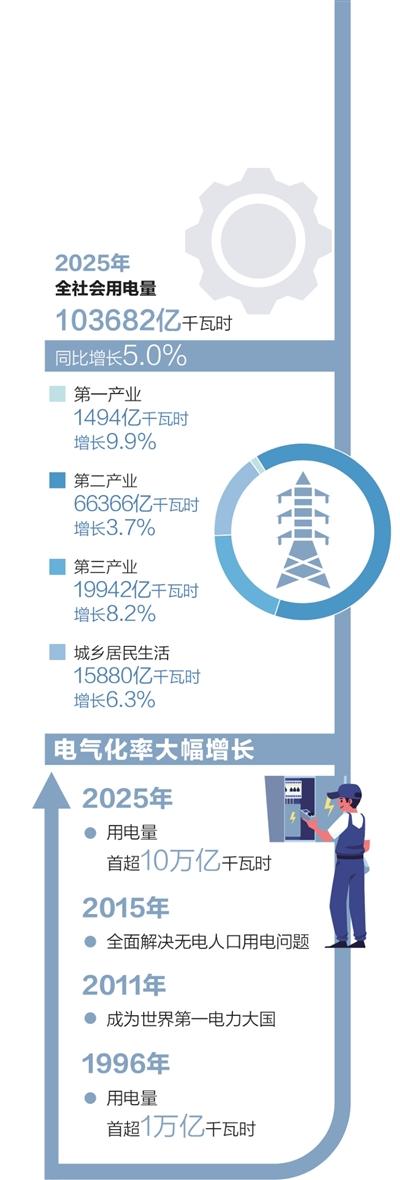
Core Insights - In 2025, China's total electricity consumption is projected to exceed 10 trillion kilowatt-hours for the first time globally, reflecting significant economic growth and energy security improvements [2][10] Group 1: Electricity Consumption Growth - China's electricity consumption in 2025 is expected to reach 10,368.2 billion kilowatt-hours, more than double that of the United States and surpassing the total consumption of the EU, Russia, India, and Japan combined [2] - The electricity consumption in 2025 will be nearly double that of 2015, showcasing an unprecedented growth rate among major economies [2][3] Group 2: Industrial and Sectoral Changes - The secondary industry is projected to consume 66,366 billion kilowatt-hours, accounting for approximately 64% of total consumption, with significant contributions from high-value-added and technology-intensive sectors [3] - The electricity consumption in the computer, communication, and other electronic device manufacturing sectors is expected to exceed 50 billion kilowatt-hours, surpassing traditional industries like steel and chemicals [3][4] - The third industry is anticipated to consume nearly 2 trillion kilowatt-hours, with a year-on-year growth of 8.2%, driven by sectors such as electric vehicle charging and information technology services [4] Group 3: Electrification and Energy Efficiency - The electrification rate of end-use energy is around 30%, which is higher than that of major developed economies, contributing to increased electricity consumption [5] - Smart irrigation systems in agriculture have improved efficiency by approximately 65%, indicating advancements in energy use in traditional sectors [6] Group 4: Power Supply and Infrastructure - China has the world's largest power supply system, with renewable energy sources accounting for over one-third of total electricity generation, and wind and solar capacity surpassing thermal power for the first time [7][8] - The construction of ultra-high voltage transmission lines has strengthened the energy supply network, facilitating the transfer of clean energy from western regions to eastern load centers [8][9] - The national electricity market has seen a significant increase in transaction volume, doubling from 10.7 trillion kilowatt-hours to 23.8 trillion kilowatt-hours, now accounting for over 60% of total electricity consumption [9]
这个“10万亿”,意味着什么(经济新方位)
Ren Min Ri Bao· 2026-01-18 23:47
Core Insights - In 2025, China's total electricity consumption is projected to exceed 10 trillion kilowatt-hours for the first time, marking a significant milestone in global energy consumption [3][4] - This consumption level is more than double that of the United States and surpasses the total consumption of the European Union, Russia, India, and Japan combined [3] - The growth in electricity consumption reflects China's robust manufacturing capabilities and enhanced energy security [3] Electricity Consumption by Sector - The primary industry is expected to consume 149.4 billion kilowatt-hours, showing a growth of 9.9% [1] - The secondary industry will account for 66,366 billion kilowatt-hours, with a growth rate of 3.7%, maintaining its status as the main consumer [1][4] - The tertiary industry is projected to consume 19,942 billion kilowatt-hours, growing by 8.2% [1][5] - Urban and rural residential electricity consumption is expected to reach 15,880 billion kilowatt-hours, with a growth of 6.3% [1][6] Industrial and Technological Developments - The electricity consumption in the industrial sector is increasingly driven by high-value-added and technology-intensive industries [5] - In Jiangsu, the semiconductor industry is experiencing significant growth, with companies like Huahong Semiconductor reporting over 43% year-on-year increase in electricity consumption [4] - The computer and communication equipment manufacturing sector has surpassed traditional industries like steel and chemicals in electricity consumption, indicating a shift in industrial structure [4] Electrification and Energy Efficiency - The electrification rate of end-use energy is approximately 30%, which is higher than that of major developed economies [6] - Innovations in agriculture, such as smart irrigation systems, are contributing to increased electricity consumption in rural areas [6][7] - The "14th Five-Year Plan" includes significant investments in rural power grid improvements, enhancing electricity access and reducing consumption disparities between urban and rural areas [6] Power Supply and Infrastructure - China's power supply system is the largest globally, with renewable energy sources like wind and solar surpassing traditional coal power [8][9] - The country has built 46 ultra-high voltage transmission lines to efficiently transport clean energy from resource-rich regions to consumption centers [9] - The national grid's investment has reached historical highs, ensuring robust electricity supply and infrastructure development [9][10] Market Dynamics and Energy Transition - The establishment of a unified national electricity market has significantly increased market transaction volumes, doubling from the previous five-year period [11] - The energy sector is actively transitioning towards a new energy system, focusing on green and low-carbon development [11] - The growth in electricity consumption is indicative of China's economic transformation and improvement in living standards [11]
全球首次,2025年我国全社会用电量超10万亿千瓦时——这个“10万亿”,意味着什么
Xin Hua Wang· 2026-01-18 23:41
Core Insights - In 2025, China's total electricity consumption is projected to exceed 10 trillion kilowatt-hours for the first time, marking a significant milestone in global energy consumption [1] - This consumption level is more than double that of the United States and surpasses the combined total of the EU, Russia, India, and Japan [1] - The growth in electricity consumption reflects China's robust manufacturing capabilities and enhanced energy security [1] Group 1: Industrial Electricity Consumption - In 2025, the secondary industry is expected to consume 66,366 billion kilowatt-hours, accounting for approximately 64% of total electricity consumption [2] - The semiconductor industry, driven by AI applications, is experiencing a surge in demand, with companies like Huahong Semiconductor reporting over 43% year-on-year growth in electricity consumption [2] - The electricity consumption structure in Jiangsu is shifting, with the computer and communication equipment manufacturing sector surpassing traditional industries like steel and chemicals for the first time [2] Group 2: High-End and Green Development - The high-end manufacturing sector, including new energy vehicles and wind power equipment, is projected to grow electricity consumption by over 20% and 30% respectively [3] - The service sector is also becoming a significant driver of electricity consumption, with the data industry in Guizhou showing rapid growth [3] - By 2025, the tertiary sector's electricity consumption is expected to reach nearly 2 trillion kilowatt-hours, growing by 8.2% year-on-year [3] Group 3: Electrification Trends - The electrification rate of end-use energy is around 30%, surpassing that of major developed economies [4] - In Yunnan, smart irrigation systems have improved efficiency by approximately 65%, reflecting advancements in agricultural electricity consumption [5] - The gap in electricity consumption between urban and rural residents is gradually narrowing due to investments in rural power grid improvements [5] Group 4: Power Supply and Infrastructure - China's power generation capacity accounts for one-third of the global total, with over 50% of coal-fired power plants capable of deep peak regulation [6] - The country has built the world's largest power supply system and clean energy generation framework, with renewable energy sources surpassing thermal power for the first time [6] - The construction of ultra-high voltage transmission lines has strengthened the energy supply network, facilitating the transfer of clean energy from the west to the east [7] Group 5: Market Dynamics - The establishment of a unified national electricity market has significantly increased electricity trading volume, doubling from 10.7 trillion kilowatt-hours to 23.8 trillion kilowatt-hours [8] - The market's role as a regulator and price guide has become more pronounced, enhancing the efficiency of electricity resource allocation [8] - The ongoing transition towards a new energy system is expected to support high-quality development in renewable energy and contribute to China's modernization efforts [8]
2025年我国全社会用电量超10万亿千瓦时 意味着什么
Ren Min Ri Bao· 2026-01-18 23:32
Core Insights - China's total electricity consumption is projected to exceed 10 trillion kilowatt-hours by 2025, marking a significant milestone as the first country to reach this level globally [1] - This consumption level is more than double that of the United States and surpasses the combined total of the European Union, Russia, India, and Japan [1] - The growth in electricity consumption reflects China's robust manufacturing capabilities and enhanced energy security [1] Electricity Consumption Trends - By 2025, the secondary industry is expected to consume 66,366 billion kilowatt-hours, accounting for approximately 64% of total electricity consumption [2] - The semiconductor industry, driven by AI applications, is experiencing a surge in demand, with companies like Huahong Semiconductor reporting over 43% year-on-year growth in electricity consumption [2] - The electricity consumption structure is shifting, with the computer and communication equipment manufacturing sector surpassing traditional industries like steel and chemicals for the first time [2] Industrial and Service Sector Developments - High-end manufacturing and technology-intensive industries are becoming the primary contributors to electricity consumption growth, with new energy vehicles and wind power equipment manufacturing seeing growth rates exceeding 20% and 30%, respectively [3] - The service sector is also a significant driver of electricity consumption, with the third industry expected to consume nearly 2 trillion kilowatt-hours by 2025, reflecting an 8.2% year-on-year increase [3] Electrification and Rural Development - The electrification rate of end-use energy is around 30%, surpassing that of major developed economies, contributing to increased electricity consumption [4] - Rural electrification initiatives have led to significant investments, with over 800 billion yuan allocated to improve rural power grids, narrowing the electricity consumption gap between urban and rural residents [5] Power Supply and Infrastructure - China's power supply system is the largest globally, with renewable energy sources accounting for over one-third of total electricity generation [6] - The construction of high-voltage transmission lines has strengthened the electricity grid, facilitating the transfer of clean energy from western regions to eastern load centers [7] - The national electricity market has seen a significant increase in trading volume, doubling from 10.7 trillion kilowatt-hours to 23.8 trillion kilowatt-hours since the 13th Five-Year Plan [8] Conclusion - The anticipated electricity consumption of 10 trillion kilowatt-hours signifies an upgrade in power supply capabilities, reflecting China's economic transition towards higher quality and improved living standards [9]
碳酸锂期货先扬后抑,旺季临近生猪震荡偏强|期货周报
2 1 Shi Ji Jing Ji Bao Dao· 2026-01-18 23:24
Commodity Market Overview - The commodity market showed mixed performance from January 12 to January 16, with the base metals sector leading gains while the black metals sector declined [1] - Energy and chemical sectors saw slight increases, with fuel up 0.32% and crude oil up 1.22% [1] - The black metals sector experienced declines, with coking coal down 2.05%, coke down 1.77%, and iron ore down 0.31% [1] - The base metals sector saw lithium carbonate up 1.94%, zinc up 3.06%, and nickel up 1.62% [1] - Precious metals saw significant gains, with gold up 2.57% and silver up 20.03% [1] - Agricultural products showed mixed results, with eggs up 1.05% and live pigs up 1.78%, while soybean meal fell 2.12% [1] Lithium Market Dynamics - Lithium carbonate futures experienced volatility, initially rising 17% before a sharp decline, closing the week at 146,200 yuan/ton after hitting a limit down [2][3] - Supply remained slightly increased, with domestic lithium carbonate production at 22,605 tons for the week, a 0.3% increase [2] - Demand remained strong despite seasonal trends, with December sales of new energy vehicles reaching 1.71 million units, a 28% year-on-year increase [2] Pig Market Trends - The pig futures market showed a strong upward trend ahead of the Spring Festival, with the main contract up 1.78% to 11,950 yuan/ton [4] - Supply dynamics indicated a slowdown in the outflow of pigs, with the number of breeding sows stable at 39.9 million heads [4] - Demand is expected to increase as the Spring Festival approaches, with slaughter rates showing slight improvements [4][5] Export Growth Insights - December 2025 saw a 6.6% year-on-year increase in exports, driven by strong performance in non-US markets and high-end manufacturing [6][7] - Key drivers included a significant increase in automobile exports and a recovery in consumer electronics demand [6][7] - The overall export growth is expected to remain resilient, supported by ongoing capital expenditure needs in Belt and Road Initiative countries [8] Financial Data and Policy Measures - December 2025 financial data revealed a decrease in new social financing, with a total of 2.21 trillion yuan, reflecting a year-on-year decline [9][10] - The People's Bank of China introduced structural monetary policy tools aimed at supporting targeted sectors, indicating a shift from broad monetary easing [12] - The focus on corporate loans showed a significant increase, while household loans continued to decline, indicating cautious consumer behavior [10][11]
涉及养老机构服务、儿童用品安全性等
Xin Lang Cai Jing· 2026-01-18 22:34
Emerging Fields - The release of 4 national standards for industrial internet platforms supports the scalable development and application of industrial internet platforms [1] - 4 national standards for digital supply chains are aimed at enhancing the resilience of industrial chains through digitalization [1] - 5 national standards for smart factory safety integration promote high-quality and sustainable development in manufacturing through data-driven management [1] - National standards for the classification and comprehensive utilization of recyclable rare earth secondary resources support the recycling of rare earth resources [1] Transportation and Green Low-Carbon - 23 national standards related to railway freight transport, intelligent transport, and aviation services facilitate efficient development in transportation [1] - 7 national standards for explosion-proof industrial vehicles and off-road forklifts promote the standardized development of the industrial vehicle sector [1] - 3 logistics national standards for multimodal transport service quality assessment and the integration of logistics and manufacturing industries guide the integration of transport modes [1] - 17 national standards for carbon capture, green factory evaluation, and greenhouse gas emission accounting assist in achieving carbon neutrality goals [1] Safety Production - 13 mandatory national standards for production safety accident investigation and economic loss statistics enhance safety emergency capabilities in hazardous chemical enterprises [2] - 4 mandatory national standards in the fire safety sector improve the fire performance and quality of building insulation materials and rescue equipment [2] - 28 national standards related to feed, pesticides, plant quarantine, and animal husbandry provide a technical foundation for agricultural production safety [2] Daily Life - 6 national standards for children's products, including portable baby sleep baskets and VOC emission measurement, aim to enhance product quality and safety [2] - 3 national standards for elderly care institutions standardize care practices and improve the quality of life services [2] - 5 national standards for traditional Chinese medicine better protect public health through classification and assessment [2] - 5 national standards for musical instruments, including pianos and electric instruments, cater to the cultural and spiritual needs of the public [2] - 2 mandatory national standards for sports venues, including climbing and fencing, ensure safety in fitness activities [2] Additional Standards - The market regulatory authority has also released national standards in areas such as government services, wind power generation systems, water conservation, and agricultural products [2]
强农惠农富农政策效能怎样进一步提高(政策问答·回应关切)
Ren Min Ri Bao· 2026-01-18 22:05
Core Viewpoint - The article emphasizes the importance of enhancing agricultural and rural policies to ensure food security and improve the living standards of rural residents, highlighting the need for targeted support and investment in rural infrastructure and services [1][2]. Group 1: Policy Effectiveness - The "14th Five-Year Plan" period has seen a rapid increase in rural residents' income, with growth rates consistently surpassing those of urban residents, leading to a reduction in the urban-rural income ratio from 2.56:1 in 2020 to 2.34:1 by 2024 [1]. - The government has established a comprehensive agricultural support system covering all stages of production and various types of operators, aimed at poverty alleviation and rural revitalization [1]. Group 2: Investment and Support Mechanisms - The Ministry of Agriculture and Rural Affairs has indicated that the importance of securing China's food supply is increasingly critical, with ongoing efforts to address infrastructure and public service gaps in underdeveloped areas [2]. - Fiscal spending on agricultural and forestry affairs reached 11.3 trillion yuan, with over 10% of national land transfer revenue allocated to agriculture and rural development [3]. - Future efforts will focus on enhancing financial support and ensuring diverse investment sources to meet the needs of rural populations [3]. Group 3: Precision of Policies - A "three-in-one" support policy system comprising pricing, subsidies, and insurance has been continuously improved, with nine stable central financial subsidy policies set to be implemented by early 2025 [4]. - The aim is to ensure profitability for farmers and motivate grain production in major grain-producing areas, with a focus on maintaining reasonable prices for essential agricultural products [4].
“功夫见永春”:福建永春在京推介时尚产业
Xin Hua Wang· 2026-01-18 10:11
活动上,永春县发布了"功夫永春"区域公用品牌及魁星文化IP形象。该品牌以白鹤拳文化为精神内 核,覆盖全县农业、工业、文旅服务业,旨在构建政府引导、市场运作的品牌生态系统,为永春全域发 展注入新动能。 1月17日,"功夫见永春"时尚产业推介活动在北京举办。活动由福建省驻京办与中共永春县委、永 春县人民政府联袂推介,并举行了系列签约仪式。 当天还举行了"永春香美学搭配时尚秀"、永春"魁星宴"美食推介、非遗快闪进景区等配套活动。未 来,永春将持续深化文旅融合,加快优质产品与文化资源"走出去"。(颜彩虹) ...