
铁矿石

Search documents
铁矿霸权崩塌!中矿集团7天逼澳洲巨头用人民币结算,美元神话破灭
Sou Hu Cai Jing· 2025-11-06 02:09
Core Viewpoint - The article discusses a significant shift in the global commodity settlement system, particularly in iron ore trading, driven by China's Minmetals Group's decision to halt all dollar-denominated transactions, which has profound implications for the industry and global financial dynamics [1][7][13]. Group 1: Iron Ore Market Dynamics - Since China's entry into the WTO in 2003, iron ore demand surged by 300%, while pricing mechanisms favored Australian miners, allowing them to profit significantly from a cost of $15 per ton to a selling price of $120 [3][4]. - Minmetals Group emerged in 2022 as a "super buyer," consolidating purchasing power from 128 steel companies and introducing a "centralized procurement + spot bidding" model, which includes a blockchain trading platform for transparency [4][10]. Group 2: Impact on Major Players - On September 30, 2024, Minmetals Group's suspension of dollar settlements directly impacted BHP, which derives 58% of its revenue from China, leading to a potential daily profit loss of $230 million [7][10]. - The introduction of a dual pricing mechanism by Minmetals, combining long-term and spot prices, disrupts the monopoly held by Platts Energy, allowing for cost reductions of $8 per ton for Chinese steelmakers [7][10]. Group 3: Currency Transition and Global Implications - Following Minmetals' actions, BHP's concession to accept renminbi for transactions marks a pivotal change in the global commodity settlement system, with immediate effects seen in the Singapore iron ore futures market [8][11]. - The shift to renminbi is expected to influence other commodities, with companies like Rio Tinto and Vale considering similar transitions, indicating a broader trend towards renminbi settlements in global trade [8][11]. Group 4: Financial Power Dynamics - The article highlights a power struggle between the U.S. and China, with the dollar's share in global reserves declining from 72% in 2000 to 58% in 2024, while the renminbi's share has surpassed 3.5% [10][11]. - Minmetals' success illustrates that market scale can create an "anti-monopoly force," leveraging blockchain technology to enhance trust in renminbi transactions [10][11]. Group 5: Future Considerations - The transition to renminbi settlements has prompted discussions among oil-producing nations about using renminbi for oil trade, indicating a potential shift in global trade practices [11][13]. - Concerns have been raised about the risks of over-reliance on domestic financial systems for Chinese steelmakers, prompting Minmetals to initiate the development of a global iron ore price index to ensure transparency [11][13].



黑色建材日报-20251106
Wu Kuang Qi Huo· 2025-11-06 01:23
Report Industry Investment Rating No relevant content provided. Core Viewpoints of the Report - The overall atmosphere in the commodity market was weak yesterday, with finished steel prices showing a weak and volatile trend. Although the steel demand has officially entered the off - season and there is a risk of inventory accumulation for hot - rolled coils, with the implementation of the Fed's easing expectations and positive signals from the China - US meeting, the market sentiment and capital environment are expected to improve, and the steel consumption end may gradually recover in the future [2]. - For iron ore, the supply is still at a high level in the same period, but the demand continues to weaken, and the inventory pressure remains. After the macro - events are realized, the fundamentals of iron ore are weak, and the price is expected to be weak and volatile in the short term. If the US liquidity problem is alleviated, the price may stabilize [5]. - Regarding manganese silicon and silicon iron, the fundamentals are not ideal, and they are likely to follow the trend of the black sector. The operability is relatively low [10]. - For industrial silicon, the supply pressure persists, and the demand support weakens. The price is likely to fluctuate with the commodity market in the short term, and attention should be paid to the option game near the expiration [13]. - For polysilicon, the supply - demand pattern may improve marginally, but the short - term inventory reduction is limited. The market has strong expectations for the industry meeting, and the price is highly volatile [16]. - For glass, the market expects an improvement in the supply structure, but the price increase is restricted by the low procurement enthusiasm of downstream factories. The sustainability of the market depends on spot transactions and inventory reduction [19]. - For soda ash, the industry operating rate remains high, the loss continues to expand, and the demand is mainly for rigid restocking. The price is expected to continue the weak and volatile pattern in the short term [21]. Summary by Related Catalogs Steel Market Quotes - The closing price of the rebar main contract was 3024 yuan/ton, down 20 yuan/ton (- 0.65%) from the previous trading day. The registered warehouse receipts decreased by 2708 tons, and the main contract positions increased by 65237 lots. The Tianjin and Shanghai aggregate prices decreased by 10 yuan/ton and 30 yuan/ton respectively [1]. - The closing price of the hot - rolled coil main contract was 3253 yuan/ton, down 12 yuan/ton (- 0.36%) from the previous trading day. The registered warehouse receipts remained unchanged, and the main contract positions decreased by 23039 lots. The Lecong and Shanghai aggregate prices decreased by 10 yuan/ton and 20 yuan/ton respectively [1]. Strategy Views - Rebar shows a situation of both supply and demand increasing, with inventory continuously decreasing, performing neutrally overall. Hot - rolled coils have a continuous recovery in demand, but the production is still high, and the inventory level is still relatively high [2]. Iron Ore Market Quotes - The main contract (I2601) of iron ore closed at 776.00 yuan/ton, with a change of + 0.06% (+ 0.50). The positions decreased by 3095 lots to 54.47 million lots. The weighted position was 94.35 million lots. The spot price of PB powder at Qingdao Port was 782 yuan/wet ton, with a basis of 55.23 yuan/ton and a basis rate of 6.64% [4]. Strategy Views - Supply: The overseas iron ore shipment volume decreased slightly but remained at a high level in the same period. The shipments from Australia and Brazil both declined, with FMG having a significant decline. The shipments from non - mainstream countries decreased slightly, and the near - end arrival volume rebounded to the annual high [5]. - Demand: The daily average pig iron output decreased by 3.54 million tons to 236.36 million tons. The number of blast furnaces under maintenance far exceeded those under restart. The steel mill profitability reached a new low, and some blast furnaces started maintenance due to profit decline. Environmental protection restrictions in Hebei also affected pig iron production [5]. - Inventory: Port inventory continued to increase, while steel mill inventory decreased [5]. Manganese Silicon and Silicon Iron Market Quotes - On November 5, the main contract of manganese silicon (SM601) closed up 0.38% at 5776 yuan/ton. The spot price in Tianjin was 5680 yuan/ton, with a basis of 116 yuan/ton [7][8]. - The main contract of silicon iron (SF601) closed up 0.91% at 5560 yuan/ton. The spot price in Tianjin was 5550 yuan/ton, with a discount of 10 yuan/ton to the futures [8]. Strategy Views - The fundamentals of manganese silicon are not ideal, and the potential driver may come from the manganese ore end. If the black sector strengthens, attention should be paid to the possible disturbances in the manganese ore end [10]. - The supply - demand fundamentals of silicon iron have no obvious contradictions and drivers, and it is likely to follow the black sector [10]. Industrial Silicon and Polysilicon Market Quotes - Industrial silicon: The main contract (SI2601) closed at 9020 yuan/ton, up 1.52% (+ 135). The weighted contract positions decreased by 13071 lots to 398388 lots. The spot price of East China non - oxygenated 553 was 9300 yuan/ton, with a basis of 280 yuan/ton; the 421 was 9700 yuan/ton, with a basis of - 120 yuan/ton [12]. - Polysilicon: The main contract (PS2601) closed at 53355 yuan/ton, down 0.67% (- 360). The weighted contract positions decreased by 7354 lots to 230402 lots. The average price of N - type granular silicon was 50.5 yuan/kg, and the basis was - 1155 yuan/ton [15]. Strategy Views - Industrial silicon: The supply pressure persists. Although the production in Southwest China is reduced during the dry season, the production in Northwest China continues to rise. The demand support weakens, and the price is likely to fluctuate with the commodity market in the short term [13]. - Polysilicon: Some production capacities will be overhauled, and the production in November will be reduced to 120,000 tons. The supply - demand pattern may improve marginally, but the short - term inventory reduction is limited. The market has strong expectations for the industry meeting, and the price is highly volatile [16]. Glass and Soda Ash Market Quotes - Glass: The main contract closed at 1097 yuan/ton on Wednesday afternoon, down 0.72% (- 8). The weekly inventory of float glass sample enterprises decreased by 823,000 cases (- 1.24%). The top 20 long - position holders increased 27375 lots, and the top 20 short - position holders increased 45091 lots [18]. - Soda ash: The main contract closed at 1195 yuan/ton on Wednesday afternoon, up 0.50% (+ 6). The weekly inventory of soda ash sample enterprises decreased by 10,000 tons (- 1.24%), with heavy - soda inventory decreasing by 48,100 tons and light - soda inventory increasing by 48,000 tons. The top 20 long - position holders decreased 16327 lots, and the top 20 short - position holders decreased 16452 lots [20]. Strategy Views - Glass: The market expects an improvement in the supply structure, but the price increase is restricted by the low procurement enthusiasm of downstream factories. The sustainability of the market depends on spot transactions and inventory reduction [19]. - Soda ash: The industry operating rate remains high, the loss continues to expand, and the demand is mainly for rigid restocking. The price is expected to continue the weak and volatile pattern in the short term [21].
铁矿石早报-20251106
Yong An Qi Huo· 2025-11-06 00:31
Group 1: Report Industry Investment Rating - No relevant information provided Group 2: Report's Core View - No relevant information provided Group 3: Summary of Spot Iron Ore - Newman powder: price 774, daily change -1, weekly change -28, import profit -27.67 [1] - PB powder: price 781, daily change -1, weekly change -24, import profit -18.45 [1] - Macfarlane powder: price 778, daily change -1, weekly change -24, import profit 7.20 [1] - Jinbuba powder: price 733, daily change -1, weekly change -26, import profit -2.81 [1] - Mainstream mixed powder: price 737, daily change -8, weekly change -27, import profit -2.25 [1] - Super special powder: price 687, daily change 0, weekly change -28, import profit -5.77 [1] - Carajás powder: price 893, daily change -1, weekly change -33, import profit 2.08 [1] - Brazilian mixed powder: price 821, daily change -1, weekly change -22, import profit -2.04 [1] - Brazilian coarse IOC6: price 783, daily change -1, weekly change -23 [1] - Brazilian coarse SSFG: price 788, daily change -1, weekly change -23 [1] - Ukrainian concentrate: price 888, daily change -2, weekly change -30 [1] - 61% Indian powder: price 722, daily change -1, weekly change -26 [1] - Karara concentrate: price 890, daily change 0, weekly change -28 [1] - Roy Hill powder: price 768, daily change -1, weekly change -24, import profit 10.80 [1] - KUMBA powder: price 840, daily change -1, weekly change -24 [1] - 57% Indian powder: price 622, daily change 0, weekly change -28 [1] - Atlas powder: price 732, daily change -8, weekly change -27 [1] - Tangshan iron concentrate: price 1008, daily change -13, weekly change -30 [1] Group 4: Summary of Exchange Contracts - i2601: price 776.0, daily change 0.5, weekly change -28.5, monthly spread -42.0 [1] - i2605: price 754.0, daily change -2.0, weekly change -27.5, monthly spread 22.0 [1] - i2609: price 734.0, daily change -1.5, weekly change -26.0, monthly spread 20.0 [1] - FE01: price 100.61, daily change -1.32, weekly change -2.06, monthly spread -4.32 [1] - FE05: price 98.38, daily change -1.20, weekly change -2.19, monthly spread 2.23 [1] - FE09: price 96.29, daily change -1.21, weekly change -2.29, monthly spread 2.09 [1]
钢联15港港口进口矿库存(2025年11月5日)
Bao Cheng Qi Huo· 2025-11-05 10:07
Report Industry Investment Rating - Not provided in the given content Core Viewpoints of the Report - The iron ore inventory at the 15 ports monitored by Steel Union has been continuously rising, with a week-on-week increase of 174,420 tons and an expanding growth rate [1]. - The inventory increase is mainly in mainstream varieties. Among them, the medium-grade Australian powder and Australian lump increased by 114,130 tons and 40,670 tons respectively, and the pellet ore increased by 10,660 tons, while the high-grade Australian powder decreased by 35,320 tons [1]. - In general, the iron ore port inventory continues to rise and the growth rate expands, indicating that industrial contradictions are accumulating and there are no structural contradictions [1]. Summary by Category Inventory Quantity and Change - **Total Inventory**: The current inventory is 11,422,200 tons, a week-on-week increase of 174,420 tons (1.55%), and a month-on-month decrease of 1,339,850 tons (-10.50%) [1]. - **High-grade Australian Powder**: The current inventory is 1,618,360 tons, a week-on-week decrease of 35,320 tons (-2.14%), and a year-on-year decrease of 719,490 tons (-30.78%) [1]. - **Brazilian Powder Ore**: The current inventory is 2,072,310 tons, a week-on-week increase of 6,570 tons (0.32%), and a year-on-year increase of 518,240 tons (33.35%) [1]. - **Medium-grade Australian Powder**: The current inventory is 714,300 tons, a week-on-week increase of 114,130 tons (19.02%), and a month-on-month decrease of 46,600 tons (-6.12%) [1]. - **Australian Lump**: The current inventory is 1,003,890 tons, a week-on-week increase of 40,670 tons (4.22%), and a year-on-year increase of 109,850 tons (12.29%) [1]. - **Pellet Ore**: The current inventory is 36,730 tons, a week-on-week increase of 10,660 tons (40.89%), and a year-on-year decrease of 76,810 tons (-67.65%) [1].
需求疲软的负反馈逐步形成 短期铁矿石偏弱
Jin Tou Wang· 2025-11-05 08:06
11月5日,铁矿石期货主力合约震荡收跌0.26%,报776.0元/吨。 机构观点 中金财富期货:矿价虽继续下跌但跌幅收窄,市场情绪偏弱,钢厂利润压缩、铁水产量下滑,需求疲软 的负反馈逐步形成,短期维持偏弱运行。 兴业期货:四季度澳矿及非主流矿发运量同比增幅明显扩大,进口矿库存加速增加,钢材去库压力显 现,环保压力上升,高炉铁水产量下降,短期铁矿价格偏弱,但政策面有支撑,整体处于宽幅震荡格 局。 11月04日:全国主港铁矿石成交146.1万吨,环比上涨12.99%;远期现货成交72.2万吨。 从前三季度来看,力拓铁矿石发货量约2.35亿吨,要想完成指导目标下限,预计四季度发货量需同比增 长约240万吨。 【消息面汇总】 本周全球铁矿石到港量环比大幅回升1229.8万吨至3314.1万吨,处于历年同期偏高水平,周一铁矿石港 口库存也回升了167万吨。 ...
《黑色》日报-20251105
Guang Fa Qi Huo· 2025-11-05 03:41
1. Report Industry Investment Rating - No relevant information provided 2. Core Views of the Reports Steel Industry - Recently, the decline in iron ore prices has led to a rapid drop in steel prices. The iron element supply is in a loose pattern, and the decrease in hot metal production suppresses iron ore prices. It is expected that steel mills will actively reduce production in winter to ease the pressure of winter storage. The single-side prices of rebar and hot-rolled coils are expected to test the support levels of 3000 and 3200 respectively. The strategy of longing coking coal and shorting hot-rolled coils can continue to be held [2]. Iron Ore Industry - The iron ore futures showed a weak downward trend. The supply side has a rebound in port arrivals, while the demand side sees a decline in hot metal production and weakening restocking demand from steel mills. The inventory pressure is increasing. The iron ore driving force is weakening. The strategy is to short iron ore 2601 on rallies, with a reference range of 760 - 810, and recommend the 1 - 5 positive spread arbitrage [4][6]. Coke Industry - The coke futures fluctuated downward. The spot price has been raised for the third time, and there is still an expectation of further increases. The cost is supported by the rebound of coking coal prices, but the demand is suppressed by environmental protection restrictions and low steel mill profits. The overall inventory is slightly increasing. The strategy is to go long on coke 2601 on dips, with a reference range of 1700 - 1850, and conduct the arbitrage of longing coking coal and shorting coke [7]. Coking Coal Industry - The coking coal futures fluctuated downward, with a divergence between the futures and the spot. The domestic coking coal market continues to be strong, but traders are becoming cautious. The supply is expected to increase slightly, and the demand is weakening. The overall inventory is slightly decreasing. The strategy is to go long on coking coal 2601 on dips, with a reference range of 1200 - 1350, and conduct the arbitrage of longing coking coal and shorting coke [7]. 3. Summary by Relevant Catalogs Steel Industry Steel Prices and Spreads - Rebar and hot-rolled coil spot and futures prices generally declined. For example, the rebar 05 contract decreased by 37 to 3108, and the hot-rolled coil 05 contract decreased by 32 to 3272 [2]. Cost and Profit - The steel billet price decreased by 20 to 2930, and the plate billet price remained unchanged at 3730. The profits of hot-rolled coils in East China and North China decreased by 10, while the profit in South China remained unchanged [2]. Production - The daily average hot metal production increased by 3.5 to 239.9, with a growth rate of 1.5%. The production of five major steel products increased by 10 to 875.3, with a growth rate of 1.2% [2]. Inventory - The inventory of five major steel products decreased by 41.1 to 1513.7, with a decline rate of -2.6%. The rebar inventory decreased by 19.6 to 602.5, with a decline rate of -3.1% [2]. Transaction and Demand - The building materials trading volume decreased by 0.5 to 9.3, with a decline rate of -5.4%. The apparent demand for five major steel products increased by 23.7 to 916.4, with a growth rate of 2.7% [2]. Iron Ore Industry Iron Ore - Related Prices and Spreads - The costs of various iron ore warehouse receipts decreased. For example, the cost of PB powder warehouse receipts decreased by 6.6 to 829.3, with a decline rate of -0.8% [4]. Spot Prices and Price Indexes - The spot prices of various iron ores in Rizhao Port decreased. For example, the price of PB powder decreased by 6 to 782, with a decline rate of -0.8% [4]. Supply - The 45 - port arrivals increased by 1189.3 to 3218.4, with a growth rate of 58.6%. The global shipments decreased by 174.6 to 3213.8, with a decline rate of -5.2% [4]. Demand - The daily average hot metal production of 247 steel mills decreased by 3.5 to 236.4, with a decline rate of -1.5%. The national pig iron monthly production decreased by 374.7 to 6604.6, with a decline rate of -5.4% [4]. Inventory Changes - The 45 - port inventory increased by 171.6 to 14714.08, with a growth rate of 1.2%. The imported ore inventory of 247 steel mills decreased by 229.3 to 8849.9, with a decline rate of -2.5% [4]. Coke Industry Coke - Related Prices and Spreads - The price of Shanxi quasi - first - grade wet - quenched coke (warehouse receipt) remained unchanged at 1612. The coke 01 contract decreased by 43 to 1729, with a decline rate of -2.4% [7]. Supply - The daily average production of all - sample coking plants remained unchanged at 64.6, and the daily average production of 247 steel mills increased by 0.1 to 46.2, with a growth rate of 0.2% [7]. Demand - The hot metal production of 247 steel mills decreased by 3.5 to 236.4, with a decline rate of -1.5% [7]. Inventory Changes - The total coke inventory increased by 8.1 to 900.0, with a growth rate of 0.9%. The coke inventory of all - sample coking plants increased by 1.2 to 59.9, with a growth rate of 2.1% [7]. Supply - Demand Gap Changes - The coke supply - demand gap increased by 1.8 to -3.6, with a growth rate of 49.2% [7]. Coking Coal Industry Coking Coal - Related Prices and Spreads - The price of Shanxi medium - sulfur primary coking coal (warehouse receipt) remained unchanged at 1420. The coking coal 01 contract decreased by 32 to 1253, with a decline rate of -2.5% [7]. Supply - The raw coal production increased by 3.8 to 851.8, with a growth rate of 0.4%, and the clean coal production increased by 1.5 to 434.9, with a growth rate of 0.3% [7]. Demand - The daily average production of all - sample coking plants remained unchanged at 64.6, and the daily average production of 247 steel mills increased by 0.1 to 46.2, with a growth rate of 0.2% [7]. Inventory Changes - The clean coal inventory of Fenwei coal mines decreased by 9.2 to 81.1, with a decline rate of -10.2%. The coking coal inventory of all - sample coking plants increased by 22.8 to 1052.5, with a growth rate of 2.2% [7].
黑色建材日报:市场情绪不佳,钢价延续跌势-20251105
Hua Tai Qi Huo· 2025-11-05 02:35
Report Industry Investment Rating - No industry investment rating provided in the reports. Core Viewpoints - The steel market has poor sentiment, and steel prices continue to decline. The iron ore market has weakening demand expectations, and prices are oscillating downward. The coking coal and coke market has average sentiment, and prices are oscillating downward. The动力煤 market has prices rising, with short - term upward momentum [1][3][5][7]. Summary by Commodity Steel Market Analysis - Futures and spot: The main contract of rebar closed at 3044 yuan/ton, and that of hot - rolled coil at 3265 yuan/ton. The overall spot steel trading was average, with the total national building materials trading volume at 9.27 tons. The trading volume in the East China region decreased significantly, while that in the North and South increased slightly [1]. - Supply and demand logic: The cost of rebar still provides support, and there is a possibility of more favorable policies. The profit of hot - rolled coil is better than that of rebar, so the output is relatively high. As steel mills have profits, the willingness to cut production is low. In November, the number of planned maintenance and production cuts by steel mills increases, and there are occasional environmental protection restrictions in the North [1]. Strategy - Unilateral: Oscillating weakly [2]. Iron Ore Market Analysis - Futures and spot: The iron ore futures price oscillated downward, and the prices of mainstream imported iron ore varieties declined slightly. Traders' enthusiasm for quoting was average, and steel mills' procurement was mainly for rigid demand. The total national main port iron ore trading volume was 146.1 tons, a 12.99% increase from the previous period; the forward - looking spot trading volume was 72.2 tons, a 22.57% decrease [3]. - Supply and demand logic: The arrival volume of iron ore this week increased significantly by 58.6%. The overall iron ore valuation is neutral, the supply - demand pattern is marginally weakening and generally loose, and the ore price is under downward pressure. However, supported by downstream restocking demand, there is no clear trend in the short term. With steel mills' loss - driven production cuts, the resilience of iron ore demand has weakened, and the price faces correction pressure [3]. Strategy - Unilateral: Oscillating weakly [4]. Coking Coal and Coke Market Analysis - Futures and spot: The black commodity sector oscillated weakly, and the closing prices of coking coal and coke futures both declined slightly. The customs clearance volume of imported Mongolian coal continued to rise to a high level, and the trading atmosphere was average, with downstream players mainly in a wait - and - see mode [5]. - Logic and view: For coking coal, due to safety inspections, the supply in some producing areas has not fully recovered, and the overall output is low, with the supply shortage pressure not significantly alleviated. On the demand side, downstream procurement is mainly for rigid demand, but the expectation of a new round of coke price increases has risen, and the inventory - building willingness of some enterprises has increased. For coke, affected by the rising coal price, coke enterprises are still operating at a loss, and some have maintenance plans, so the supply has contracted to some extent. On the demand side, the price of finished steel has declined recently, and the profit of steel mills has shrunk significantly, but the market's expectation of rising raw material prices has increased, and the procurement plan has increased compared with before, providing some support for the coke price [6]. Strategy - Coking coal: Oscillating [6]. - Coke: Oscillating [6]. 动力煤 Market Analysis - Futures and spot: In the producing areas, the coal price is still strong. Affected by safety inspections, the supply is tight. Downstream procurement is active, and the inventory of coal mines is decreasing. Miners believe that due to safety inspections and heating demand, the supply - demand mismatch will continue, and the price is difficult to decline in the short term. At ports, affected by the rising upstream prices, the quoted prices are firm, but downstream procurement is mainly for rigid demand and is resistant to high - priced coal. Although railway transportation has increased and port inventory has accumulated, the accumulation rate is low. With the continuous price increase of upstream coal mines, the arrival cost has risen, so there is a shortage of low - priced coal resources, and the price will continue to rise in the short term. In the import market, the price is also strong, and the price difference between domestic and imported coal is still large, so imported coal still has an advantage [7]. - Demand and logic: Affected by the situation in the producing areas, the price will oscillate strongly in the short term. In the long - term, the supply is still in a loose pattern, but with the approaching of the winter heating season, attention should be paid to the consumption and restocking of non - power coal [7]. Strategy - No strategy provided [7].
海南矿业涨2.07%,成交额1.05亿元,主力资金净流出409.27万元
Xin Lang Zheng Quan· 2025-11-05 01:53
Core Viewpoint - Hainan Mining's stock price has shown significant growth this year, with a year-to-date increase of 41.26%, despite a decline in net profit for the first nine months of 2025 [1][2]. Financial Performance - For the period from January to September 2025, Hainan Mining achieved a revenue of 3.36 billion yuan, representing a year-on-year growth of 5.93%. However, the net profit attributable to shareholders decreased by 42.84% to 312 million yuan [2]. - Cumulative cash dividends since the company's A-share listing amount to 993 million yuan, with 657 million yuan distributed over the past three years [3]. Stock Market Activity - As of November 5, Hainan Mining's stock price was 9.86 yuan per share, with a market capitalization of 19.703 billion yuan. The stock experienced a 2.07% increase during the trading session [1]. - The trading volume indicated a net outflow of 4.0927 million yuan from main funds, with significant buying and selling activity from large orders [1]. Shareholder Structure - As of September 30, 2025, the number of shareholders increased to 50,600, up by 8.38%. The average number of circulating shares per person decreased by 7.74% to 39,072 shares [2]. - Among the top ten circulating shareholders, Hong Kong Central Clearing Limited holds 12.7031 million shares, an increase of 2.1073 million shares from the previous period [3].

前三季度四大矿山铁矿石产量实现增长 四季度仍将维持高位
Qi Huo Ri Bao· 2025-11-05 00:47
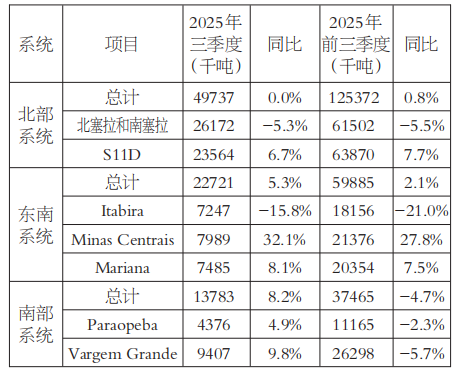
Group 1: Global Iron Ore Shipment and Production - In the first three quarters of 2025, global iron ore shipments reached 120.031 million tons, a year-on-year increase of 0.2% [1] - The four major mining companies collectively shipped 72.155 million tons, a 0.5% increase year-on-year, accounting for 60% of global shipments [1] - China's iron ore imports decreased by 1.8% year-on-year, totaling 96.889 million tons [1] Group 2: Vale's Production and Sales Performance - Vale's iron ore production in Q3 2025 was 94.4 million tons, a 3.8% increase year-on-year, with a cumulative production of 245.67 million tons, up 1.3% [4] - Vale's Q3 sales volume was 86 million tons, a 5.1% increase year-on-year, with iron concentrate sales showing strong performance [5] - The average price of Vale's iron ore in Q3 was $94.4 per ton, reflecting a $9.3 increase from the previous quarter [5] Group 3: Rio Tinto's Production and Project Updates - Rio Tinto's iron ore production in the Pilbara region for Q3 2025 was 84.1 million tons, a slight increase of 0.1% year-on-year, while shipments decreased by 0.2% [8] - The Guinea Simfer project has begun trial operations, with the first shipment expected in November 2025, which may impact the global iron ore supply structure [9] - Rio Tinto's new projects are progressing as planned, with several expected to reach full production by 2027 [10] Group 4: BHP's Production and Sales Insights - BHP's iron ore production in Q3 2025 was 70.25 million tons, a 1.9% decrease year-on-year, with cumulative production of 215.57 million tons, down 0.4% [15] - BHP's sales volume for Q3 was 70.59 million tons, a 1.3% decrease year-on-year, with block ore performing relatively well [17] - The company maintains its shipment guidance for FY2026 despite the decline in production [13] Group 5: Fortescue Metals Group (FMG) Performance - FMG's iron ore processing volume in Q3 2025 was 50.8 million tons, a 5.8% year-on-year increase, with shipments reaching 49.7 million tons [22] - The Iron Bridge project saw significant production increases, with processing volume up 62% year-on-year [22] - FMG's sales performance was strong across most product categories, with notable growth in the Iron Bridge product line [24]


铁矿石早报-20251105
Yong An Qi Huo· 2025-11-05 00:27
Report Summary 1. Report Industry Investment Rating - Not provided in the given content 2. Core View - Not provided in the given content 3. Summary by Relevant Catalogs Spot Market - **Australian Mainstream Iron Ore**: Newman powder price is 775, down 10 daily and 18 weekly; PB powder is 782, down 6 daily and 14 weekly; Mac powder is 779, down 7 daily and 14 weekly; Jinbuba is 734, down 6 daily and 22 weekly; Mixed powder is 745, down 3 daily and 12 weekly; Super special powder is 687, down 5 daily and 22 weekly; Carajás powder is 894, down 5 daily and 24 weekly [1] - **Brazilian Mainstream Iron Ore**: Brazilian blend is 822, down 2 daily and 12 weekly; Brazilian coarse IOC6 is 784, down 6 daily and 13 weekly; Brazilian coarse SSFG is 789, down 6 daily and 13 weekly [1] - **Other Iron Ores**: Ukrainian concentrate is 890, down 5 daily and 20 weekly; 61% Indian powder is 723, down 6 daily and 22 weekly; Karara concentrate is 890, down 5 daily and 20 weekly; Roy Hill powder is 769, down 6 daily and 14 weekly; KUMBA powder is 841, down 6 daily and 14 weekly; 57% Indian powder is 622, down 5 daily and 22 weekly; Atlas powder is 740, down 3 daily and 12 weekly; Tangshan iron concentrate is 1021, down 5 daily and 12 weekly [1] Futures Market - **DCE Contracts**: i2601 is 775.5, down 7.0 daily and 17.0 weekly; i2605 is 756.0, down 4.5 daily and 12.5 weekly; i2609 is 735.5, down 5.0 daily and 11.5 weekly [1] - **SGX Contracts**: FE01 is 101.93, down 1.07 daily and 0.24 weekly; FE05 is 99.58, down 1.07 daily and 0.42 weekly; FE09 is 97.50, down 1.05 daily and 0.50 weekly [1]