
乘用车

Search documents
汽车行业周报:小鹏、大众CEA架构覆盖燃油车,或带来显著增量-20250818
Shanghai Aijian Securities· 2025-08-18 10:43
Investment Rating - The automotive industry is rated as "Outperforming the Market" with a weekly increase of +3.08%, ranking 9th out of 31 sectors [3][4][12]. Core Insights - The automotive sector has shown a positive trend, with significant stock performances from companies like Feilong Co. (+39.06%) and Tenglong Co. (+35.05%) [3][7]. - A strategic partnership between XPeng Motors and Volkswagen Group aims to enhance the electronic architecture across both electric and traditional fuel vehicles, potentially increasing market competitiveness and profitability for both companies [3][6]. - The launch of the new intelligent SUV, Zhiji LS6, featuring advanced range-extending technology, is expected to drive sales growth, with a pre-sale performance indicating strong market interest [3][6]. Summary by Sections Industry Performance - The A-share automotive sector index closed at 7,461.2 points, with a weekly increase of +3.08%, outperforming the CSI 300 index which rose by +2.37% [3][4]. - The sub-sectors showed varied performance, with motorcycles and others leading at +6.90%, while automotive services lagged at -1.35% [4][6]. Key Company Developments - The collaboration between XPeng and Volkswagen is set to enhance the software-defined vehicle strategy, improving the smart capabilities of traditional fuel vehicles and expanding XPeng's international market reach [3][6]. - Zhiji LS6's pre-sale success, with over 10,000 orders in 30 minutes, highlights its competitive edge in the market, particularly against rivals like Li Auto and Aito [3][6]. Stock Performance - Top-performing stocks in the A-share automotive sector included Feilong Co. (+39.06%) and Tenglong Co. (+35.05%), indicating strong investor interest in automotive components [3][7]. - In the Hong Kong market, Heshang Automotive saw a remarkable increase of +76.00%, reflecting robust performance in the automotive services sector [8][9].

乘用车板块8月18日涨1.82%,长城汽车领涨,主力资金净流入6.75亿元
Zheng Xing Xing Ye Ri Bao· 2025-08-18 08:38
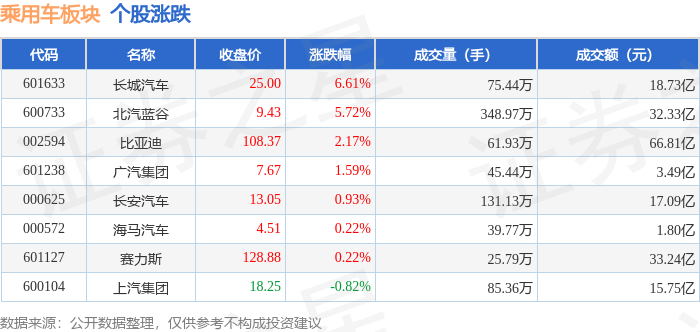
Group 1 - The passenger car sector increased by 1.82% on August 18, with Great Wall Motors leading the gains [1] - The Shanghai Composite Index closed at 3728.03, up 0.85%, while the Shenzhen Component Index closed at 11835.57, up 1.73% [1] - Great Wall Motors' stock price rose by 6.61% to 25.00, with a trading volume of 754,400 shares and a transaction value of 1.873 billion [1] Group 2 - The passenger car sector saw a net inflow of 675 million yuan from main funds, while retail investors experienced a net outflow of 140 million yuan [1] - BYD had a main fund net inflow of 450 million yuan, but retail investors had a net outflow of 165 million yuan [2] - North Benz Blue Valley experienced a main fund net inflow of 230 million yuan, with retail investors seeing a net outflow of 619.5 million yuan [2]





崔东树:7月全国乘用车厂商批发222万辆创当月历史新高
智通财经网· 2025-08-18 05:45
智通财经APP获悉,8月18日,崔东树发布2025年7月乘用车细分市场车型走势。7月全国乘用车厂商批发222万辆创当月历史新高,同比增长13%,环比下 降11%;1-7月全国乘用车厂商批发1,550万辆,同比增长12.4%。受零售调整的影响,7月乘用车批发同比增速比零售增速高7个百分点。7月自主车企批发 158万辆,同比增长20%,环比下降5%;主流合资车企批发44万辆,同比增长7%,环比下降21%;豪华车批发20万辆,同比下降16%,环比下降25%。 7月乘用车主力厂商总体批发格局持续变化,部分中段企业有逐步崛起迹象,如吉利汽车(00175)、东风日产、小鹏汽车(09868)、小米汽车、零跑汽车 (09863)等车企的环比表现较强。 | 总体乘用车 | | 25.7批 | 同比 | 环比6 | 25年累 | 同比 | 25.7零 | 同比 | 环比6 | 25年累 | 同比 | | --- | --- | --- | --- | --- | --- | --- | --- | --- | --- | --- | --- | | | | 发 | | 日 | 批 | | 售 | | 月 | 통 | | | a0 ...


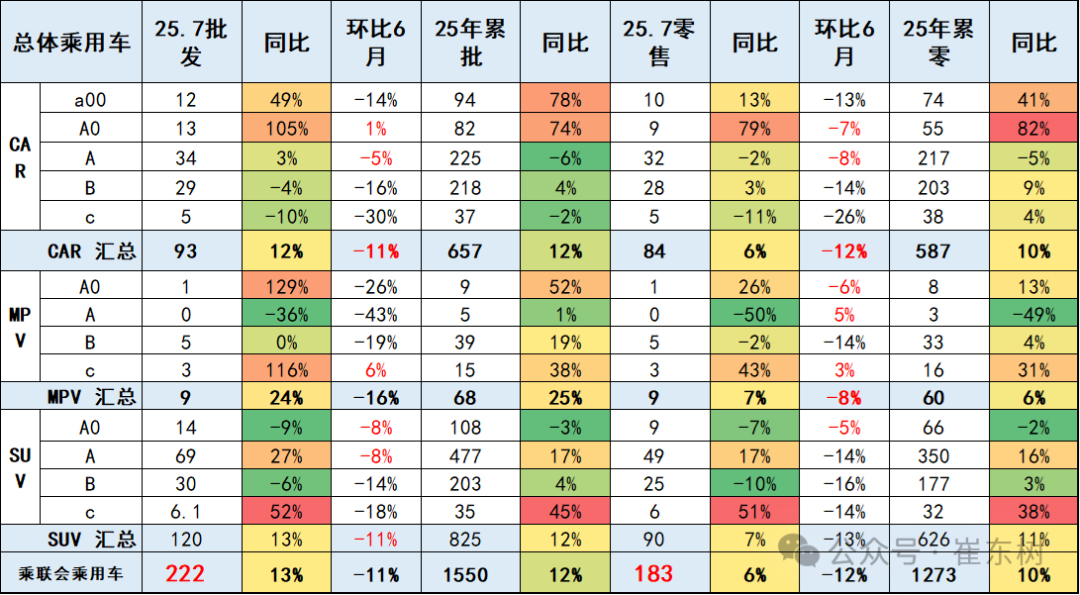
乘联分会秘书长崔东树:7月全国乘用车厂商批发222万辆创当月历史新高 同比增长13%
Di Yi Cai Jing· 2025-08-18 05:33
(文章来源:第一财经) 乘联分会秘书长崔东树发文称,7月全国乘用车厂商批发222万辆创当月历史新高,同比增长13%,环比 下降11%;1-7月全国乘用车厂商批发1,550万辆,同比增长12.4%。受零售调整的影响,7月乘用车批发 同比增速比零售增速高7个百分点。7月自主车企批发158万辆,同比增长20%,环比下降5%;主流合资 车企批发44万辆,同比增长7%,环比下降21%;豪华车批发20万辆,同比下降16%,环比下降25%。7 月乘用车主力厂商总体批发格局持续变化,部分中段企业有逐步崛起迹象,如吉利汽车、东风日产、小 鹏汽车、小米汽车、零跑汽车等车企的环比表现较强。 ...
周观点 | 人形机器人运动会开幕 具身智能催化可期【民生汽车 崔琰团队】
汽车琰究· 2025-08-17 15:07
Core Viewpoints - The automotive industry is experiencing intensified competition and demand is not meeting expectations, particularly in the passenger vehicle segment, which saw a year-on-year decline in sales [12] - The opening of the World Humanoid Robot Games is expected to catalyze advancements in robotics, with significant participation from leading domestic companies [5][13] - The recent surge in Huawei's automotive initiatives indicates a rapid acceleration in the high-end domestic vehicle market [6][14] Weekly Data - In the second week of August 2025, passenger car sales reached 383,000 units, down 5.2% year-on-year and down 18.6% month-on-month; New energy vehicle sales were 219,000 units, up 2.7% year-on-year and down 11.7% month-on-month, with a penetration rate of 57.3%, up 4.5 percentage points [2][43] Weekly Market Performance - The A-share automotive sector rose by 2.7% from August 11 to August 15, outperforming the CSI 300 index, which increased by 2.0%; sub-sectors such as motorcycles and parts saw significant gains, while automotive services declined [3][32] Investment Recommendations - Recommended companies include Geely, BYD, Li Auto, Xiaomi Group, Xpeng Motors, Bertley, Top Group, New Spring, Hu Guang, and Chunfeng Power, focusing on high-quality domestic brands that are accelerating in smart and global markets [4][16] - In the parts sector, recommendations include companies involved in smart driving and smart cockpits, as well as those in the new forces supply chain [7][18] Robotics Sector Insights - The World Humanoid Robot Games featured 487 competitions, showcasing advancements in robotics from leading companies; significant developments in robot capabilities are anticipated, particularly in autonomous perception and decision-making [5][13] - Tesla's production goals for the Optimus V3 robot indicate a long-term growth trajectory for robotics, with expectations of reaching a production scale of one million units within five years [19][20] Passenger Vehicle Market Dynamics - The continuation of vehicle replacement policies is expected to stimulate demand; the recent policy updates include expanded subsidy ranges for older vehicles, which may stabilize overall demand in 2025 [15][40] - The market is witnessing a shift towards intelligent and globalized vehicle offerings, with domestic brands gaining market share against traditional competitors [17][18] Motorcycle Market Trends - The motorcycle market is experiencing growth, with a notable increase in sales of larger displacement motorcycles; the top companies are expected to benefit from this trend [23][25] Heavy Truck Market Outlook - The heavy truck market is seeing a recovery in demand, supported by new policies aimed at replacing older vehicles; the sales figures indicate a positive trend for the sector [26][27] Tire Industry Developments - The tire industry is benefiting from high demand and improved operational efficiencies; leading companies are expanding their global presence, which is expected to enhance their competitive positioning [28][30]

吉利汽车(00175):港股公司信息更新报告:潜力新车或支撑高增长,战略整合利于利润释放
KAIYUAN SECURITIES· 2025-08-17 12:41
Investment Rating - The investment rating for the company is "Buy" (maintained) [2][11]. Core Insights - The company is expected to experience high growth driven by the release of potential new vehicles and strategic integration, which will facilitate profit release from the second half of 2025 onwards [6][7]. - The net profit forecasts for 2025-2027 have been adjusted upwards to 156.6 billion, 179.7 billion, and 215.7 billion RMB, respectively, corresponding to EPS of 1.7, 1.9, and 2.2 RMB [6]. - The company has raised its annual sales target for 2025 to 3 million vehicles, supported by the platform-based cost advantages and the launch of several new models [7]. Financial Summary and Valuation Metrics - Revenue for 2023 is projected at 179.204 billion RMB, with a year-on-year growth of 21.1%. By 2025, revenue is expected to reach 330.103 billion RMB, reflecting a growth rate of 37.4% [7]. - The net profit for 2023 is estimated at 5.308 billion RMB, with a significant increase of 213.3% in 2024, followed by a slight decrease of 5.9% in 2025 [7]. - The gross margin is expected to improve from 15.3% in 2023 to 17.1% by 2027, while the net margin is projected to rise from 3.0% to 5.4% over the same period [7].
北汽蓝谷6月30日股东户数27.14万户,较上期减少0.18%
Zheng Quan Zhi Xing· 2025-08-16 09:18
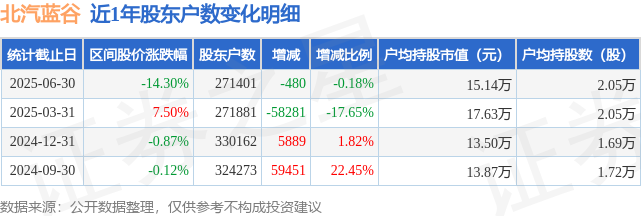
Group 1 - The core viewpoint of the news is that Beiqi Blue Valley has experienced a decrease in shareholder numbers and average shareholding value, despite having a higher number of shareholders compared to the industry average [1][2] - As of June 30, 2025, the number of shareholders for Beiqi Blue Valley is 271,401, which is a decrease of 480 shareholders or 0.18% from March 31, 2025 [1][2] - The average shareholding value per shareholder is 151,400 yuan, which is below the industry average of 1,115,800 yuan for A-share listed companies in the passenger car sector [1][2] Group 2 - From March 31, 2025, to June 30, 2025, Beiqi Blue Valley's stock price fell by 14.3%, coinciding with a reduction in shareholder numbers [1][2] - During the same period, the net outflow of main funds was 1.965 billion yuan, while retail investors saw a net inflow of 1.944 billion yuan [2]
对外贸易图谱2025年第31期:制造业用工续创新低
CAITONG SECURITIES· 2025-08-15 13:09
Domestic Demand - New housing and passenger car sales growth has declined, while second-hand housing sales have rebounded[2] - In August, new housing sales saw a year-on-year decline of 8%, while second-hand housing sales volume increased, but prices fell[2] - Retail sales of home appliances in August showed a downward trend in year-on-year growth[2] External Demand - The extension of tariff exemptions between China and the U.S. for three months has led to a continued decline in shipping volumes from China to the U.S.[2] - Overall exports are weakening, with the China Containerized Freight Index (CCFI) showing a decrease in shipping rates and a significant drop in container throughput[2] Production - Manufacturing employment index has reached a historical low, with a year-on-year decline continuing[2] - Steel production has decreased due to maintenance and operational adjustments, while rebar prices have started to rise[2] Prices - Tariff exemptions have suppressed gold prices, while domestic rebar prices have increased, and cement and coal prices continue to rise[2] - The geopolitical situation and rising U.S. commercial crude oil inventories have put downward pressure on oil prices[2] Risks - Potential policy changes and economic recovery not meeting expectations pose risks to the forecasts[2]
乘用车板块8月15日涨0.82%,北汽蓝谷领涨,主力资金净流出3.51亿元
Zheng Xing Xing Ye Ri Bao· 2025-08-15 08:37
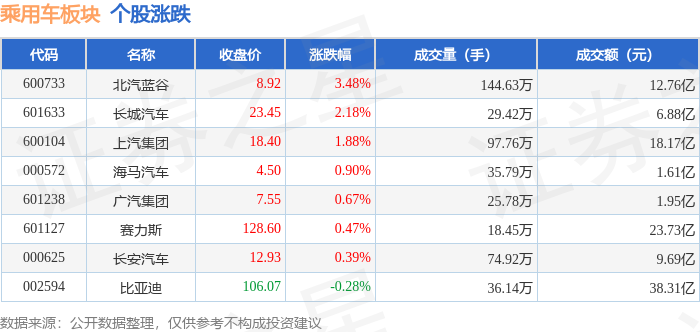
从资金流向上来看,当日乘用车板块主力资金净流出3.51亿元,游资资金净流入1200.67万元,散户资金净流入3.39亿元。乘用车板块个股资金流 向见下表: 证券之星消息,8月15日乘用车板块较上一交易日上涨0.82%,北汽蓝谷领涨。当日上证指数报收于3696.77,上涨0.83%。深证成指报收于 11634.67,上涨1.6%。乘用车板块个股涨跌见下表: | 代码 | 名称 | 收盘价 | 涨跌幅 | 成交量(手) | 成交额(元) | | --- | --- | --- | --- | --- | --- | | 600733 | 北汽蓝谷 | 8.92 | 3.48% | 144.63万 | 12.76亿 | | 601633 | 长城汽车 | 23.45 | 2.18% | 29.42万 | 6.88亿 | | 600104 | 上汽集团 | 18.40 | 1.88% | 97.76万 | 18.17亿 | | 000572 | 步写汽车 | 4.50 | 0.90% | - 35.79万 | 1.61亿 | | 601238 | 广汽集团 | 7.55 | 0.67% | 25.78万 | 1.95 ...




北汽蓝谷(600733):华为合作深化,新车周期将启
Tianfeng Securities· 2025-08-15 05:12
Investment Rating - The report gives a "Buy" rating for the company with a target price of 12.68 RMB, indicating a potential upside of 47% from the current price of 8.62 RMB [6][70]. Core Insights - The company is positioned as a leading player in the domestic new energy vehicle market, with a comprehensive brand matrix and a focus on high-end and scenario-based segmentation strategies [1][18]. - The collaboration with Huawei is deepening, enhancing the company's technological capabilities and market positioning, particularly in the high-end electric vehicle segment [3][43]. - The company has shown significant revenue growth, with a 150.75% year-on-year increase in Q1 2025, indicating a recovery from previous losses [1][19]. Summary by Sections 1. Company Overview - The company is the first new energy vehicle manufacturer listed in China, with three major brands: ARCFOX, Beijing Automotive, and HUAWEI's Xiangjie, covering various market segments [1][15]. - The company has implemented a three-year leap plan focusing on marketing, quality, and cost management, which has started to show positive results in revenue and profit margins [15][19]. 2. ARCFOX Brand Development - ARCFOX is transitioning to the mainstream vehicle market, with a focus on mid-to-high-end electric vehicles priced between 100,000 to 300,000 RMB [2][29]. - The brand has launched several new models and implemented pricing strategies to boost sales, achieving a 169.91% year-on-year increase in deliveries for 2024 [2][30]. 3. Xiangjie Brand and Huawei Collaboration - The Xiangjie brand, developed in collaboration with Huawei, targets the high-end market with the S9 model, which has become a leader in the luxury electric vehicle segment priced above 400,000 RMB [3][46]. - The partnership with Huawei has evolved from the HI model to a more integrated smart vehicle model, enhancing product design and market reach [43][44]. 4. Financial Projections - The company expects significant revenue growth from 2025 to 2027, with projected revenues of 362.52 billion RMB, 617.94 billion RMB, and 795.76 billion RMB, representing year-on-year growth rates of 149.8%, 70.5%, and 28.8% respectively [70][74]. - The forecasted net profit for the same period is expected to improve, moving from a loss of 38.40 million RMB in 2025 to a profit of 9.18 million RMB by 2027 [70][74].