
数据中心

Search documents
爱尔兰在2026年主要面临的三个商业挑战
Shang Wu Bu Wang Zhan· 2025-12-30 11:39
Group 1 - Ireland faces three main challenges by 2026: tariff impacts, artificial intelligence, and cybersecurity [1] - The U.S. imposes a 15% import tariff on Irish products, significantly affecting exports, particularly in pharmaceuticals, semiconductors, and beverages like whiskey [1] - Pharmaceuticals and semiconductors account for 75% of Ireland's trade with the U.S., making them the most vulnerable sectors to potential tariff increases [1] Group 2 - U.S. tech companies are investing billions in the rapidly growing AI market, necessitating significant upgrades to data center capacities in Ireland [1] - Ireland's current electrical grid capacity is insufficient to meet the increasing demands from data centers, raising concerns about potential business relocations to countries with more reliable infrastructure [1] - The Irish government plans to invest billions in grid upgrades from 2026 to 2030, but timely completion remains uncertain [1] Group 3 - Cybersecurity is identified as a pressing issue leading up to 2026, with healthcare, manufacturing, and financial services being primary targets of cyberattacks [1]
金元证券每日晨报-20251230
Jinyuan Securities· 2025-12-30 05:10
Core Insights - The report highlights the performance of major stock indices across different markets, indicating a mixed trend with slight gains in European markets and declines in US and Asian markets [10][11][12] - Key developments in international and domestic news include significant meetings between US and Ukrainian leaders, the announcement of a new tariff adjustment plan by the Chinese government, and ongoing regulatory efforts to enhance fair competition in the market [11][12][13] International Market Overview - European markets showed slight gains with the DAX index up 0.05% at 24351.12 points, and the CAC40 index up 0.1% at 8112.02 points, while the FTSE 100 index fell 0.04% to 9866.53 points [10] - In the US, the Dow Jones index decreased by 0.51% to 48461.93 points, the S&P 500 index fell 0.35% to 6905.74 points, and the Nasdaq dropped 0.5% to 23474.35 points [10] - The Asia-Pacific market saw the Hang Seng index decline by 0.71% to 25635.23 points, while the KOSPI index increased by 2.2% to 4220.56 points [10] Domestic News - The State Council's Tariff Commission released the 2026 Tariff Adjustment Plan, which will implement temporary import tariffs below the most-favored-nation rate on 935 items starting January 1, 2026 [11] - The Market Supervision Administration emphasized the need to deepen fair competition governance and enhance anti-monopoly enforcement as part of its 2026 key tasks [12] Key Company Developments - TSMC announced that its 2nm technology has commenced mass production as scheduled in the fourth quarter [13] - SoftBank agreed to acquire DigitalBridge, a data center investment company, for $4 billion as part of its AI strategy [13] - Toray Industries indicated a new round of price increases in the carbon fiber market starting January 2026, with price hikes ranging from 10% to 20% [13] A-Share Important Announcements - Ganfeng Lithium received a notice of prosecution from the Yichun Public Security Bureau for suspected insider trading, but its operations remain normal [13] - Longpan Technology will reduce production on some lines for maintenance starting January 1, 2026, expecting to decrease lithium iron phosphate output by approximately 5,000 tons [13] - Rising Technology obtained AS 9100D certification for aerospace quality management and has begun supplying products for Chinese commercial aircraft [13] Research Recommendations - The fixed income report indicates that the RMB exchange rate has broken 7.0, leading to a rebound in the bond market, with overall yield declines observed [14] - The low-altitude economy industry report highlights several policy developments and company advancements, including the launch of low-altitude financial services and the successful ignition of a high-power rotor engine by Dong'an Power [14] - The electronic sector report discusses Nvidia's potential acquisition of Groq to enhance its competitive edge in the inference market, indicating a shift towards mixed processing capabilities in future GPU architectures [15] - The computer industry monthly report notes a 2.88% increase in the CSI 300 index, while the computer industry index fell by 1.39%, suggesting ongoing adjustments despite positive catalysts in the AI sector [16]
工信部、国家发改委、国家能源局等六部门发布重要名单
中国能源报· 2025-12-30 03:22
Core Viewpoint - The announcement of the "2025 National Green Computing Power Facility List" aims to promote the green and low-carbon development of computing power facilities in accordance with the "2024-2025 Energy Conservation and Carbon Reduction Action Plan" issued by the State Council [2][3]. Group 1: Announcement Details - The announcement was made by six departments: the Ministry of Industry and Information Technology, the National Development and Reform Commission, the Ministry of Commerce, the Financial Regulatory Bureau, the National Administration of State Assets, and the National Energy Administration [2]. - The list includes various sectors, with a total of 60 facilities recognized for their contributions to green computing power [3][4]. Group 2: Sector Breakdown - **Energy Sector**: Two facilities were recognized: - State Power Investment Corporation Gui'an Data Center - Southern Power Grid Green Smart Data Center [3][4]. - **Industrial Sector**: Includes facilities such as: - Hongsheng Copper Industry Data Center - China Telecom Hangzhou Smart Computing Center [3][4]. - **Telecommunications Sector**: Notable entries include: - China Telecom's multiple data centers across various locations, including Wenzhou and Changji [3][4]. - **Financial Sector**: Facilities such as: - Bank of Communications Data Center in Pujiang Park (Phase I) - China People's Insurance Group Northern Information Center [5][6]. Group 3: Public Institutions and Educational Facilities - Public institutions and educational facilities also feature in the list, including: - Beijing Urban Sub-center Administrative Office Data Center - Karamay Vocational Technical College Data Center [6].




60个!六部门发布国家绿色算力设施名单,国家电投、南方电网上榜
中关村储能产业技术联盟· 2025-12-30 03:22
Core Viewpoint - The article discusses the announcement of the "2025 National Green Computing Power Facility List" by six government departments, highlighting the importance of promoting green and low-carbon development in computing power facilities [2][6]. Group 1: Announcement Details - The announcement was made on December 29, 2025, by the Ministry of Industry and Information Technology, National Development and Reform Commission, Ministry of Commerce, Financial Regulatory Bureau, State Administration of Government Affairs, and National Energy Administration [2][3]. - The list includes 60 computing power facility projects across various sectors, including industry, information communication, energy, internet, finance, and public institutions [2][6]. Group 2: Sector-Specific Facilities - In the energy sector, notable facilities include the State Power Investment Corporation Gui'an Data Center and the Southern Power Grid Green Smart Data Center [2][6]. - The information communication sector features multiple data centers from China Telecom and China Mobile, such as the Hangzhou Intelligent Computing Center and the Wenzhou Coastal Data Center [7][8]. - The list also includes facilities from the internet sector, such as the Karamay Carbon and Water Cooling Data Center and the Douyin-Zhonglian Green Big Data Industrial Base [9][10]. - Financial institutions are represented by data centers from the Bank of Communications and China People's Insurance Group [11][12]. - Public institutions have data centers listed, including the Beijing Urban Sub-center Administrative Office Area Data Center [12][13]. Group 3: Future Trends - The construction of green computing centers is becoming a core area at the intersection of technology and energy, with energy storage solutions being integral to this development [14]. - The upcoming 14th International Energy Storage Summit and Exhibition (ESIE 2026) will focus on how energy storage technology can ensure reliable power supply for computing centers and enhance energy efficiency [14][18].

“东数西算”下,谁将主宰 AI时代的能源命脉?
Feng Huang Wang Cai Jing· 2025-12-30 02:50
Group 1: National Strategy and Infrastructure - The "East Data West Computing" project is a national strategic initiative aimed at creating a new integrated circulation pattern for data elements across the country, similar to previous projects like "South-to-North Water Diversion" and "West-to-East Power Transmission" [1] - The project includes the establishment of 8 national computing power hub nodes and 10 national data center clusters, with a focus on enhancing computing power as a critical infrastructure for economic development [1] - Research indicates that a 1% increase in computing power index can lead to a 3.3‰ growth in the digital economy and a 1.8‰ increase in GDP [1] Group 2: Regional Development and Investment - The Shaoguan data center cluster, as the only cluster in the Guangdong-Hong Kong-Macao Greater Bay Area, is set to accommodate real-time computing power demands from cities like Guangzhou and Shenzhen, with an investment exceeding 500 billion yuan [2] - By 2025, the Shaoguan cluster is expected to have a capacity of 500,000 standard racks and 5 million servers, primarily serving large and super-large data centers [2] - The cluster's strategic location and favorable climate conditions contribute to reduced operational costs and energy consumption for data centers [2] Group 3: Energy Demand and Supply - The electricity demand of the Shaoguan data center cluster is projected to reach 9.7 billion kilowatt-hours annually by 2025, accounting for nearly half of the city's total electricity consumption [3] - The energy consumption for AI applications is significant, with generating approximately 5,000 words of text consuming 1 kilowatt-hour, and producing a 1-minute 4K video requiring 3-5 kilowatt-hours [3] - The stability and economic viability of electricity supply are critical for the success of the Shaoguan cluster, as electricity costs represent 50%-60% of computing power costs [3] Group 4: Green Energy Advantages - Shaoguan has a clean energy installed capacity ratio of 51.64%, significantly higher than the national average, with every second kilowatt-hour coming from clean energy [4] - The electricity price for computing centers in Shaoguan is 20%-30% lower than that in the Pearl River Delta, providing a substantial cost advantage for data centers [4] - Shaoguan aims to achieve a "fully green electricity" target by 2025, with plans to expand renewable energy facilities significantly [4] Group 5: Opportunities for Local Energy Companies - Under the "East Data West Computing" initiative, local energy companies like Chenzhou Electric International are positioned to benefit from the development of the Shaoguan data center cluster [6] - Chenzhou Electric International, serving 1.21 million users, is transitioning from a traditional hydropower supplier to a comprehensive energy service provider, capitalizing on the growing electricity demand from the cluster [6] - The company reported a 33.93% year-on-year increase in net profit for the first three quarters of 2025, indicating strong growth momentum [6] Group 6: Industry Transformation and Value Reassessment - The shift towards AI computing power is transforming electricity from a traditional utility into a core production factor of the digital economy, leading to a reassessment of the value of electricity companies, especially those with clean energy resources [8] - Companies with green electricity resources are expected to enjoy premium pricing, driven by increasing demand for clean power in data centers [8] - The advancement of smart grids, energy storage technologies, and energy management systems is opening new revenue streams for electricity companies as they transition to comprehensive energy service providers [8]

12.30犀牛财经早报:2026年铜或迎来历史级别上涨
Xi Niu Cai Jing· 2025-12-30 01:38
Group 1 - The total scale of public funds in China has reached a historic high of 37.02 trillion yuan, marking the first time it has surpassed this threshold, with continuous growth over the past eight months [1] - The macroeconomic trends are expected to drive a significant increase in copper prices by 2026, influenced by the restructuring of global trade orders and the demand from AI-related industries [1] Group 2 - Several banks, including Beijing Bank and Shanghai Bank, have announced the redemption of preferred shares, with a total redemption scale of 458 billion yuan in December [2] - The lithium iron phosphate industry is facing challenges due to rising raw material prices and reduced production plans, with companies collectively planning to cut production by 35% to 50% [2] Group 3 - SoftBank is reportedly in advanced talks to acquire DigitalBridge Group, focusing on investments in data centers as part of its strategy to capitalize on the AI-driven digital infrastructure boom [3] - Meta has announced the acquisition of AI company Manus for a deal potentially worth several billion dollars, marking its third-largest acquisition to date [4] Group 4 - The restructuring plan for 38 companies under Suning has been approved, with total debts amounting to 238.73 billion yuan [5] - BYD has denied rumors regarding the launch of flying cars, clarifying that there are no such plans [5] Group 5 - The second-hand market for Labubu products has seen significant price drops, with some items falling below their original prices [6] - Fujian Ningde Rural Commercial Bank has been fined 1.25 million yuan for multiple loan business violations [6] Group 6 - Shenzhen Edge Medical is seeking to raise 1.2 billion HKD through an IPO in Hong Kong, with shares expected to start trading on January 8 [7] - Shanghai Iluvatar Corex Semiconductor is also applying for an IPO in Hong Kong, aiming to issue 25.4 million shares [7] Group 7 - *ST Panda has been investigated by the China Securities Regulatory Commission for suspected information disclosure violations [10] - Oriental Fashion's stock continues to face risk warnings due to negative audit opinions and uncertainty regarding its ability to continue as a going concern [11] Group 8 - The ICE BofA MOVE index, which measures bond market volatility, is on track for its largest annual decline since 2009, reflecting reduced recession risks due to Federal Reserve rate cuts [12] - U.S. stock indices experienced slight declines, with notable drops in major tech stocks like Tesla and Nvidia [12] Group 9 - Silver prices experienced a significant drop after briefly surpassing $80, while gold also saw a sharp decline, nearing $4,300 [13]
“东数西算”工程铺就绿色算力发展之路
Zheng Quan Ri Bao· 2025-12-30 00:00
Group 1 - The "East Data West Computing" project has significantly enhanced the green computing power supply capacity and solidified the green foundation of computing infrastructure over the past two years [1] - By the end of 2025, the green electricity proportion in newly built data centers at national hub nodes is expected to exceed 80% [1] - The push for green transformation in data centers is driven by higher energy-saving requirements, leading to increased adoption of renewable energy sources such as solar, wind, and hydropower [1][2] Group 2 - The integration of data centers as a new type of infrastructure is crucial for supporting the deep development of the digital economy, necessitating a scientific layout and green, efficient operations [2] - Policies have been implemented to promote the green transformation of data centers, including the issuance of 22 key tasks aimed at fostering low-carbon development in the digital industry [2] - The establishment of a standardized system for the national integrated computing network enhances the quality and reliability of computing services, supporting the healthy development of the green data center industry [3] Group 3 - The demand for computing power is experiencing explosive growth, with the market size expected to reach 835.1 billion yuan by 2025, reflecting the robust development and market potential of the computing industry [4] - The "dual carbon" goals and related policies provide clear green development targets for data center industry chain enterprises, driving innovation in energy-efficient solutions [4] - High voltage direct current technology is being developed to support the integration of renewable energy sources, reducing reliance on traditional energy and promoting the growth of green data centers [4][5] Group 4 - Innovations in cooling technology, such as immersion liquid cooling, are crucial for the efficient operation of data centers, leading to lower Power Usage Effectiveness (PUE) and enabling the use of high-density computing equipment [5] - The construction of green data centers is fostering collaborative innovation across the industry chain, involving operators, equipment manufacturers, energy suppliers, and software developers [5] - Green data centers are driving technological innovation and product development, pushing the industry towards a greener, more efficient, and intelligent future [5]
早报 | 贵金属大跳水;乌91架无人机袭击普京官邸?特朗普很生气;解放军无人机俯瞰台北101大厦;王忠磊、王忠军被限高
虎嗅APP· 2025-12-29 23:59
Group 1 - Precious metals, led by silver, experienced significant price corrections after a recent surge, with silver dropping over 8% and gold falling nearly $200 in a single day [2] - The Chicago Mercantile Exchange raised margin requirements for several popular futures contracts, including silver and gold, to mitigate market volatility [2] - The price of platinum and palladium also saw substantial declines, with platinum down nearly 13% and palladium over 15% [2] Group 2 - Labubu blind box prices have drastically decreased from previous highs, with the second-hand market seeing prices drop from over 4,600 yuan to around 260 yuan [5][7] - Morgan Stanley reported that Pop Mart is transitioning from explosive growth to sustainable growth, predicting a slowdown in revenue growth for Labubu by 2026 [7] Group 3 - Huayi Brothers and its founders are facing legal and financial issues, with a court restricting high consumption due to a 74.73 million yuan enforcement case [8] - The company has been involved in multiple legal disputes, indicating potential financial instability [8] Group 4 - SoftBank is in talks to acquire DigitalBridge Group, which manages over $100 billion in data center assets, as part of its strategy to enhance its data infrastructure [9] - DigitalBridge's stock surged by 45% in pre-market trading following news of the potential acquisition [9] Group 5 - The People's Bank of China announced a new action plan for digital yuan management, set to be implemented on January 1, 2026, with significant transaction volumes already recorded [10][11] - By November 2025, digital yuan transactions reached 34.8 billion, totaling 16.7 trillion yuan, indicating strong adoption [11][12] Group 6 - Zero Run Auto announced a 3.744 billion yuan investment from FAW Group, which will help enhance the company's stability and risk management capabilities [32] - The investment agreement ensures that the founding team retains control, reflecting a strategic partnership for future growth [32]

AI浪潮席卷!今年全球数据中心并购交易额已飙破700亿美元
智通财经网· 2025-12-29 23:52
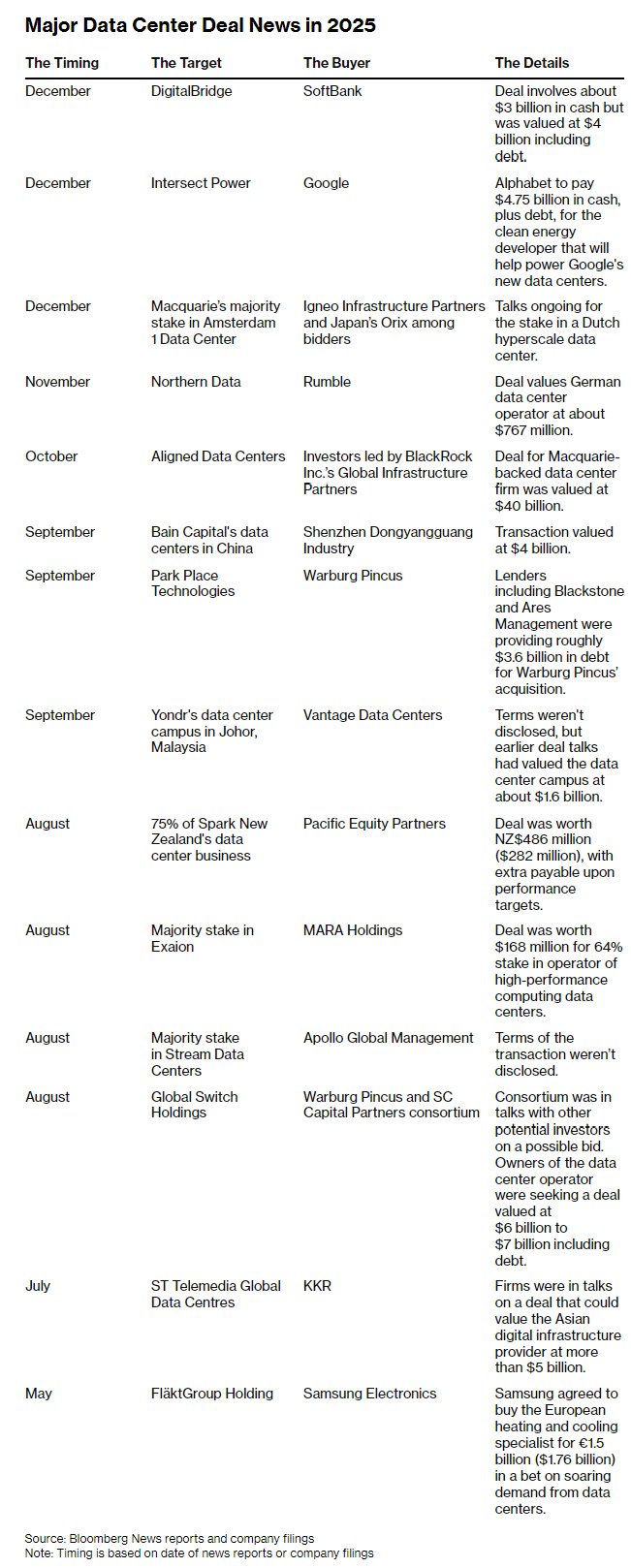
如果加上相关投资,全球数据中心交易额在今年已创下历史新高。 智通财经APP获悉,席卷全球的人工智能(AI)热潮已吸引数千亿美元融资与战略合作,如今正推动数据 中心行业掀起一轮并购浪潮。 周一,软银集团(SFTBY.US)成为最新加入战局的企业,宣布与数字基础设施投资商 DigitalBridge(DBRG.US)达成价值数十亿美元的收购协议,这也推动了今年全球数据中心并购交易额突 破700亿美元。以下为今年数据中心相关并购交易动态一览。 | The Timing | The Target | The Buyer | The Details | | --- | --- | --- | --- | | December | DigitalBridge | SoftBank | Deal involves about | | | | | $3 billion in cash but | | | | | was valued at $4 | | | | | billion including | | | | | debt. | | December | Intersect Power | Google | Alpha ...



格林大华期货早盘提示-20251230
Ge Lin Qi Huo· 2025-12-29 23:30
早盘提示 Morning session notice 更多精彩内容请关注格林大华期货官方微信 格林大华期货研究院 证监许可【2011】1288 号 2025 年 12 月 30 日 星期二 研究员: 于军礼 从业资格: F0247894 交易咨询资格:Z0000112 联系方式:yujunli@greendh.com | 板块 | 品种 | 多(空) | | | --- | --- | --- | --- | | | | | 【重要资讯】 | | | | | 1、野村预计,美联储新主席将在 6 月主导一次降息,但 FOM 内部可能强烈反对进 | | | | | 一步降息,可能引发美联储与特朗普政府之间的紧张关系。这种不确定性预计将在 | | | | 明年 | 7 月至 11 月集中爆发,届时市场可能出现"逃离美国资产"的趋势。 | | | | | 2、以色列总理将在美国佛州分别与美国国务卿和美国总统会面,可能与美方讨论 | | | | | 再次打击伊朗导弹项目的问题。伊朗总统表示,伊朗正面临与美国、以色列和欧洲 | | | | | 的"全面战争"。伊朗将对任何新的美以"侵略行为"做出更加果断的回应。 | | ...