职业教育

Search documents
国务院批复同意!苏南重点城市纳入要素市场化配置综合改革试点
Nan Jing Ri Bao· 2025-09-12 02:20
Core Viewpoint - The State Council has approved a comprehensive reform pilot plan for market-oriented allocation of factors in ten regions, including the Beijing urban sub-center and key cities in southern Jiangsu, aiming to enhance the efficiency of resource allocation and promote high-quality development [1][2]. Group 1: Reform Objectives - The pilot will focus on seven major areas: promoting market-oriented allocation of technological factors, improving land allocation efficiency, facilitating the free flow of human resources, accelerating the cultivation of a data factor market, promoting capital market linkage, enhancing the market-oriented allocation system for resource and environmental factors, and improving the overall efficiency of factor coordination [2]. - A total of 24 reform measures have been proposed, including deepening the reform of the technology system, establishing a unified urban-rural construction land market, and innovating capital supply methods [2]. Group 2: Specific Initiatives in Nanjing - The plan emphasizes Nanjing's role in talent recruitment and training, proposing reforms in vocational education and the establishment of a collaborative community for vocational education [3]. - Nanjing and Suzhou are set to develop a smart city brain based on AI and 5G technology, enhancing urban infrastructure and promoting the integration of the internet with advanced manufacturing [3]. - The plan includes exploring digital services and regulatory platforms for asset securitization, with a focus on Nanjing, Wuxi, and Suzhou [3]. - Nanjing and Suzhou will also explore mechanisms for realizing the value of ecological products, focusing on sustainable development practices [3][4]. Group 3: Nanjing's Development Efforts - Nanjing has been actively enhancing its factor abundance through initiatives in human resources, land supply, and financing, while also promoting new production factors such as computing power, data, and green electricity [4].
AI赋能职业教育教材形态创新路径
Xin Hua Ri Bao· 2025-09-11 23:27
Core Viewpoint - The innovation of vocational education textbooks, driven by AI technology, is crucial for enhancing the quality of technical and skilled talent training, transitioning from static paper-based materials to dynamic, intelligent formats [1][2][7]. Group 1: Policy and Demand - Vocational education textbook innovation is a key breakthrough in the national digital education strategy, utilizing AI to create real-time updated, intelligent teaching resources [2][7]. - The national vocational education smart education platform has aggregated over 10.28 million resources across 19 major professional categories, facilitating the transition to a new textbook format [2][3]. - The rapid technological iteration in industries highlights the urgent need for AI-driven textbook innovation, as traditional materials have a content update cycle of 3-5 years, while fields like smart manufacturing require updates every 6-12 months [2][3]. Group 2: Infrastructure Support - 88% of higher vocational colleges in China have internet bandwidth exceeding 1 Gbps, providing a solid foundation for the immersive presentation and personalized delivery of AI textbooks [3]. Group 3: Implementation Pathways - The restructuring of content production mechanisms is a core breakthrough, shifting from a linear model to a collaborative ecosystem involving human-machine co-creation [4]. - AI technology is transforming content presentation from flat text to immersive, interactive formats, significantly enhancing student engagement and learning outcomes [4]. - The intelligent transformation of evaluation systems is providing new paradigms for improving textbook quality, utilizing AI to analyze over 30 indicators of student performance [4]. Group 4: Case Studies and Insights - Collaborative development between schools and enterprises has become the mainstream model for AI textbook innovation, exemplified by the partnership between Changzhou Mechanical and Electrical Vocational Technical College and BYD [5][6]. - The enhancement of teacher capabilities is critical for the successful application of AI textbooks, with training programs designed to equip educators with necessary skills [5][6]. Group 5: Future Trends - Future trends in AI textbooks include lightweight development for accessibility, pervasive integration into various learning environments, and an ecological evolution involving collaboration among government, schools, enterprises, and society [7]. - The transformation of vocational education textbooks represents the "last mile" in digital education, with AI providing revolutionary tools for this process [7].

“在这里,我们的人生迎来了新机遇”
Ren Min Ri Bao· 2025-09-11 22:02
Group 1: Youth Cooperation and Education - The Shanghai Cooperation Organization (SCO) emphasizes youth exchange and cooperation, establishing the SCO Youth Committee and creating platforms for friendship and development among youth [1] - The China-SCO Vocational Education Cooperation Center was recently inaugurated at Tianjin Vocational Technical University, enhancing vocational education collaboration between China and Egypt [2][3] - The "Luban Workshop" initiative has trained over 2,000 students in Egypt, showcasing the high demand for skilled professionals in the region [2][3] Group 2: Economic Cooperation and Trade - The China-SCO Local Economic and Trade Cooperation Demonstration Zone aims to create a high-end economic platform focused on modern trade and bilateral investment [5] - As of now, there are 22,000 registered enterprises on the cooperation platform, indicating growing interest from SCO member states in economic collaboration [5] - China's investment stock in other SCO member countries exceeds $84 billion, with annual bilateral trade surpassing $500 billion [5] Group 3: Agricultural Collaboration - Agricultural cooperation is a key focus, with initiatives aimed at enhancing food security and agricultural technology exchange among SCO member states [6][7] - The recent signing of the China-Pakistan action plan for 2025-2029 emphasizes agricultural research collaboration and expert exchanges [7] - The SCO member states are committed to strengthening agricultural cooperation, as highlighted in the Tianjin Declaration [7]
中国东方教育:深化新专业布局,赋能“新蓝领”职业发展
Zhong Guo Zheng Quan Bao· 2025-09-11 12:15
Core Viewpoint - The company is strategically positioning itself to address the talent gap in new professions, enhancing its professional offerings and training programs to meet the growing demand for skilled blue-collar workers in the context of economic restructuring and policy support [1][5]. Group 1: Professional Development and Training - The company has introduced multiple emerging majors focusing on skill-based and standardized training for new blue-collar workers, including areas like smart device maintenance and IoT technology [3][4]. - The training modules include skill upgrades, advanced manufacturing technology, and modern service business, aiming to cultivate high-skilled talent aligned with industry needs [3][5]. - The company emphasizes the importance of digital skills, offering programs such as PLC and e-commerce to empower traditional industries [3][4]. Group 2: Employment Promotion Initiatives - The company has implemented measures to synchronize professional training with market demands, ensuring that students' skills align with industry requirements [8][9]. - New programs such as AI algorithm engineers and AI application trainers have been introduced to keep pace with technological advancements [8]. - The company actively collaborates with enterprises to gather insights on the latest technology trends and talent needs, facilitating a comprehensive employment ecosystem [9]. Group 3: Continuous Curriculum Updates - The company maintains a high professional update and replacement rate of over 30% annually, ensuring that educational content remains relevant to industry advancements [11][12]. - A three-tiered research and development system supports the continuous iteration of course content in line with industry demands [12][13]. - The company has successfully expanded into new sectors, such as beauty education, which has seen significant revenue growth and high employment rates for graduates [12].


郭永航开展教育工作调研并召开座谈会,向全市广大教师和教育工作者致以节日问候
Guang Zhou Ri Bao· 2025-09-11 01:39
Core Viewpoint - The article emphasizes the importance of education in supporting the modernization of Guangzhou and highlights the commitment of local authorities to enhance the quality of education and teacher development [2][3]. Group 1: Education Development - The recent achievements in Guangzhou's education sector were acknowledged, with a focus on building a high-quality education system and accelerating educational modernization [3]. - The local government aims to construct a strong education city, enhancing the integration of science, education, and talent to support the modernization of Guangzhou [3]. Group 2: Teacher and Student Development - Teachers are encouraged to embody the mission of nurturing talent for the country and to focus on moral education, integrating Xi Jinping's thoughts into their teaching [3]. - There is a call for teachers to continuously improve their professional knowledge and teaching methods to meet the evolving needs of students [3]. Group 3: Vocational Education - The importance of vocational education was highlighted, with a focus on aligning educational programs with the "12218" modern industrial system of Guangzhou to cultivate skilled professionals [4]. - The initiative to elevate vocational colleges to undergraduate status is seen as a new starting point for enhancing vocational education [4].
海南软件职业技术学院与海南省技师学院签约合作
Hai Nan Ri Bao· 2025-09-11 01:24
Core Viewpoint - The strategic cooperation between Hainan Software Vocational Technical College and Hainan Technician College aims to enhance the cultivation of high-skilled talents through deep collaboration in areas such as resource sharing and integrated training [1] Group 1: Collaboration Details - The partnership leverages the strengths of both institutions, with Hainan Software Vocational Technical College excelling in software technology and computer applications, while Hainan Technician College has a solid foundation in advanced and intelligent manufacturing [1] - The collaboration sets a precedent for other vocational technical schools, promoting a model for cooperation in high-skilled talent development and resource sharing [1] Group 2: Areas of Cooperation - The two colleges will engage in comprehensive cooperation in high-skilled talent training, faculty exchange, professional course development, shared training bases, high-quality competitions, and employment opportunities [1] - The initiative aims to explore new models for cultivating "new quality digital craftsmen" and to provide vocational skills training accessible to the community [1]
为铁路行业培育高素质人才
Ren Min Ri Bao· 2025-09-10 22:13
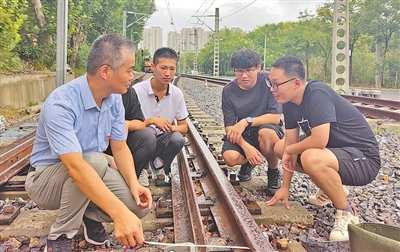
Core Insights - The article highlights the innovative teaching journey of a dedicated educator, Bo Yiyong, who has made significant contributions to vocational education over 35 years, emphasizing the importance of practical skills and hands-on training [2][3]. Group 1: Teaching Innovations - The first "from zero to one" initiative involved creating practical training equipment from old railway materials to enhance students' hands-on skills [2]. - The second initiative in 2008 focused on designing a leading practical training base, which included a 1200-meter electrified railway simulation, allowing students to practice real-world skills in a controlled environment [4][5]. Group 2: Professional Development - The third initiative was the establishment of a new railway signal major, where Bo Yiyong led a team to research industry needs and develop a curriculum that enriched the school's offerings and produced high-quality skilled professionals [7]. - The fourth initiative involved forming a consulting team for urban metro safety, providing significant support for metro operations in Nanjing and contributing to national safety management standards [8]. Group 3: Educational Philosophy - Bo Yiyong's approach reflects a commitment to continuous improvement in education, aiming to bridge the gap between theoretical knowledge and practical application, ultimately benefiting both students and the railway industry [9].
管理干部学院召开庆祝教师节表彰大会暨年中工作会
Zhong Guo Min Hang Wang· 2025-09-10 14:34
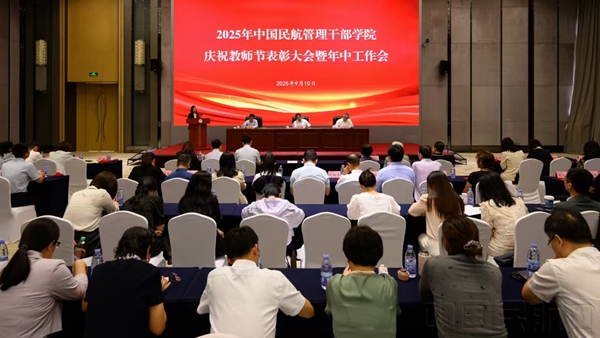
Core Viewpoint - The Civil Aviation Management Institute of China held a celebration for Teachers' Day and a mid-year work meeting, emphasizing the importance of educational spirit and quality improvement in the aviation education sector [1][5]. Group 1: Meeting Highlights - The meeting conveyed a message from the Civil Aviation Administration to all education and training workers in the industry, recognizing outstanding teachers and teams [1]. - The theme for this year's Teachers' Day is "Forge the Soul with the Spirit of Educators, Write a Chapter for Building a Strong Education Nation" [5]. - The meeting highlighted the need to integrate the spirit of educators with the implementation of key educational policies and the academy's guiding principles [5]. Group 2: Achievements and Future Goals - In the first half of the year, the academy made significant progress in nine areas, including educational quality and team building, achieving a strong and resilient development trend [6]. - The academy aims to focus on seven specific tasks in the second half of the year, including enhancing teaching quality, advancing research innovation, and improving governance effectiveness [6]. - A total of 18 outstanding groups and 61 advanced individuals were recognized during the meeting, with award-winning teachers sharing their experiences [6].
奋力推动教育强国首善之区建设再上新台阶
Bei Jing Wan Bao· 2025-09-10 06:12
Group 1 - The core message emphasizes the importance of education in national development and the role of Beijing in building a strong educational foundation for the country [1][4] - The Beijing Yu Cai School's new campus can accommodate 114 classes and 4,300 students, highlighting the city's investment in educational infrastructure [2] - The establishment of the China Renmin University Tongzhou campus aims to create a green campus and cultivate innovative talents to support high-quality development in the capital [3] Group 2 - The focus is on enhancing the quality of public education services in Beijing through comprehensive reforms and improved resource allocation [4] - The integration of technology in education is being prioritized, with initiatives like "AI+" course innovations to enrich educational applications [4] - The collaboration between educational institutions and industries is being encouraged to accelerate the transformation of technological achievements into practical applications [4]
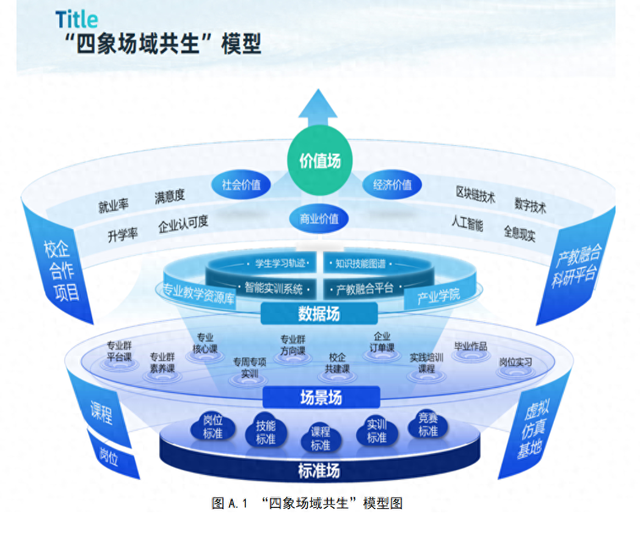
惠州工程职业学院四象场域锻造数字工匠
Huan Qiu Wang· 2025-09-08 02:53
Core Viewpoint - The article discusses the innovative educational model developed by Huizhou Engineering Vocational College to address the structural challenges in business education, particularly in the context of the digital economy and the Greater Bay Area's industrial needs [1][7]. Group 1: Educational Challenges and Solutions - Huizhou Engineering Vocational College identifies three structural challenges in traditional business education: disconnection from industry, virtualized practice, and fragmented resources [1]. - The college aims to cultivate composite talents with digital literacy, business skills, and craftsmanship spirit, establishing a new educational ecosystem that integrates education, industry, and innovation [1][6]. Group 2: "Four-Dimensional Coexistence" Model - The "Four-Dimensional Coexistence" model is based on Bourdieu's field theory, incorporating four interconnected mechanisms: standard field, scenario field, data field, and value field [1][4]. - The standard field involves collaboration with leading companies like TCL and JD.com to create talent training standards covering 12 job clusters and 48 skills, ensuring seamless integration of curriculum and industry [1][2]. Group 3: Practical Training and Resource Integration - The college has established a comprehensive resource system that includes four levels of training, dual-teacher collaboration, and project transformation, covering over 700 students annually and completing 53 real projects [5]. - The faculty consists of 96.66% dual-qualified teachers, with a mechanism for internal training and external recruitment to enhance teaching quality [5]. Group 4: Industry Collaboration and Community Impact - The college has formed the "Huizhou New Generation Electronic Information Industry-Education Alliance," involving 55 enterprises and 12 schools, and has established 42 order classes in collaboration with JD.com [6]. - The college's initiatives have led to the development of IP for seven villages, boosting agricultural product sales and providing training for over 1,200 enterprise employees and new farmers annually [6]. Group 5: Outcomes and Employment Statistics - The reform has resulted in a 95% initial employment rate for the 2025 graduating class, with an average starting salary of nearly 4,000 yuan, reflecting a 15% increase compared to before the reforms [7]. - Over 30% of graduates are employed in e-commerce platforms or specialized enterprises, with 56% working in core technical positions such as data analysis, indicating improved employment quality [7].