
农业

Search documents
2025年巴西贸易顺差达683亿美元
Shang Wu Bu Wang Zhan· 2026-01-15 17:00
Core Insights - Brazil's trade surplus is projected to reach $68.3 billion by 2025, driven by record high export and import figures [1] Group 1: Trade Data - Brazil's total exports are expected to amount to $348.7 billion, reflecting a growth of 3.5% [1] - Total imports are projected at $280.4 billion, showing an increase of 6.7% [1] - Both exports and imports are set to achieve historical highs [1] Group 2: Sector Performance - Manufacturing sector exports are forecasted to reach $188.7 billion, with a growth rate of 3.8% [1] - Mining sector exports are anticipated to be $80.4 billion, experiencing a slight decline of 0.7% [1] - Agricultural exports are expected to total $77.6 billion, marking a growth of 7.1% [1] Group 3: Trade by Country - Exports to China are projected at $100.02 billion, with a growth of 6.0% [1] - Exports to the European Union are expected to reach $49.81 billion, increasing by 3.2% [1] - Exports to the United States are forecasted at $37.72 billion, reflecting a decline of 6.6% [1] - Exports to Argentina are anticipated to be $18.11 billion, with a significant growth of 31.4% [1]
央行将推出八项政策措施
Qi Huo Ri Bao Wang· 2026-01-15 14:31
Core Viewpoint - The People's Bank of China (PBOC) is set to implement a moderately accommodative monetary policy to support high-quality economic development, with specific measures aimed at enhancing credit flow to key sectors and facilitating economic structural transformation [1][2][3] Group 1: Monetary Policy Measures - The PBOC will lower the interest rates of various structural monetary policy tools by 0.25 percentage points, reducing the one-year re-lending rate from 1.5% to 1.25% [1] - The PBOC will merge the agricultural and small enterprise re-lending with re-discounting, increasing the re-lending quota for agricultural and small enterprises by 500 billion yuan, with a separate quota of 1 trillion yuan designated for private enterprises [1][2] - The quota for re-lending aimed at technological innovation and technological transformation will be increased from 800 billion yuan to 1.2 trillion yuan, expanding support to high R&D investment private small and medium-sized enterprises [2] Group 2: Support Tools and Initiatives - The PBOC will merge the existing private enterprise bond financing support tool and the technological innovation bond risk-sharing tool, providing a total re-lending quota of 200 billion yuan [2] - The carbon reduction support tool will be expanded to include more projects with carbon reduction effects, such as energy-efficient renovations and green upgrades [2] - The minimum down payment ratio for commercial property loans will be lowered to 30% to support the destocking of the commercial real estate market [2] Group 3: Coordination and Implementation - The related policy documents will be released soon, and the implementation will be coordinated with fiscal policies such as interest subsidies and risk cost sharing to enhance policy effectiveness [3] - The PBOC will continue to increase liquidity and maintain ample liquidity levels, guiding overnight interest rates to operate near policy rate levels [3]
2025年末哈萨克斯坦劳务市场用工需求持续上升
Zhong Guo Xin Wen Wang· 2026-01-15 14:08
Core Insights - Kazakhstan's labor market demand is expected to continue rising by the end of December 2025, with over 109,000 job postings on online platforms, indicating a "more jobs, fewer applicants" scenario [1][2] Group 1: Job Market Overview - In December, employers posted a total of 109,600 job openings, reflecting a month-on-month increase of 8.4% [1] - The number of job seekers uploading resumes decreased significantly to 71,500, showing a month-on-month decline of 29.4% [1] - The job postings are primarily concentrated in the education, service, and agriculture sectors, with education positions at 23,300 (21.3%), service positions at 23,200 (21.2%), and agriculture-related roles at 18,700 (17.1%) [1] Group 2: Applicant Demographics - The majority of job seekers are under 35 years old, accounting for 40.8% of applicants, while those aged 35-44 make up 29.9%, 45-54 years old represent 19.1%, and those over 55 years old are at 10.2% [2] - Female applicants slightly outnumber male applicants, with women making up 52.1% and men 47.9%. Women tend to apply for positions in education, healthcare, and accounting, while men prefer technical and managerial roles [1] Group 3: Market Dynamics - The Ministry of Labor and Social Protection of Kazakhstan indicates a temporary mismatch in supply and demand in the labor market due to increased hiring by companies and a slowdown in job-seeking behavior among workers [2] - It is anticipated that job-seeking activity will rebound after the holiday season in early 2026, potentially improving the overall supply-demand relationship [2]
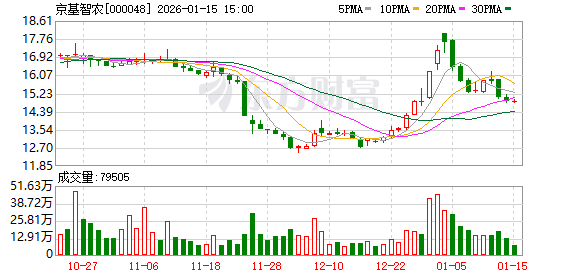
京基智农:第十一届董事会第十四次临时会议决议公告
Zheng Quan Ri Bao· 2026-01-15 13:40
Group 1 - The core announcement is that Jingji Zhino has approved multiple resolutions during its 14th temporary meeting of the 11th Board of Directors, including the conditions for the second unlock period of the 2023 restricted stock incentive plan [2] Group 2 - The company is moving forward with its stock incentive plan, indicating a commitment to employee motivation and retention [2] - The approval of the resolutions suggests a strategic focus on enhancing shareholder value through effective incentive mechanisms [2] - This development may reflect the company's overall performance and future growth prospects in the industry [2]


华英农业:2026年2月3日召开2026年第二次临时股东会
Zheng Quan Ri Bao Wang· 2026-01-15 13:20
证券日报网讯1月15日,华英农业(002321)发布公告称,公司将于2026年2月3日14:00召开2026年第 二次临时股东会。 ...

湖南出台七大举措 推动2026年经济平稳起步
Xin Lang Cai Jing· 2026-01-15 13:17
Group 1: Economic Measures - Hunan Province government has announced measures to ensure a stable start for the economy in Q1 2026, focusing on consumption, project construction, and industry among other areas [1][3] - The government aims to boost consumer confidence and stabilize social expectations by implementing policies such as a trade-in program for consumer goods and distributing consumption vouchers [3] Group 2: Project Construction - Hunan has identified 4,345 major projects to be advanced in Q1, with plans to issue over 50 billion yuan in special bonds for project construction in February [3][4] - The government will also promote the development of the private economy and regularly introduce projects to private capital [3] Group 3: Industrial Focus - The industrial sector will be prioritized as a key economic stabilizer, with initiatives to support production increases and cost reductions for enterprises [3] - Specific policies will be tailored to support key industries and small and medium-sized enterprises, including measures like time-based electricity pricing and logistics cost reductions [3] Group 4: Service Sector Initiatives - Policies will target key areas in the service sector such as real estate, finance, and transportation, including the use of special bonds to convert existing housing into affordable housing [4] - Large financing events will be organized to support enterprise listings and enhance services for key foreign trade enterprises [4] Group 5: Agricultural Production - Hunan will focus on stabilizing grain and oil production, enhancing economic crops, and ensuring the supply of essential food products, aiming to complete 85% of early rice planting by the end of March [4] Group 6: Employment and Social Welfare - The government will address urgent public concerns by organizing over 2,000 recruitment events and ensuring energy supply and safety in key sectors during the winter [5]
不装了,普京的真正实力被严重低估,整个欧洲加起来都不是对手!
Sou Hu Cai Jing· 2026-01-15 12:59
Group 1: Russia's Resource Strength - Russia holds 28% of the world's natural gas reserves, 80 billion tons of oil (second globally), and 1,621 billion tons of coal (also second) [2] - By 2025, Russia is expected to extract 804 tons of gold and has 20% of the global rare earth reserves, which directly support its economy and military spending during the conflict [2] - Russia has 220 million hectares of arable land, with a projected grain output of 145 million tons by 2025, achieving a self-sufficiency rate of 155%, and is the world's second-largest wheat exporter [2] Group 2: Europe's Energy Dependency - Before 2022, the EU relied on Russia for 40% of its natural gas, 27% of its oil, and 46% of its coal [4] - Despite efforts to replace Russian gas with U.S. liquefied gas, by 2025, Russia is still expected to account for 13% of EU gas imports [4] - European electricity prices are four times higher than those in the U.S., leading to decreased factory operating rates and economic challenges [4] Group 3: Military Capabilities - Russia has inherited the Soviet military system, producing 5,750 tanks (second globally), 4,162 military aircraft (second), and 419 naval vessels (third) by 2025 [6] - In 2023, Russia produced 1,200 tanks, four times more than the U.S., and is capable of producing 300 drones weekly [6] - Russian defense spending is 9% of GDP, benefiting from low costs due to domestic energy and raw material availability [6] Group 4: European Military and Economic Challenges - European military production is struggling due to financial and energy constraints, leading to delays in expansion [8] - The internal conflicts within NATO and the European leadership hinder effective military support for Ukraine [10] - The ongoing energy crisis in Europe has resulted in a significant depletion of ammunition stocks and public protests against rising energy prices [12] Group 5: Russia's Strategic Position - Russia's resilience is highlighted by its ability to maintain economic stability despite sanctions, with oil and gas exports to China and India increasing [10] - The Russian economy is projected to grow at 1% in 2025, with stable fiscal conditions despite a slow growth rate [10] - Russia's strategic stability and resource availability position it favorably against a fragmented and struggling Europe [14]

事关稀土资源再利用、儿童用品安全性等 一批重要国家标准发布
Yang Shi Xin Wen· 2026-01-15 12:47
Emerging Fields - The release of 4 national standards for industrial internet platforms supports the large-scale development and application of industrial internet platforms [1] - 4 national standards for digital supply chains are aimed at enhancing the resilience of industrial chains through digitalization [1] - 5 national standards for smart factory safety integration promote high-quality and sustainable development in manufacturing through data-driven management [1] - National standards for the classification and comprehensive utilization of recyclable rare earth secondary resources support the recycling of rare earth resources [1] Transportation and Green Low-Carbon - 23 national standards related to railway freight transport, intelligent transport, and aviation services facilitate efficient development in transportation [1] - 7 national standards for explosion-proof industrial vehicles and off-road forklifts promote the standardized development of the industrial vehicle sector [1] - 3 logistics national standards for multimodal transport service quality assessment and the integration of logistics and manufacturing industries promote standard alignment across transport modes [1] - 17 national standards for carbon dioxide capture, green factory evaluation, and greenhouse gas emission accounting assist in achieving carbon neutrality goals [1] Safety Production - 13 mandatory national standards for production safety accident investigation and economic loss statistics enhance safety emergency capabilities in hazardous chemical enterprises [2] - 4 mandatory national standards in the fire safety sector improve the fire performance and quality of building insulation materials and rescue equipment [2] - 28 national standards related to feed, pesticides, plant quarantine, and animal husbandry provide a technical foundation for agricultural production safety [2] Daily Life - 6 national standards for children's products, including portable baby sleep baskets and VOC emission measurement, aim to improve product quality and safety [2] - 3 national standards for elderly care institutions standardize care practices and enhance the quality of life services [2] - 5 national standards for traditional Chinese medicine better protect public health [2] - 5 national standards for musical instruments, including pianos and electric instruments, cater to the cultural and spiritual needs of the public [2] - 2 mandatory national standards for sports venues ensure safety in fitness activities [2] Additional Standards - The market regulatory authority also released national standards related to government services, wind power generation systems, water conservation, and agricultural products [2]
全国人大代表李叶红:提高强农惠农富农政策效能
Ren Min Ri Bao· 2026-01-15 09:58
Core Viewpoint - The article emphasizes the importance of enhancing the effectiveness of policies aimed at strengthening agriculture, benefiting farmers, and enriching rural areas, which are crucial for the quality of China's modernization [1] Policy Precision - There is a need to increase the precision of agricultural policies by listening to the real demands of rural production and helping agricultural entities address practical difficulties such as labor and market connections [1] - Agricultural subsidy policies should be more targeted, rewarding those who produce more grain to motivate farmers to engage in agricultural activities [1] - The focus should be on addressing urgent issues faced by farmers and filling gaps in rural construction to avoid resource wastage from ineffective initiatives [1] Policy Coordination - A consistent policy direction is necessary to create a synergistic effect, leading to coordinated policy efforts [1] - The article suggests improving the diversified investment mechanism for rural revitalization, ensuring financial support and social participation [1] - For example, in grain production, it is essential to strengthen the support and coordination of pricing, subsidies, and insurance policies to maintain reasonable prices for important agricultural products, ensuring profitability for farmers [1] Enhancing Internal Motivation - Policies should not only address immediate challenges but also focus on long-term development [1] - Continuous skills training, support for returning workers, and the development of profitable industries are recommended to enhance farmers' resilience to market risks and broaden income channels [1] - This approach aims to strengthen the internal motivation and resilience of agricultural and rural development [1]
银河期货花生日报-20260115
Yin He Qi Huo· 2026-01-15 09:10
Group 1: Report Overview - Report Name: Peanut Daily Report [1] - Date: January 15, 2026 [1] Group 2: Data Summary Futures Data - PK604: Closing price 7800, down 26 (-0.33%); Volume 21,399, down 25.60%; Open interest 32,309, down 0.31% [3] - PK610: Closing price 8216, down 24 (-0.29%); Volume 217, up 80.83%; Open interest 2,773, up 3.24% [3] - PK601: Open interest 1,012, unchanged [3] Spot and Basis Data - Spot prices: Henan Nanyang 7400, Shandong Jining 8400, Shandong Linyi 8400; Rize peanut meal 3250, Rize soybean meal 3100; Peanut oil 14320, Rize first-grade soybean oil 8330 [3] - Price changes: All spot prices unchanged except Rize first-grade soybean oil down 50 [3] - Basis: Henan Nanyang -400, Shandong Jining 600, Shandong Linyi 600; Soybean meal - peanut meal, -4; Peanut oil - soybean oil, 5990 [3] - Import prices: Sudanese peanuts 8600, unchanged; Senegalese peanuts price unchanged [3] Spread Data - PK04 - PK10 spread: -416, down 2 [3] Group 3: Market Analysis - Peanut prices in Henan and Northeast China are stable. Northeast Jilin Fuyu 308 common peanuts at 4.55 yuan/jin, Liaoning Changtu at 4.55 yuan/jin; Henan Baisha common peanuts at 3.6 - 3.8 yuan/jin, Shandong Junan at 3.5 yuan/jin [5] - Imported peanut prices are stable. Sudanese refined peanuts at 8600 yuan/ton, Brazilian new peanuts at 9200 yuan/ton, Indian 50/60 peanuts at 8000 yuan/ton [5] - Peanut oil prices are stable. Domestic first-grade common peanut oil at 14300 yuan/ton, small-pressed fragrant peanut oil at 16500 yuan/ton [5][7] - By-product prices are stable. Rize soybean meal at 3100 yuan/ton, peanut meal with 48% protein at 3100 yuan/ton [7] - Short-term peanut prices are expected to be relatively stable due to increased supply and weak downstream demand. Peanut futures are likely to fluctuate at the bottom [5][9] Group 4: Trading Strategies - Unilateral: Go short-term long on 05 peanuts at low prices [10] - Calendar spread: Wait and see [11] - Options: Sell PK603 - P - 8200 at high prices [12] Group 5: Relevant Figures - Figure 1: Shandong peanut spot prices [14] - Figure 2: Peanut oil mill crushing profits [14] - Figure 3: Peanut oil prices [21] - Figure 4: Peanut spot and continuous contract basis [21] - Figure 5: Peanut 4 - 10 contract spread [23] - Figure 6: Peanut 1 - 4 contract spread [23]