
光模块

Search documents
通信行业研究:Marvell收购Celestial AI布局CPO,DeepSeek-V3.2发布
SINOLINK SECURITIES· 2025-12-07 09:29
Investment Rating - The report suggests focusing on sectors driven by domestic AI development such as servers and IDC, as well as sectors like servers and optical modules driven by overseas AI development [5] Core Insights - Marvell reported revenue of $2.075 billion for the quarter, exceeding market expectations and guidance by $15 million, and announced the acquisition of Celestial AI for approximately $3.25 billion to enhance its position in the CPO field [1][50] - AWS launched the AI training chip Trainium 3 with a computing power of 2.52 PFLOPS FP8 at its annual cloud computing event, indicating strong growth in AI infrastructure [1] - Credo's Q2 FY2026 revenue reached $268 million, a year-over-year increase of 272.1%, driven by growth in its core AEC and IC businesses [1] - DeepSeek introduced two AI models, achieving performance levels close to GPT-5, indicating advancements in domestic AI capabilities [1][47] - ByteDance's Doubao team launched the "Doubao Phone Assistant," with the first device selling out quickly, showcasing the potential for AI applications in consumer electronics [1] Summary by Sections Communication Sector - The communication sector shows a steady upward trend, with significant investments in cloud and IDC businesses compensating for pressures in traditional telecom services [14] Server Sector - The server index decreased by 1.22% this week, but AWS's announcement of a significant expansion in AI/HPC data centers suggests ongoing demand growth [2][7] Optical Modules - The optical module index increased by 4.67%, supported by Marvell's strong quarterly performance and strategic acquisition [2][7] IDC Sector - The IDC index rose by 0.50%, with DeepSeek's new AI models expected to drive demand in data centers [3][8] Core Data Updates - Telecom business revenue reached 1.467 trillion yuan in the first ten months of 2025, a year-over-year increase of 0.9% [4][15] - The export value of optical modules decreased by 27.6% year-over-year in October, attributed to domestic companies establishing overseas factories [31] Market Trends - The communication sector's performance this week ranked second among all industries, with notable gains in specific companies [39][42]




LP周报丨300亿,北京成立了一只并购基金
投中网· 2025-12-06 07:04
Core Insights - The article discusses the recent developments in the LP market, focusing on new fund establishments and government policies aimed at promoting mergers and acquisitions in Beijing [5][6]. Group 1: Policy Developments - Beijing has issued a policy to support high-quality development through mergers and acquisitions, encouraging quality listed companies and various investment entities to establish and operate acquisition funds [5]. - The establishment of the "Beijing Jingguochuang Intelligent Computing M&A Equity Investment Fund" with a scale of 30 billion RMB reflects the rapid implementation of this policy [8]. Group 2: New Fund Establishments - A total of 13 new funds were established in the LP circle this week, including the 14 billion RMB South Network Industrial Fund and the Jiangsu Zhenjiang High-end Intelligent Manufacturing Special Mother Fund [6]. - The South Network Industrial Fund focuses on new power system construction and aims to invest in major infrastructure and technological innovations [9]. - The "Xianggan Xizheng Advanced Sensing Industry Investment Fund" was established with a scale of 102 million RMB, targeting advanced magnetic sensing and related industries [15]. Group 3: Fund Management and Investment Focus - The "Beijing Innovation Industry Investment Co., Ltd." manages the newly established 30 billion RMB fund, which will significantly increase its management scale [6]. - The newly formed funds are primarily focused on sectors such as biotechnology, advanced manufacturing, and energy, indicating a trend towards investing in high-tech and innovative industries [11][21]. Group 4: Regional Investment Strategies - The establishment of the "Hangzhou Talent Fund Phase II" aims to support innovation and entrepreneurship among high-level talents, with a focus on technology and industry integration [17][18]. - The "Guizhou Qieneng No. 1 Private Fund" was established with a capital of 2.7 billion RMB, reflecting Guizhou's increasing activity in equity investment [14]. Group 5: Market Trends - The article highlights a growing trend of local governments and state-owned enterprises establishing funds to support technological innovation and industrial upgrades, particularly in regions like Fujian and Jiangsu [16][23]. - The establishment of various funds across different regions indicates a strategic push towards enhancing local industrial capabilities and fostering innovation ecosystems [22].






金融、资源股护盘 股指探底回升 存量资金博弈下关注主题性板块机会
Sou Hu Cai Jing· 2025-12-05 14:12
Market Performance - The market showed a rebound this week, with the Shanghai Composite Index rising by 0.37%, the Shenzhen Component Index increasing by 1.26%, and the ChiNext Index up by nearly 2% [2][3] - On Friday, the market saw a significant increase in trading volume, leading to a rise in major indices, with the Shanghai Composite Index up by 0.70% and the Shenzhen Component Index up by 1.08% [3][5] Sector Performance - The non-ferrous metals sector rose over 5% this week, with notable gains from companies like Minfa Aluminum and Hongchuang Holdings, which saw weekly increases exceeding 20% [4] - Other sectors that performed well included communications, national defense and military industry, machinery equipment, and non-bank financials, while media, real estate, and food and beverage sectors faced declines [4] Investment Opportunities - Analysts suggest that investors should continue to monitor the performance of industrial metals, aerospace equipment, and military electronics sectors for potential investment opportunities [2][5] - The recent performance of companies like Tianfu Communication, which is positioned to benefit from increased demand for 1.6T optical modules, highlights specific investment opportunities within the technology sector [2] Trading Volume Insights - The increase in trading volume on Friday is seen as a positive indicator for the market's potential recovery, with analysts recommending that investors pay close attention to volume changes in the upcoming week [5][6] - The overall trading volume on Friday rebounded to 17,257 billion yuan, indicating renewed investor interest [6]
AI算力热战正酣!CPO板块强势爆发,“易中天”齐涨
Ge Long Hui· 2025-12-05 07:45
Group 1 - The CPO optical module sector in A-shares experienced a strong surge, with several companies hitting the daily limit up, including Zhishang Technology and Changguang Huaxin, both rising by 20% [1][2] - The sector has seen a cumulative increase of over 104% since April 9 [2] Group 2 - The demand for 1.6T optical modules is accelerating, marking a clear direction for industry evolution [4][6] - Companies like New Yisheng have confirmed mass shipments of their 1.6T optical modules, with expectations for continued growth in shipments through the next year [6] - Cambridge Technology has also reported that its 1.6T products are performing at industry-leading levels and is preparing for large-scale shipments in early 2026 [6] Group 3 - Major tech companies are significantly increasing their capital expenditures, indicating strong investment in AI and computing infrastructure [7] - Microsoft, Amazon, Meta, and Google are all planning substantial increases in their capital spending, with Amazon's projected spending for 2025 at approximately $125 billion [7] - Domestic internet giants like Alibaba and Tencent are also showing strong intentions to invest in computing capabilities, with Alibaba planning to invest 380 billion yuan over the next three years [7] Group 4 - The optical module sector is viewed as one of the most certain beneficiaries in the ongoing global AI computing investment boom [8] - Leading manufacturers in the optical module industry are accelerating capacity expansion, with expectations for a significant release of production capacity in early 2026 [8] - Companies are expected to see revenue growth and margin expansion due to the ongoing investment cycle in AI infrastructure [9]

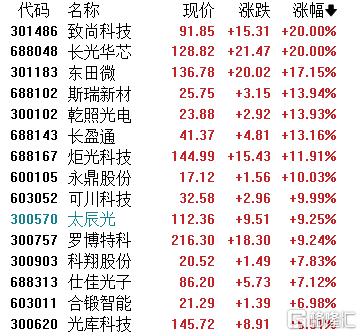
AI算力热战正酣!CPO板块集体起舞,“易中天”齐涨
Ge Long Hui· 2025-12-05 07:40
Group 1: Market Performance - The CPO optical module sector in A-shares experienced a strong surge on December 5, with companies like Zhishang Technology and Changguang Huaxin hitting the daily limit, while others like Dongtianwei and Sruy New Materials also saw significant gains [1][2] - The sector has accumulated a growth of over 104% since April 9 [2] Group 2: Industry Trends - The 1.6T optical module is entering a phase of accelerated release, becoming a clear direction for industry evolution [4][6] - New Yisheng confirmed that its 1.6T optical modules have achieved mass shipment and are expected to continue increasing output from Q4 this year to next year [6] - Major companies like Cambridge Technology and Pengding Holdings are also preparing for increased demand for 1.6T products, with significant revenue growth anticipated [6] Group 3: AI and Capital Expenditure - Major tech companies, including Google, Microsoft, and Amazon, are significantly increasing their capital expenditures, indicating strong investment in AI and computing infrastructure [7][8] - Google’s TPU chip is expected to see a procurement increase, with estimates suggesting 5 million units by 2027, which will drive demand for optical modules [5][6] Group 4: Future Outlook - The optical module industry is expected to experience a concentrated release of production capacity in Q1 2026, driving performance into a new growth phase [8] - Analysts predict that 2025 will be a standout year for optical module suppliers with high AI business ratios, leading to significant revenue growth and profit margin expansion [9]


急速拉升迫近上市高点!AI硬件逆市活跃,创业板人工智能ETF(159363)迅速翻红涨逾1%
Mei Ri Jing Ji Xin Wen· 2025-12-05 05:16
Group 1 - The core viewpoint of the articles highlights the active performance of AI hardware stocks, particularly in the context of the launch of Amazon's third-generation custom AI chip, Trainium3, which claims to enhance performance by four times compared to its predecessor and reduce AI model training and operational costs by up to 50% compared to equivalent GPU systems [1][2] - The AI application landscape is driving the demand for computing infrastructure, with a focus on the AIDC industry chain, including optical modules, PCBs, main equipment manufacturers, and copper cables, which are expected to see rapid demand release and a dual boost in performance and valuation [1] - The largest and most liquid AI-themed ETF in the market, the ChiNext AI ETF (159363), has shown significant trading activity, with a real-time transaction amount exceeding 280 million yuan, indicating strong investor interest in AI-related investments [1] Group 2 - The recommendation emphasizes the importance of capturing core opportunities in computing power and AI applications, suggesting a focus on the ChiNext AI ETF (159363) and its associated off-market connection (023407), which has a significant allocation to leading optical module companies [2] - The ETF's index is heavily weighted towards computing power, with over 70% of its portfolio allocated to this sector and more than 20% to AI applications, positioning it to effectively capture trends in the AI theme [2]

AI硬件逆市活跃,创业板人工智能ETF(159363)涨逾1%交投领跑!算力基建产业链迎戴维斯双击
Sou Hu Cai Jing· 2025-12-05 03:23
Group 1 - The core viewpoint of the news highlights the active performance of AI hardware stocks, particularly in the context of the entrepreneurial board, with significant gains in companies like Zhishang Technology and Taicheng Light [1] - The largest and most liquid AI-themed ETF, the Entrepreneurial Board AI ETF (159363), saw a 1% increase in value, with a trading volume exceeding 250 million yuan, leading the market in AI-themed ETFs [1] - Major AI hardware stocks such as optical modules and high-speed copper connections are experiencing a surge in demand, driven by the ongoing development of AI applications [3] Group 2 - Long-term investment opportunities are anticipated in the AI infrastructure sector, particularly in components like optical modules, PCBs, and copper cables, as demand rapidly increases [3] - Significant revenue growth and profit margin expansion are expected for leading optical module suppliers by 2025, supported by ongoing investments in AI infrastructure [3] - The Entrepreneurial Board AI ETF (159363) is positioned to capture market trends effectively, with over 70% of its portfolio allocated to computing power and more than 20% to AI applications [3]



主力资金丨尾盘2股获主力重点出手
Zheng Quan Shi Bao Wang· 2025-12-04 09:13
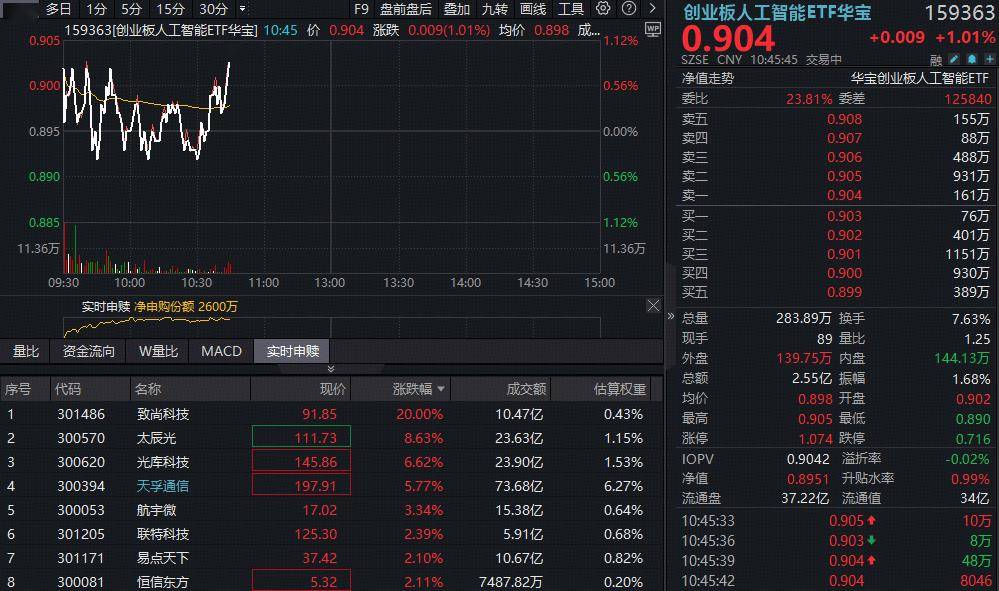
Group 1 - The main point of the article highlights that on December 3rd, the main funds in the Shanghai and Shenzhen markets experienced a net outflow of 452.5 billion yuan, with the ChiNext board seeing a net outflow of 211.17 billion yuan and the CSI 300 index stocks a net outflow of 103.53 billion yuan [1] - Among the 25 declining industries, the media and computer sectors both fell over 2%, while real estate, retail, comprehensive, and defense industries also saw declines exceeding 1% [1] - Only two industries received net inflows from main funds, with the non-ferrous metals industry leading at 2.99 billion yuan, followed by the coal industry with over 45 million yuan [1] Group 2 - The stock N China Uranium saw a net inflow of 3.671 billion yuan, marking a significant increase of over 280% on its first trading day [2][3] - Tianfu Communication ranked second with a net inflow of 1.369 billion yuan, with its stock price rising over 7% [2][3] - BOE Technology Group had a net inflow of 1.084 billion yuan, the highest since June 15, 2022, driven by anticipated high operating rates and stable product prices [2] Group 3 - ZTE Corporation led the net outflow with 2.148 billion yuan, continuing a trend of outflows for two consecutive days [4][5] - Pingtan Development experienced a significant drop of 9.91%, with a net outflow of 1.825 billion yuan [4][5] - The semiconductor sector, represented by companies like Saiwei Electronics, saw a decline of over 19%, with a net outflow of 1.145 billion yuan [4][5] Group 4 - In the tail end of trading, the main funds saw a net outflow of 37.35 billion yuan, with the ChiNext board experiencing a net outflow of 14.66 billion yuan [6] - N China Uranium led the tail end net inflow with 274.15 million yuan, followed by Aerospace Development with 239.11 million yuan [6][7] - ZTE Corporation and Zhongji Xuchuang had significant tail end outflows of 2.23 billion yuan and 1.87 billion yuan, respectively [8][9]



“易中天”接力连涨!创业板人工智能ETF(159363)下探回升逾1%,成交超5亿元领跑同类
Sou Hu Cai Jing· 2025-12-04 03:29
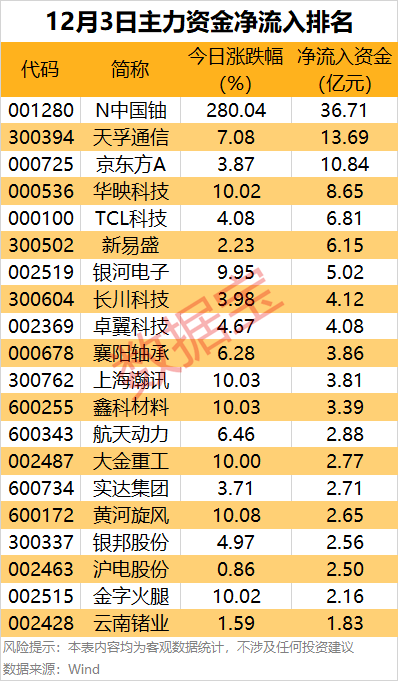
招商证券指出,2025年对具有高AI业务占比的光模块供应商而言是表现突出的一年,主要厂商实现了显著的营收增长和利润率扩张。预计在 AI基础设施投资周期未见减弱以及产品结构持续向更高价值解决方案升级的驱动下,这一优异表现有望延续2026年及以后。 把握算力+AI应用核心机会,建议重点关注全市场首只创业板人工智能ETF(159363)及场外联接(A类023407、C类023408),标的指数重 点布局光模块龙头"易中天",光模块含量最新超56%。从赛道分布看,逾七成仓位布局算力,超两成仓位布局AI应用,能够高效捕捉AI主题 行情。(截至2025.11.30) 4日早盘,光模块CPO等算力硬件继续活跃,"易中天"接力连涨,今日天孚通信涨超8%冲击五连涨,新易盛冲击八连阳,中际旭创涨超1%, 长芯博创、铜牛信息、金信诺、联特科技等多股涨超2%。热门ETF方面,光模块CPO含量超56%的创业板人工智能ETF(159363)场内下探 回升,盘中翻红拉升逾1%,放量成交5亿元领跑同类。 | 多日 1分 5分 15分 30分 ▼ | F9 盘前盤后 叠加 九转 画线 工具 (2 (2 | 创业板人工智能ETF华宝 | 159 ...
西部证券晨会纪要-20251204
Western Securities· 2025-12-04 01:40
Core Conclusions - The report emphasizes that companies that are the first to enter mass production of silicon photonic modules are likely to enjoy high margins during the industry's acceleration phase and benefit from market share consolidation [1][8] - Leading silicon photonic module manufacturers are expected to receive priority supply chain support, with key materials such as silicon photonic chips and CW light sources likely to see accelerated domestic substitution and market share breakthroughs [1][8] Industry Overview - Since 2025, the optical module industry has maintained high prosperity due to the continuous growth in AI computing demand. Silicon photonic modules are gaining recognition from end customers due to their high integration, low energy consumption, and low cost. Additionally, silicon photonic solutions are becoming a key supplement to capacity supply amid shortages of EML raw materials [5] - Silicon photonic technology is currently in the phase of integration and application, with future trends pointing towards higher speeds, greater integration, advanced packaging, and broader application fields [5] Physical Structure Analysis - Key components of silicon photonic modules include: 1. Lasers: Responsible for converting electrical signals into optical signals, with external CW light sources being the mainstream solution. Heterogeneous bonding technology is expected to become the mainstream solution for on-chip lasers in the future. 2. Modulators: Currently dominated by silicon-based substrates, with MZM being the mainstream solution. Thin-film lithium niobate modulators are expected to see large-scale application in the 3.2T era. 3. Detectors: Silicon-based germanium detectors are the mainstream solution. 4. Other passive devices: Such as (de)multiplexers, resonators, etc. 5. Electrical chips: Such as DSP, TIA, Driver, etc. [6] Industry Chain Analysis - The silicon photonic module industry chain can be divided into several segments: 1. Upstream: Key materials, including silicon photonic chips, which are primarily designed by North American manufacturers. The wafer foundry segment has high process barriers, with capacity concentrated in Tower Semi, GF, and TSMC. 2. CW Light Sources: Mainly composed of InP, with major suppliers including Sumitomo Electric and AXT. Domestic suppliers include Yuanjie Technology and Shijia Photonics. 3. DSP: Mainly designed by Broadcom and Marvell, with TSMC responsible for foundry. 4. Midstream: Optical module packaging, with representative companies such as Zhongji Xuchuang and Xinyi Technology. 5. Downstream: System integrators or end customers [7] Investment Recommendations - Companies that lead in the mass production of silicon photonic modules are expected to enjoy high margins and benefit from market share consolidation during the industry's acceleration phase. Key areas of focus include: 1. Silicon photonic chip design: Attention should be paid to the layout and further participation of optical module manufacturers in the silicon photonic chip design segment, with recommendations to focus on Zhongji Xuchuang and Xinyi Technology. 2. Substrates and epitaxy: Focus on heterogeneous integration and InP material suppliers, recommending Sumitomo Electric and AXT. 3. Silicon photonic wafer foundry: Monitor capacity scale and expansion, as well as the potential for domestic substitution, recommending Tower Semi, GlobalFoundries, TSMC, and SMIC. 4. CW Light Sources: Look for investment opportunities amid supply-demand mismatches and capacity expansion, recommending Yuanjie Technology and Shijia Photonics. 5. Silicon photonic modules: Focus on companies that achieve early scale and technological leadership, which may significantly enhance profitability, recommending Zhongji Xuchuang, Xinyi Technology, Cambridge Technology, Tianfu Communication, and Guangxun Technology [8]